NEWS
Apple Music Turns Sound Into Ripples, Then Strips Red
Apple Music filmed Fred Again’s notes as mineral-oil ripples, then locked a black-and-white app icon into iOS 27.2.

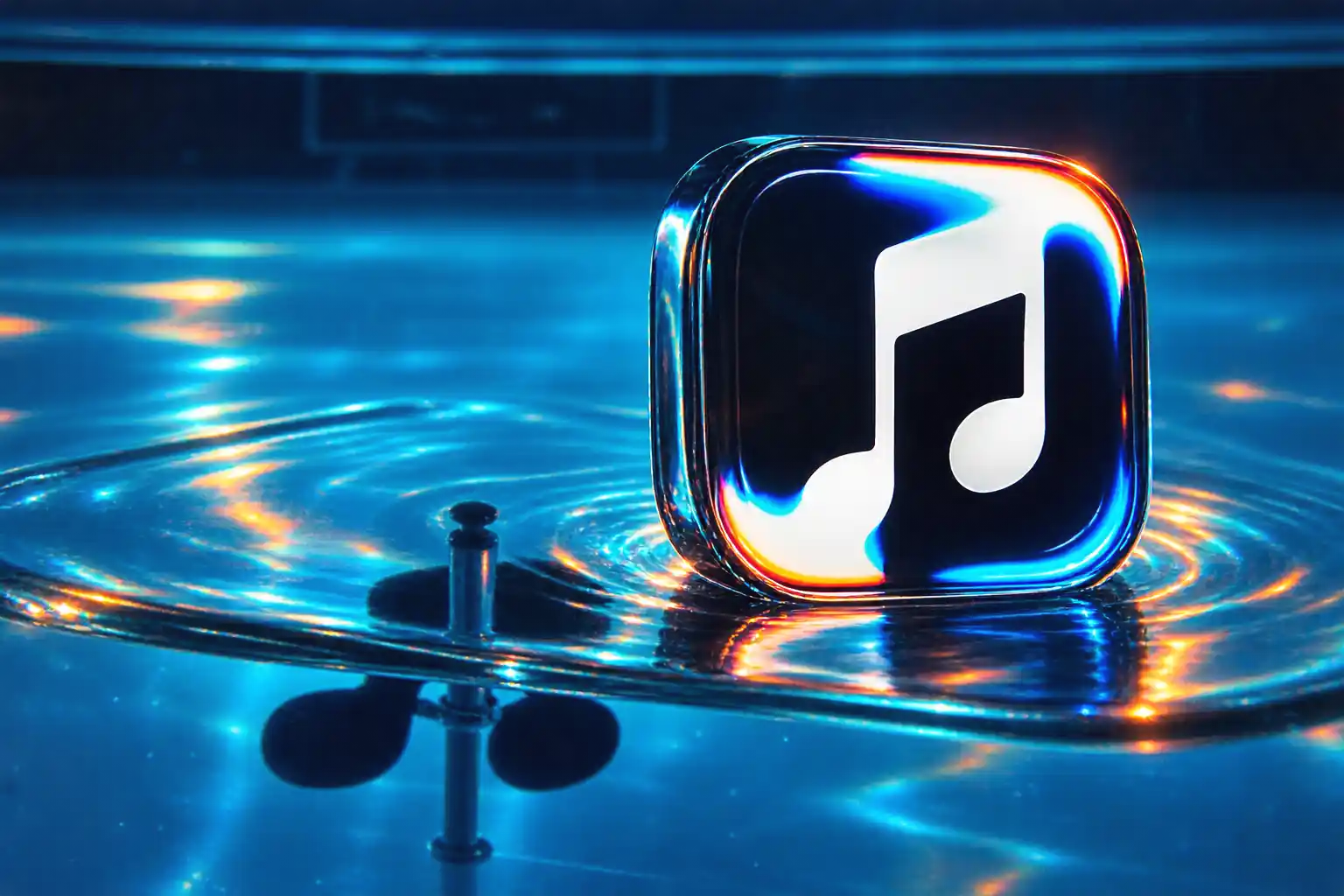
Apple Music unveiled a new mark on October 21, filmed as ripples in mineral oil driven by notes from Fred Again and NEST Acoustics. The home-screen tile that will sit beside it in iOS 27.2 is already black and white.
Those two objects landed eight days apart. The oil film is the craft Apple wants credited. The tile is what opens the app.
A Logo Made by Sound in a Tank
Apple Music posted the work under the line Made by Sound, and said the pictures were physically shaped by an original piece from Fred Again and NEST Acoustics. TBWA\Media Arts Lab, Apple’s long-running agency, ran the rebrand. The company said the footage was captured entirely in camera.
For the rebrand of Apple Music, we wanted sound to create the visuals. How do we take this idea of music and distill it into something visually beautiful? Essentially the idea was to create the perfect sound wave.
Narrator, Apple Music, Made by Sound film
The film is the public proof of method. A narrator walks through a rig that takes a frequency and moves a volume of liquid at the pitch of the notes, then uses those notes as the final mnemonic. Apple Music followed the launch post with a longer behind-the-scenes cut the same afternoon.
Go behind the scenes of Made by Sound.
A story of music, collaboration and craft with @fredagainagain1 and NEST Acoustics. Discover how sound brought the Apple Music logo to life, captured entirely in camera. Just music, made visible. pic.twitter.com/ZyMRGdUVUX— Apple Music (@AppleMusic) October 21, 2026
The stills already look like Liquid Glass, the translucent software finish running through iOS 27. That is not an accident of grading. The tank, the cover, and the oil were built to bend light the way that interface already does on a phone.
Fred Again Wrote Notes That Ripple Mineral Oil
Fred Again, the British producer, did not score a mood piece after the pictures were done. He and NEST Acoustics, a sound-design studio, wrote the short run of tones that now doubles as Apple Music’s sonic signature. Those tones had to move oil in a way a camera could read, so the pitches and the pictures were built together. Not every frequency made a ripple worth keeping.
Apple has used this analog trick before. In November 2025 the Apple TV rebrand also came with a practical-effects film instead of a pure CGI sting. The Music version fits the product more tightly, because the thing being filmed is vibration.
HOW THE RIG WORKS
- The tank: The Music note was etched into the glass floor of a small tank, then the tank was filled with mineral oil.
- The cover: A transparent sheet cut in the shape of an app icon sat on the oil, on a moving rig.
- The driver: A transducer turned the chosen tones into physical vibration and sent ripples out across the oil, distorting the mark.
- The shot: Cameras recorded the movement and the way light bent through the liquid, and that footage became the sting and the raw material for the note’s outline.
A full wordmark version will open Apple Music videos. A shorter cut with only the two-note glyph is meant to overlay concert footage. Out-of-home ads will carry the same system. Apple said the look would start showing up across original shows and event programming after the October 21 film. What the launch material does not say is whether the new sonic signature will play inside the Music app itself.
Why the Red Tile Disappeared
The red Music tile that has marked the iPhone app since iOS 14 in 2020 is gone in the iOS 27.2 betas, replaced by a black note on white, a white note on black in Dark Mode, and Clear and Tinted variants that follow the system. Inside the app, selected tabs now light up blue instead of red or pink, and the old pink widgets have gone black, so the color that made Music easy to find is no longer part of the product chrome.
Apple has not published a design note on the change. The closest official story is Liquid Glass: a clear, refractive interface that treats first-party apps more like system tools than like poster brands. Music is being pulled into that finish. Spotify still owns a green square you can spot from across a room. Apple just gave up the red that did the same job.
The oil film is full of motion, caustics, and weight. The home-screen glyph is a flat ink drawing of the same note. Under Apple’s own announcement, viewers asked the company to put a still from the tank on the grid instead. That request is the whole split. The expensive object is a bumper for videos. The cheap object is the one on a billion home screens.
Black-and-White Tiles in iOS 27.2
Designer Andreas Storm posted the new Music icon on October 13, when Apple seeded iOS 27.2 beta 4. Light Mode shows a black beamed eighth note on a white rounded square. Dark Mode inverts it. Clear and Tinted treatments ride along with the rest of iOS 27’s icon styles. The release candidate Apple sent testers on October 19 still carries that set, which is how a beta look becomes the look that ships unless someone pulls it.
MUSIC ICON MODES IN IOS 27.2
| Mode | Background | Note |
|---|---|---|
| Light | White | Black |
| Dark | Black | White |
| Clear | System glass | Follows wallpaper |
| Tinted | User tint | Single-color glyph |
Apple has not named a public day for iOS 27.2. The candidate build arrived on October 19, and the same train includes macOS 27.2. Until that software is on phones, the red tile remains on the App Store listing and on devices that have not installed the beta. After it ships, the monochrome glyph is the default unless Apple reverses it in a later seed.
WHAT WE KNOW
- The film: Apple Music published Made by Sound on October 21 and credited Fred Again, NEST Acoustics, and in-camera oil.
- The tile: iOS 27.2 beta 4 on October 13 replaced the red icon, and the October 19 release candidate kept the swap.
- The type: The wordmark pairs the Apple symbol with bold lowercase letters in a customized SF Pro.
WHAT IS UNCONFIRMED
- Ship day: Apple has not announced when iOS 27.2 and macOS 27.2 go to everyone.
- In-app sound: Launch materials do not say whether the new mnemonic will play inside the Music app.
- A last change: Beta icons have been pulled before; nothing in the candidate proves a last-minute red revival.
The loudest complaint is practical, not taste. The old red square was one of the few first-party icons people could pick off a crowded page without reading. A black note on white sits next to Books, TV, and every other ink-on-paper tile iOS now allows. Finding Music becomes a hunt for a silhouette.
The Music Note Has Changed Color Before
Apple Music launched on June 30, 2015, with iOS 8.4, and the app icon then was a pair of notes in a pink-to-blue wash on white. That rainbow held through iOS 13. iOS 14 in 2020 flipped the recipe: white notes on a red field, the tile most owners still have. The note itself is older than the streaming service, a beamed eighth-note pair that has survived orange iPod-era Music apps, the rainbow years, and the red years. Color is what changed. Color is what people are fighting over now.
THE PATH TO THE NEW MARK
- June 30, 2015: Apple Music launches with rainbow notes on a white app icon in iOS 8.4.
- 2020: iOS 14 turns the tile red with white notes, the look that lasts six years.
- September 21, 2026: Apple Music Hall opens in London and the lowercase wordmark appears in venue marketing.
- October 13, 2026: iOS 27.2 beta 4 puts a black-and-white Music icon on the home screen.
- October 19, 2026: The iOS 27.2 release candidate keeps the monochrome tile.
- October 21, 2026: Apple Music releases Made by Sound and the oil-made identity.
iOS 27 itself went out on September 14. The Music rewrite is a point release, not a keynote app. That is why the icon shock hit a developer beta on a Tuesday and the oil film followed as a brand video, not as a stage demo. One is software chrome. The other is advertising. They are being sold as one system.
Battersea Previewed the Lowercase Wordmark
The lettering showed up a month before the tank film. On September 21 Apple opened Apple Music Hall, a 600-capacity room in Battersea Power Station, and the new wordmark was already on the venue work. Oliver Schusser, vice president of Apple Music and International Content, tied the hall to a line that runs from the iPod through the iTunes Music Festival to the streaming service.
Today, with the opening of Apple Music Hall, we are once again taking an unprecedented step further in our commitment to artists and fans by supporting live music in ways only Apple can do.
Oliver Schusser, vice president of Apple Music and International Content, Apple Newsroom
INSIDE THE HALL
- The room: 600 seats beside the Thames, with a 38-foot stage that can face forward or sit in the round.
- The sound: A 48-speaker spatial system around the audience, built so a Spatial Audio set can be heard in the room as it is recorded.
- The capture: Two mix studios behind the stage, plus hardwired feeds from 16 or more cameras into a broadcast control room.
An artist can play an intimate set and leave with a Spatial Audio master, a broadcast mix, and multicamera video from the same night. Shows also go out as livestreams. Zane Lowe, Apple Music’s global creative director, called the hall a place to put artists and fans in the same room and then share the night. London radio hosts now broadcast from new studios in the same Battersea complex. Apple Music Hall show announcements run on the venue’s own site.
That is the other half of the rebrand, and it is physical in a way an app icon is not. The oil tank is a studio prop. The hall is a building that records the concerts the new sting will introduce. Apple Music’s catalog of over 100 million songs is still the product, sold ad-free in over 167 countries and regions. The hall, the mnemonic, and the lowercase SF Pro are how the company wants that catalog to look when it leaves the phone.
The oil film will lead concert videos. The black-and-white tile is what iOS 27.2 still shows on the home screen.

Bulk Scotch Still Faces Full Duty After India’s UK Deal

Typhoon Champi Loops Off Taiwan and Still Injures 527

PM Modi Opens Chinmaya’s AI Guru and Asks for Unity

Mahim Police Hold a JeM Suspect on Enmity Charges

Gold Falls Below $4,000 as Hormuz Oil Hits $117

The iPhone 18 Pro Max Splits Apple’s Fall in Two

OpenAI Calls GPT-6 Astra AGI Then Locks Its Exploits

Clancy Juror Says the Holdout Never Cited Evidence

Trump Claims Hormuz Control as Oil Holds Near $96

Russia Closes the Goethe-Institut Berlin Tried to Save

 NEWS2 months ago
The iPhone 18 Pro Max Splits Apple’s Fall in Two
- NEWS2 months ago
OpenAI Calls GPT-6 Astra AGI Then Locks Its Exploits
- NEWS1 month ago
Clancy Juror Says the Holdout Never Cited Evidence
- BUSINESS2 months ago
Trump Claims Hormuz Control as Oil Holds Near $96
- LIFESTYLE2 months ago
Russia Closes the Goethe-Institut Berlin Tried to Save
- AUTO2 months ago
Volkswagen’s Job Cuts Leave Four Plants Without Cars
- NEWS2 months ago
Dyson Puts Nurovi Robots on Sale Without the UV Flagship
- NEWS2 months ago
The Lincoln’s 286-Day War Cruise Ends at a Thai Pier