
NEWS
Iran’s Hormuz Cable Plans Aim at Gulf Tech Bets
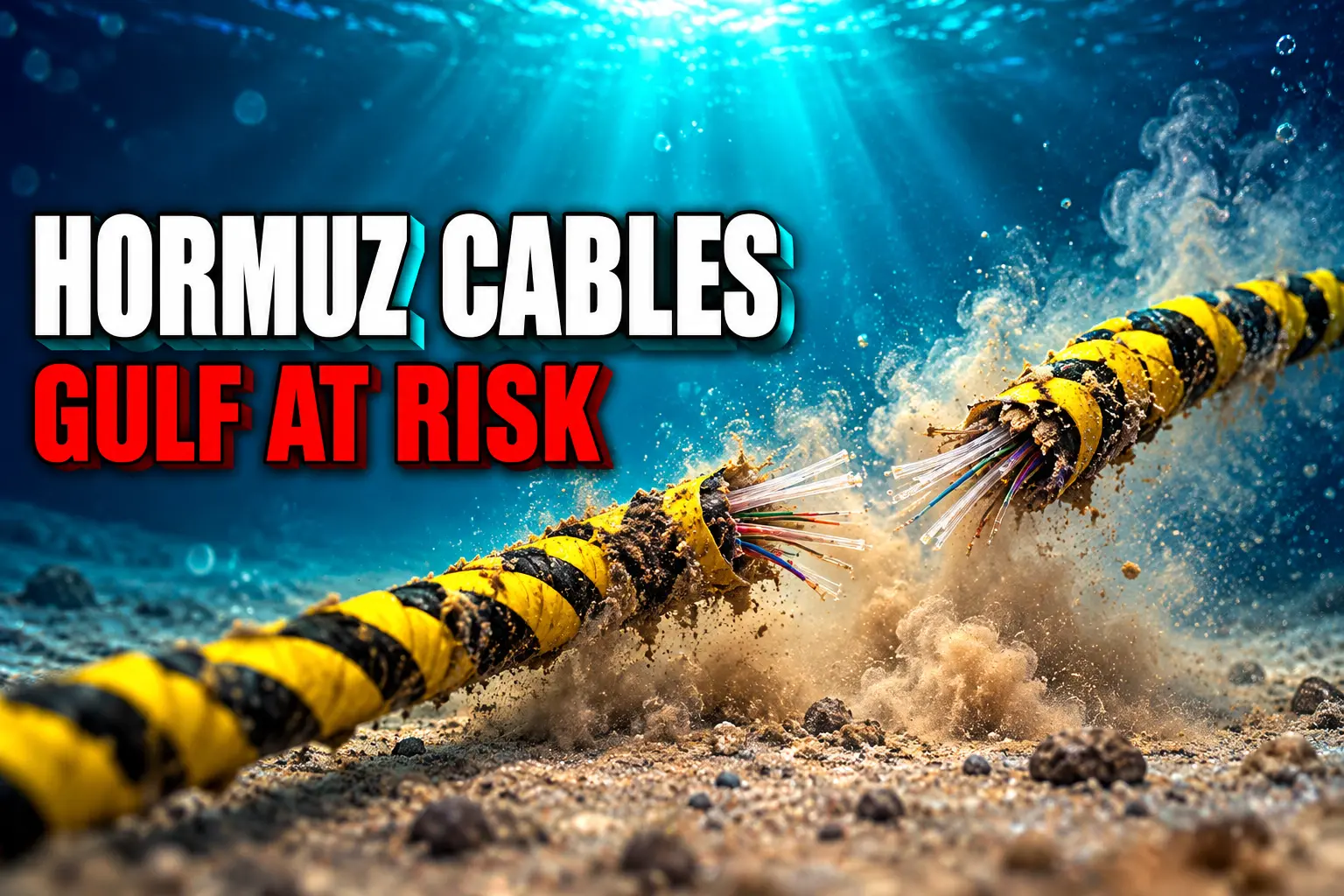
Iran’s plans to hit Hormuz undersea cables would strike Gulf internet and U.S. cloud plants first, not the world network, cable data shows.

Iran has drawn up plans to cut undersea communications cables in the Persian Gulf if the United States and Israel attack again, two senior security officials said. They spoke on condition of anonymity and gave few details of how or where the cuts would be made.
One official said Iran would then try to stop repairs, to keep internet and other links down longer. “If Iran is attacked, there will be no more red lines, from undersea cables to military bases, including covert ones,” the official said, warning Washington not to “play with fire.”
Yadollah Javani, deputy head of political affairs for the Islamic Revolutionary Guard Corps, said on Wednesday, October 21, that Iran could target seven major internet cables under the Strait of Hormuz if Iranian plants came under attack. IRGC spokesman Brigadier General Hossein Mohebbi had already named those seven lines at a Tehran event on October 19. The U.S. Department of State and Iran’s Foreign Ministry did not respond to questions about the officials’ remarks, and Gulf governments issued no immediate comment.
WHAT WE KNOW
- The condition: The plans are framed as a reply if the United States and Israel attack Iran again, not as a strike already ordered.
- The extra step: One official said Tehran would try to keep repair crews away after any cut, stretching outages for internet and other traffic.
- The named official: Javani tied the warning to seven major cables under the strait if Iranian sites were hit.
WHAT IS UNCONFIRMED
- The method: The two officials did not say which tools, boats, or landing points would be used.
- The Red Sea: Tehran has made no public statement that it plans to cut cables there, even though those routes carry far more long-haul traffic.
- The count: The Guard’s seven-cable figure does not match the industry count of five active system segments in the strait.
The people with the most to lose are not users in New York or Tokyo. They are Gulf states that bought U.S. cloud and AI plants, and the firms that put those plants on the water.
Hormuz Carries Less Than 1% of Global Bandwidth
Undersea cables carry around 99% of global internet traffic, according to the International Telecommunication Union, a UN agency. That global fact is what Iranian officials keep reaching for. It does not describe the strait they are pointing at.
Alan Mauldin, research director at the telecom research firm TeleGeography, said less than 1% of international bandwidth passes through the Strait of Hormuz. The International Cable Protection Committee, a Portsmouth-based industry body whose members hold most of the world’s submarine telecom lines, said the same share in a May 20, 2026, statement and called the risk regional rather than global.
The committee counted five active submarine cable system segments crossing the strait, plus more systems still being built. It also said two cables land in Iran. Industry maps of the same corridor name three main working systems, Asia-Africa-Europe-1, FALCON, and Gulf Bridge International. Mohebbi’s seven-cable line and the committee’s five-segment count are different tallies, and they should not be added or averaged.
HOW THE ROUTES COMPARE
| Route | Industry measure | Who feels a cut first |
|---|---|---|
| Strait of Hormuz | less than 1% of international bandwidth | Arab Gulf states |
| Red Sea | about 3% of global international demand; about 10% of traffic between regions | Europe, East Africa and Asia |
| All undersea cables | around 99% of internet traffic | nearly every country |
Those three rows use different yardsticks on purpose. The 3% and 10% figures are Mauldin’s measures for Red Sea capacity and for traffic that moves between regions. They are not a second take on the Hormuz share. Figures that get repeated as “Middle East internet” often mix the Red Sea into the strait, which is the error the cable committee flagged in May.
Mauldin also noted that the Hormuz cables were laid in Omani waters because of long-running trouble with Iranian permits. They sit in a tight cluster on one side of the channel. A single dragged anchor can, in theory, hit more than one line. That is a Gulf problem. Europe-to-Asia trunks run through the Red Sea, no closer than about 900 miles from Hormuz.
Bahrain, Qatar and Kuwait Sit Closest to the Risk
Damage in the strait would hit Arab Gulf networks first because those cables exist to serve them. Mauldin’s March 13, 2026, note on the corridor walked through the backups country by country, and none of them is a full spare for a dead Gulf system.
WHERE THE BACKUPS ARE
- Bahrain, Kuwait and Qatar: All three have land links into Saudi Arabia, and Kuwait also has a land path into Iraq, so traffic can leave by desert fiber if the sea lines fail.
- The UAE: Most of its submarine landings sit at Fujairah on the Gulf of Oman, outside the strait, which gives it a cleaner path than a landing inside the Gulf.
- Saudi Arabia: Only a few of its submarine landings are on the Gulf coast. Most of its international bandwidth arrives on the Red Sea coast.
Mauldin warned that land networks may not hold a full reroute if several Gulf systems go down at once. Land fiber can be hit in a fight too. Bahrain, Qatar and Kuwait would feel a Hormuz cut sooner than Saudi Arabia. The UAE’s Fujairah landings help, but they do not make the country immune if regional cloud sites go dark at the same time.
That is the map Iranian officials are using as leverage. The second anonymous official said Gulf governments “should hold Washington, not Tehran, responsible for any damage to undersea cables.” The line treats Riyadh, Abu Dhabi, Doha, Kuwait City and Manama as the people who would have to place the call.
What Microsoft’s $10 Billion Bet Now Buys
Microsoft spent September putting more money behind those same governments. On September 23, Vice Chair and President Brad Smith posted a Middle East plan that names Kuwait, Qatar, Saudi Arabia and the United Arab Emirates. The company said it would invest more than $10 billion in capital and operating expenses in the region through 2030, on cloud and AI capacity, and separately more than $400 million on subsea and terrestrial links by 2030.
Microsoft’s economic ties to the Middle East run deep, and our commitment to the region has always been, and will remain, steadfast. As AI reshapes economies around the world, the Middle East has an important opportunity to lead.
Brad Smith, Vice Chair and President, Microsoft On the Issues, September 23, 2026
The same post said Microsoft would put more than $10 billion in capital and operating expenses into the four countries, and that it already runs more than 275,000 miles of terrestrial and subsea fiber. It listed national AI partners including HUMAIN in Saudi Arabia, G42 in the UAE, QAI in Qatar, and the government of Kuwait, plus government tech programs such as TAMM, ALLaM and TASMU.
Microsoft also named the SeaMeWe-6 cable system landings in Qatar, Saudi Arabia and the UAE as part of that bet. Mauldin’s March note said work on SeaMeWe-6, along with 2Africa, India Europe Xpress, Raman and Africa-1, was on hold because of fighting and permit trouble. The company is still writing the checks. The fiber is not all in the water yet.
Mohsen Rezaei, secretary of Iran’s Supreme National Security Council, had already widened the target list. In an October 11 interview with Press TV he said undersea cables, data centers and artificial intelligence sites could be hit if fighting resumed. That list matches the plants Microsoft, Amazon, Google and Gulf sovereign AI groups have been building. The hostage is the spend, not a webpage in London.
Amazon’s March Outages Already Showed the Pattern
The Guard does not need a new theory of digital war. It already flew one.
Before sunrise on Sunday, March 1, Iranian Shahed drones struck two Amazon Web Services data centers in the UAE, according to a March commentary by Joseph Jarnecki and Noah Sylvia at the Royal United Services Institute. Debris from a nearby strike damaged a third AWS site in Bahrain the same morning. Banking apps, payments and consumer services in the UAE went down as backup zones failed together.
At the height of that fighting the IRGC named U.S. tech firms including Microsoft, Google, Apple and Nvidia as legitimate targets. Amazon’s cloud unit spent days trying to restore Gulf services. Microsoft said in other briefings at the time that its own regional sites were still up. The point for Tehran was the demonstration: a commercial hall of servers in a U.S. partner state can be treated as a war target.
HOW THE DIGITAL THREAT BUILT
- March 1, 2026: Iranian drones directly hit two AWS data centers in the UAE and damage a third AWS site in Bahrain by nearby debris.
- March 2026: The IRGC names Microsoft, Google, Apple and Nvidia among U.S. tech firms it calls legitimate targets.
- May 20, 2026: The International Cable Protection Committee says five active cable segments cross Hormuz and that they carry less than 1% of international bandwidth.
- September 23, 2026: Microsoft announces more than $10 billion in regional cloud and AI spending through 2030 and more than $400 million for subsea and land links.
- October 11, 2026: Rezaei says cables, data centers and AI sites could be targets if fighting starts again.
- October 19 and 21, 2026: Mohebbi and then Javani point to seven major cables under Hormuz.
- October 23, 2026: Two senior Iranian security officials say detailed cable-attack plans exist and that Iran would try to block repairs.
The March hits were on buildings. The October warnings add the seafloor. Together they tell Gulf hosts that U.S. cloud halls and the lines that feed them are in the same target set.
One Repair Ship Is Stationed Inside the Gulf
The officials’ most practical line was not the cut. It was the promise to keep the cut open. Specialized repair ships need permits to enter the water where a fault sits. Once they find the break they have to hold still for days, which makes them easy to threaten in a war zone. Insurance costs rise. Permission arrives late, or not at all.
UAE-based e-Marine is the maintenance authority for Gulf repairs. As of Mauldin’s March 13 note, the company ran five ships. Marine traffic data at that time showed only one of those five inside the Gulf. The others were in the Red Sea and the Indian Ocean. If Hormuz itself were closed to civilian work, a break inside the Gulf would wait on a single hull.
THE REPAIR MATH
- Ordinary faults: About 150 to 200 submarine telecom faults happen worldwide each year, the cable committee says.
- The usual cause: Around 70 to 80 percent come from fishing gear and ships’ anchors, not sabotage.
- The local fleet: e-Marine had five repair vessels, with one inside the Gulf as of March 13, 2026.
- The Red Sea lesson: Three cables damaged in 2024 took six months to fix. Four cables damaged in September 2025 took five months for three of them, and the fourth was still out as of March 13, 2026.
Those Red Sea delays are the closest working model for what “prevent repairs” would mean. Houthi attacks and permit fights already slowed how submarine cable repairs work on a busier corridor. Mauldin wrote that the sharp near-term danger in the Gulf is not only a new cut. It is the inability to mend one on time. New builds face the same stall. He listed 2Africa’s Pearls extension and the Fibre in Gulf system among projects that would struggle if fighting persisted.
A viral reading of Mohebbi’s seven-cable warning treated Hormuz as a kill switch for the world internet. The bandwidth share is less than 1%, and the users on those lines are in the Gulf. The longer outage is the part that would actually hurt banks, cloud jobs and government sites in those states, because a wartime permit for a repair barge can take longer than the splice itself.
Tehran Wants Gulf Capitals to Call Washington
Alex Vatanka, director of the Iran program at the Middle East Institute in Washington, said the threats are meant to deter a new round of fighting and to make Gulf governments and U.S. companies fear for what they have already built.
Tehran wants Gulf states and corporate executives to press Trump over the risks his policies pose to their investment plans.
Alex Vatanka, director, Iran program, Middle East Institute
That is a lobbying strategy dressed as a targeting list. Javani said the United States and its allies hold large assets in the region and that Tehran would use all its means to reply, including destroying their property. Rezaei added data centers and AI halls. The second anonymous official told Gulf states to blame Washington if the cables were damaged. None of those lines is aimed at a teenager streaming video in Chicago.
The Red Sea would still be the larger prize for anyone trying to slow Europe-Asia data. Mauldin said capacity routed through it accounts for about 3% of global international demand and around 10% of traffic traveling between regions. Iran has not said it will hit those cables, even with Houthi partners on the Yemeni coast. The public plan on the table is the Gulf, where the customers are also U.S. security partners and Microsoft’s named AI allies.
Land links can take some of the load, and operators can swing traffic onto other submarine paths when a system dies. Mauldin said the size of any slowdown would depend on those backups and on spare capacity. Wartime repairs would still be the bottleneck. Higher insurance and slow permits would pile on after the first cut.
The two officials said Iran has full access to the cables and could destroy them easily. They offered no chart, no method, and no date. Gulf cloud operators already know what a strike on a computer hall looks like, because they spent March putting one back together.

Bulk Scotch Still Faces Full Duty After India’s UK Deal

Typhoon Champi Loops Off Taiwan and Still Injures 527

PM Modi Opens Chinmaya’s AI Guru and Asks for Unity

Mahim Police Hold a JeM Suspect on Enmity Charges

Gold Falls Below $4,000 as Hormuz Oil Hits $117

The iPhone 18 Pro Max Splits Apple’s Fall in Two

OpenAI Calls GPT-6 Astra AGI Then Locks Its Exploits

Clancy Juror Says the Holdout Never Cited Evidence

Trump Claims Hormuz Control as Oil Holds Near $96

Russia Closes the Goethe-Institut Berlin Tried to Save

 NEWS2 months ago
The iPhone 18 Pro Max Splits Apple’s Fall in Two
- NEWS2 months ago
OpenAI Calls GPT-6 Astra AGI Then Locks Its Exploits
- NEWS1 month ago
Clancy Juror Says the Holdout Never Cited Evidence
- BUSINESS2 months ago
Trump Claims Hormuz Control as Oil Holds Near $96
- LIFESTYLE2 months ago
Russia Closes the Goethe-Institut Berlin Tried to Save
- AUTO2 months ago
Volkswagen’s Job Cuts Leave Four Plants Without Cars
- NEWS2 months ago
Dyson Puts Nurovi Robots on Sale Without the UV Flagship
- NEWS2 months ago
The Lincoln’s 286-Day War Cruise Ends at a Thai Pier










