
NEWS
Houthi Strike on Riyadh Airport Tests a New Alliance
Saturday’s Houthi strike killed 12 at Riyadh’s airport and now tests Pakistan’s Mecca pact and Trump’s choice to stay out of Yemen.

A missile strike on Riyadh’s King Khalid International Airport on Saturday killed 12 people and wounded 309, the kingdom’s civil aviation authority said. Four of the dead were Saudi. The other eight came from Bangladesh, the United States, Jordan, Palestine, Syria, Sudan and Egypt.
It was the third strike on the capital’s main airport between October 6 and 10, and the deadliest attack on Saudi soil since May 2015. The blast now presses two unfinished decisions: whether Pakistan’s new Mecca defence pact means combat, and whether President Donald Trump reverses a September refusal to bomb Yemen’s Houthis.
Twelve Dead After a Strike With No Public Warning
The General Authority of Civil Aviation said some of the wounded were in critical condition and that damage to the airport was still being assessed. Operations at the hub that serves a city of about 8 million people were halted. Incoming flights were diverted.
Saudi Arabia’s Coalition Joint Forces Command blamed the Houthis, who are at war with the Saudi-backed Yemeni government, and said the weapon hit a passenger terminal, killing both travellers and staff. Coalition spokesman Major General Turki al-Maliki called the strike a full-fledged war crime. A diplomatic source put the missile at about 3pm. The kingdom’s public threat-warning system issued no alert.
A passenger who had been standing at gate 403 said gate 401 was hit, that wounded people were in front of him, and that everyone ran. Hospitals took casualties by ambulance and helicopter. A medical source at one hospital said an Egyptian flight attendant for a Saudi airline was among the dead. Flight-tracking data from Flightradar24 showed 155 arriving flights and 161 departing flights cancelled, with 222 delayed. The United States, the United Kingdom, Spain and Canada warned their citizens against using the airport. Major energy and investment conferences planned in Riyadh were still on the calendar.
The Houthis had claimed Thursday’s missiles on the same airport through military spokesman Yahya Saree. They did not put out a matching spokesman’s claim in the hours after Saturday’s strike. The Saudi-led coalition said a projectile also fell near King Fahd International Airport in Dammam the same afternoon.
WHAT WE KNOW AND WHAT IS UNCONFIRMED
- Confirmed dead: GACA listed 12 killed, including four Saudis, two Bangladeshis, and one person each from the United States, Egypt, Jordan, Syria, Palestine and Sudan.
- Confirmed wounded: GACA put the injured at 309, with some in critical condition, and said airport operations were suspended.
- Coalition blame: The Saudi-led coalition said the Houthis struck a passenger terminal and called the attack a war crime.
- Unconfirmed: Public accounts still differ on which hall was hit, the exact missile type, and whether the Houthis issued a formal Saturday claim to match Thursday’s.
UN Secretary-General Antonio Guterres said he was deeply shocked and that attacks on civilians and civilian infrastructure violated international law and must cease immediately. Special Envoy Hans Grundberg, briefing the Security Council, said Yemen has slid back into full-scale war and that Ansar Allah attacks on Abha International Airport and King Khalid International Airport had already killed and injured civilians.
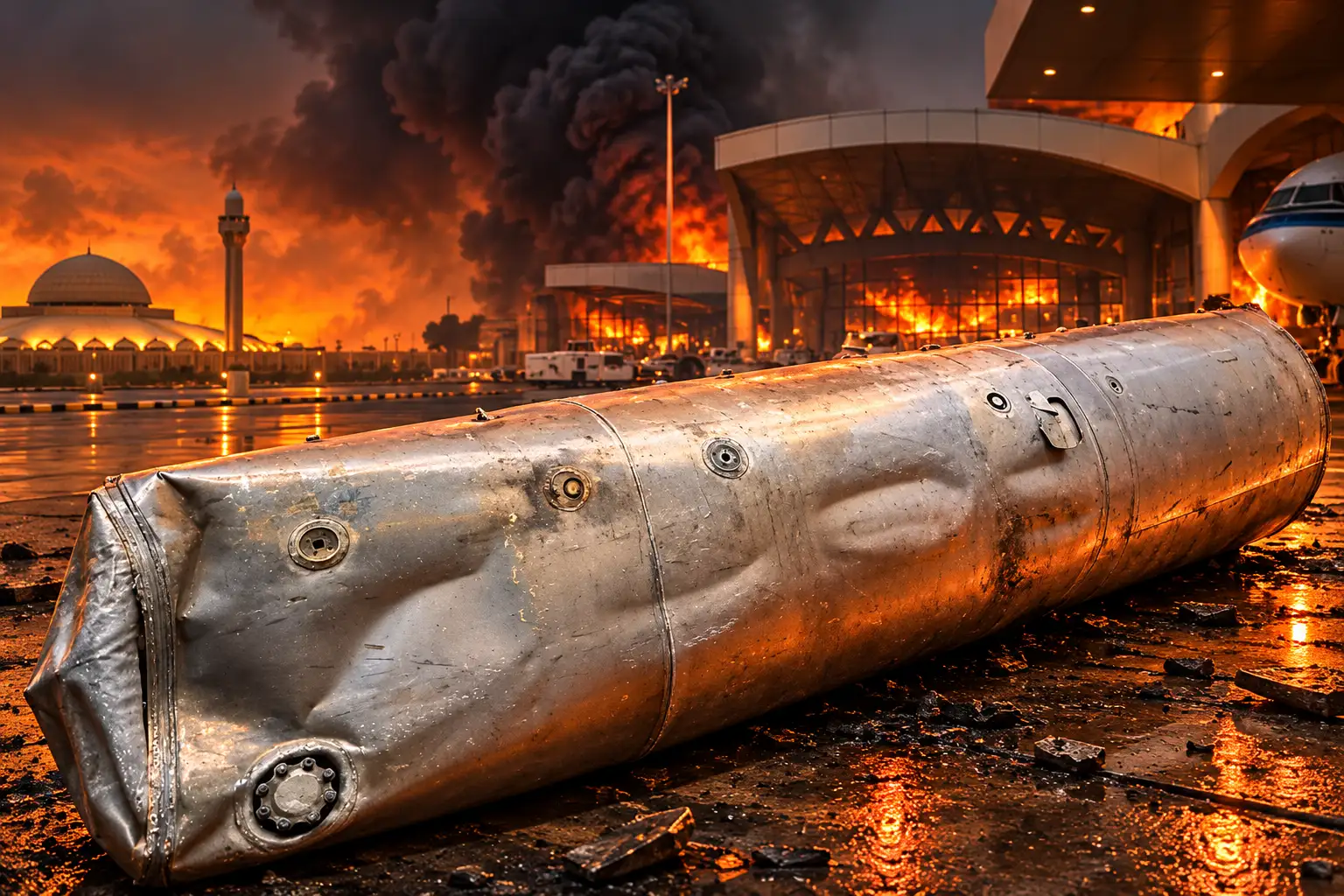
The Week of Strikes on Saudi Airports
Saturday did not open this campaign. It closed a five-day run in which the Houthis, by Saudi count, kept walking fire onto civil airfields while Riyadh flew an air war over Yemen.
SAUDI AIRPORT HITS, OCTOBER 6 TO 10
| Date | Airport | Killed | Wounded | What was hit |
|---|---|---|---|---|
| October 6-7 | Abha International | 2 (Moroccan and Algerian women) | 28 | Civilian airport |
| October 6-7 | King Khalid International | 1 Sudanese national | 8 | Civilian airport |
| October 8 | King Khalid International | 3 Saudis, including Capt. Hamoud Ali Alkalthami | Several, minor to severe | Airport facilities and a Saudia aircraft |
| October 10 | King Khalid International | 12 | 309 | Passenger terminal |
| October 10 | Near King Fahd International, Dammam | Not reported | Not reported | Projectile nearby, per the coalition |
Saudia announced the death of Captain Hamoud Ali Alkalthami after Thursday’s second hit on the Riyadh field, which GACA said struck one of the state carrier’s aircraft. Air traffic was later described as back to normal, until Saturday shut the airport again. On Thursday, aviation analytics firm Cirium counted 169 of 378 scheduled Riyadh departures cancelled or listed as no-fly, or 44.71 percent. At least three people were also wounded in other attacks on Jazan and Najran airports near the Yemen border.
The week’s fire followed a Yemeni government offensive that began on October 5, the same day the Mecca alliance was invoked. The Houthis had seized the Bab al-Mandab strait in September. About 12 percent of world trade passes that waterway in normal times. Saudi-backed units, with air cover from 100 coalition fighter jets, said they had taken Mocha and ground around the strait. The Houthis then told airlines to treat Saudi airspace as a military zone.
What Did the Mecca Pact Commit on October 5?
On October 5, Saudi Arabia, Pakistan and Turkey held an emergency meeting of the Strategic Political and Defense Committee of the Makkah Alliance for Defense in Riyadh, the first time the pact had been invoked since it was signed on August 7. That is 59 days from signature to activation. A joint statement said the three would move at once to put collective defence into practice and to send agreed forces and kit into the kingdom, under each country’s own laws.
The committee agreed to activate collective deterrence measures, within the framework of the Alliance, in response to the attacks and all those responsible for them.
Khalid bin Salman, Saudi defence minister, October 5 statement
The text treats an armed attack on one member as an attack on all three, the same political formula NATO wrote into its founding treaty. The treaty still leaves each ally to take such action as it deems necessary. NATO’s own guarantee has been invoked only once after September 11. The Mecca pact is two months old, with a secretariat headed by retired Pakistani Lt. Gen. Nauman Mahmood on a three-year term.
HOW THE PACT MOVED, THEN STOPPED SHORT OF YEMEN
- April 2015: Pakistan’s parliament votes to stay out of the Saudi war in Yemen, while pledging to stand with the kingdom if its land or the holy cities are threatened.
- August 7, 2026: Saudi Arabia, Pakistan and Turkey sign the Mecca joint defence agreement in Mecca.
- October 5, 2026: The three invoke the pact, appoint Nauman Mahmood secretary-general, and order rapid deployment into Saudi Arabia on the same day Yemeni government forces open their counteroffensive.
- October 11, 2026: After Saturday’s 12 dead, Pakistan’s Foreign Office repeats a firm and unshakeable commitment to Saudi defence and still does not announce combat inside Yemen.
Pakistan already had weight in the kingdom: about 8,000 troops by analyst tallies, a squadron of JF-17 fighters, drones, and a Chinese HQ-9 air-defence battery run by Pakistani crews. Defence Minister Khawaja Asif said Pakistani and Turkish forces would scout and support while Saudi units did the fighting. Foreign Minister Ishaq Dar called the pact defensive. Turkey’s constitution requires a parliamentary vote to send troops abroad, and that vote had not come by the time of the airport massacre. About 2.5 million Pakistanis live in Saudi Arabia.
The design is a ring around Saudi cities and oil plants so Saudi crews can fly over Yemen. Aziz Alghashian, a senior non-resident fellow at the Gulf International Forum, had already called the Houthi campaign a shove that forced the alliance to grow a skeleton. After Saturday he went further, saying that if there had been no appetite for a long campaign against the Houthis, this attack would change that.
Trump Left Open a War He Refused in September
Trump called the attack terrible and said he would speak soon with Crown Prince Mohammed bin Salman. Asked whether the United States should join the war against the Houthis, he did not close the door.
We may. We’re gonna look at it. We just found out about the recent attack, so we’ll make a decision. We’ll move very quickly.
Donald Trump, US president, remarks after the Riyadh strike
Secretary of State Marco Rubio said a Houthi attack had killed an American, called the strikes reprehensible, and said they must stop. In September, Trump had refused the crown prince’s requests for US strikes on the Houthis after the group promised to spare American shipping. Rubio has said Washington will honour its defence deal with Riyadh. Former Pentagon officials have described that as intelligence and surveillance, not combat. The Mecca deployment lets that bargain stand: Asian partners on the ramparts, American aircraft still not tasked to bomb Sanaa.
A missile that reaches a passenger hall with no public warning, after Pakistani air defences were already in the kingdom, is the operational fact those bargains now have to survive. Reading the strike as simple blowback for Saudi bombing is too neat, and it does not clear the Houthis of hitting a civilian field. It does explain why a terminal full of foreign workers and transfer passengers became the place the week’s war showed up.
Who Died in Saturday’s Airport Strike?
GACA’s list is a map of who actually uses a Gulf capital’s airport. Four of the 12 were Saudi. Eight were not. The wounded, officials said, were being treated at several hospitals, some of them critical.
THE 12 DEAD, BY NATIONALITY
- Saudi Arabia: Four citizens, unnamed in the GACA statement.
- Bangladesh: Two people, the largest foreign group on the list.
- United States: One person; Rubio confirmed an American was killed.
- Egypt, Jordan, Syria, Palestine, Sudan: One person each, including, a hospital source said, an Egyptian flight attendant.
That mix is the Gulf labour and transit system under fire, not a military base. The airport has no military facilities. Early hospital accounts also described pilgrims bound for Makkah among the wounded. Oman, even as it denounced the attack, urged wisdom, self-restraint, and a halt to moves that would widen the war. Grundberg told the Security Council that civilians, especially women and children, were again taking the weight of a fight in a country the IMF has ranked as the world’s poorest.
Houthi Fire on Saudi Airports Since 2019
Cross-border fire at Saudi civilian airports is not a new Houthi tactic. It is an old one used at a new volume. ACLED’s study of the 2015-2022 air war recorded nearly 1,000 rocket and missile attacks and more than 350 drone attacks on Saudi and Emirati territory before the April 2022 UN truce. In June 2019, Houthi spokesman Muhammad Abdulsalam described civilian airports as military targets, answering the coalition’s hold on Sanaa airport. Between June and September 2019, ACLED logged 37 rocket and drone events against Saudi civilian airports.
The 2022 UN truce froze that pattern. It came apart in July 2026 as the wider regional war thickened and the Houthis pushed down the Red Sea coast. Saudi aircraft went back to Yemen. Houthi missiles and drones came north. Saturday’s death toll passed every airport strike in that earlier campaign and landed just short of the May 2015 Islamic State suicide bombing in Qatif, which killed 21 worshippers in a Shia mosque, the last time a single attack on Saudi soil had cost more lives.
Hans Grundberg’s warning sits on that loop. Attacks on civilian airports, he said, are a grave escalation, a threat to regional security, and a further complication of any Yemen peace. The Houthis have used airport strikes before as a message timed to talks and visits. A packed Saturday terminal is that message written in a casualty list.
Pakistan’s Sunday Pledge Stops at Yemen’s Border
On Sunday, Pakistan’s Foreign Office condemned the new wave of attacks and restated a firm and unshakeable commitment to Saudi Arabia’s sovereignty, land, and security under the Makkah Joint Defence Agreement and the October 5 deployment decision. It backed Saudi self-defence, told the Houthis to stop, and said Pakistan would stand shoulder to shoulder with the kingdom. It did not say Pakistani jets would bomb Yemen. That limit matches Asif’s earlier line on the Mecca pact, which tied Islamabad to defending the kingdom without promising a war inside Yemen.
Yemeni government commanders have talked of marching on Sanaa, held by the Houthis since 2014, which would turn a coastal recovery into an open-ended war. Reports of Pakistani weapons flights into Aden already pull at the defensive line Dar keeps drawing. A Tehran analyst’s split still governs the risk for Islamabad: protecting Saudi plants can be lived with; offensive operations against the Houthis cannot.
Twelve people are dead in a Riyadh terminal, 309 are wounded, and the two capitals that can widen this war have not yet moved. Trump says he may. Pakistan says it will defend Saudi ground. Saturday’s missile asked both to pick a side inside Yemen, and by Sunday night neither had.

Bulk Scotch Still Faces Full Duty After India’s UK Deal

Typhoon Champi Loops Off Taiwan and Still Injures 527

PM Modi Opens Chinmaya’s AI Guru and Asks for Unity

Mahim Police Hold a JeM Suspect on Enmity Charges

Gold Falls Below $4,000 as Hormuz Oil Hits $117

The iPhone 18 Pro Max Splits Apple’s Fall in Two

OpenAI Calls GPT-6 Astra AGI Then Locks Its Exploits

Clancy Juror Says the Holdout Never Cited Evidence

Trump Claims Hormuz Control as Oil Holds Near $96

Russia Closes the Goethe-Institut Berlin Tried to Save

 NEWS2 months ago
The iPhone 18 Pro Max Splits Apple’s Fall in Two
- NEWS2 months ago
OpenAI Calls GPT-6 Astra AGI Then Locks Its Exploits
- NEWS1 month ago
Clancy Juror Says the Holdout Never Cited Evidence
- BUSINESS2 months ago
Trump Claims Hormuz Control as Oil Holds Near $96
- LIFESTYLE2 months ago
Russia Closes the Goethe-Institut Berlin Tried to Save
- AUTO2 months ago
Volkswagen’s Job Cuts Leave Four Plants Without Cars
- NEWS2 months ago
Dyson Puts Nurovi Robots on Sale Without the UV Flagship
- NEWS2 months ago
The Lincoln’s 286-Day War Cruise Ends at a Thai Pier










