NEWS
Dammam Airport Strike Leaves Oil Hub Workers Exposed
A Dammam airport strike killed one resident the same day Shaybah debris killed two contractors, and Washington ordered non-emergency families out of Saudi Arabia.

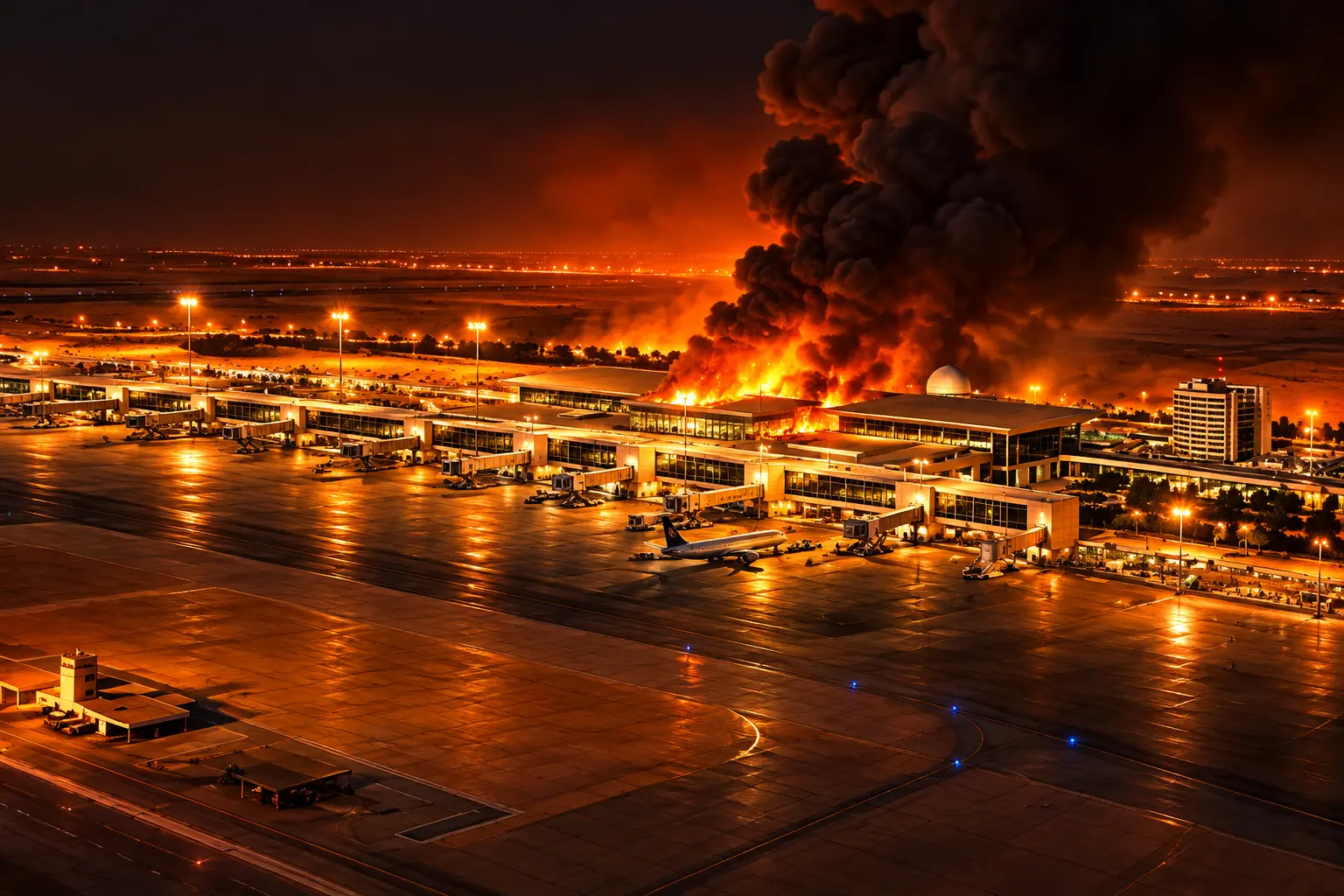
A strike on Dammam’s King Fahd International Airport killed one resident and injured eight people on the evening of October 21, Saudi Arabia’s General Authority of Civil Aviation said. Hours earlier, debris from a drone shot down at Aramco’s Shaybah oil field had already killed a Filipino contractor and a Nepali contractor.
In Washington, the State Department had already told non-emergency U.S. staff and their families to leave the kingdom, citing Iran-backed Houthi attacks on civilian airports. The body count in Dammam was small. The signal was not.
One Dead at Dammam, Two at Shaybah
GACA said the airport in the eastern city of Dammam was hit on the evening of Wednesday, October 21, corresponding to 10 Jumada Al-Awwal 1448. The authority said one resident was killed and eight injured, with wounds ranging from minor to critical, and that all eight were taken to hospital. It reported property damage and said the full extent was still being assessed. It did not name a weapon, and it did not name an attacker.
The attack resulted in the fatality of a resident, and injuries to eight others, ranging from minor to critical. All injured individuals were immediately transported to hospital to receive the necessary medical care.
General Authority of Civil Aviation, statement via the Saudi Press Agency
The English version of that notice went out from GACA’s official account.
#Statement | An attack targeted King Fahd International Airport in Dammam.#GACA pic.twitter.com/kRueeaQbSm
— هيئة الطيران المدني (@ksagaca) October 21, 2026
Dammam sits in an oil-producing area near Bahrain that is home to thousands of the industry’s foreign workers. Saudi authorities have blamed Iran-backed Houthis for the wider airport campaign that began on October 6. Some accounts said the group had not commented on this particular strike.
The same Wednesday, according to an official source at the Ministry of Energy, Saudi air defenses intercepted a drone aimed at a processing plant at Shaybah, in the Empty Quarter near the UAE border. Falling debris set fire to a contractor’s vehicle outside the plant fence. The two men killed were Filipino and Nepali nationals. The two wounded were Pakistani and Indian. The ministry said the field’s operations were unaffected. It did not name who launched the drone.
A shoot-down that works on paper can still kill the people standing outside the wire. That is the part of Wednesday that a one-line airport bulletin does not carry.
Washington Ordered Families Out of the Kingdom
State Department spokesperson Tommy Pigott posted the departure order on October 21, before GACA’s Dammam statement. He was answering reports that U.S. missions across the Gulf were about to send families home. Those reports, he said, were wrong. The order, he said, was an ordered departure for non-emergency staff and their family members in Saudi Arabia only.
Iranian-supported Houthis have increasingly engaged in hostilities against Saudi Arabia, including attacks on civilian airports and other critical infrastructure resulting in civilian casualties and severe travel disruptions.
Tommy Pigott, State Department spokesperson, on X
U.S. officials still said other Gulf missions would tell families to leave. Pigott did not confirm that. Emergency staff remain, and the embassy stays open. There is no order for private American citizens to get out. The department did tell Americans to treat airports as a risk, and it said U.S. government employees in the kingdom need special authorization from the chief of mission before using any Saudi airport.
It also pointed people toward cars, trains, and buses, and noted that airports in Bahrain, Jordan, Oman, Qatar, and the United Arab Emirates were still running. The King Fahd Causeway into Bahrain remains a land exit from the same Eastern Province the Dammam airport serves.
This is the second time this year Washington has emptied the non-emergency roster. A Level 3 Reconsider Travel advisory dated March 13 still warns of Iranian drones and missiles, armed conflict, and Houthi threats. On March 8 the department ordered non-emergency employees and families out after Iran struck U.S. facilities. The Riyadh embassy was damaged at the start of that war, which began in late February, and ran for months on a skeleton staff. Some diplomats had only recently been sent back. Wednesday’s order pulled the families again.
A U.S. military footprint in the region has been shrinking on a quieter track, officials have said, under restricted operations rather than a formal ordered departure. The Saudi order is the louder step. It tells insurers, airlines, and every company that still flies people into Dhahran and Dammam that the U.S. government no longer treats those airports as routine.
The Oil Province’s Main Commercial Airport
King Fahd International Airport is the main commercial gateway for the Eastern Province, the kingdom’s oil belt on the Gulf. It is the airport that serves Dammam and the foreign workforce around Aramco’s eastern operations. GACA had already reported an attack on the same airport on October 11 and gave no casualty figures then. October 21 was the first of those two hits to kill.
Flightradar24 said halted since about 11:15 p.m. local time. That is the operational fact behind the GACA notice: the oil province’s main airport went dark in the middle of the night, after a morning in which two contractors were already dead at Shaybah.
Dhahran, the Aramco town, and the U.S. consulate that sits in that same eastern cluster are not abstract dots on a threat map. They are the reason Dammam is a more useful target than a body count of one would suggest. Hit Riyadh and you scare the capital. Hit Dammam and you scare the people who keep the oil system staffed.
Sixteen Days of Missiles Aimed at Terminals
The Dammam strike did not open this campaign. It extended a run of ballistic-missile and drone attacks on Saudi civilian airports that began on October 6. Can Kasapoğlu, a senior fellow at the Hudson Institute, described the pattern as systematic strikes against Saudi airports, aimed at connectivity and confidence rather than at flattening every runway.
THE OCTOBER AIRPORT STRIKES
| Date | Airport | Killed | Injured |
|---|---|---|---|
| October 6-7 | King Khalid, Riyadh | 1 (Sudanese) | 8 |
| October 6-7 | Abha | 2 (Algerian and Moroccan women) | 28 |
| October 8 | King Khalid, Riyadh | 3 Saudis, including a Saudia pilot | 20+ |
| October 10 | King Khalid, Riyadh | 13 | More than 300 |
| October 11 | King Khalid, Riyadh | 1 (Pakistani) | 11 |
| October 11 | King Fahd, Dammam | None reported | None reported |
| October 21 | King Fahd, Dammam | 1 resident | 8 |
The October 10 missile that hit a complex of terminals 3 and 4 in Riyadh was the worst day. GACA and subsequent identifications put the dead at four Saudis, two Bangladeshis, and one person each from the United States, Jordan, Palestine, Syria, Sudan, and Egypt, with an Indian man dying of his wounds the next day. Coalition spokesperson Turki al-Maliki called that attack a “full-fledged war crime.” On October 8, a Saudia Airbus A320 was destroyed on the ground.
King Khalid, the kingdom’s second-busiest airport, was closed after the early October hits. As of an October 13 Hudson assessment it had stayed shut, and the U.S. embassy said on October 21 that Riyadh airport remained suspended. Jeddah, the main western hub, was only partly running. On October 12, three ballistic missiles, one of them toward King Khalid, were intercepted.
What the Houthis Want From Saudi Airspace
Houthi military spokesman Yahya Saree has warned airlines that Saudi airports and airspace are “potential targets and sites for operation by our forces,” with the airports of Makkah and Madina excepted. Houthi official Mohammed al-Bukhaiti has framed the strikes as payback for Saudi attacks on civilian sites in Yemen, and as a demand that the same rules apply to airports and ports on both sides of the border.
The fuse runs back to July 13, when Saudi-backed strikes hit Sanaa International Airport to stop an Iranian Mahan Air flight from landing after the funeral of Supreme Leader Ali Khamenei, who was killed on the first day of the Iran war. The Houthis then ended the 2022 U.N.-brokered truce and moved to a blockade language of their own. Fighting widened again in October when Saudi-backed Yemeni forces pushed near the Bab al-Mandeb Strait.
Kasapoğlu’s point is blunt enough: an airport is a soft civilian node. A force does not need to wreck the whole field. One or two missiles can make airlines and passengers redo the risk, which is cheaper than a long air campaign against air defenses. The political effect is a picture of a rich state that cannot keep its terminals open. That picture is the product.
President Donald Trump called the Riyadh airport attack “terrible” and “not acceptable” and said the United States would “make a decision” about joining the fight in Yemen. Secretary of State Marco Rubio condemned the King Khalid strikes and noted that a U.S. citizen had been killed. U.N. Secretary-General António Guterres called the lethal Houthi attack a violation of international law that “must cease immediately.” Iran offered to mediate.
The Workers Who Cannot Book a Seat Out
Look at who actually dies in these strikes, and the U.S. departure order reads differently. Diplomats can be told to go. The men in the contractor truck at Shaybah could not. Neither could the passengers queued in Riyadh’s terminals on October 10.
NATIONALITIES NAMED IN THE OCTOBER TOLL
- Shaybah, October 21: Filipino and Nepali contractors killed; Pakistani and Indian contractors wounded, after debris from an intercepted drone hit a vehicle outside the plant.
- Dammam, October 21: One resident killed and eight people wounded; GACA has not released names or nationalities.
- Riyadh, October 10-11: Saudis, Bangladeshis, and citizens of the United States, Jordan, Palestine, Syria, Sudan, Egypt, India, and Pakistan among the dead.
- Abha, October 6-7: Two women, from Algeria and Morocco, killed, and 28 people wounded.
The Eastern Province runs on that mix of Saudi staff and South Asian and Southeast Asian contractors. Ordered departure is a tool the State Department has for its own people. It does not cover the Shaybah crew, and it does not cover the unnamed resident killed in Dammam. Land borders help a passport that can use them. They do not help a shift worker whose job is the plant.
That gap is why Wednesday’s pairing matters more than the Dammam death toll. An intercept at Shaybah still produced two funerals. A second hit on King Fahd still produced a third. The people Washington can extract are not the people the oil system is built on.
Airlines Have Already Rewritten Routes to Riyadh
Carriers moved after the Riyadh terminal strikes, which is how an airport campaign scores even when runways survive. Lufthansa Group cancelled flights to Riyadh through October 16. Air France and KLM suspended service through the end of October. Etihad stretched cancellations it had already posted. Delta postponed the planned Atlanta-Riyadh launch from October 23 to March 2027. The U.S. Federal Aviation Administration had already told American carriers to be careful over Saudi Arabia, and the European Union Aviation Safety Agency had widened its airspace warnings.
Those decisions outlast any single GACA update. They are the second-order hit: fewer seats, higher war-risk costs, and a capital that is harder to reach for the conferences and investment traffic Riyadh has spent a decade courting. Kasapoğlu tied that pressure to Vision 2030’s bet on the kingdom as a logistics and aviation hub. Repeated terminal strikes tax that bet without needing to shut every field in the Eastern Province.
U.S. government employees in Saudi Arabia now need the chief of mission’s sign-off to use any airport in the country. Families of non-emergency staff have been told to leave. The eight people wounded in Dammam are in hospital, and GACA is still counting the damage at King Fahd. The two contractors killed at Shaybah died on a morning when the ministry could still say the oil field itself kept running.

Bulk Scotch Still Faces Full Duty After India’s UK Deal

Typhoon Champi Loops Off Taiwan and Still Injures 527

PM Modi Opens Chinmaya’s AI Guru and Asks for Unity

Mahim Police Hold a JeM Suspect on Enmity Charges

Gold Falls Below $4,000 as Hormuz Oil Hits $117

The iPhone 18 Pro Max Splits Apple’s Fall in Two

OpenAI Calls GPT-6 Astra AGI Then Locks Its Exploits

Clancy Juror Says the Holdout Never Cited Evidence

Trump Claims Hormuz Control as Oil Holds Near $96

Russia Closes the Goethe-Institut Berlin Tried to Save

 NEWS2 months ago
The iPhone 18 Pro Max Splits Apple’s Fall in Two
- NEWS2 months ago
OpenAI Calls GPT-6 Astra AGI Then Locks Its Exploits
- NEWS1 month ago
Clancy Juror Says the Holdout Never Cited Evidence
- BUSINESS2 months ago
Trump Claims Hormuz Control as Oil Holds Near $96
- LIFESTYLE2 months ago
Russia Closes the Goethe-Institut Berlin Tried to Save
- AUTO2 months ago
Volkswagen’s Job Cuts Leave Four Plants Without Cars
- NEWS2 months ago
Dyson Puts Nurovi Robots on Sale Without the UV Flagship
- NEWS2 months ago
The Lincoln’s 286-Day War Cruise Ends at a Thai Pier