NEWS
A 7.0 in Baqen Leaves Tibet Racing Against the Cold
A 7.0 quake killed 16 in Baqen as 339 homes fell. The harder fight is minus 9 degrees, thin plateau air, and Saturday snow on a blocked highway.

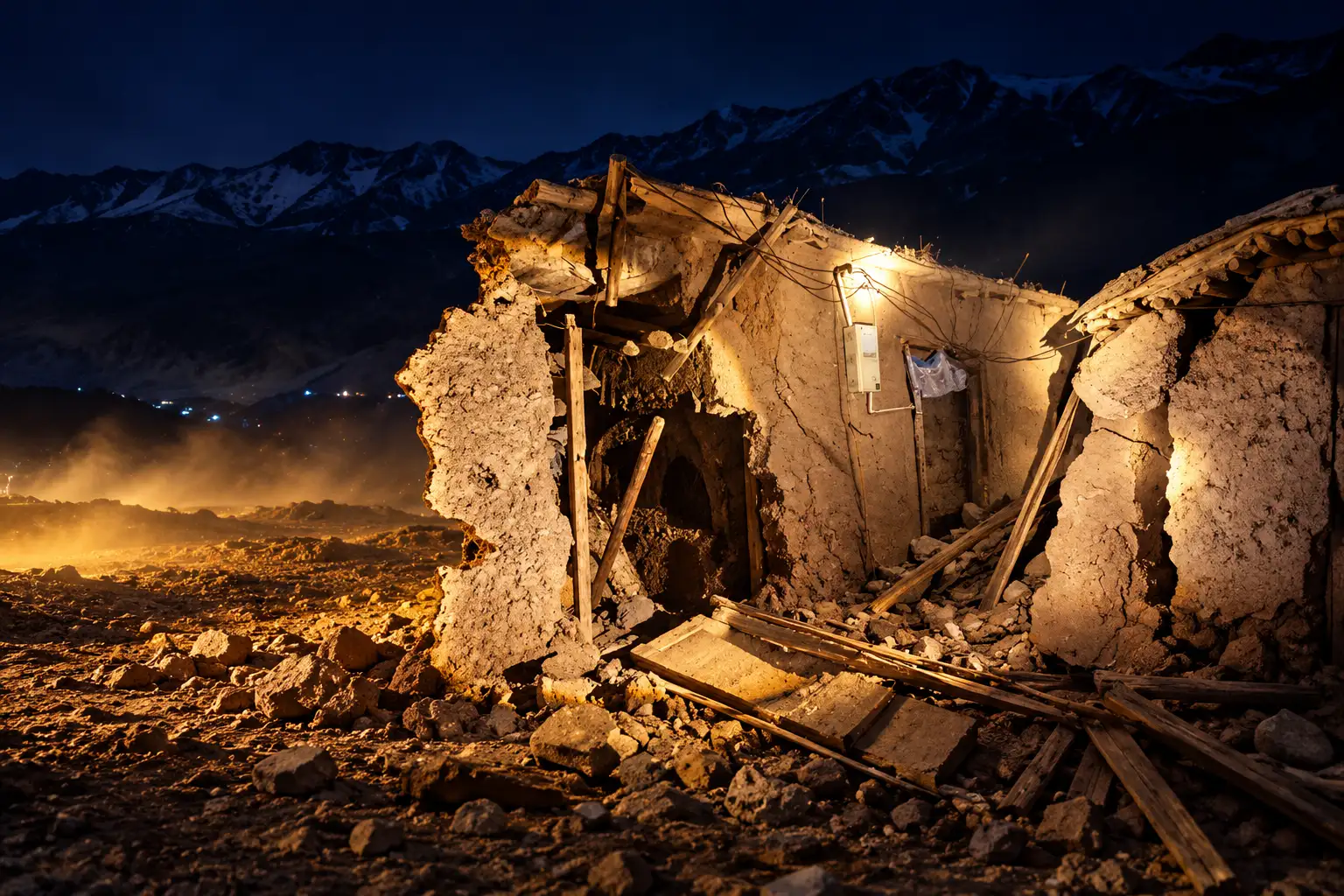
A magnitude 7.0 earthquake killed 16 people in Baqen County in northern Tibet on October 22 and injured 65, local officials said Friday. The shock hit at 10:33 p.m. Beijing time in Maru township, at an average height of 4,864 metres within five kilometres of the epicentre, according to the China Earthquake Networks Center.
Nagqu’s earthquake relief headquarters said 11 of the injured were in serious condition and 54 had minor wounds. At least 339 homes and 20 livestock sheds came down. The shaking is over. The plateau is not.
Sixteen Dead After a 7.0 Hits Baqen at Night
The U.S. Geological Survey located the rupture 191 kilometres east-northeast of Nagqu, at 32.380 degrees north and 93.780 degrees east, and measured a reviewed depth of 18.0 kilometres. China’s network placed the shock in Maru township, Baqen County, a high, thinly settled belt that borders Qinghai.
THE FRIDAY MORNING TALLY
- The dead: 16 people, unchanged through Friday morning as the injured count kept rising.
- The injured: 65 in all, with 11 in serious condition and 54 listed as minor.
- The houses: 339 homes down, plus 20 livestock sheds, with damage still being counted.
- The moved: 12,489 residents evacuated by 10 a.m. Friday, according to the city headquarters.
Township deputy head Lhawang Dagpo said the jolt was clearly felt at the Maru office, where walls cracked. Power and phone service failed in the county seat. A section of National Highway 317 was closed to ordinary traffic after rockfalls, with only emergency, rescue and official vehicles waved through while crews cleared debris.
A County of 56,200 Spread Thin on the Plateau
Baqen recorded 56,200 people in the 2020 census, spread across 9,812 square kilometres. Maru township, where the epicentre sat, counted 6,921 people that year. Most of the county still lives outside towns: 46,053 rural residents against 10,147 urban ones.
That scatter is why a 7.0 can flatten hundreds of houses and still show a death toll in the tens. There were simply fewer people inside the buildings that failed. It is also why the next 48 hours are harder than the first. Houses here sit far apart. So do clinics. A blocked highway and a dead phone line turn a short map distance into a night of walking.
Sixteen dead against 339 fallen homes is the ratio of a place where the land is empty and the walls are not strong. Rural houses on this plateau are often mud brick and unreinforced masonry. They come down in strong shaking. The people who slept in them are the ones crews still have to reach.
The Next Threat Is Minus Nine and Snow
Local weather offices told state authorities that temperatures around the epicentre will fall as low as minus 9 degrees Celsius over the next three days, with intermittent snow expected Saturday in the three townships nearest the rupture. President Xi Jinping, in an instruction issued Friday, noted the high altitude and low temperatures and told crews to monitor seismic activity and weather conditions so secondary disasters do not pile onto the first.
Premier Li Qiang told the Ministry of Emergency Management and the China Earthquake Administration to keep watch for aftershocks. The national earthquake emergency response was raised from Level IV to Level III on Friday. The regional disaster committee activated a Level III natural-disaster relief response the same morning.
WHAT THE PLATEAU ADDS TO A 7.0
- The height: Average ground within five kilometres of the epicentre sits at 4,864 metres, where cold and thin air slow both survivors and crews.
- The forecast: Minus 9 degrees Celsius over three days, with snow due Saturday on the three nearest townships.
- The road: Rockfalls shut ordinary traffic on National Highway 317, the line rescuers need for tents, stoves and the injured.
- The grid: Power and telecoms dropped in the county seat; State Grid Xizang Electric Power said 1,937 households had power back by 10 a.m. Friday.
Tents and folding beds are the right kit for a housing collapse. They are a thin kit for a Saturday snow at that height. Quilts, stoves and winter clothes were in the same convoys, which is the tell that officials already treat exposure as a second event, not a footnote.
How Many People Felt the Strongest Shaking
The USGS said the October 22 shock was normal faulting inside the Tibetan Plateau, slip on a crustal fault dipping northwest or southeast. India still drives under Eurasia, lifting the Himalaya and the plateau; the high plateau then spreads east and west under its own weight. That spreading is taken up by strike-slip and normal faults. The survey’s comparison is a pile of honey flattening after it leaves the bottle.
A rupture this size is not a point on a map. Normal-faulting shocks near magnitude 7 typically break a plane about 50 kilometres long and 20 kilometres wide. Since 1900, 29 earthquakes of magnitude 7.0 or larger have hit the plateau and its edges. The largest was the August 15, 1950, magnitude 8.6 Assam-Tibet earthquake, which killed more than 4,000 people.
On April 13, 2010, a magnitude 6.9 shock only 272 kilometres east-northeast of Thursday’s epicentre killed more than 2,500. That was Yushu, a denser town on the same high ground. The USGS put the difference in one line.
Because this region of the Tibetan Plateau is sparsely populated, the impact from large earthquakes varies significantly based on how close the earthquake rupture is to population concentrations.
U.S. Geological Survey, tectonic summary for the M7.0 Nagqu earthquake
ShakeMap modelling found about 111,000 people felt moderate to severe shaking, from intensity V through VIII. The survey’s PAGER product carried an orange alert for economic loss. Ground-failure maps flagged a wide landslide zone with few people in it, and little liquefaction exposure.
WHO WAS IN THE STRONG SHAKING
| Shaking (MMI) | Estimated people |
|---|---|
| VIII, severe | 3,000 |
| VII, very strong | 4,000 |
| VI, strong | 42,000 |
| V, moderate | 62,000 |
| Total, V to VIII | 111,000 |
Only about 7,000 people sat in the two strongest bands. That is a small city, scattered across empty ground, which is why 339 homes can fall and the first death list still reads 16. It is also why a missed hamlet does not show up until someone walks there.
Dingri Showed How Cold Multiplies the Toll
The last comparable Tibet shock was on January 7, 2025, in Dingri County in Shigatse, on the north slope of the Himalaya. The USGS put that event at magnitude 7.1. China’s official count settled at 126 dead. Field work published later recorded 3,612 collapsed buildings and 27,248 damaged, with 6,900 people living in 27 villages within 20 kilometres of the epicentre.
A Chinese field investigation found most deaths clustered in three towns, and 74.60 percent of the dead in Changsuo town alone. The authors listed weak houses, villages sitting on the fault, and “low temperatures and oxygen deficiency” among the reasons people died after the shaking stopped. Rescuers then worked in air that felt like minus 15 degrees Celsius. Baqen’s forecast of minus 9 degrees is milder. It is still the same physics: wet clothes, wrecked roofs, and a night that does not forgive delay.
TWO PLATEAU QUAKES, TWO SETTLEMENT PATTERNS
| Measure | Baqen, Oct. 22, 2026 | Dingri, Jan. 7, 2025 |
|---|---|---|
| USGS magnitude | 7.0 | 7.1 |
| Official deaths | 16 | 126 |
| Collapsed houses | 339 | 3,612 |
| People nearest the fault | 6,921 in Maru township (2020) | 6,900 in 27 villages within 20 km |
| Mechanism | Normal faulting, Tibetan Plateau | Normal faulting, Dinggye-Xainza rift |
Dingri packed a similar number of people into tight villages on a mapped rift. Baqen’s 6,921 in Maru are spread across a township, not stacked in lanes. That is the cleanest reason the first death lists diverge. It is not a reason to treat 16 as a final number while 11 people remain in serious condition and Saturday’s snow has not yet fallen.
Prefab Houses Are Rolling In Before Saturday
China’s national comprehensive fire and rescue force sent 350 rescuers and 83 vehicles. By 6:30 a.m. Friday, 120 rescuers and 27 vehicles were in the hit zone; the other 230 rescuers and 56 vehicles had entered Nagqu and were still on the road. More than 300 police officers went to the epicentre area. The local county put more than 1,600 people into the effort. Emergency officials also arranged a Wing Loong drone for reconnaissance.
The Ministry of Emergency Management upgraded the national response and dispatched a work team. Relief goods from central, regional, city and county stocks were already arriving Friday morning: 1,000 prefabricated houses, more than 3,200 tents, over 2,800 folding beds, plus quilts, stoves and clothes.
THE FIRST 12 HOURS AFTER 10:33 P.M.
- October 22, 10:33 p.m.: Magnitude 7.0 strikes Maru township; walls crack at the township office.
- October 22, 11:12 p.m.: A magnitude 4.3 shock hits Zadoi County in Qinghai, just across Baqen’s northern border.
- October 23, 2:25 a.m.: Nagqu emergency officials report 16 dead, 32 injured and 339 homes down, a first pass later overtaken as more hamlets are checked.
- October 23, 6:30 a.m.: 120 fire and rescue staff and 27 vehicles are on scene; 230 more are inside Nagqu.
- October 23, 10:00 a.m.: The injured stand at 65, 12,489 residents have been evacuated, power is back to 1,937 households, and passenger trains on the damaged stretch of the Qinghai-Xizang Railway restart at reduced speed.
China Railway Qinghai-Xizang Group Co. said those trains were moving again Friday morning, slower than usual. That reopens a spine across the plateau that road rockfalls had left hanging. It does not put heat into a tent at 4,864 metres.
National Highway 317 Is the Choke Point
The USGS warned that aftershocks, some with strong shaking, may follow. China’s network had already logged a string of smaller shocks around magnitude 3 and 4, and the 4.3 in Zadoi County at 11:12 p.m. Landslide maps showed a large area of slope failure with few people on it. The people who are there still need a road. Until G317 is fully open, every stove, folding bed and injured patient shares the same cut in the hillside.
Xi’s instruction also told officials to house the displaced, repair damaged infrastructure quickly, and keep searching for anyone still missing. The 1,000 prefabricated houses are the longer stay. The more than 3,200 tents are the Saturday problem. Intermittent snow is due on the three townships around the epicentre, on ground that already sits at 4,864 metres, with night temperatures headed toward minus 9 degrees Celsius.
Sixteen dead is the number crews published after the first night. The 339 empty houses, the 11 serious cases, and the snow still to fall are the numbers that decide whether it holds.

Bulk Scotch Still Faces Full Duty After India’s UK Deal

Typhoon Champi Loops Off Taiwan and Still Injures 527

PM Modi Opens Chinmaya’s AI Guru and Asks for Unity

Mahim Police Hold a JeM Suspect on Enmity Charges

Gold Falls Below $4,000 as Hormuz Oil Hits $117

The iPhone 18 Pro Max Splits Apple’s Fall in Two

OpenAI Calls GPT-6 Astra AGI Then Locks Its Exploits

Clancy Juror Says the Holdout Never Cited Evidence

Trump Claims Hormuz Control as Oil Holds Near $96

Russia Closes the Goethe-Institut Berlin Tried to Save

 NEWS2 months ago
The iPhone 18 Pro Max Splits Apple’s Fall in Two
- NEWS2 months ago
OpenAI Calls GPT-6 Astra AGI Then Locks Its Exploits
- NEWS1 month ago
Clancy Juror Says the Holdout Never Cited Evidence
- BUSINESS2 months ago
Trump Claims Hormuz Control as Oil Holds Near $96
- LIFESTYLE2 months ago
Russia Closes the Goethe-Institut Berlin Tried to Save
- AUTO2 months ago
Volkswagen’s Job Cuts Leave Four Plants Without Cars
- NEWS2 months ago
Dyson Puts Nurovi Robots on Sale Without the UV Flagship
- NEWS2 months ago
The Lincoln’s 286-Day War Cruise Ends at a Thai Pier