
LIFESTYLE
This Jain Courtyard House in Bhuj Still Runs AC
Hiten Kakadiya’s rammed-earth Bhuj house still needs air conditioning at 40°C, even as Jain rules and nine-inch earth walls shape the plan.

A 6,300-square-foot courtyard house in Bhuj still needs air conditioners once the air hits 40°C, its architect said. Hiten Kakadiya of Aayam Architects designed the bungalow around rammed earth, earth blocks, wooden louvers and a Jain family’s rules, then fitted mechanical cooling anyway.
Bhuj recorded 40.0°C on October 14, 2026, 3.1°C above normal, according to the India Meteorological Department. That is the temperature at which Kakadiya says passive cooling loses.
A 6,300-Square-Foot House on a Triangular Plot
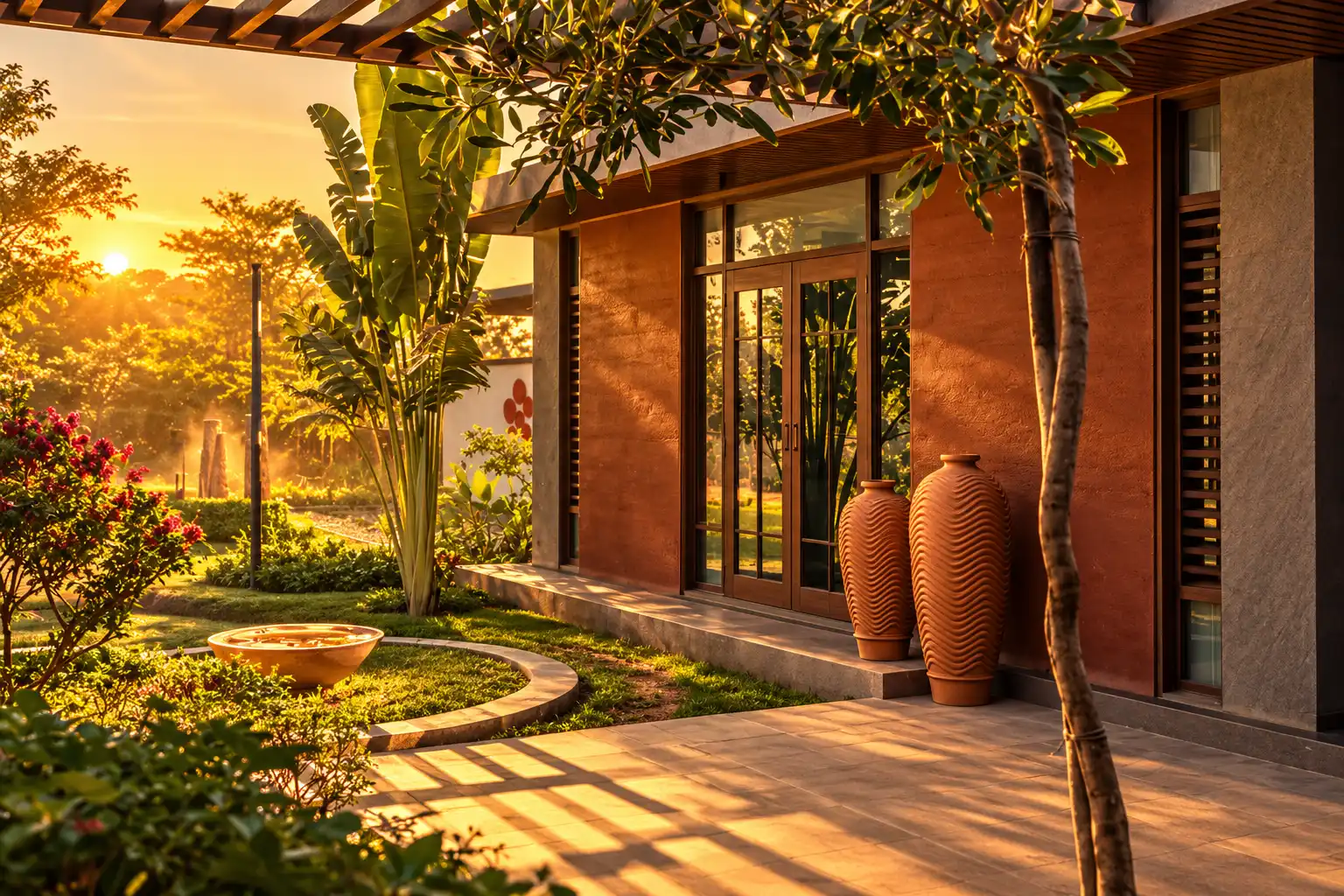
The built-up house occupies 6,300 square feet of a 22,500-square-foot triangular plot, so 16,200 square feet stay open and 28 percent of the land is built. Kakadiya said every elevation shows, so the team could not dress only the front. The plan turns inward instead, wrapping three sides of a central courtyard that pulls light and air into the rooms.
There is no attempt to frame long views. Openings are wooden louvered windows, set horizontal so a breeze can be sent upward when a direct draft is not wanted. Thirty-inch overhangs keep sun off the walls. Kakadiya treats shadows as part of the daily sequence, not as leftovers from the structure.
THE HOUSE IN FIGURES
| Measure | Figure |
|---|---|
| Built-up area | 6,300 square feet |
| Plot | 22,500 square feet, triangular |
| Unbuilt ground | 16,200 square feet |
| Rammed-earth walls | 9 inches, soil from Morbi |
| Roof overhangs | 30 inches |
Nine-inch rammed-earth walls, packed from red Morbi soil, take the main load of the climate argument. Other walls use compressed stabilised earth blocks, which are pressed rather than fired in a kiln. Natural stone is used on outdoor floors, which Kakadiya said gives the ground plane weight. Photographs are by Studio Secondspace.
The Ahmedabad practice puts “Back to Roots” on its own site and, in Kakadiya’s telling, prefers master artisans over imported finishes. “The client didn’t want a home with Italian marble flowing through it,” he said. The family follows Jainism and, he added, holds contemporary schooling and those older rules at the same time.
Passive Cooling Loses at 40°C in Bhuj
Kakadiya was blunt about the limit of the envelope he drew.
When the ambient temperatures hit 40 degrees and more, passive cooling fights a losing battle
Hiten Kakadiya, principal architect, Aayam Architects
Bhuj crossed that line in the second week of October, not in May. An IMD bulletin issued on October 15 put the city’s October 14 maximum at 40.0°C, 3.1°C above normal, with Deesa at 40.2°C the same day. A week later the heat had eased only a little. The department’s Bhuj’s 39.3°C reading on October 21 was still 2.3°C above normal, with a night minimum of 23.8°C, 1.5°C above normal. Rajkot led the region that day at 40.6°C. The forecast from that report held dry weather over Kutch for the following week, with no large change in maximums.
OCTOBER HEAT IN BHUJ
- October 14 maximum: Bhuj 40.0°C, 3.1°C above normal.
- October 21 maximum: Bhuj 39.3°C, 2.3°C above normal.
- October 21 night: Bhuj 23.8°C, 1.5°C above normal.
- Regional high, October 21: Rajkot 40.6°C.
Kachchh summers have long run from 33 to 45°C, a band recorded in post-2001 reconstruction studies, so 40°C is not a new physics problem for the district. What has changed is the calendar. A house sold as a reply to summer heat was being photographed while Bhuj was still near 40°C in the third week of October, with nights too warm for the walls to dump the day’s load. The louvers, the courtyard and the 30-inch eaves still do their work. They do not retire the compressor.
Why the Sister Sleeps on a Window Ledge
Religion drew lines the climate model did not. In the sister’s room, a ledge by the window is the preferred sleeping spot. The bed in that room is for guests.
It sits there simply, without explanation, yet it holds deep meaning for the initiated, who instantly comprehend its purpose
Hiten Kakadiya, principal architect, Aayam Architects
A paved walking track runs around the house so residents do not have to step on grass, a practice discouraged in their religion because of ahimsa, the duty to reduce harm to small life. The path is not a garden flourish. It is a route that keeps feet off plants and the insects that live in them, and it is why so much of the 16,200 unbuilt square feet is hard paving rather than lawn.
JAIN MOVES IN THE PLAN
- Window ledge: The sister sleeps on a ledge by the window, a spot Kakadiya said the initiated recognise at once.
- Guest bed: The bed in that room is kept for houseguests, not for her daily rest.
- Paved track: A hard path rings the house so the family can walk without treading on grass.
Those three moves do more to explain the ground plane than any diagram of stack ventilation. The courtyard still feeds light and air. The track decides where a body is allowed to go. Kakadiya said the family holds both its schooling and its vows without a fight, and the drawings follow that truce: a modern bungalow whose circulation is a religious instrument.
Nine-Inch Earth Walls Follow a Post-Quake Minimum
The wall thickness is not a rustic gesture. After the January 26, 2001 earthquake, which the U.S. Geological Survey put at magnitude 7.7, the Gujarat State Disaster Management Authority issued guidelines for new earthen houses. Elizabeth Hausler’s paper for the 13th World Conference on Earthquake Engineering records a GSDMA nine-inch minimum for rammed earth, written as 230 mm, with a 5.0 MPa crushing strength and reinforced concrete seismic bands at plinth and lintel. Compressed earth-block walls were given the same 230 mm width. Kachchh sits in Seismic Zone V, the highest Indian band. Authorities counted 215,255 houses completely destroyed across Gujarat. Annual rainfall in the district is about 345 mm.
Kakadiya’s nine-inch Morbi-soil walls match that reconstruction minimum, even though this is a large private bungalow rather than a rural replacement unit. Hunnarshala Foundation in Bhuj had already packed more than 2,000 cement-stabilised rammed-earth houses in the years after the quake, which is how the method moved from relief yards into ordinary practice. This house does not claim that credit. It does use the same earth logic on a triangular plot with a courtyard and a glass gazebo.
FROM 2001 TO A NINE-INCH WALL
- January 26, 2001: A magnitude 7.7 earthquake strikes Kachchh; 215,255 houses across Gujarat are later logged as completely destroyed.
- December 2001: GSDMA issues guidelines for stabilised earthen walls, including 230 mm rammed earth, 5.0 MPa strength, and seismic bands.
- April 2008: Kakadiya’s Aayam Architects is established in Ahmedabad, with a stated practice in earth, stone and wooden roofs.
- October 14, 2026: Bhuj records 40.0°C, the air temperature at which Kakadiya says this house’s passive cooling loses.
The other walls are compressed stabilised earth blocks. The Auroville Earth Institute describes the method as moistened soil compressed in a steel press, usually with cement or lime, then cured. A Ministry of Housing and Urban Affairs note puts the stabiliser at cement of up to 5 percent and a 28-day cure, with dry strength after that period in the 5 to 9 MPa range. The blocks are not fired, which is the energy saving Kakadiya cites, and they still need those seismic bands in Zone V. Brick-like earth, in this town, is a structural choice with a date stamp.
Alankaram’s Artisans Furnished the Rooms in Wood
The client refused Italian marble. The rooms were filled instead with handcrafted wooden furniture from Alankaram, made by female artisans. Kakadiya said each piece carries its own character and that the wood makes the rooms feel simple and comforting. Alankaram, founded by architect Anupriya Sahu, runs a 200,000-square-foot solid wood workshop in Pithampur, Madhya Pradesh, with about 350 artisans and a catalogue the company puts at more than 800 designs and 5,000 SKUs in teak, ash, oak and beech.
That is a long supply line for a house that boasts local soil. The Morbi earth stayed in Kutch. The chairs and beds came from a factory several states away, then met a Jain brief that already banned a marble floor. The warmth Kakadiya praises is real, and it is manufactured. Female hands in Pithampur, not a village carpenter on site, produced the “craft over uniformity” he describes.
A short walk from the main bungalow, a glass-walled gazebo works as a family sit-out and as a waiting room for visitors tied to the client’s work. Even the garden building has a job. The inward house keeps family life off the grass; the glass room receives the office.
The Garden Uses Only Local Trees
Tattva Designs handled the planting. Kakadiya said no trees were imported for looks and that the landscape is treated as part of daily living. Tattva Landscapes is a Gujarat practice that has worked on courtyard and tree-led houses around Ahmedabad; here the brief was local species only, on a plot where a paved track already decides how people move.
The soil, the blocks, the louvers and the 30-inch eaves are doing climate work. The track, the ledge and the gazebo are doing social work. Air conditioners do the rest once the mercury reaches the number Kakadiya named, a number Bhuj actually posted on October 14, 2026, and nearly posted again a week later. The house belongs to its plot in the ways he listed. It also belongs to a Kutch summer that now runs into October, and to a reconstruction code that already knew nine inches of rammed earth was a starting point, not a finish.
Frequently Asked Questions
What Are Compressed Stabilised Earth Blocks?
They are bricks made from local soil, sand and water, mixed with a small share of cement, pressed in a manual or motorised steel mould, and cured for 28 days instead of being baked in a kiln. A Ministry of Housing fact sheet puts typical dry compressive strength after that cure at 5 to 9 MPa and wet strength at 3 to 4 MPa; the Auroville Earth Institute’s Auram Press 3000 can form dozens of block shapes from one machine. In this Bhuj house they share the walls with nine-inch rammed earth and still require seismic bands because Kachchh is Zone V.
Why Do Jain Households Avoid Walking on Grass?
Ahimsa, the vow of non-harm, extends to insects, worms and other small life that live in turf, so many Jain households treat a lawn as a surface that should not be crossed without need. Monks may sweep the path in front of their feet; householders often pave the routes they use every day. That is why this bungalow has a walking track around the building and why the sister’s ledge, not a garden bed under the trees, is the designed place to rest.
Who Designed the Bhuj Rammed Earth House?
Hiten Kakadiya, principal of Aayam Architects in Ahmedabad, a practice established in April 2008 that lists earth construction, stone and wooden roofing as its usual tools. Studio Secondspace photographed the finished bungalow. Alankaram in Pithampur made the wooden furniture, and Tattva Designs planted only local trees. The client is unnamed; Kakadiya said the family follows Jainism and rejected an Italian-marble interior.
Why Does the House Still Use Air Conditioning?
Kakadiya said passive cooling loses once outdoor air hits 40°C and above, and Bhuj’s October 14, 2026 night minimum was 25.6°C, 2.7°C above normal, which is a poor setup for walls to shed the day’s heat after dark. Courtyard air, horizontal louvers and 30-inch overhangs still cut glare and slow the morning gain. They do not bring a 6,300-square-foot house through a 40.0°C afternoon without compressors.

Bulk Scotch Still Faces Full Duty After India’s UK Deal

Typhoon Champi Loops Off Taiwan and Still Injures 527

PM Modi Opens Chinmaya’s AI Guru and Asks for Unity

Mahim Police Hold a JeM Suspect on Enmity Charges

Gold Falls Below $4,000 as Hormuz Oil Hits $117

The iPhone 18 Pro Max Splits Apple’s Fall in Two

OpenAI Calls GPT-6 Astra AGI Then Locks Its Exploits

Clancy Juror Says the Holdout Never Cited Evidence

Trump Claims Hormuz Control as Oil Holds Near $96

Russia Closes the Goethe-Institut Berlin Tried to Save

 NEWS2 months ago
The iPhone 18 Pro Max Splits Apple’s Fall in Two
- NEWS2 months ago
OpenAI Calls GPT-6 Astra AGI Then Locks Its Exploits
- NEWS1 month ago
Clancy Juror Says the Holdout Never Cited Evidence
- BUSINESS2 months ago
Trump Claims Hormuz Control as Oil Holds Near $96
- LIFESTYLE2 months ago
Russia Closes the Goethe-Institut Berlin Tried to Save
- AUTO2 months ago
Volkswagen’s Job Cuts Leave Four Plants Without Cars
- NEWS2 months ago
Dyson Puts Nurovi Robots on Sale Without the UV Flagship
- NEWS2 months ago
The Lincoln’s 286-Day War Cruise Ends at a Thai Pier










