
NEWS
Riyadh Airport Reopens as Houthi Strikes Ground Foreign Flights
Houthi strikes killed three at Riyadh airport, and EASA plus major airlines now treat Saudi airspace as too dangerous to fly.

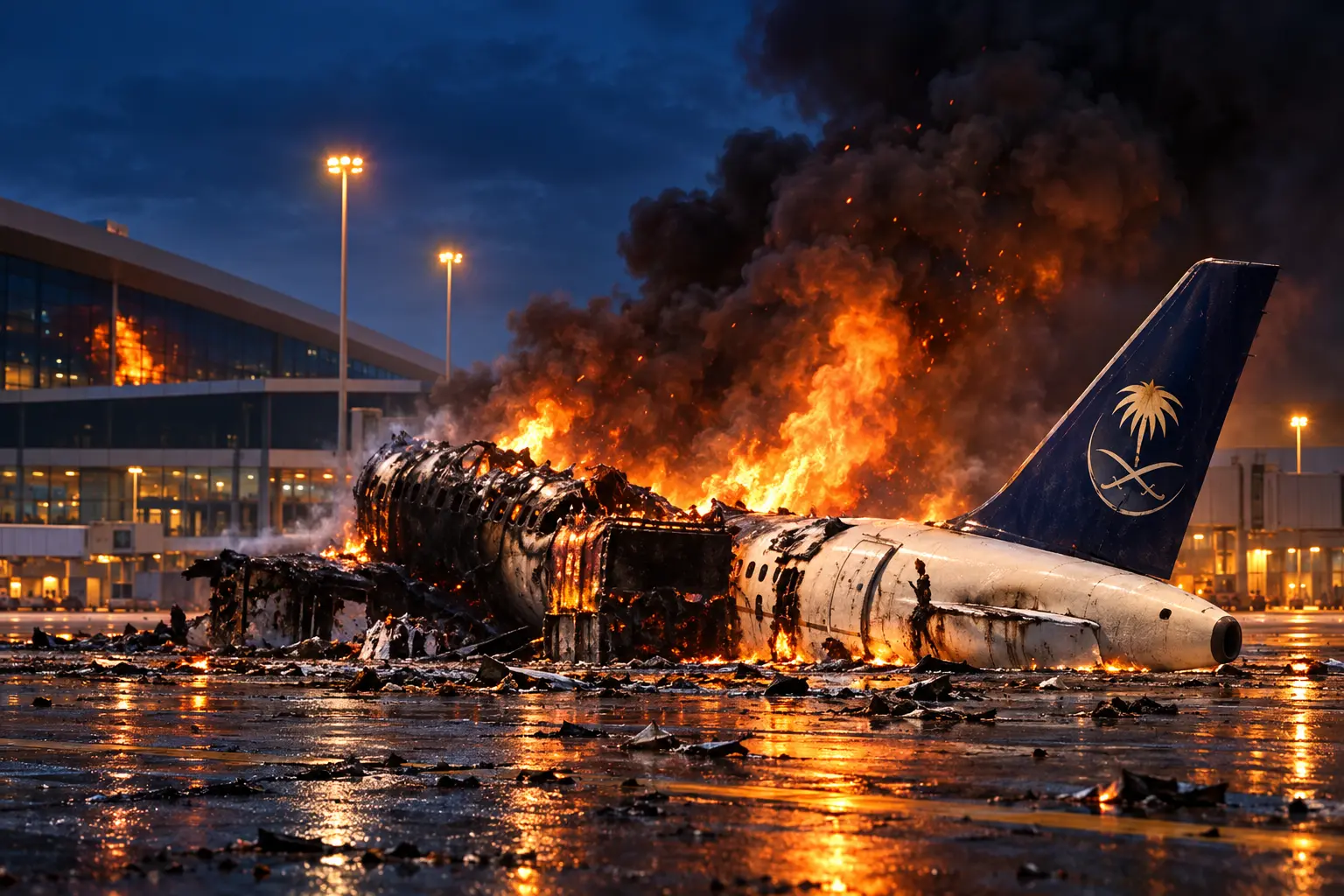
Two Houthi-claimed missile strikes on Riyadh’s King Khalid International Airport on October 8 killed three Saudi citizens, including a Saudia captain, and damaged a parked airliner. The General Authority of Civil Aviation said the first blow hit airport facilities and the second hit a Saudia jet. Several other people of mixed nationalities were wounded, with injuries from minor to critical.
GACA said air traffic had returned to normal the same evening. Foreign regulators and airlines spent Friday treating Saudi airspace as a live missile zone anyway.
Two Missiles and a Parked Saudia Jet
Saudia identified the dead crew member on October 9 as Captain Hamoud Ali Alkalthami and said he died in the October 8 incident at the airport. The airline did not say where on the field he was when he was killed. It did say the damaged aircraft was empty.
It is with profound sadness that Saudia announces the passing of Captain Hamoud Ali Alkalthami, who lost his life on Thursday, October 8, 2026, in the incident at King Khalid International Airport in Riyadh.
Saudia, official obituary, October 9, 2026
GACA’s Friday statement, posted in Arabic and then in English, is the official Saudi account of how the field was hit twice.
بعد الخبر هذا اتمنى حرق الحوثي عن بكرة ابيه رحمهم الله وجعلهم من الشهداء
— الدوسري 🇸🇦💚 (@502asa) October 9, 2026
The other two Saudi citizens killed on October 8 have not been named. All of the wounded were taken to hospital, GACA said, and the authority was still assessing damage to buildings and the jet. Clips offered as Thursday’s strike included older wreckage from other countries. The only firm description of what burned on the Riyadh tarmac is the one GACA and Saudia put out: a Saudia aircraft was damaged on the ground, with no passengers aboard.
Saudia said its own flights and operations at King Khalid had returned to normal as of 6 p.m. on October 8, and that it was still watching the schedule. Flightradar24 later showed a patchy restart, with some Middle Eastern carriers moving and many other flights still cancelled or delayed. Keeping the runway open is a political choice. Filling the seats is someone else’s.
Lufthansa and KLM Halt Riyadh After the Strikes
Europe’s aviation safety agency had already warned operators off a slice of Saudi airspace at the end of September. On October 9 it revised that active Saudi airspace bulletin, CZIB-2026-09, which remains in force until November 16 unless it is reviewed sooner. The bulletin covers FIR Jeddah (OEJD) at all altitudes and flight levels. It tells EASA operators and third-country operators flying into the EU they should not operate at any altitude inside a mapped polygon running through RIBOK, BOSUT, ISLAM, DEKLO, OBSAM and SILPA, and that they should treat the rest of the FIR with caution.
EASA’s text says recent attacks show the Houthis can and will strike deeper inside the kingdom, including in the Riyadh, Tabuk and Yanbu areas, and that missiles, drones and air-defence fire raise the risk of a civil aircraft being misidentified, overflew or hit by debris. OPSGROUP, a professional aviation-risk network, went further with its members on Friday.
AVIATION ORDERS AFTER THE RIYADH STRIKES
- EASA CZIB-2026-09: Do not fly the mapped Jeddah FIR slice at any level; use caution in the rest of the FIR; bulletin first issued September 30 and revised October 9, valid until November 16.
- OPSGROUP: Avoid operations in Saudi Arabia entirely, including the use of Saudi airports as en route alternates.
- Lufthansa: Halt flights to Riyadh until October 16.
- KLM: Keep Riyadh grounded until October 25.
- Air India: Suspend Riyadh services, joining other carriers that pulled the route after Thursday’s hits.
- UK, France and Germany: Advise citizens against all but essential travel to Riyadh.
Those are not the same statement as GACA’s claim that the airport is open. Saudi crews can still be told to fly. A German or Dutch dispatcher working under EASA’s bulletin, or under a corporate policy that tracks Western travel warnings, cannot treat King Khalid as a normal alternate. Andrew Charlton, managing director of the Swiss consultancy Aviation Advocacy, called the decision to keep Saudi airports open “quite unusual,” because the default in his trade is to close first. He also drew a line with the Iran war that restarted this region’s airspace crisis in February: Iranian forces never said they were targeting aviation. The Houthis have.
Why the Houthis Are Hitting Civilian Runways
Houthi military spokesman Yahya Saree said on October 8 that the group had fired two missiles at King Khalid Airport, one at Najran airport and another at the air base in Khamis Mushait. The Saudi-led coalition’s spokesman, Maj. Gen. Turki al-Maliki, said his forces intercepted two ballistic missiles heading toward Riyadh and a third toward Khamis Mushait. Both accounts can sit together. Some shots get killed. Some still land. GACA’s two-attack statement is the evidence that at least two of them counted on the field.
On October 9 the Houthis repeated that Saudi airspace, except over Mecca and Medina, is a theatre of operations for their missile forces. They have told airlines they will accept no responsibility for crews, passengers or ground staff if that warning is ignored, and they have tied the warning to an end of what they call the aggression and blockade on Yemen. Humanitarian flights into Riyadh would be allowed only with prior leave, they said. Mohammed Albasha, founder of the Basha Report risk shop, described the shift as a move past energy sites and bases onto civilian airports and commercial flying, part of a pressure campaign against Saudi energy, transport and military targets.
The method is not new. On September 18 the Saudi-led coalition said it intercepted a suspected Houthi ballistic missile aimed at King Khalid. A day later an explosion was heard near the airport and black smoke rose from a fuel-storage area. This week’s fire is the same play run against a parked airliner and against people standing on a civilian field. Sanaa’s airport has been under pressure for months. The Houthi answer is to make Saudi airports pay in kind.
Six People Died at Airports in Three Days
Thursday’s three Saudi dead sit on top of a GACA tally from October 6 and 7. Abha International Airport and King Khalid were hit in separate attacks those two days. Three civilians were killed and 36 people were injured. The dead were not Saudi citizens. They were foreign residents who happened to be on the wrong field.
AIRPORT ATTACKS FROM OCTOBER 6 TO 8
| Date | Airport | Killed | Injured |
|---|---|---|---|
| October 6 | Abha International | 2 female residents, Moroccan and Algerian | 28, including Saudis plus Bangladeshi and Filipino residents |
| October 7 | King Khalid International | 1 Sudanese resident | 8: 5 Saudi citizens, 2 Egyptian residents, 1 Pakistani resident |
| October 8 | King Khalid International (two attacks) | 3 Saudi citizens, including Capt. Alkalthami | Several, mixed nationalities, minor to critical |
Abha produced the larger wound list. King Khalid produced the named Saudi captain and the burned jet. Across the three days that is six people killed at civil airports. GACA had also recorded wounded in earlier strikes on Jazan and Najran, closer to the Yemen border. The Houthis have made passenger terminals the main Saudi-side target of this round, not a side effect of shots at bases.
Pakistani Troops Are Already Inside Riyadh
The airport campaign is already pulling in armies that were not in this war a few months ago. On October 5, Saudi Arabia, Pakistan and Turkey agreed to a rapid deployment of forces under their mutual defence pact with Pakistan. Lt. Gen. Ahmed Sharif Chaudhry, the Pakistani military’s media chief, confirmed the troops were already in the kingdom. “The forces of Pakistan are already there. That I can share with you,” he said, refusing to give numbers or kit.
Foreign Ministry spokesman Sajjad Haider Khan said a substantial number of Pakistani forces and resources were in Riyadh, and that they would not cross into Yemen to attack the Houthis. They were there, he said, in defence of Saudi territory. Defence Minister Khawaja Asif has argued separately that the pact does not bar members from treating an attack on one as an attack on all. An anonymous claim that Pakistani jets had already joined strikes on Yemen was denied by Islamabad the same day it appeared.
Al-Maliki said the coalition had destroyed three rocket launch platforms used in the airport attacks and that shots at civilians and civilian sites “will be met with resolve.” Overnight into October 9, air strikes were reported in Sanaa. Explosions were also reported in Aden. On the ground, Yemeni government forces have been trying to claw back the Red Sea coast around the Bab el-Mandeb Strait after a Houthi surge last month, and fighting has thickened around Taiz.
At the United Nations on October 9, Hans Grundberg, the Secretary-General’s special envoy for Yemen, told the Security Council the country had slid back into full-scale war.
Ansar Allah has also carried out attacks against civilian and energy infrastructure in the Kingdom of Saudi Arabia, including recent attacks against Abha International Airport and King Khalid International Airport in Riyadh, which killed and injured civilians.
Hans Grundberg, UN Special Envoy for Yemen, Security Council briefing, October 9, 2026
Saudi ambassador Abdulaziz al-Wasil asked the council to treat the shots at civilians, and the threat to Red Sea and Bab el-Mandeb shipping, as a matter of international peace. Abdullah Ali Fadhel al-Saadi, sitting for Yemen’s internationally recognised government, said the Houthi threat was no longer an internal Yemeni affair. US deputy envoy Jeff Bartos condemned the airport attacks and called on Iran to end its support. Pakistan’s UN ambassador, Asim Iftikhar Ahmad, condemned the strikes on King Khalid and Abha and on sites in the Makkah and Madinah governorates, and said the Two Holy Mosques must be left alone. The UAE Ministry of Foreign Affairs called the Riyadh hits a violation of Saudi sovereignty. Cyprus issued a similar condemnation. None of those statements puts a commercial jet back on a European schedule.
The Oil Congress Still Has a Sunday Date
Riyadh is still listed as host of the WPC Energy Congress from Sunday, a gathering of oil ministers, officials and company executives. The event was still being advertised on October 9. Italian energy minister Gilberto Pichetto Fratin said he would join by video and would not attend in person, without giving a reason. The Future Investment Initiative, the kingdom’s flagship investor conference later in the month, is still described as going ahead. Corporate travel desks that follow British, French or German warnings will not need a reason from Rome to stay home.
That is the second blow the airport campaign is built to land. The first is the six people killed on the fields at Abha and Riyadh. The next is a capital that can declare its runways open while Lufthansa’s last Riyadh flight sits on a calendar that now ends on October 16, KLM’s on October 25, and EASA’s mapped hole in Jeddah FIR stays in force into November. Saudia can mourn Alkalthami and push its own metal. It cannot write the insurance clause that lets a foreign carrier treat King Khalid as just another alternate.

Bulk Scotch Still Faces Full Duty After India’s UK Deal

Typhoon Champi Loops Off Taiwan and Still Injures 527

PM Modi Opens Chinmaya’s AI Guru and Asks for Unity

Mahim Police Hold a JeM Suspect on Enmity Charges

Gold Falls Below $4,000 as Hormuz Oil Hits $117

The iPhone 18 Pro Max Splits Apple’s Fall in Two

OpenAI Calls GPT-6 Astra AGI Then Locks Its Exploits

Clancy Juror Says the Holdout Never Cited Evidence

Trump Claims Hormuz Control as Oil Holds Near $96

Russia Closes the Goethe-Institut Berlin Tried to Save

 NEWS2 months ago
The iPhone 18 Pro Max Splits Apple’s Fall in Two
- NEWS2 months ago
OpenAI Calls GPT-6 Astra AGI Then Locks Its Exploits
- NEWS1 month ago
Clancy Juror Says the Holdout Never Cited Evidence
- BUSINESS2 months ago
Trump Claims Hormuz Control as Oil Holds Near $96
- LIFESTYLE2 months ago
Russia Closes the Goethe-Institut Berlin Tried to Save
- AUTO2 months ago
Volkswagen’s Job Cuts Leave Four Plants Without Cars
- NEWS2 months ago
Dyson Puts Nurovi Robots on Sale Without the UV Flagship
- NEWS2 months ago
The Lincoln’s 286-Day War Cruise Ends at a Thai Pier










