
LIFESTYLE
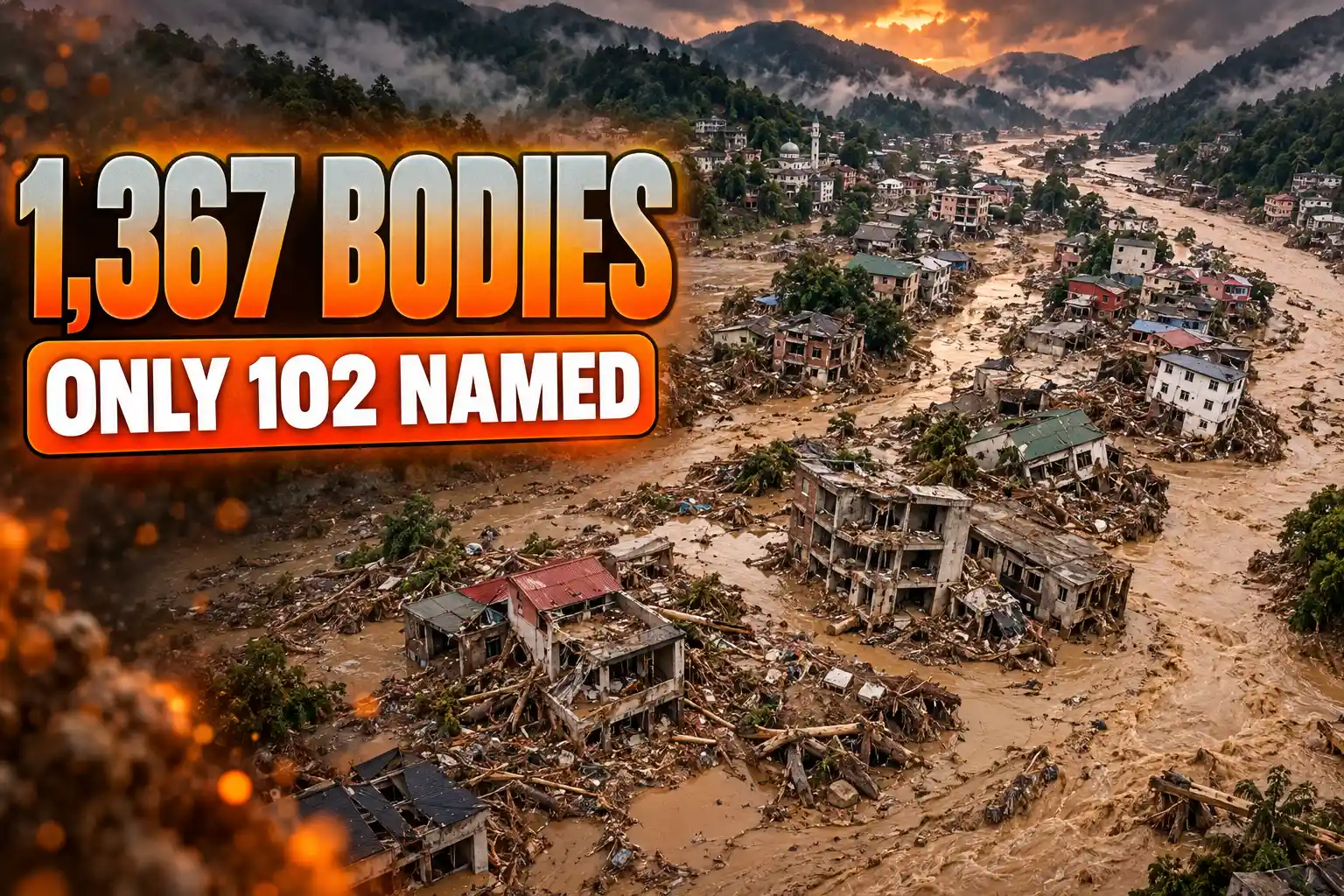
Nepal Recovers 1,367 Flood Bodies but Names Only 102
Nepal has recovered 1,367 flood bodies and named only 102, as DNA labs and a NPR 11.98 billion fund take over from tunnel rescue.

Nepal has recovered 1,367 bodies from the August 26 Bhote Koshi flood, yet only 102 have been handed to families, while 5,132 people remain listed as missing. Search crews have pulled 13,646 people out alive, and more than 21,000 security personnel are still in the field.
The Prime Minister’s Disaster Relief Fund now holds NPR 11.98 billion (about $79 million), but the longer job sits in the labs, where Indian forensic teams are processing more than 1,400 DNA samples against unnamed graves.
Only 102 Families Have Been Given Remains
The National Disaster Risk Reduction and Management Authority, in a September 9 bulletin, put recovered bodies at 1,367 and the missing at 5,132, including 587 foreign nationals. NDRRMA spokesperson Shanti Mahat said 102 of those remains have been identified and returned. That is about one in 13 bodies. Another 7,151 people have received medical treatment, and 3,628 displaced people are in holding centres in Nuwakot, Dhading, Rasuwa and Kathmandu.
Nepal Police figures compiled the same week show specialised teams have taken 2,698 DNA samples, 1,286 from the dead and 1,412 from relatives hunting for kin. Profiles and photographs of 1,310 unidentified victims have been put on an official site so families can look for a match. The Ministry of Health said on September 1 that only 4 percent of the roughly 900 bodies found by then had been named. The ratio has barely moved.
THE IDENTIFICATION GAP
- Bodies recovered: 1,367 as of September 9, according to NDRRMA.
- Handed to families: 102 remains returned after verification.
- Still missing: 5,132 people, including 587 foreign nationals.
- Samples on file: 2,698 DNA samples, split between the dead and living relatives.
Most of the recovered dead did not turn up in Rasuwa, where the surge first hit. They turned up far downriver, which is why so many families still have no body to bury.
BODIES RECOVERED BY DISTRICT
| District | Bodies recovered |
|---|---|
| Chitwan | 363 |
| Nawalparasi East | 226 |
| Nawalparasi West | 222 |
| Nuwakot | 197 |
| Rasuwa | 174 |
| Gorkha | 75 |
| Dhading | 70 |
| Tanahun | 38 |
| Kathmandu (died in care) | 2 |
More than one in four recovered bodies were found in Chitwan, about 100 miles below the collapse. Nawalparasi East and West together account for 448 more. Rasuwa, at the border, has 174 recovered dead and 2,860 people listed missing, among them 1,393 local residents, 45 army personnel, 25 Nepal Police, 12 Armed Police Force, 73 government staff and 26 bank employees. Nuwakot has 1,787 missing against 197 bodies. The river moved people faster than recovery teams could.
Some remains travelled 240 kilometres into India. Superintendent of Police Navin Karki, chief of Kaski District Police, said unidentified bodies had to be buried after DNA was taken because they could not be kept. “There was no way to keep the bodies preserved indefinitely. As the smell created a risk of disease outbreaks, we had to manage them,” he said. Temporary graves have been opened in the Devghat forest in Chitwan and in Gokarna on the edge of Kathmandu, under the Unclaimed Bodies Management (First Amendment) Directive, 2026, with pits 1.5 metres down and 40 centimetres apart, each body in a sealed bag after photographs, fingerprints and samples.
Langtang Lirung Failed in Under Eight Minutes
The flood was not a monsoon cloudburst and not a glacial lake burst. At 8:37 a.m. Nepal time on August 26, ice and bedrock let go on the north flank of Langtang Lirung, at about 5,200 metres. Seismometers first logged a magnitude 4.4 quake. The U.S. Geological Survey later reclassified the shaking as a glacial collapse and debris flow, event us7000tbwb, magnitude 5.2. No tectonic quake had occurred. Geomorphologist Kristen Cook at Université Grenoble Alpes said the rock the glacier sat on collapsed, sending millions of metric tons of rock and ice into the valley.
A Nepal Environment Society field study estimated 100 to 200 million cubic metres of ice and rock, four to eight times the 2021 Chamoli collapse in India. The mass dropped 2,270 metres from about 5,200 metres to the Lhende Khola at about 2,930 metres. Water levels at Rasuwagadhi and Syabrubesi had been falling between 5 a.m. and 8 a.m., a sign the river may already have been blocked upstream. There was no large cloudburst in the upper catchment that morning.
The surge that then hit Rasuwagadhi did not look like a river coming up its banks. It looked like the valley had been emptied and thrown downhill, which is why gauges built for monsoon rise never had time to warn anyone.
THE MORNING THE VALLEY EMPTIED
- August 26, 8:37 a.m. NPT: Ice and rock detaches from Langtang Lirung and registers as a magnitude 5.2 seismic signal.
- August 26, 8:44:55 a.m.: The surge reaches Rasuwagadhi, 22 kilometres on, at about 167 kilometres per hour.
- August 26, about 9:20 a.m.: The flow reaches Betrawati after another 44 kilometres, slowed to about 73 kilometres per hour.
- August 26, about 3:20 p.m.: The flood reaches Devghat, far down the Trishuli, at about 22 kilometres per hour.
- September 4: Two Nepali workers come out of the Upper Trishuli 3A tunnel alive.
- September 5: A Chinese national is pulled from Upper Trishuli 1.
- September 8: A magnitude 5.0 earthquake strikes northwestern Nepal while flood crews are still deployed.
CCTV at the border showed floodwater hitting the Gyirong port crossing into Tibet about seven minutes after the seismic signal. The channel, once 100 to 300 metres wide, opened to about 900 to 1,300 metres in places. Four automatic hydrological stations on the Bhote Koshi and Trishuli were destroyed. Text alerts went out at 9:15 a.m., 679,295 of them in a minute, after several towers were already down. Chinese and Nepali flood sirens had been tuned for monsoon water and for glacial lakes. This failure was bedrock and ice, and the monitors were in the path.
Hydropower Crews Make Up a Hidden Share of the Missing
Early NDRRMA registers put more than 900 hydropower workers among the missing, clustered on plants bored into the same corridor the debris filled. The Nepal Electricity Authority said 13 hydropower sites and one solar plant were hit, taking about 431 megawatts off the grid. The 220 kV Trishuli 3B substation was destroyed. About 32 suspension bridges were damaged from the source down to Dhading.
Tunnel crews from India, China and South Korea are still working with the Nepali Army at the buried plants, a grind that already follows a familiar Himalayan tunnel-rescue pattern. The United Arab Emirates and Malaysia have joined the wider search. Live finds inside the pipes have almost stopped. The foreign ministry said two Nepali nationals were taken alive from Upper Trishuli 3A on September 4 and one Chinese national from Upper Trishuli 1 on September 5. No later live tunnel rescue has been confirmed.
TUNNEL SITES STILL UNDER SEARCH
- Upper Trishuli 1: One Chinese national was brought out alive on September 5; Indian crews are still pumping slush at nearby Chilime.
- Upper Trishuli 3A: Two Nepali nationals were rescued on September 4 after days inside the pipe.
- Upper Trishuli 3B: The 220 kV substation was destroyed; crews remain on the plant.
- Chilime, Rasuwagadhi and Langtang: Extra pumps, drones and tunnel suits have been sent to all three, the foreign ministry said.
Above ground, 13,646 people have been brought out, among them more than 300 foreigners. Among the living is a 97-year-old woman who rode an excavator to safety. NDRRMA said on September 2 that nearly 1.6 million people had been affected. The people still unaccounted for are no longer, in the main, expected to walk out of a tunnel. They are expected to match a sample.
A Separate Earthquake Interrupted the Search
A magnitude 5.0 earthquake struck northwestern Nepal at 9:38 p.m. India time on September 8, while flood units were still deployed. India’s National Centre of Seismology put the epicentre at 29.022 degrees north, 83.978 degrees east, at a depth of 143 kilometres. Because the focus was deep, surface damage was expected to be limited. It was not the Langtang collapse relabelled. That signal on August 26 was the ice and rock itself. This one was a tectonic jolt two weeks later, in a different part of the country, landing on crews already stretched across Rasuwa, Nuwakot, Dhading, Gorkha and Chitwan.
The coincidence still mattered on the ground. Helicopters, Bailey bridge teams and tunnel pumps had to pause and check slopes that were already stripped. The flood had already taken the Friendship Bridge, the Rasuwagadhi customs yard and police posts at Timure, Rasuwagadhi and Syabrubesi. Prime Minister Balendra Shah had been in Nuwakot the day after the collapse. On September 8 the search was still running when the ground moved again.
NPR 11.98 Billion Has Reached the Relief Fund
Cash has moved faster than names. The Office of the Prime Minister and Council of Ministers said on September 9 that NPR 11.98 billion had been deposited in the Prime Minister’s Disaster Relief Fund accounts. Of that, NPR 8.78 billion sits in nine commercial banks and $21.14 million in two dollar accounts. NPR 1 billion has already been released to NDRRMA for the response. Shah and the cabinet pledged one month’s salary to the fund after the flood.
PRIME MINISTER RELIEF FUND, SEPTEMBER 9
| Item | Amount |
|---|---|
| Total deposited | NPR 11.98 billion |
| Local-currency accounts (9 banks) | NPR 8.78 billion |
| Dollar accounts (2 banks) | $21.14 million |
| Already sent to NDRRMA | NPR 1 billion |
That pile is not the whole outside purse. Finance Secretary Ghanashyam Upadhyay told parliament’s Economy Committee that forensic kits and body bags had come from five countries, that the United States had provided a $5 million grant plus $0.15 million in technical aid, and that China had provided a $2 million grant. The World Bank’s CAT-DDO facility has already disbursed $8.5 million, with $150 million on standby. India has sent 95 tonnes of relief on seven aircraft, plus tunnel and forensic crews, MEA spokesperson Randhir Jaiswal said, and 54 Indian personnel have been deployed, including tunnel-rescue, forensic and medical staff. China sent drones and DNA gear. South Korea sent rescuers and forensic staff.
Deposits were still being announced on September 10. Nepal SBI Bank said it had put NPR 13.1 million into the fund. The money can buy pumps, freezers and temporary bridges. It cannot shorten the wait for a match between a tooth and a relative’s blood.
Foreign Labs Are Matching Samples Against Unnamed Graves
By September 7, Nepal’s foreign ministry had asked partners for DNA testing kits, laboratory freezers, LiDAR, high-capacity drones, Bailey bridges, mud and tunnel rescue suits, and epidemic supplies. Forensic teams from India, China, Japan, Singapore and South Korea have joined Nepal Police. Relatives in Nepal are told to go to Nepal Police Hospital in Maharajgunj or the nearest district police office. Relatives abroad are told to send profiles to dnacodis@nepalpolice.gov.np.
The Nepal Police is facilitating DNA sample collection, testing, and matching them with the DNA of the unidentified or unclaimed bodies. Our wish is to hand over the mortal remains of the flood victims to their respective families, whether they are ours or from any other country.
Dharam Raj Uprety, NDRRMA chief executive
Jaiswal said Indian forensic staff were working in two Kathmandu labs. A ministry update on September 9 said those teams were processing more than 1,400 DNA samples and had generated 378 profiles. Dr J.M. Vyas, vice chancellor of India’s National Forensic Sciences University, said the unit was drawing on work from the AI171 air crash in Ahmedabad, where staff had learned to pull usable DNA from hard samples. India’s Ministry of Home Affairs opened central and state forensic labs, plus NFSU and accredited private labs, to first-degree relatives of the missing who live in India. MEA said 275 Indian nationals are still missing, 169 have been rescued, and 49 of the missing were on the Chinese side of the disaster zone.
𝐏𝐫𝐞𝐬𝐬 𝐑𝐞𝐥𝐞𝐚𝐬𝐞: 𝐃𝐍𝐀 𝐏𝐫𝐨𝐟𝐢𝐥𝐢𝐧𝐠 𝐨𝐟 𝐅𝐢𝐫𝐬𝐭-𝐃𝐞𝐠𝐫𝐞𝐞 𝐑𝐞𝐥𝐚𝐭𝐢𝐯𝐞𝐬 𝐨𝐟 𝐏𝐞𝐫𝐬𝐨𝐧𝐬 𝐌𝐢𝐬𝐬𝐢𝐧𝐠 𝐢𝐧 𝐭𝐡𝐞 𝐅𝐥𝐚𝐬𝐡 𝐅𝐥𝐨𝐨𝐝𝐬 𝐢𝐧 𝐍𝐞𝐩𝐚𝐥
Through its Press Release dated 01 September 2026, the Embassy of India, Kathmandu,… pic.twitter.com/e9waEzpgdB
— IndiaInNepal (@IndiaInNepal) September 3, 2026
NDRRMA said 1.6 million people were affected. Across the border, Chinese figures as of September 6 listed 43 dead and 519 missing in Tibet, 261 of them foreign nationals. Nepal has brought 736 of its own people back from the Chinese side through Tatopani. A Rapid Damage and Needs Assessment is being finished, and a fuller Post Disaster Needs Assessment is under way. Those papers will price roads, plants and houses. They will not name the 5,132 people still on the missing list.
The helicopters are still flying. The fund is still taking rupees. The next confirmed identity is more likely to arrive as a match from dnacodis@nepalpolice.gov.np than as a voice from a tunnel. Until that inbox clears, 1,367 is a count of bodies, not of funerals.

Police Tighten the Ring Around Gyanesh Kumar’s House

Ravi Shankar Calls Hanuman Ansh a Slap to Big Spenders

Microsoft Puts Nvidia in the Surface Laptop Ultra Flagship

Adult Fires on an Armed Juvenile at Longmont Dollar Tree

Jordan Absorbs Iranian Missiles Aimed at Parked US Jets

The iPhone 18 Pro Max Splits Apple’s Fall in Two

OpenAI Calls GPT-6 Astra AGI Then Locks Its Exploits

Russia Closes the Goethe-Institut Berlin Tried to Save

Trump Claims Hormuz Control as Oil Holds Near $96

Volkswagen’s Job Cuts Leave Four Plants Without Cars

 NEWS2 months ago
The iPhone 18 Pro Max Splits Apple’s Fall in Two
- NEWS2 months ago
OpenAI Calls GPT-6 Astra AGI Then Locks Its Exploits
- LIFESTYLE2 months ago
Russia Closes the Goethe-Institut Berlin Tried to Save
- BUSINESS2 months ago
Trump Claims Hormuz Control as Oil Holds Near $96
- AUTO1 month ago
Volkswagen’s Job Cuts Leave Four Plants Without Cars
- NEWS1 month ago
Clancy Juror Says the Holdout Never Cited Evidence
- BUSINESS2 months ago
Cable Stocks Fall as UltraTech Copies the Paints Playbook
- NEWS2 months ago
The Lincoln’s 286-Day War Cruise Ends at a Thai Pier