NEWS
India’s New Apple Watch Series 12 Waits on Hypertension Alerts
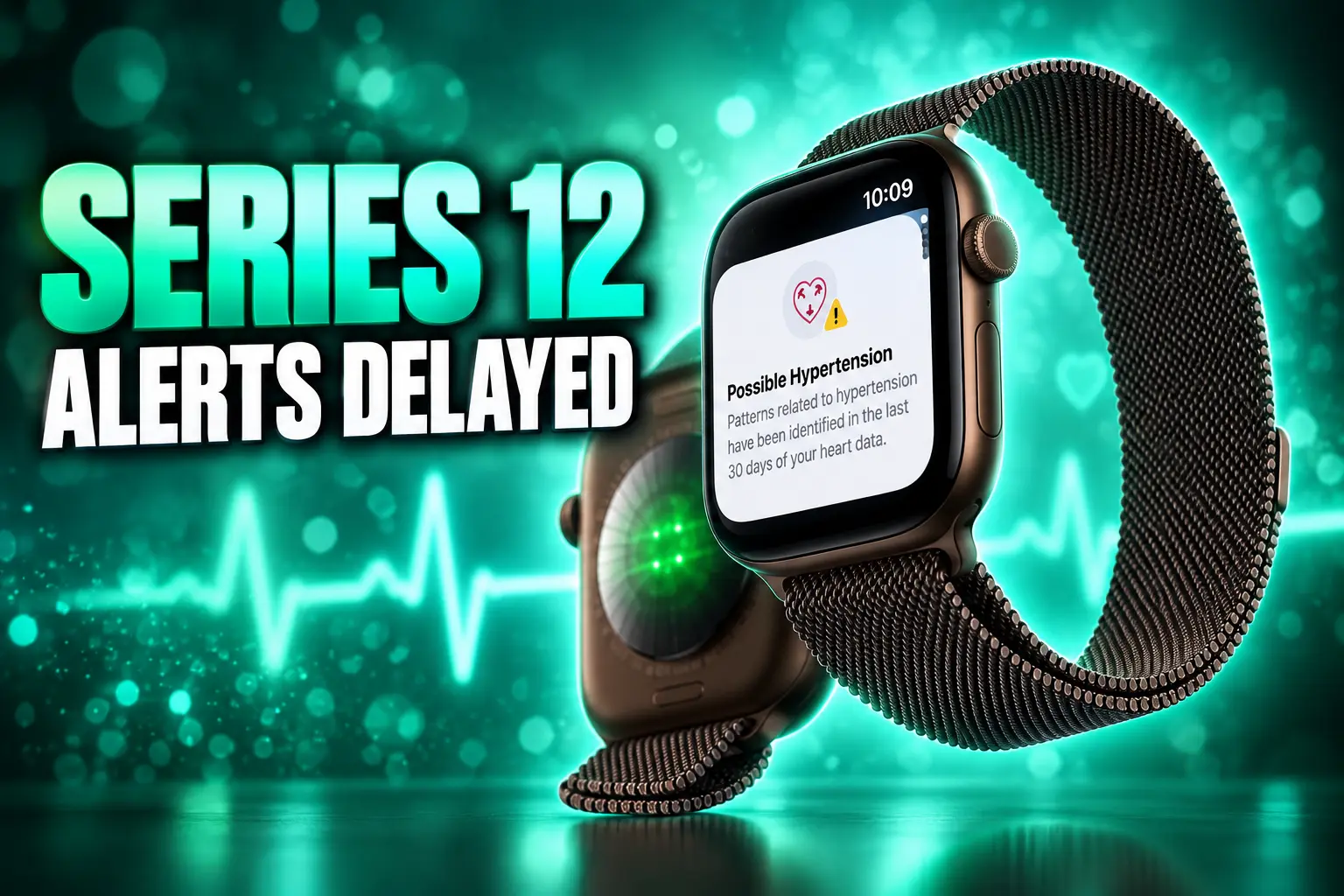
Series 12 and Ultra 4 ship in India without hypertension alerts, even though older Apple Watches already notify, while 210.2 million adults have high blood pressure.

Apple said on September 9 that hypertension notifications will not ship at launch on Apple Watch Series 12 or Ultra 4 in India, with availability expected next year. Pre-orders are open, and both watches reach stores on September 18, with Series 12 starting at Rs 56,900.
The gap is narrower than that sentence sounds. The same alert went live on older Apple Watches in India on December 3, 2025. Buyers of the new heart-sensor stack are the ones who wait.
The Alert Last Year’s Watch Already Sends
Apple’s wording is specific. “Hypertension notifications will not be initially available in India on Apple Watch Series 12 or Ultra 4, as additional regulatory clearances for the feature for these models is in process. Availability is expected next year,” the company said.
That is a model filing, not a decision to pull the feature from the country. Series 9, Series 10, Series 11, Ultra 2 and Ultra 3 can still run the alert for adults who set it up in the Health app. Apple Watch SE was never on the list.
THE WATCHES THAT CAN ALERT YOU NOW
| Watch | Hypertension alerts in India | When |
|---|---|---|
| Series 9, 10, 11 | Yes | Since December 3, 2025 |
| Ultra 2, Ultra 3 | Yes | Since December 3, 2025 |
| Series 12 | No at launch | Clearance expected next year |
| Ultra 4 | No at launch | Clearance expected next year |
| Apple Watch SE | Not supported | Never listed |
Series 11 is still on Apple’s India store from Rs 41,900, and its product page still advertises the hypertension pitch. Series 12’s India page lists sleep apnea notifications, the ECG app and blood oxygen, and does not list the blood-pressure alert.
Apple’s Algorithm Never Reads a Cuff Number
The feature is software. It does not print a systolic or diastolic number, and it is not a blood pressure monitor. The watch’s optical heart sensor collects photoplethysmography, or PPG, data, which tracks how blood volume at the wrist changes with each beat.
A machine-learning model scores those signals, and the iPhone looks for a pattern over a 30-day window. If the pattern looks like chronic high blood pressure, the watch pings the wearer and asks for a seven-day log with a third-party cuff. Apple says the feature was trained on studies totalling more than 100,000 people, then checked in a clinical study of 2,229 adults, of whom 1,863 had enough data for the main analysis.
The U.S. Food and Drug Administration cleared that software on September 11, 2025, as K250507, a Class II over-the-counter application. Overall it posted 41.2% sensitivity in the FDA file and 92.3% specificity. Stage 2 hypertension sensitivity was 53.7%. Specificity in the normal group was 95.3%. Apple has said the first year of the feature could notify more than 1 million people with undiagnosed hypertension.
Hypertension is one of the most widespread yet under-diagnosed health conditions. Integrating opportunistic detection into a device people already wear daily will democratise access for early detection and help people have more informed conversations with their doctors.
Dorairaj Prabhakaran, executive director, Centre for Chronic Disease Control, Apple India announcement, December 2025
Prabhakaran, who is also president-elect of the World Heart Federation, said that on the day the feature opened in India. The intended user is an adult 22 or older who has not already been diagnosed and is not pregnant. A missed ping is not a clean bill of health.
WHO THE FEATURE IS FOR
- Age floor: Adults 22 and over, set up once in the iPhone Health app.
- Who is out: Anyone already diagnosed, anyone pregnant, and Apple Watch SE.
- What it needs: Wrist detection on, regular wear, and at least 14 days of usable waking data in each 30-day window.
- After an alert: Log cuff readings for seven days and take that record to a doctor.
The algorithm uses 60-second PPG clips, taken about every two hours, and drops samples when the accelerometer says the wearer is moving. It is a screen for people who have not been told they have high blood pressure, not a tool for tracking treatment.
210 Million Adults, 17% Under Control
India is a hard place to argue that this alert is a nice-to-have. The World Health Organization’s 2025 country profile counts 210.2 million Indian adults aged 30-79 with hypertension, 30% of that age group. Of those, 173.9 million do not have the condition controlled. Diagnosis sits at 39%. Control sits at 17%.
INDIA’S HYPERTENSION LOAD
- How many: 210.2 million adults aged 30-79, per the WHO 2025 profile.
- Share of that age group: 30%, against a global rate of 33% in 1.4 billion adults in 2024.
- Diagnosed: 39% of those Indian adults know they have it.
- Controlled: 17% have it under control, leaving 173.9 million without control.
High blood pressure often has no symptoms, which is the whole point of a watch that looks for it in the background. Apple’s own India note called it the leading modifiable risk factor for heart attack, stroke and kidney disease. The people who would get the new watches first, urban buyers who already wear an Apple Watch, are not a national screening program. They are still the group Apple asked to pay for a denser heart sensor this year.
What Indian Buyers Get on September 18
Series 12 and Ultra 4 still arrive as the densest health watches Apple has sold here. The new Health Sensing System in India pairs redesigned optical and electrical heart sensors with the S11 chip. Background heart rate is read every five seconds, which Apple says is 60 times more often than on Series 11. Heart-rate variability is sampled up to 24 times more often, as often as every five minutes.
A readiness score from 0 to 10 now sits on top of that stream. It looks at recent activity, training load, vitals and sleep, then offers Recover, Pace Yourself, Ready, or Go For It, and it updates through the day. Overnight and daytime vitals both include recovery HRV. The ECG app, blood oxygen, sleep tracking, sleep apnea notifications, fall detection and Emergency SOS remain on the spec sheet.
Battery life is still listed at up to 24 hours of everyday use. Outdoor workout time moves to up to 10 hours, 25% more than the previous model. A 15-minute charge is rated for up to 12 hours of extra use, 50% more than before. Series 12 comes in 42mm and 46mm, in aluminium, titanium and ceramic. Ultra 4 is listed in India from Rs 1,09,900. Pre-orders opened with the iPhone 18 Pro Max launch split on September 9.
Kaiann Drance, Apple’s vice president of Worldwide Apple Watch Product Marketing, called Series 12 “the most advanced health and fitness companion we’ve ever created.” The hypertension software that already runs on last year’s optical sensor is the piece Indian buyers of that companion will not get at pickup.
New Optical Sensors Mean a Fresh Filing
India treats a health alert like this as a medical device, not a fitness extra. The Central Drugs Standard Control Organisation licenses devices under the Medical Devices Rules, 2017, and since 2020 that net has covered software that is meant to flag a condition. Apple’s FDA file describes HTNF as a software-only application that reads PPG from “compatible Apple Watch platforms.” A new optical stack is a new platform, even if the marketing name of the alert stays the same.
That is why last year’s clearance did not travel automatically. Samsung was first in India with CDSCO clearance for blood pressure and ECG on Galaxy Watch 6 in January 2024, and that blood-pressure mode still needs a cuff for calibration. Apple’s feature never claims a millimetre-of-mercury reading. It still has to be listed on each hardware generation that feeds it.
APPLE’S INDIA HEALTH-FEATURE CLOCK
- January 2024: Samsung gets CDSCO clearance for blood pressure and ECG on Galaxy Watch 6, the first consumer watch through that door.
- September 11, 2025: FDA clears Apple’s Hypertension Notification Feature as K250507.
- December 3, 2025: Apple turns the feature on in India for Series 9 and later and Ultra 2 and later.
- May 21, 2026: Sleep apnea notifications, first sold in 2024 elsewhere, open on eligible Apple Watches in India.
- September 9, 2026: Apple says Series 12 and Ultra 4 still need extra clearances for hypertension notifications, expected next year.
The likely path is a software update once the new models are listed, not a hardware recall or a new sensor. Sleep apnea followed that script. ECG and irregular-rhythm alerts did too. The new LEDs and photodiodes are also prompting fresh hypertension paperwork in at least one other market that already cleared last year’s watches, which fits a per-model review rather than an India-only freeze.
Sleep Apnea Cleared in May, This Feature Waits
Buyers who want the hypertension ping this month still have a simple option: keep a Series 9, 10 or 11, or an Ultra 2 or 3, and leave the feature on. Those watches already passed the Indian listing. Series 12 will still be the better heart-rate instrument on paper, with denser HRV, a readiness score and a longer outdoor-workout battery. It will not, for now, be the watch that tells an undiagnosed wearer to find a cuff.
The people who spend Rs 56,900 or Rs 1,09,900 in September are paying for new sensors that the hypertension software is not yet allowed to read. Last year’s watches, which Apple already called good enough for that job, keep sending the alert. The new hardware sits in stores from September 18. The notification that made the health pitch specific in India is scheduled to catch up sometime after that, on a clearance calendar Apple has not dated more tightly than next year.
Disclaimer: This article is news reporting and analysis of a product launch and a delayed software feature. It is informational only and is not medical advice, a diagnosis, or a recommendation to buy, skip, or rely on any watch for blood-pressure screening. Hypertension notifications are not a substitute for a clinically validated cuff, and readers who are concerned about blood pressure should speak with a qualified physician before acting on any wearable alert or the absence of one. Prices, model lists, clearance status and feature availability reflect company and regulator materials as of the dates cited and can change.

Police Tighten the Ring Around Gyanesh Kumar’s House

Ravi Shankar Calls Hanuman Ansh a Slap to Big Spenders

Microsoft Puts Nvidia in the Surface Laptop Ultra Flagship

Adult Fires on an Armed Juvenile at Longmont Dollar Tree

Jordan Absorbs Iranian Missiles Aimed at Parked US Jets

The iPhone 18 Pro Max Splits Apple’s Fall in Two

OpenAI Calls GPT-6 Astra AGI Then Locks Its Exploits

Russia Closes the Goethe-Institut Berlin Tried to Save

Trump Claims Hormuz Control as Oil Holds Near $96

Volkswagen’s Job Cuts Leave Four Plants Without Cars

 NEWS1 month ago
The iPhone 18 Pro Max Splits Apple’s Fall in Two
- NEWS1 month ago
OpenAI Calls GPT-6 Astra AGI Then Locks Its Exploits
- LIFESTYLE1 month ago
Russia Closes the Goethe-Institut Berlin Tried to Save
- BUSINESS1 month ago
Trump Claims Hormuz Control as Oil Holds Near $96
- AUTO1 month ago
Volkswagen’s Job Cuts Leave Four Plants Without Cars
- NEWS1 month ago
Clancy Juror Says the Holdout Never Cited Evidence
- BUSINESS1 month ago
Japan’s 3 Percent Yield Reprices Government Debt Worldwide
- NEWS1 month ago
The Lincoln’s 286-Day War Cruise Ends at a Thai Pier