
BUSINESS
Japan’s 3 Percent Yield Reprices Government Debt Worldwide
Japan’s 10-year yield touched 3 percent for the first time since 1996, changing who funds Western deficits as G7 interest bills climb.

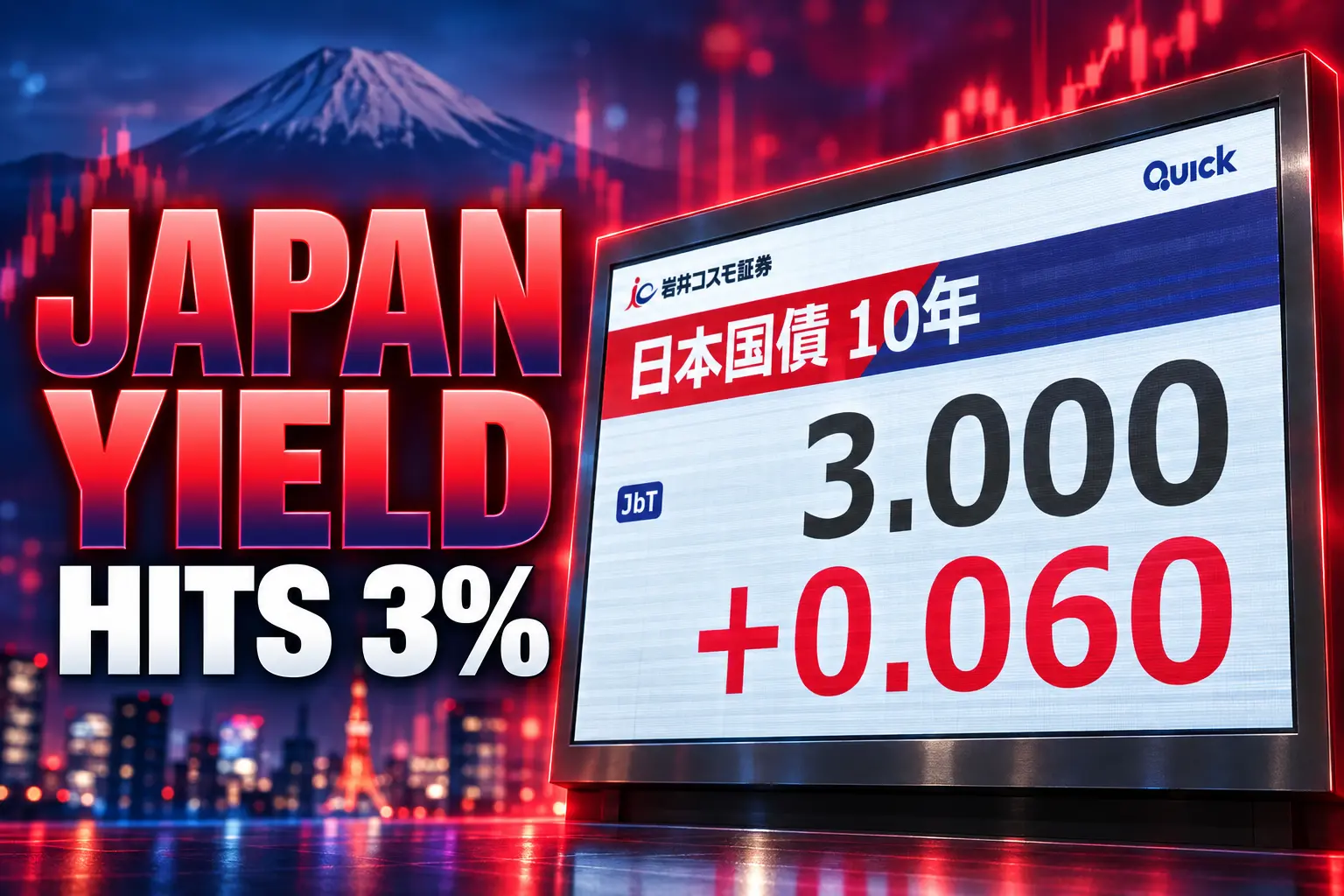
Japan’s 10-year government bond yield touched 3 percent on Tuesday, the first print at that level since October 1996.
The U.S. 10-year yield reached 4.788 percent, its highest since Jan. 14, 2025, as a living yield in Tokyo changed the math for every other major bond market.
Japan Prints a 3 Percent 10-Year for the First Time Since 1996
The 10-year Japanese government bond, the JGB, printed 3.000 percent shortly after the Tokyo afternoon session opened, then settled at 2.990 percent, up 0.050 percentage point on the day. A 10-year auction still cleared, with a bid-to-cover ratio of 3.29 times, so this was not a failed sale. It was a round number that the market had not seen in 30 years, and it arrived with selling in shorter and longer paper too.
The 2-year yield climbed to 1.795 percent, the highest since April 1995. The 5-year hit an all-time intraday high of 2.265 percent. The 30-year briefly reached 4.185 percent and the 40-year 4.270 percent. The 10-year has risen 1.4 percentage points since August 2025 and has more than tripled in two years, after the Bank of Japan ended negative rates in 2024, hiked to 0.75 percent last December, and took the policy rate to 1 percent in June.
West Texas Intermediate crude topped $85 a barrel after fighting between the United States and Iran resumed, and the yen sat near 160 to the dollar. Government ministries had just sent in budget requests totaling a record 143 trillion yen ($890 billion) for the next fiscal year, a figure that tracks Prime Minister Sanae Takaichi’s push for more spending. Japan’s outstanding debt is already twice the size of its economy, and the fiscal 2026 budget had assumed a 3 percent long-term rate when it set debt-service costs.
FOUR MARKETS ON TUESDAY
| Market | 10-year high | Last at that level | 30-year high | Last at that level |
|---|---|---|---|---|
| Japan | 3.000% | October 1996 | 4.185% | multi-decade |
| United States | 4.788% | Jan. 14, 2025 | 5.27% | near 2007 |
| Britain | 5.25% | 2008 | 5.89% | 1998 |
| Germany | 3.36% | 2011 | 3.84% | 2011 |
Peter Schaffrik, a strategist at RBC Capital Markets in London, called it a global story. France’s 10-year yield also rose to 4.215 percent, a level last seen in November 2008. The Nikkei 225 finished down 0.15 percent, a small stock move beside a bond move that rewrites funding costs for the state itself.
The Marginal Buyer of Treasuries Is Going Home
Japanese institutions spent decades buying other countries’ bonds because yields at home were near zero. That arithmetic has flipped. A 10-year JGB at 3 percent, and a 30-year above 4 percent, pays a Japanese pension fund or insurer in yen, with no currency hedge to fund. The next U.S. or European auction then has to clear without the same bid from Tokyo.
Japan remains the largest foreign holder of U.S. Treasuries. Holdings fell to $1,116.7 billion in June from $1,143.1 billion in May, a $26.4 billion drop in one month, and they are down 3.3 percent from $1,154.8 billion in June 2025. That stock is still huge. The change that matters is at the margin: less buying of the next issue, not a fire sale of the last one.
LARGEST FOREIGN HOLDERS, JUNE 2026
- Japan: $1,116.7 billion, still first, down $26.4 billion from May.
- United Kingdom: $939.9 billion, now the second-largest foreign holder.
- China: $633.4 billion, down from $731.4 billion a year earlier.
Foreign investors as a group held $9,299.0 billion of Treasuries in June. Japan alone is nearly 4 percent of Treasuries outstanding, and Takaichi’s government has talked about pulling more of that savings home. Bond desks do not need Tokyo to dump paper for U.S. and European yields to rise. They need the next buyer to demand a higher return, and a 3 percent JGB gives that buyer a reason to stay put.
$931 Billion in Interest, and the Next Rollover
The first bill from higher yields lands on finance ministries, not on new mortgage applicants. The United States has already paid $931 billion of interest through July, the tenth month of fiscal 2026, against $842 billion a year earlier, a 10.6 percent rise. The Congressional Budget Office puts net interest at $1.0 trillion for the full year, more than the $885 billion it projects for defense and the $708 billion for Medicaid, and at $2.1 trillion by 2036.
THE INTEREST BILL IN FOUR MEASURES
- Share of revenue: Federal interest took 18.5 percent of receipts in 2025, above the 18.4 percent peak set in 1991, when the 30-year yield was near 8 percent rather than a little above 5 percent.
- Share of the economy: CBO sees interest at 3.2 percent of GDP this year, above the 1991 high, and at 4.6 percent by 2036.
- Ten-year total: Net interest is projected at $16.2 trillion over the next decade if current law holds.
- Debt stock: Gross national debt crossed $40 trillion on Aug. 18, with debt held by the public near the size of the economy, against 44 percent of GDP in 1991.
Treasury still has to finance the gap. In its August refunding update it said it expects $739 billion this quarter in privately held net marketable borrowing, $68 billion more than it had flagged in May, and $628 billion in the October-December quarter, with a $950 billion cash balance assumed at the end of September. Rolling that paper at 4.8 percent, rather than at the 3 percent-and-change coupons still sitting on older notes, is how a deficit feeds on itself.
The August Buyback Already Unwound
Treasury Secretary Scott Bessent tried to cap the long end two weeks ago. On Aug. 19, a day after the 30-year yield hit a 19-year high of 5.34 percent, the department said it would raise long-end liquidity support buybacks from $2 billion to at least $4 billion per operation in the 10-year to 20-year and 20-year to 30-year sectors, from Sept. 9 through Nov. 4. The 10-year closed that day at 4.647 percent and the 30-year at 5.196 percent. By Tuesday the 10-year was more than 10 basis points above the post-announcement close, and the 30-year was back at 5.27 percent, the area seen just before the buyback news.
FROM THE BUYBACK TO THE REVERSAL
- March 2026: The Iran war starts and the U.S. 10-year yield sits near 4 percent.
- Aug. 18, 2026: The 30-year yield hits 5.34 percent, a 19-year high.
- Aug. 19, 2026: Treasury doubles long-end buybacks; the 10-year settles at 4.647 percent.
- Aug. 28, 2026: Federal Reserve Chair Kevin Warsh, in his first speech at the Fed’s annual conference, sounds hawkish on inflation.
- Sept. 1, 2026: Japan’s 10-year touches 3.000 percent; the U.S. 10-year reaches 4.788 percent; the 30-year sits at 5.27 percent.
- Sept. 9, 2026: The larger buybacks are scheduled to start, still tiny against the stock of debt.
- Sept. 17-18, 2026: The Bank of Japan meets, with markets pricing an 80 to 90 percent chance of a hike to 1.25 percent.
Buybacks do not cut the deficit. New bills or notes replace the bonds that are bought in, and the calendar still has to fund war spending, interest, and a deficit CBO put at $1.9 trillion for this year in its February outlook. The August buybacks and the Iran oil shock already showed how fast long yields can reverse a policy tweak. Bessent has said the market is the market, and on Tuesday the market took the long bond back to where it was before he moved.
Gilts Opened From a Holiday Into a 28-Year High
London was closed Monday, so Tuesday was a catch-up session, and gilts led the European side of the selloff. The 10-year yield climbed as much as 11 basis points to 5.25 percent, a level last seen in 2008, before easing toward 5.21 percent. The 30-year yield touched 5.89 percent, the highest since 1998, then slipped to about 5.85 percent. Traders priced two Bank of England rate increases by February.
That print lands on a thin budget. Economists put the hit to fiscal headroom at about £12 billion if yields stay here into the autumn, almost all of it from higher interest costs. The Office for Budget Responsibility’s March forecast had gilt yields at 5.1 percent for this year. Chancellor John Healey is due to deliver his first budget on Oct. 28, and Prime Minister Andy Burnham returned to parliament on Tuesday to a funding picture that had worsened while the market was shut.
Germany’s 10-year bund yield climbed above 3.36 percent, later around 3.34 percent, the highest since 2011, and the 30-year bund rose above 3.84 percent. German consumer prices accelerated to 2.9 percent in August from 2.8 percent in July, with energy up 10.5 percent, and eurozone inflation topped 3 percent. EU commissioner Valdis Dombrovskis told reporters that the bond move reflects the need for governments to get deficits under control. In Tokyo, Masahiro Ichikawa, chief market strategist at Sumitomo Mitsui DS Asset Management, said the focus is now how the budget size is set, what revenue is used, and how spending is held in check.
Why 5 Percent on the 10-Year Is the Line Traders Watch
Padhraic Garvey, ING’s regional head of research for the Americas, put the concern zone on the other side of 5 percent for the U.S. 10-year, and between 3.5 percent and 4 percent for the eurozone 10-year. Tuesday’s 4.788 percent print is not that line. It is close enough that a further leg higher, from oil or from a Fed hike, would take the market there. The 2-year yield, which tracks policy, rose 6 basis points to 4.4 percent, and traders priced a roughly 70 percent chance that the Fed raises rates this month for the first time since 2023.
Warsh’s Jackson Hole inflation warning is part of that pricing. So is crude. WTI above $85 keeps import prices alive in Japan and pump prices alive in Europe and the United States, and it reduces the room for any central bank to ease. Bessent has said inflation expectations in U.S. yields are flat to down and that the rise in yields is a growth story. Garvey’s split is different: he said the move is in real yields, which companies cannot offset by raising prices.
A 10-year at 5 percent would reprice mortgages, corporate loans, and the Treasury’s own coupons together. The first-order channel is household credit. The larger channel is the interest line in every G7 budget, which already runs ahead of most other programs and which rises automatically when old cheap debt matures into new expensive debt. That is the loop Tuesday’s tape is feeding.
Asheville’s Growth Story Meets a $40 Trillion Debt
Bessent spent the week at a Group of 20 finance meeting in Asheville, N.C., with Warsh, and he used the trip to play down the tape. He said the U.S. bond market has been the best performer among major countries since President Donald Trump returned to office on Jan. 20, 2025, and that what happens over a month does not matter. He also said the world is awash in debt and that the only way out is to grow out of it. On Japan he told an interviewer he has information the market does not have, and that he believes Tokyo and the Bank of Japan will take steps that lead to a stronger yen, a line that markets read as pressure for another hike when the BOJ meets on Sept. 17 and 18.
I don’t think we are in any kind of a dire situation.
Scott Bessent, Treasury secretary, G20 meeting in Asheville
Growth would help the debt-to-GDP ratio if it arrives without another burst of prices. Oil from the Iran war works against that, and so does a Fed chair who will not rule out a hike. Treasury can buy back some long bonds in September. It cannot buy back Japan’s need for a higher domestic yield, or Britain’s gilt bill, or a $40 trillion stock of U.S. debt that now rolls in a 4.8 percent world. The 3 percent JGB is the new floor under that roll, and it is already in the price.
Disclaimer: This article is news reporting and analysis of government-bond markets, yields, and public finances, and it is for information only. It is not investment advice, a recommendation to buy or sell any bond, note, or related fund, or a forecast you should trade on. Readers who are considering portfolio or borrowing decisions should consult a licensed financial adviser or fixed-income professional who can review their own situation. Yields, debt totals, auction results, and policy odds in this piece reflect the sources as of Sept. 2, 2026, and those figures can move in the next session.

Police Tighten the Ring Around Gyanesh Kumar’s House

Ravi Shankar Calls Hanuman Ansh a Slap to Big Spenders

Microsoft Puts Nvidia in the Surface Laptop Ultra Flagship

Adult Fires on an Armed Juvenile at Longmont Dollar Tree

Jordan Absorbs Iranian Missiles Aimed at Parked US Jets

The iPhone 18 Pro Max Splits Apple’s Fall in Two

OpenAI Calls GPT-6 Astra AGI Then Locks Its Exploits

Russia Closes the Goethe-Institut Berlin Tried to Save

Trump Claims Hormuz Control as Oil Holds Near $96

Volkswagen’s Job Cuts Leave Four Plants Without Cars

 NEWS1 month ago
The iPhone 18 Pro Max Splits Apple’s Fall in Two
- NEWS1 month ago
OpenAI Calls GPT-6 Astra AGI Then Locks Its Exploits
- LIFESTYLE1 month ago
Russia Closes the Goethe-Institut Berlin Tried to Save
- BUSINESS1 month ago
Trump Claims Hormuz Control as Oil Holds Near $96
- AUTO1 month ago
Volkswagen’s Job Cuts Leave Four Plants Without Cars
- NEWS1 month ago
The Lincoln’s 286-Day War Cruise Ends at a Thai Pier
- BUSINESS1 month ago
Cable Stocks Fall as UltraTech Copies the Paints Playbook
- NEWS1 month ago
Dyson Puts Nurovi Robots on Sale Without the UV Flagship