NEWS
Climate Models Miss Earth’s Hidden East-West Albedo Lock
A NOAA team found matching sunlight east and west of 27 degrees east, a triple symmetry that eight climate models used to test aerosol injection cannot reproduce.

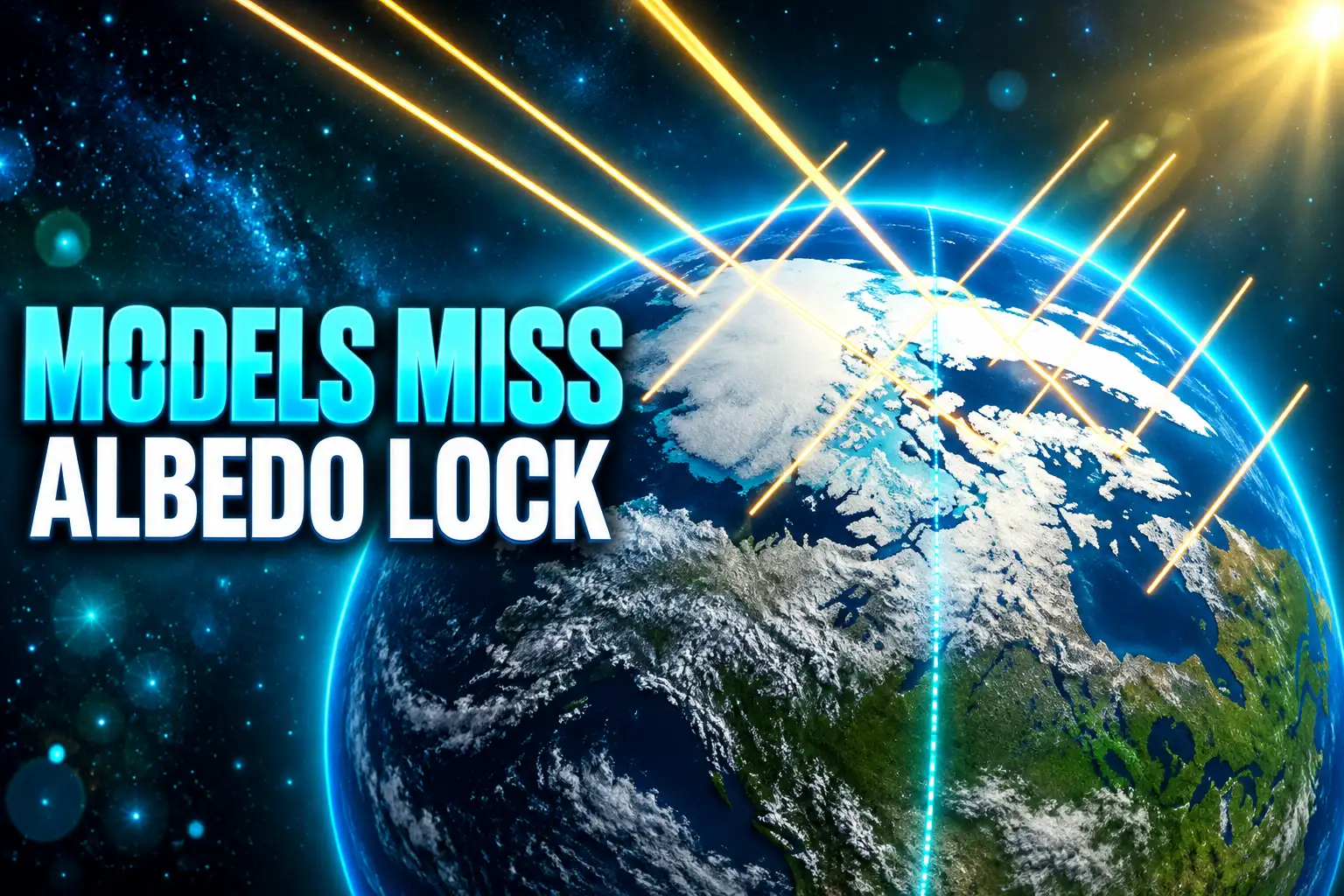
A meridian near 27 degrees east splits Earth into two halves that send back matching sunlight, according to a 25-year satellite record published on 3 June 2026. Jianhao Zhang, a CIRES research scientist in NOAA’s Chemical Sciences Laboratory, led the Nature paper with Jake J. Gristey of CIRES and Graham Feingold of NOAA CSL.
The east-west albedo symmetry is the only such divide in longitude. Eight Earth system models miss the triple match behind it, including four that also ran stratospheric aerosol injection tests.
The Triple Lock at 27 Degrees East
Earth reflects about 29 percent of incoming sunlight. For decades that planetary albedo has been known to match, almost exactly, between the Northern and Southern Hemispheres, even though the north holds more land and the south holds more cloud. Zhang’s team asked a simpler question: does any north-south cut through the globe do the same job east to west?
They sliced the planet at every longitude, one degree at a time, using monthly top-of-atmosphere shortwave fluxes from January 2001 through December 2025. Only 27 degrees east, with 153 degrees west completing the great circle, produced a lasting balance. The NOAA CSL account of the work says those two halves reflect nearly identical amounts of sunlight. Anywhere else, the balance breaks.
The Nature paper, volume 654, pages 676 to 682, puts a number on how close the match is. The 25-year mean difference in all-sky reflected sunlight at that meridian is 0.04 plus or minus 0.24 W/m2. A difference inside 0.1 W/m2 would arise in fewer than 3 percent of random hemisphere pairs, the authors note, which is why they refuse to treat the line as a geometric party trick.
What they call a triple symmetry sits on the same cut. Ice-free ocean fraction is nearly the same in each half. Clear-sky reflection is nearly the same. Cloud radiative effect, the extra sunlight clouds bounce to space, is nearly the same, even though the clouds themselves are not. Those three pieces line up together only at this meridian, each within about 0.5 W/m2.
THE TRIPLE MATCH AT 27 DEGREES EAST
| Piece of the energy budget | What the 25-year record shows at 27° E | Contrast with the north-south split |
|---|---|---|
| All-sky reflected sunlight | 0.04 plus or minus 0.24 W/m2 apart | Hemispheres already known to match |
| Ice-free ocean fraction | Nearly identical in each half | The north has more land, the south more ocean |
| Clear-sky reflection | Near symmetry | Northern clear skies are brighter |
| Cloud radiative effect | Near symmetry | Southern clouds do the compensating work |
On year-long averages the identified divide wanders between about 20 and 30 degrees east. On decadal averages the mean and median sit between 27 and 28 degrees east. Year-to-year wobble at 27 degrees east is plus or minus 0.24 W/m2, close to the plus or minus 0.20 W/m2 seen in the north-south pair.
Nature research paper: Analysis of a 25-year satellite record shows that Earth has a persistent east–west albedo symmetry split at 27° E, with clear-sky albedo, cloud radiative effect and open-ocean fraction exhibiting a triple symmetry around this meridian.…
— nature (@Nature) June 4, 2026
High Clouds Offset a Different Kind of Low Cloud
The two halves do not look alike. Zhang said the balance “emerges from very different cloud regimes across the planet,” with high clouds in one hemisphere and low clouds in the other keeping the energy budget nearly even.
All three of Earth’s standing subtropical stratocumulus decks sit in the Western Hemisphere, over cool ocean off California, Chile, and Namibia. Those low, bright decks should make the west more reflective. They do not, because the Eastern Hemisphere answers with high anvil cloud over deep tropical storms, above Southeast Asia, the Indian Ocean, and the maritime continent.
THE CLOUDS THAT CANCEL
- Western low decks: Persistent stratocumulus off California, Chile, and Namibia supplies most of the extra low-cloud reflection in the west.
- Eastern high anvils: Deep convection over Southeast Asia and the Indian Ocean supplies the extra high-cloud reflection in the east.
- Clear-sky split: More reflective ocean and ice in the east roughly offset more reflective ice-free land in the west, so the cloud terms are not covering a huge surface mismatch.
- Net result: Different cloud types, nearly equal cloud cooling, at the same meridian where the ice-free ocean also splits evenly.
Zhang compared the setup to a dynamic equilibrium rather than a fixed pattern. Thinning and retreat of those western stratocumulus decks, plus cloud darkening over the Amazon, are already tugging the system toward imbalance. Over the 25-year record that tug remains statistically insignificant. The older north-south symmetry is the one recent satellite work suggests may already be slipping.
How ENSO Tugs the Meridian From Year to Year
The candidate mechanism is the Walker circulation, the east-west overturning of tropical air that links Pacific rainfall to Indonesia and beyond. Its strength and position move with the El Niño-Southern Oscillation. When Zhang’s team lined the east-west albedo wobble up against the ENSO record, the two tracked each other across the full 25 years.
During La Niña years the Eastern Hemisphere reflects slightly more sunlight. During El Niño years the Western Hemisphere does. The authors argue that this back-and-forth is what pins the long-term lock to 27 degrees east once both phases are averaged together. In a Behind the Paper note, Zhang called the Walker cell “a massive planetary adjustment mechanism” that reorganizes cloudiness and reflected sunlight.
That is a working hypothesis, not a closed proof. The correlation is strong and consistent in the CERES years. Whether the open-ocean divide at 27 degrees east is required for the sunlight match, or only one piece of a wider set of offsets, is still open.
Eight Models Miss the Same Triple Test
The team then asked eight coupled Earth system models from CMIP6, ScenarioMIP, and GeoMIP6 to find the same triple symmetry. None did.
The eight, one from each model family, include NOAA’s GFDL-ESM4, NASA GISS-E2-1-H, IPSL-CM6A-LR, MIROC6, and the UK Met Office’s UKESM1-0-LL. All eight get the ice-free ocean split roughly right. All eight fail to capture the simultaneous symmetry in cloud radiative effect and clear-sky reflection. A model can still produce a decent global albedo while its clouds, surfaces, and circulation cancel in the wrong places. The 27-degree-east test is meant to catch that.
Zhang was blunt about what the miss does not mean. Climate models remain essential tools, he wrote. The miss does mean they may still be getting the coupling among clouds, surface reflection, ocean, sea ice, and circulation wrong, and those same models are the ones used to project future climate and to evaluate climate intervention.
WHAT WE KNOW
- Ocean geography: The eight models roughly reproduce the even ice-free ocean split at 27 degrees east.
- The triple test: None of the eight reproduce the observed coincidence of ocean, clear-sky, and cloud symmetries.
- Present-day window: The model check uses 1995 to 2015 against the satellite years that follow.
WHAT IS UNCONFIRMED
- Walker as cause: The ENSO tracking is observational; a closed physical proof that the Walker cell maintains the lock is still missing.
- How long it lasts: CMIP6 runs under the SSP3-7.0 path for 2080 to 2100 raise the possibility that both the east-west and north-south symmetries are transient features of the present climate.
Pre-industrial slices from 1850 to 1870 and late-century slices from 2080 to 2100 were part of that check. The paper’s own reading is that Earth’s observed albedo symmetries may not be permanent properties of the planet.
Aerosol Injection Moves a Balance Models Cannot See
That is the second-order problem. Four of the eight models also ran GeoMIP’s G6sulfur simulations, in which sulfate is placed in the stratosphere to scatter sunlight. In those runs, the intervention can shift the east-west energy difference, but the size of the shift differs from model to model, and the physical path is unclear. The four aerosol runs move total reflected-sunlight asymmetry back toward historical values. IPSL-CM6A-LR restores that total difference exactly to its present-day value. They do not restore the cloud radiative effect. All four show a clear drop in hemispheric-mean cloud cooling while a hemispheric cloud difference remains.
G6sulfur is not a boutique side case. The GeoMIP G6sulfur experiment is the standardized CMIP6-era test of equatorial stratospheric aerosol injection, built to knock a high-warming path down toward a moderate one over 2020 to 2100. If those runs cannot hold the cloud term that actually balances 27 degrees east, then a sunlight-blocking scheme is being scored with engines that do not assemble the present-day parts in the right way.
If we try to modify clouds in one region, the system could respond in ways that offset or amplify that change. The lack of understanding on such Earth system responses is concerning as proposals for solar radiation management attract growing attention.
Jianhao Zhang, CIRES research scientist at NOAA Chemical Sciences Laboratory, NOAA CSL news release
The same caution applies to marine cloud brightening, which would lean on the western stratocumulus decks that already do half of this job. Zhang’s group has used the 2020 shipping-fuel sulfur cut as an inadvertent test of how hard such a cloud brightening signal is to see. The east-west lock adds a further warning: change one cloud province and the other half of the planet may answer.
A Very Strong El Niño Is Already Underway
Zhang’s June note mentioned a predicted 2026 super El Niño as a reason to keep watching the radiation record. Eight days after the paper appeared, NOAA’s Climate Prediction Center issued an El Niño Advisory. The 11 June 2026 discussion put the weekly Niño-3.4 index at +0.7°C and assigned a 63 percent chance of a very strong event in November to January.
By 21 September 2026 the same office listed Niño 3.4 at 2.1°C and assigned a greater than 90 percent chance of a very strong El Niño through the Northern Hemisphere fall and winter of 2026-27. If the paper’s ENSO tracking holds, the Western Hemisphere should now be the slightly brighter half.
THE 2026 EL NIÑO AGAINST THE PAPER
- Alert status: El Niño Advisory, issued 11 June 2026 and still in force in the 21 September briefing.
- Niño 3.4: +0.7°C in the 11 June weekly value, 2.1°C in the 21 September briefing.
- Peak odds: Greater than 90 percent chance of a very strong event in fall and winter 2026-27.
- Predicted pull: Western Hemisphere slightly more reflective than the east, if the 25-year ENSO tracking continues.
That is a test the models cannot grade for us. They never produced the triple symmetry whose year-to-year motion is now in play. CERES can still measure it, as long as the record stays continuous.
The Satellite Record That Found the Pattern Is Drifting
The discovery rests on the CERES Energy Balanced and Filled product, Edition 4.2.1, built from shortwave radiances between 0.3 and 5.0 micrometers on NASA’s Terra and Aqua spacecraft and on NOAA-20. Terra launched on 18 December 1999, Aqua on 4 May 2002, and NOAA-20 on 18 November 2017. Edition 4.2.1 exists because Terra and Aqua have been drifting off their maintained equator-crossing times, so the later record is being tied to NOAA-20. Terra’s FM2 instrument ceased operations on 10 January 2025.
THE RECORD BEHIND THE MERIDIAN
- 18 December 1999: Terra carries the first long-running CERES scanners into polar orbit.
- January 2001: Start of the monthly 1-degree all-sky shortwave series used in the Nature analysis.
- 18 November 2017: NOAA-20 adds CERES FM6 as Terra and Aqua age.
- 10 January 2025: Terra FM2 stops, tightening the case for a NOAA-20-centred record.
- December 2025: End of the 25-year window Zhang, Gristey, and Feingold analysed.
- 3 June 2026: Nature publishes the east-west albedo symmetry.
- 11 June 2026: Climate Prediction Center issues the El Niño Advisory.
- 21 September 2026: CPC assigns greater than 90 percent odds of a very strong event this winter.
Zhang’s last practical point was not about aerosol schemes. It was about keeping that radiation record intact under a climate that is already darkening and whose energy imbalance has doubled in recent decades. If the east-west lock holds through a very strong El Niño, the compensating machinery is still working. If it snaps, the 27-degree-east line will have been a feature of a climate that is already on the way out, scored by models that never saw it in the first place.
Frequently Asked Questions
What Is Earth’s East-West Albedo Symmetry?
It is the finding that a great circle through 27 degrees east and 153 degrees west is the only east-west cut where the two halves of the planet reflect almost the same sunlight in a 25-year CERES series. The line runs through eastern Europe, Turkey, central Africa, Norway, and Alaska and on to both poles, and the match is unique in longitude rather than one of several near-misses.
How Does East-West Albedo Symmetry Differ From North-South?
North-south symmetry has been measured since early satellite radiation missions and is built from a cloudier Southern Hemisphere offsetting brighter northern land and aerosol, with no even split of ice-free ocean. East-west symmetry adds that ocean split and a near match in both clear-sky reflection and cloud radiative effect, which is why the authors call it a triple symmetry and treat it as a tighter model test.
Which Instruments Produced the 25-Year Record?
The fluxes come from CERES scanners on Terra, Aqua, and NOAA-20, merged in the Energy Balanced and Filled Edition 4.2.1 product as monthly, 1-degree all-sky top-of-atmosphere shortwave fields from 0.3 to 5.0 micrometers, with the later years increasingly anchored on NOAA-20 as Terra and Aqua drift.
What Is the G6sulfur Test Tied to This Finding?
G6sulfur is GeoMIP’s CMIP6-era stratospheric aerosol injection protocol, with equatorial sulfate used over 2020 to 2100 to bring a high-warming scenario’s global temperature down toward a moderate path. Four of Zhang’s eight models ran it, and those four shifted east-west reflected-sunlight differences without restoring the cloud radiative effect that holds the observed lock.


Adult Fires on an Armed Juvenile at Longmont Dollar Tree

Jordan Absorbs Iranian Missiles Aimed at Parked US Jets

Clancy Juror Says the Holdout Never Cited Evidence

Trump Asks Dallas to Pretend He Is on the Ballot

Revanth Reddy’s Boycott Call Mirrors the Purification He Condemns

The iPhone 18 Pro Max Splits Apple’s Fall in Two

OpenAI Calls GPT-6 Astra AGI Then Locks Its Exploits

Russia Closes the Goethe-Institut Berlin Tried to Save

Trump Claims Hormuz Control as Oil Holds Near $96

Volkswagen’s Job Cuts Leave Four Plants Without Cars

 NEWS1 month ago
The iPhone 18 Pro Max Splits Apple’s Fall in Two
- NEWS1 month ago
OpenAI Calls GPT-6 Astra AGI Then Locks Its Exploits
- LIFESTYLE1 month ago
Russia Closes the Goethe-Institut Berlin Tried to Save
- BUSINESS1 month ago
Trump Claims Hormuz Control as Oil Holds Near $96
- AUTO1 month ago
Volkswagen’s Job Cuts Leave Four Plants Without Cars
- BUSINESS1 month ago
Cable Stocks Fall as UltraTech Copies the Paints Playbook
- BUSINESS1 month ago
Japan’s 3 Percent Yield Reprices Government Debt Worldwide
- NEWS1 month ago
Dyson Puts Nurovi Robots on Sale Without the UV Flagship