
NEWS
Pope Leo Says the Amazon Wounds Have Grown Worse
In Pucallpa, Pope Leo XIV said Amazon wounds have grown worse since 2018, as Peru’s courts convict a few killers and the forest keeps falling.

Pope Leo XIV told Indigenous leaders in Pucallpa on November 15 that Amazon wounds have, in some cases, grown worse. He named Pope Francis’s 2018 visit to Puerto Maldonado, then said the blood of murdered land defenders cries out for justice.
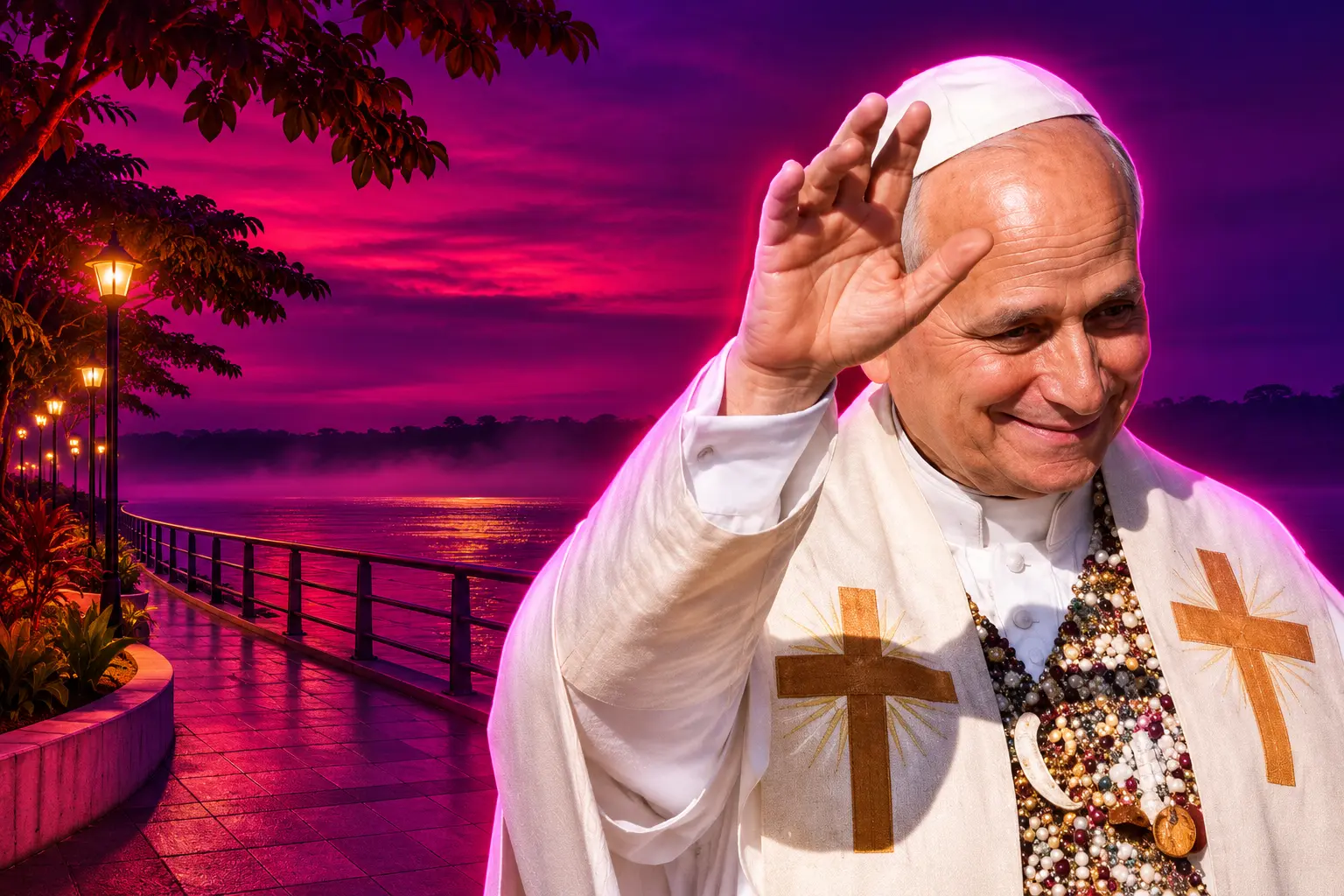
The 71-year-old pope, a Chicago-born Augustinian who holds Peruvian citizenship, spoke at the Malecón Puerto Callao after flying from Chiclayo and Cusco on the same Sunday. Local authorities put about 5,000 people at the riverside entrance and about 20,000 along the streets. He later said Mass for a crowd officials estimated at around 100,000.
Leo Tells Pucallpa the Wounds Have Grown Worse
The Vatican’s own bulletin recorded the line that the wire copy flattened. Following Francis into the Peruvian Amazon, Leo said he had come as a shepherd to walk with communities still waiting on justice and peace. Then he said the voice rising from those places now speaks of wounds that remain unhealed and have, in some cases, grown worse.
The first testimony today reminds us that defending one’s home can come at the cost of one’s life. In recent years, many Indigenous leaders have been murdered for defending their territories. The blood of these brothers cries out to God and demands justice.
Pope Leo XIV, address at Malecón Puerto Callao, Pucallpa, November 15, 2026
He tied the killings to a model that treats the forest as a store of gold, timber, and oil. Indiscriminate cutting and the pollution of rivers by illegal mining and oil spills, he said, are not isolated accidents. They are the result of irresponsible use of resources, and they undercut the life of the communities themselves. Drug trafficking, he added, preys on young people with false promises of money and pulls them out of their own culture.
A second testimony, which the pope answered in the same address, concerned schools and clinics that never arrive. He called it unacceptable that distance and official neglect still block the right to health care and education. He also named violence and sexual abuse against women, girls, and adolescents, wounds he said are often compounded by complicity and impunity.
At Mass in the Villa Deportiva Regional Ucayali he returned to the same ground. Very little has been done, and very slowly at that, he said, while the means to exploit and pollute creation have accelerated. Social peace and ecological balance go hand in hand, he told the stadium, so violence against the people is violence against the land, and violence against the land is violence against the people.
Puerto Maldonado Heard the Same Warning First
Leo did not hide the earlier sermon. He said he was following Francis’s “memorable visit to Puerto Maldonado.” That visit was January 19, 2018, in the Madre de Dios indoor stadium, eight years before Pucallpa.
The native Amazonian peoples have probably never been so threatened on their own lands as they are at present.
Pope Francis, meeting with the peoples of Amazonia, Puerto Maldonado, January 19, 2018
Francis listed the same extractive list Leo would repeat: petroleum, gas, lumber, gold, and agro-industrial monoculture. He also warned against conservation schemes that lock native people out of their own woods. Illegal mining, he said then, brought slave labor and sexual abuse, a violence against adolescents and women that “cries out to heaven.” He told the gathering they were a living memory of the duty to protect a common home, and he announced an Amazon synod for 2019.
Leo quoted that later exhortation, Querida Amazonia, in Pucallpa: a dream of a region that fights for the rights of the poor and the original peoples, where their voices are heard. The 2018 text is still on the Vatican site, including the claim that Amazon peoples had never been so threatened on their own lands. The 2026 visit was the receipt. The Church had already said the quiet part. The hectares and the graves are what followed.
Forty-Five Documented Killings and Nine Identified Perpetrators
Pucallpa is not a neutral backdrop for that charge. It is the main city of Ucayali, the region an August 2026 American Bar Association brief ranked as Peru’s deadliest for environmental defenders, with 10 of the recorded deaths. The same brief counted 45 defenders killed in 40 documented cases from 2013 to 2024. Thirty-two of the 45 were Amazonian Indigenous people. In 9 of the 40 cases, a perpetrator was identified.
THE RECORD LEO WALKED INTO
- Documented deaths: 45 defenders in 40 cases from 2013 to 2024, per the American Bar Association brief updated August 24, 2026.
- Who they were: 32 of the 45 were Amazonian Indigenous people, about 1 percent of Peru’s population carrying most of the dead.
- Protection that failed: 1 of 30 people killed after Peru’s 2020 defender registry was created had active protection measures.
- After the brief: Global Witness recorded 4 killings of land and environmental defenders in Peru in 2024 and 4 more in 2025, part of 124 such killings worldwide last year.
The five deadliest regions in that brief all sit in the Amazon basin: Ucayali (10), Pasco (6), Loreto (5), Madre de Dios (5), and Junín (3). Nearly every victim died in the territory they were defending. Among Kakataibo communities, six leaders have been killed since 2020 as coca and organized crime pushed deeper into the forest. Segundo Ispón, commander of the Kakataibo Indigenous Guard, said the work is taught from an early age, and that for the next generation it is more dangerous than ever.
FROM SAWETO TO PUCALLPA
- September 1, 2014: Illegal loggers ambush and kill four Ashéninka leaders of Alto Tamaya-Saweto, including Edwin Chota Valera, near the Peru-Brazil border.
- January 19, 2018: Francis tells Puerto Maldonado that native Amazonian peoples have probably never been so threatened on their own lands.
- November 29, 2023: Kichwa leader Quinto Inuma Alvarado is shot on a boat on the Yanayacu River while returning to Santa Rosillo de Yanayacu.
- August 25, 2025: An Ucayali appeals court confirms 28 years and 3 months for four men in the Saweto murders, 11 years after the ambush.
- 2025: Peru loses 200,000 hectares of natural forest, according to Global Forest Watch.
- August 24, 2026: A national criminal court sentences four men in the Inuma killing, with the longest terms at 35 years.
- November 15, 2026: Leo speaks in Pucallpa and says the wounds have, in some cases, grown worse.
Global Witness’s 2025 worldwide count fell from 142 killings and four disappearances in 2024, and from 196 killings in 2023. Latin America still accounted for 105 of the 124 deaths last year. Peru is not Colombia or Brazil on that list. It is a country where the dead are few enough to name and still, in most files, without a defendant in the dock.
What Two Amazon Murder Trials Delivered
The incomplete reckoning is not that Peru never convicts anyone. It is that two heavy sentences, years apart, are now asked to stand in for a pattern the pope called murder.
TWO MURDER TRIALS, A DECADE APART
| Case | Killing | Court action | Terms |
|---|---|---|---|
| Alto Tamaya-Saweto (four Ashéninka leaders) | September 1, 2014 | Ucayali appeals court, August 25, 2025 | 28 years and 3 months for four men; S/400,000 in civil damages |
| Quinto Inuma Alvarado, Kichwa apu of Santa Rosillo de Yanayacu | November 29, 2023 | Third National Collegiate Criminal Court, August 24, 2026 | 35 years, 35 years, 28 years and 4 months, and 15 years |
The Saweto file is the older wound. Edwin Chota Valera, Jorge Ríos Pérez, Francisco Pinedo Ramírez, and Leoncio Quintisima Meléndez were killed after years of complaints about illegal mahogany cutting on land the state had still not titled. The Primera Sala Penal de Apelaciones of the Ucayali Superior Court confirmed 28 years and 3 months in prison for timber businessmen Hugo Soria Flores and José Carlos Estrada Huayta as mediate authors, and for brothers Josimar Atachi Félix and Segundo Euclides Atachi Félix as co-authors. The court raised civil damages to S/400,000, S/100,000 for each victim’s successors, and ordered the men found and jailed. They had not appeared. A fifth suspect, Eurico Mapes Gómez, remained a fugitive.
The Inuma verdict is the newer one. Peru’s public prosecutor’s office said a national court handed down sentences of up to 35 years for contract killing. Genix Saboya Saboya and Limber Ríos Ruiz received 35 years each. Timber operator Segundo Juan Villalobos Guevara, accused of ordering the hit, received 28 years and 4 months. Jerly Saboya Saboya, convicted as a primary accomplice, received 15 years. Inuma, 50, was shot as he travelled by boat after a national meeting of land defenders. Axeldina Barbarán Tapullima, in the same boat, was wounded. Judges sat in Tarapoto for three days so the family could take part. The ABA brief notes he was the only victim in its dataset with active protection measures, and that those measures failed: relocated without a way to live, he went home and was ambushed.
Tom Younger, Peru programme co-ordinator at the Forest Peoples Programme, called the Inuma terms a decisive step toward justice and said they showed that impunity for these killings is not inevitable. Most of the 40 cases in the ABA count still have not ended that way.
The Forest Kept Falling After That First Visit
The other ledger is measured in hectares. Global Forest Watch figures show Peru lost 200,000 hectares of natural forest in 2025, about 494,200 acres, equal to 130 million tonnes of CO₂. In 2020 the country still held 71 million hectares of natural forest, 55 percent of its land. From 2002 to 2025 it lost 3.0 million hectares of humid primary forest, 66 percent of its total tree cover loss in that span, a 4.0 percent drop in primary forest area.
Andean Amazon monitoring group MAAP, using University of Maryland data carried by Global Forest Watch, put Peru’s non-fire primary forest loss in 2025 at 147,480 hectares, the highest in five years and the fifth highest on its record. Across the nine-country Amazon that year, it estimated 736,484 hectares of deforestation, 94.6 percent of it from agriculture and 5.3 percent from hard commodities, mostly gold. Peru’s share of that deforestation was 16.8 percent, and the same study said Peru recorded the largest mining deforestation among Amazon countries. In Madre de Dios, gold mining accounted for 33 percent of primary forest loss from 2002 to 2025.
Those are the “patterns of exploitation” Leo said threaten the balance of creation. Francis had already named gold as a false god in 2018, in the same Madre de Dios region where mercury still sits in the rivers. The citizen-pope did not need a briefing book to know the map. He needed the years after Puerto Maldonado to show that the map had not improved.
A Vicariate the Size of Countries Has 25 Priests
The pastoral arithmetic in the same speech was as blunt as the criminal one. The vicariate, Leo said, is as large as entire countries and has only 25 priests. He thanked women and men religious and lay leaders who keep the faith in places the state barely reaches, and he said their service should be recognized. Vatican News, in its wrap of the meeting, noted that more than 6.7 million Peruvians identify as Indigenous, about 20.7 percent of the country.
WHAT HE NAMED BEYOND THE GRAVES
- Schools and clinics: He called it unacceptable that isolation and institutional neglect still deny health care and education in many communities.
- Girls and women: The Awajún and Wampis Women’s Council recorded 370 cases of sexual violence in Condorcanqui province between January and July 2026, the wound he tied to complicity and impunity.
- Drugs: He said trafficking lures the young with profit and uproots them from their culture, a pressure Kakataibo patrols now treat as a daily risk.
- The Church on the ground: Twenty-five priests for a vicariate the size of countries, with lay people holding remote chapels together.
Before Mass he stopped at Pucallpa’s cathedral, prayed, greeted those inside, and planted a tree. Shipibo-Conibo singers welcomed him on the riverbank in their own language. Gifts came from Amazonian delegations after the blessing. The pictures from the Malecón look like a feast. The text he left there is a docket.
The Citizen Pope Closes the Tour in Lima
Robert Francis Prevost spent about 20 years of ordained ministry in Peru, longer than in the United States or Rome: a year in Chulucanas in 1985 and 1986, a long stretch in Trujillo from 1988 to 1999, and nearly nine years as bishop of Chiclayo from 2015 to 2023. He became a Peruvian citizen on August 24, 2015. Elected on May 8, 2025, he is the first U.S.-born pope. On this 12-day trip, dated November 6 to 17, he had already been through Uruguay and Argentina before the Peru homecoming.
Sunday ran coast to Andes to jungle. He left Chiclayo in the morning, said the Angelus in Cusco, then flew into Capitán FAP David Abensur Rengifo airport at 14:22 and was on the Malecón by 15:00. After Mass he flew to Lima and greeted people outside the nunciature that night. On Monday, November 16, he was due to finish the Latin America tour in the capital and leave for Rome.
The Church that spoke in Puerto Maldonado in 2018 now has a Peruvian passport in the See of Peter. The Ucayali court and the national bench have shown that a logger’s hit can end in a long sentence. Leo’s own measure, spoken on the red earth of Pucallpa, was that the wounds are still open, and that some of them are worse.

ADNOC Ship Hit in Hormuz Leaves One Crew Missing

SpiceJet’s Rs 5,500 Crore Plan Follows a Rescue That Failed

Hasina’s Return Fight Sets Fire to Yunus’s Bank

Bancroft Recants the 2018 Inquiry and Names the Team

Adhikari Ties the Saffron Saree Row to School Licences

Clancy Juror Says the Holdout Never Cited Evidence

The iPhone 18 Pro Max Splits Apple’s Fall in Two

OpenAI Calls GPT-6 Astra AGI Then Locks Its Exploits

Trump Claims Hormuz Control as Oil Holds Near $96

Russia Closes the Goethe-Institut Berlin Tried to Save

 NEWS2 months ago
Clancy Juror Says the Holdout Never Cited Evidence
- NEWS3 months ago
The iPhone 18 Pro Max Splits Apple’s Fall in Two
- NEWS3 months ago
OpenAI Calls GPT-6 Astra AGI Then Locks Its Exploits
- BUSINESS3 months ago
Trump Claims Hormuz Control as Oil Holds Near $96
- LIFESTYLE3 months ago
Russia Closes the Goethe-Institut Berlin Tried to Save
- AUTO3 months ago
Volkswagen’s Job Cuts Leave Four Plants Without Cars
- NEWS3 months ago
Dyson Puts Nurovi Robots on Sale Without the UV Flagship
- BUSINESS2 months ago
US Destroys Five Iranian Tankers as the Shock Hits Jordan










