
BUSINESS
Karnataka Asks the Centre to Split E20 With E10
Karnataka wants E10 and ethanol-free petrol beside E20 after labs found blends up to 31.2%, a demand that would break the Centre’s single-grade pump.

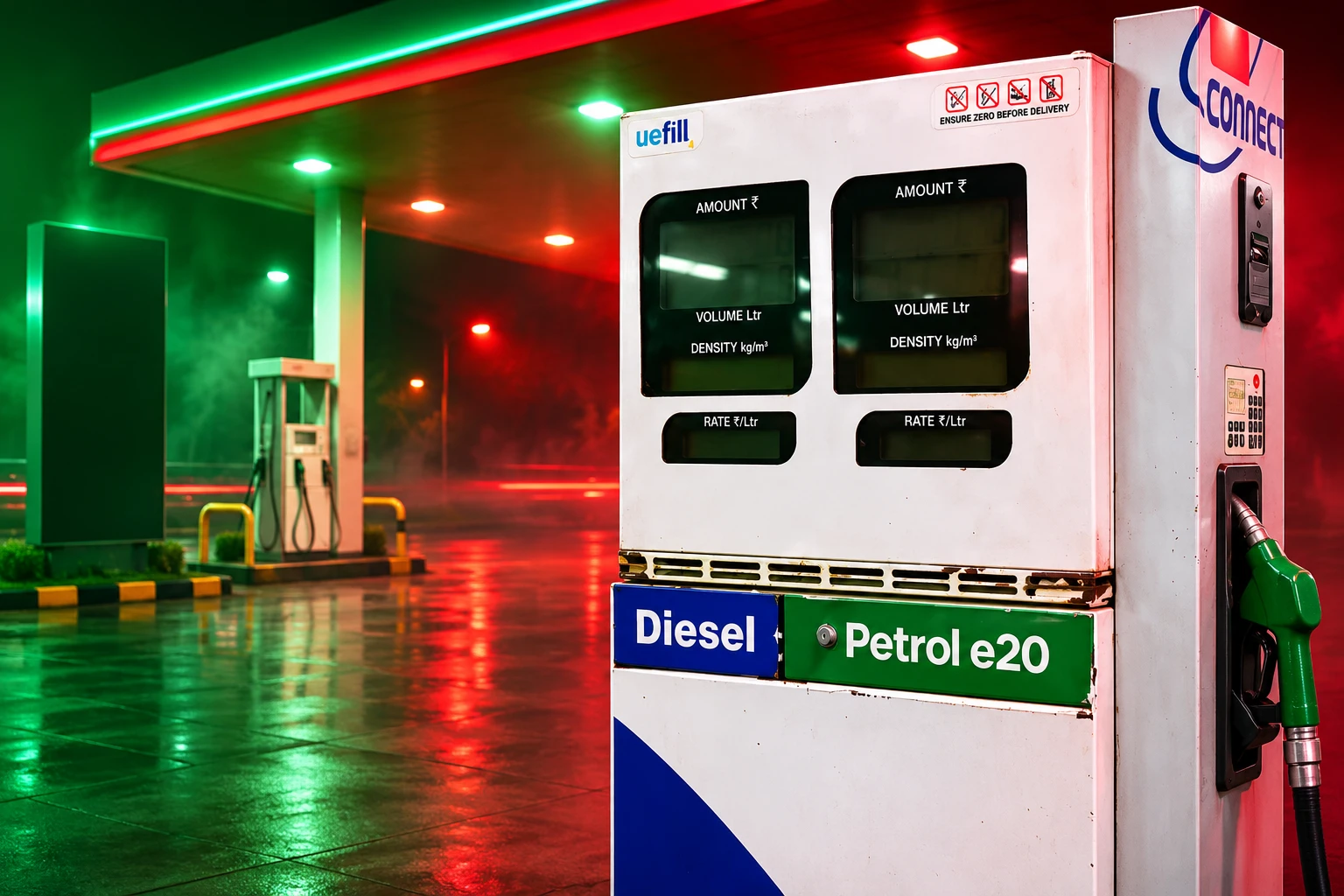
Karnataka has told the Centre that petrol sold as E20 in the state tested as high as 31.2% ethanol. Food, Civil Supplies and Consumer Affairs Minister Rizwan Arshad wrote to Union petroleum minister Hardeep Singh Puri on November 17.
He asked for E10 and ethanol-free petrol on the same forecourt, blend figures on every board and bill, and a fund for engines damaged by fuel above the cap. Those asks would end the single-grade pump the Centre finished building in 2025.
Eleven of Fourteen Samples Ran Past E20
Arshad’s six-page letter says Karnataka is not against the Ethanol Blended Petrol programme. It is against fuel sold as E20 that does not stay at 20%. Independent labs accredited by the National Accreditation Board for Testing and Calibration Laboratories found ethanol from 13.5% to 31.2%, and 11 of 14 samples sat above the notified cap.
Indian Oil samples were recorded at 31.2% and Hindustan Petroleum at 30.5%, both sold as the standard blend. Premium high-speed petrol, priced at nearly Rs 120 to Rs 140 a litre, also carried a high ethanol share, Arshad wrote, which left buyers of the dearer grade with no cleaner option at the nozzle.
HOW THE TWO TEST SETS COMPARE
| Check | Karnataka NABL (14 samples) | Oil firms in Karnataka (56 samples) |
|---|---|---|
| Peak ethanol | 31.2% | 20% |
| Share above 20% | 11 of 14 | 0 of 56 |
| Spread or average | 13.5% to 31.2% | 19.30% average |
The NABL round was the second try. In September 2026, state officers inspected 63 retail outlets of Indian Oil, Bharat Petroleum, Hindustan Petroleum and MRPL, and sent the samples through the oil firms’ state coordinator. Only 42 of 63 reports came back, and none stated the ethanol percentage. The companies said Research Octane Number was the compliance test. Their own note, Arshad wrote, still accepted that IS 17021, the Bureau of Indian Standards spec for ethanol-blended petrol, requires an ethanol measurement that was never reported.
Oil Firms Dispute Density, Labs and Method
Indian Oil, Bharat Petroleum and Hindustan Petroleum said the Karnataka results did not follow the statutory sampling path and cannot be rechecked. A statement issued through the petroleum ministry said E20 they supply “conforms to IS 17021”, and that all 56 of their Karnataka samples sat between 19% and 20%, averaging 19.30%.
Union consumer affairs minister Pralhad Joshi went further on November 9. He called Arshad’s press conference a “classic case of choosing sensationalism over responsible governance”, and wrote that 893 samples across 27 states and Union Territories stayed inside the 19-21% band.
WHERE EXPERTS DISAGREE
- Karnataka: NABL labs using gas chromatography found blends up to 31.2%, after oil-firm labs returned 42 reports with no ethanol figure.
- The oil firms: Their 56 Karnataka samples averaged 19.30%, and they say the state’s draws skipped the gazette procedure, counterpart samples and Schedule 3 labs.
- Joshi’s density point: State samples logged 0.742-0.749 g/cc, while compliant E20 in company tests sat at 0.752-0.760 g/cc, a gap he says should not appear if ethanol were truly above 20%.
Arshad’s reply is that oil firms cannot certify their own product. “When oil companies test their own products and certify their own compliance, where is the independent accountability? They are acting as both the accused and the judge,” he said. He added that density on the signed proformas matched the lab sheets, and that doubting an NABL lab is doubting the Centre’s own accreditation system. Kerala has since begun its own random pump checks, so the method fight is no longer a one-state brief.
What a Dual-Grade Pump Would Cost Delhi
The letter’s sharpest line is not the 31.2% peak. It is the demand that E10 and ethanol-free petrol sit beside E20 at an affordable price until the fleet can take a higher blend. Display the actual percentage at every outlet, print it on every bill, test at random through NABL labs, and pay for engines hurt by fuel above the cap. That package would force a second set of tanks, tankers and nozzles onto a network that has just been standardised.
THE FIVE ASKS IN THE NOVEMBER 17 LETTER
- Pump boards: Show the actual ethanol share of each petrol grade at every retail outlet.
- Printed bills: Put that same percentage on every fuel receipt.
- A second grade: Keep E10 and ethanol-free petrol on sale with E20 until vehicles are compatible.
- Outside labs: Run random checks through NABL-accredited laboratories that must report ethanol content.
- A damage fund: Pay owners whose vehicles are hurt by petrol with ethanol above the notified limit, on a time-bound claim from an authorised workshop.
Chief Minister D.K. Shivakumar had already put an E20 damage compensation fund on the state’s public list, with pump-level audit reports opened and legal action against firms that breach the cap. Arshad’s letter turns that list into a request the petroleum ministry has to answer.
Karnataka demands transparency and accountability on petrol quality!
I have written to Hon’ble Union Minister for Petroleum and Natural Gas, Shri @HardeepSPuri , placing before him Karnataka’s findings from statewide inspections and independent laboratory testing.
We are not… pic.twitter.com/74yO6LDtlS
— Rizwan Arshad (@ArshadRizwan) November 18, 2026
The government has told Parliament that a parallel nationwide chain for E0, E10 and E20 across more than one lakh outlets would raise logistics, inventory and handling costs. Regular petrol and 95-octane premium have already been standardised to E20. The leftover ethanol-free product is niche 100-octane fuel such as IndianOil XP100 and HP Power100, sold in small volumes. If Bengaluru wins a second grade, every other state can ask for the same tanks.
Pre-2023 Cars Have Nowhere Else to Fill
Carmakers had to make new petrol models from April 2023 compatible with E20. Cars and bikes built before that date were designed around E10. Owners of those machines now buy whatever the pump holds, because the lower blend is gone. Arshad put it in the letter as a transition that “needs the whole ecosystem to be ready, including fuel infrastructure and ethanol-compliant vehicles, and that transition takes time.”
The ministry’s public line is that any mileage loss on older E10 cars is generally 3-5%, and that more than 20 crore two-wheelers and over 3 crore petrol cars have run on higher blends without a verified wave of engine failures. ARAI has put the fuel-use rise with E20 versus E10 at about 1-6%, with rubber and plastic parts in some older fuel systems wearing faster than on E10, and with turbo engines more exposed than two-wheelers.
ROAD TESTS OF FOUR PETROL CARS ON E20 VERSUS E10
| Car | Year | km/l on E10 | km/l on E20 | Change |
|---|---|---|---|---|
| Hyundai Creta N Line | 2024 | 12.12 | 10.59 | -12.62% |
| Maruti Suzuki Dzire (BS6) | 2024 | 14.81 | 14.24 | -3.84% |
| Volkswagen Polo GT TSI | 2017 | 9.63 | 9.13 | -5.19% |
| Maruti Suzuki Dzire (BS4) | 2016 | 11.19 | 9.8 | -12.42% |
The spread is the point the official 3-5% band does not hold. A new Creta and an old Dzire both lost more than 12% in those instrumented runs, while a 2024 Dzire lost 3.84%. Maruti Suzuki’s Rahul Bharti has said that across 2.84 crore vehicles serviced in FY 2025-26, including 1.5 crore more than three years old, the firm found no E20-linked damage, and that a car doing 20 km per litre might lose about 0.6 km. SIAM says warranties still cover spec-compliant E20. That assurance does not create a second nozzle for a 2016 hatchback whose owner is already paying for more litres.
Arshad has used a 10% mileage drop as a conservative national bill of over Rs 60,000 crore a year. Older-car owners keep putting the hit well above the official band, some of them treating the farmer-income argument as cover for distillers. Even if every Karnataka sample had landed at 20%, the letter’s dual-grade ask would still stand, because the pre-2023 fleet was never given a legal place to buy E10.
Karnataka’s Nozzle Survey and the Two-Year Stamp
The quality row sits on top of a quantity row the same department already fought in September. Legal Metrology inspected 805 of Karnataka’s 5,946 fuel outlets and found 768 needed recalibration. Of 3,071 nozzles tested, 2,618 of 3,071 missed their rated accuracy. One hundred and one outlets were booked for dispensing beyond the maximum permissible error, and fines of Rs 6.66 lakh were collected. Nozzles still inside the limit were, on average, nearing the threshold in 9 to 11 months.
WHAT THE SEPTEMBER PUMP SWEEP FOUND
- Outlets due: 5,946 pumps were in the calibration cycle; 805 were inspected.
- Failed stamp: 768 of those 805 needed recalibration.
- Nozzles off: 2,618 of 3,071 guns missed rated accuracy; 101 outlets were booked.
- Fines: Rs 6.66 lakh collected, with wear showing up inside a year.
A Central notice dated December 18, 2025 stretched mandatory verification of petrol and diesel dispensers from 12 months to 24 months. A second notice dated May 8, 2026 let government-approved private test centres do the stamping. Arshad wrote to Joshi on September 28 asking that both be withdrawn, and said Karnataka would keep annual checks through its own inspectors. He also asked that the error band be tightened to 0.3%. Joshi has not answered those letters either. Short litres and a higher ethanol share can hit the same tank in the same week, and the buyer sees only the rupee figure on the display.
Why the State Still Bids for Ethanol Litres
Joshi’s political counter is that Karnataka cannot attack blending while its mills still want the offtake. In 2025-26, he wrote, Karnataka distilleries were allocated 165.89 crore litres of ethanol, including 97.54 crore litres from sugarcane-based feedstocks. Of 30 lakh metric tonnes of sugar diverted for ethanol across India, Karnataka accounted for 11.92 lakh metric tonnes as of August 31, 2026, nearly 40% of the national diversion. Since 2014-15, he said, the programme has paid farmers over Rs 1.66 lakh crore, with nearly 97% of 2025-26 sugarcane dues cleared by August 20, 2026.
If the Karnataka Government believes ethanol blending is detrimental to farmers, why does it seek greater ethanol allocation for its sugar industry?
Pralhad Joshi, Union Minister for Consumer Affairs, on X, November 9, 2026
Arshad does not ask for the mills to shut. He asks for the pump to tell the truth and to keep a lower blend on sale. Deputy Chief Minister G. Parameshwara has, separately, accused the Centre of squeezing sugarcane-based ethanol in the latest procurement tender while still selling high blends at the pump, a squeeze he said hurts Karnataka cane growers in a drought year. The state is on both sides of the ledger: it wants the litres for its distilleries, and it wants a forecourt that does not treat every petrol car as E20-ready.
Those farm payments sit inside a larger energy brief. India already imports 88.5 percent of the crude oil it consumes. Joshi put foreign-exchange savings from blending at over Rs 1.97 lakh crore, crude substitution at about 316 lakh metric tonnes, and carbon dioxide cuts at about 952 lakh metric tonnes. Production capacity has gone from 421 crore litres in 2014 to about 2,000 crore litres in 2026. A dual-grade pump would not erase those totals overnight. It would make them harder to hold, because every litre of E10 or neat petrol sold is a litre that does not move the 20% average.
BIS Has Already Written Standards Past E20
Public-sector oil firms hit 20% blending in December 2025, five years before the original 2030 mark in the National Policy on Biofuels. A blending of 1.14 percent in 2014-15 became 19.24% in 2024-25, then 20% in 2025-26. Ethanol use rose from 38 crore litres in 2013-14 to over 1,000 crore litres in 2024-25, with about 1,200 crore litres projected for 2025-26. All mainland public-sector petrol outlets now dispense E20. No decision has been taken, the ministry has said, to mandate a blend above that level.
HOW FAST THE BLEND CLIMBED
- 2014-15: Average blending sits at 1.14%.
- June 2022: Public-sector firms hit 10% ethanol in petrol, five months early.
- 2024-25: The yearly average reaches 19.24%, on more than 1,000 crore litres.
- April 2025: E20 becomes the nationwide pump grade.
- December 2025: The 20% target is met, five years before 2030.
- May 2026: BIS notifies quality specs for E22, E25, E27 and E30 petrol.
Arshad’s comparison is Brazil, which spent 50 years from 1975 building flex-fuel cars and pump hardware before running a high blend, now around E27 and headed higher, with more than 80% of new cars able to take it. India compressed that ladder into a few seasons and then, in May 2026, wrote the paper standards for the next steps. ARAI has been asked to study E25 on existing E10 and E20 vehicles. The 100-octane niche is still the only legal way off the E20 nozzle.
Puri has not issued a public reply to the November 17 letter. The five asks remain on his desk, and the specs for blends above E20 are already on the books. The board on the pump still says E20.

ADNOC Ship Hit in Hormuz Leaves One Crew Missing

SpiceJet’s Rs 5,500 Crore Plan Follows a Rescue That Failed

Hasina’s Return Fight Sets Fire to Yunus’s Bank

Bancroft Recants the 2018 Inquiry and Names the Team

Adhikari Ties the Saffron Saree Row to School Licences

Clancy Juror Says the Holdout Never Cited Evidence

The iPhone 18 Pro Max Splits Apple’s Fall in Two

OpenAI Calls GPT-6 Astra AGI Then Locks Its Exploits

Trump Claims Hormuz Control as Oil Holds Near $96

Russia Closes the Goethe-Institut Berlin Tried to Save

 NEWS2 months ago
Clancy Juror Says the Holdout Never Cited Evidence
- NEWS3 months ago
The iPhone 18 Pro Max Splits Apple’s Fall in Two
- NEWS3 months ago
OpenAI Calls GPT-6 Astra AGI Then Locks Its Exploits
- BUSINESS3 months ago
Trump Claims Hormuz Control as Oil Holds Near $96
- LIFESTYLE3 months ago
Russia Closes the Goethe-Institut Berlin Tried to Save
- AUTO3 months ago
Volkswagen’s Job Cuts Leave Four Plants Without Cars
- NEWS3 months ago
Dyson Puts Nurovi Robots on Sale Without the UV Flagship
- BUSINESS2 months ago
US Destroys Five Iranian Tankers as the Shock Hits Jordan










