
LIFESTYLE
Chhath Puja Ends as Cities Run a National Ghat Build
Chhath Puja closed with Usha Arghya as Bihar opened 10,599 ghats, Delhi prepared 1,482, and a UNESCO file with Mauritius moved behind the greetings.

Chhath Puja ended at dawn on 16 November, with Usha Arghya to the rising sun and a prayer from Prime Minister Narendra Modi. He asked Chhathi Maiya to bless the vratis and “my family members across the country.”
By then Bihar had opened 10,599 public ghats, Delhi had prepared 1,482, and conservative estimates put the homecoming at more than a crore people. The greeting fit in two sentences. The festival no longer does.
A Dawn Offering After 36 Hours Without Water
Usha Arghya is the last act of the four-day vrat, offered at local sunrise on Kartik Shukla Saptami. In Patna that meant about 6:07 AM on 16 November. In New Delhi it was 6:44 AM, in Ranchi 6:03 AM, in Kolkata 5:50 AM and in Mumbai 6:46 AM. Vratis stood in the water, poured arghya of water mixed with milk toward the sun, then broke the fast with prasad.
The clock on that fast starts after Kharna on 14 November and runs without food or water until the morning offering, a span sources put at about 36 hours. Sandhya Arghya on 15 November honours the setting sun first. The dawn rite closes the sequence.
THE FOUR DAYS IN KARTIK
- 13 November 2026: Nahay Khay opens the vrat with a holy bath and a single sattvic meal.
- 14 November 2026: Kharna, or Lohanda, is a day-long fast broken after sunset; the nirjala stretch begins.
- 15 November 2026: Sandhya Arghya is offered to the setting sun from rivers, ponds and built ghats.
- 16 November 2026: Usha Arghya is offered to the rising sun, then parana ends the fast.
Modi had already issued greetings on Sandhya Arghya of Chhath Mahaparv on 15 November, asking that the sun’s grace light every life and closing with “Jai Chhathi Maiya.” The next morning’s Hindi post treated the rite as finished business.
उदीयमान सूर्यदेव को अर्घ्य अर्पित करने के साथ आज महापर्व छठ का चार दिवसीय अनुष्ठान संपन्न हुआ। प्रकृति को समर्पित इस दिव्य उत्सव में दृढ़ संकल्प और आध्यात्मिक साधना का अद्भुत संगम देखने को मिला। छठी मइया से विनती है कि वे सभी व्रतियों के साथ-साथ देशभर के मेरे परिवारजनों को अपना…
— Narendra Modi (@narendramodi) November 16, 2026
10,599 Public Ghats, and a Crore Coming Home
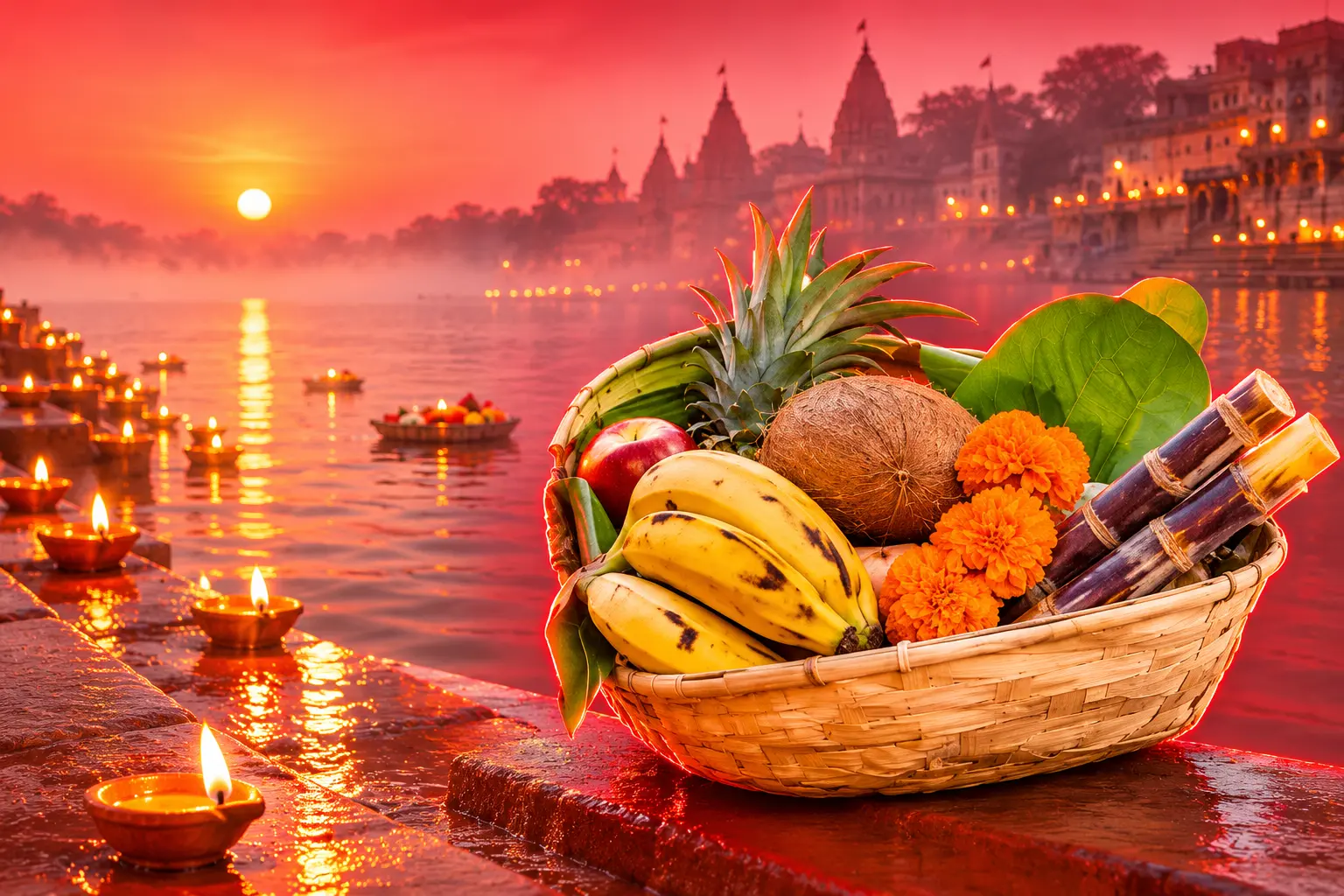
Bihar still holds the festival’s centre of gravity, and the state ran it as a logistics job. Rituals were set for 10,599 public ghats on rivers, lakes and ponds, with many more families using tanks in courtyards and on terraces. Conservative estimates said more than a crore people, including migrant workers and their families, would come back by train, bus, flight and road.
Along the Ganga in Patna, 103 ghats sit on the river. Five were marked dangerous, so work went into the remaining 98. The Patna Municipal Corporation listed facilities at 92 river ghats and 103 ponds, 66 of them permanent and 37 artificial. For the crowds it added 552 temporary toilets, 450 urinals, 400 changing rooms and 13 rest sheds. Sandbags were stacked in the shallows so vratis could stand; bamboo fences were pushed into deeper water to keep people off the current.
Chief Minister Samrat Chaudhary told officials to put swimmers on rural ghats, keep bare electric wires off the banks, and make returnees “feel happiness on coming to their native state.” Bihar Police deployed 16,000 trainee constables plus 1,500 constables, home guards and Rapid Action Force companies on top of regular strength. Disaster teams were posted at 254 ghats by the SDRF and at 123 by the NDRF.
BIHAR AND DELHI, SIDE BY SIDE
| Place | Sites prepared | What else the count hides |
|---|---|---|
| Bihar public ghats | 10,599 | More than a crore people expected home |
| Patna Ganga ghats | 98 of 103 | Five marked dangerous; 552 extra toilets |
| Delhi | 1,482 ghats at 996 locations | 81 permanent, 1,372 temporary, 29 on the Yamuna |
Welcome gates went up in 18 border districts, from Kaimur and Buxar to Kishanganj and Purnea, because Chhath traffic crosses state lines and the Nepal frontier. Folk songs were queued in secretariat offices each afternoon. The festival is still Bihar’s, and the state now stages it like a harvest of people.
Delhi Now Runs Chhath as Civic Work
Delhi’s BJP government under Chief Minister Rekha Gupta prepared 1,482 ghats at 996 locations, a higher count than last year, and declared 16 November a public holiday. The split published by the government is 81 permanent ghats, 1,372 temporary ones and 29 along the Yamuna. More than 5,000 police were put on crowd and traffic duty, with cameras and watchtowers on the busier banks.
The showpiece is an 11-kilometre Chhath ghat on the Munak Canal from Shalimar Bagh to Inderlok, opened by Gupta and BJP national president Nitin Nabin. The government said the stretch had sat neglected for nearly two decades, that about 1,400 truckloads of garbage, debris and silt came out of it, and that the work cost Rs 115.29 crore. The Delhi Jal Board is feeding the canal from the Haiderpur Water Treatment Plant. The site is built for more than 30,000 people at a time and is meant to serve five Assembly seats.
WHAT THE MUNAK CANAL GHAT ADDED
- Banks: Permanent steps were cut along both sides of the canal so vratis can stand in a controlled depth.
- Access: Paved roads, benches, lights and CCTV were added after encroachments were cleared.
- Women’s rooms: Changing rooms and public toilets sit on the same stretch, which is the practical test for a women’s water vrat.
- Water: Treated supply from Haiderpur is the substitute for a river that still fails a dip.
Where the Yamuna stays foul, the city put up artificial and filtered-water ghats, including at Vasudev Ghat. Gupta has said about 26 kilometres of the river were cleaned in 20 months, and she walked cleanliness drives at 70 ghats under a ‘Chalo Yamuna’ campaign. In October the Centre launched Yamuna works worth about Rs 8,941 crore. The filtered tanks exist because that work has not yet given vratis a river they trust.
How Chhath Left the Ganga Belt
Chhath is the sun-and-water vrat of Bihar, Jharkhand, eastern Uttar Pradesh and the Nepal Terai. It travelled because people did. Bhairab Lal Das, INTACH Bihar convenor, traces one line of that movement to indentured workers shipped out of old Bihar between 1834 and 1920, and another to post-1990 migration into the United States, Europe, Russia and parts of Asia and Africa.
The festival spread with ‘Girmitiya’ or indentured labourers transported from the erstwhile Bihar to British, French and Dutch colonies across the world between 1834 and 1920 to work at sugar, rubber, tea plantations and agricultural farms in Mauritius, South Africa, Kenya, Uganda, Fiji, Guyana, Trinidad and Tobago, Suriname, Jamaica, Grenada, Seychelles, Malaysia and other countries. The people of Bihar origin in those countries still celebrate Chhath.
Bhairab Lal Das, INTACH Bihar convenor
The same carry is visible inside India. In 1978, a Delhi organiser later recalled only four devotees at a Yamuna ghat near the ITO barrage. The capital now lays more than a thousand ghats because Purvanchali families made the rite local. Kolkata keeps it on Hooghly steps such as Babughat and on neighbourhood ponds after courts restricted rituals at Rabindra Sarobar. Mumbai uses Juhu and Versova because mill and construction workers from the Ganga belt needed a shoreline they could walk to.
The festival’s present map follows those jobs. Dawn video on 16 November came not only from Patna but from Moga, Varanasi’s Ganga ghats, Ghaziabad’s Koel Enclave tank and Kolkata’s Kadamtala Ghat. That is not a branding campaign. It is families rebuilding a waterline in the cities that hired them, then standing in it before sunrise.
Nabin Took a Steamer Down the Ganga Ghats
Politics has followed the crowd. On 10 November, Nabin inspected Patna’s Ganga ghats by steamer, riding from Nasriganj Ghat at Digha toward Gay Ghat and Kangan Ghat with Chaudhary, deputy chief minister Vijay Kumar Chaudhary and Bihar BJP president Sanjay Saraogi. He checked levelling, barricades, watch towers, women’s changing rooms, drinking water, lights and emergency medical posts, and said every vrati should get a clean, safe bank.
On the final morning he was in Patna with his wife, Deepmala, carrying a daura and offering Usha Arghya. He told cameras he bowed to Lord Bhaskar and Chhathi Maiya after “a period marked by rigorous discipline and physical hardship,” and that Bihar’s message of cleanliness and discipline was travelling with the festival. During Kharna he had already argued that the rite makes no cut between the ordinary and the prominent, which is why, in his telling, a Bihar tradition now reads as a national one.
The circuit was wider than Patna. Chaudhary did morning arghya at a Munger ghat. In Gorakhpur, BJP MP Ravi Kishan offered the dawn rite at Bhim Sarovar inside the Gorakhnath Temple premises and said, “Chhath Maiya’s blessings are incredible.” In Delhi, BJP MP Manoj Tiwari stood at Sonia Vihar Ghat. In Jashpur, Chhattisgarh Chief Minister Vishnu Deo Sai and his wife went, as they do each year, to his Kunkuri constituency, offered arghya, and performed bhumi pujan for a new Chhath ghat with funds already sanctioned for women’s facilities.
Leaders want to be seen in the water because the vratis are a voting public that now lives in Delhi, Mumbai and the Gulf as much as in Shahabad or Mithila. The daura on a party president’s head is part of that math. It does not do the 36-hour fast for the women who actually keep it.
A UNESCO File Shared With Mauritius
Behind the greetings sits a heritage bid. Union culture minister Gajendra Singh Shekhawat told the Rajya Sabha that the government had decided on a multinational nomination of Chhath Mahaparva for UNESCO’s Representative List of the Intangible Cultural Heritage of Humanity, that Mauritius was contacted and showed keen interest, and that a completed dossier, including film and consent letters, had been sent. Sangeet Natak Akademi is the nodal body. After Deepavali’s inscription in December 2025, India has 16 elements on that list, and UNESCO’s rules allow only one nomination in a two-year cycle.
On 16 September 2025, culture secretary Vivek Aggarwal met diplomats from the UAE, Suriname and the Netherlands at the Indira Gandhi National Centre for the Arts, with the Ministry of External Affairs, the Akademi and IGNCA in the room, to build that multinational file. A living tradition that already exists in those diasporas is easier to argue as more than a Bihar district calendar. India’s UNESCO mission repeated the 2027 aim while the arghya was still under way.
On the auspicious occasion of Chhath Mahaparv, heartfelt greetings to all devotees celebrating this sacred festival.
A profound expression of devotion to Surya Dev and Chhathi Maiya, Chhath celebrates gratitude to nature, purity, discipline and humanity’s enduring bond with the… pic.twitter.com/M4UNuzYiio
— India at UNESCO (@IndiaatUNESCO) November 15, 2026
INTACH Bihar spent two years on documentation and still talks of songs, thekua, soops and the open ghat as the core of the file. Das calls Chhath a festival of equality in which other religions often help or even keep the vrat. Inscription is not a fact in hand. The file is.
Polluted Water, and the Women Who Stand in It
Chhath has almost no idol and almost no shortcut. Offerings are milk, jaggery, sugarcane, fruit and thekua carried in cane soops. Vratis go barefoot in freshly washed cloth. The rite needs a waterline facing the sun, which is why a dirty Yamuna is not a side issue. Delhi can open 1,372 temporary ghats and still have to truck in filtered water because standing in the river, for many families, is the point.
Bihar’s answer is fences, sandbags, trainee constables and divers. Delhi’s answer is a canal rebuilt at Rs 115.29 crore and a holiday so office-goers can reach a bank. Chhattisgarh’s answer, on the morning the fast broke, was a groundbreaking for a ghat that does not yet exist. Each is a state learning that a women’s river vrat, once ignored outside the Ganga belt, now has to be staffed, lit, cleaned and filmed.
In Kunkuri, Sai said he had come for the mothers keeping the vrat and for the sun. After Usha Arghya the prasad went round, the nirjala clock stopped, and the temporary bamboo came down. The 81 permanent Delhi ghats will wait for Kartik again. The women who stood in the water were the festival. The rest was scaffolding.
Frequently Asked Questions
What Is Usha Arghya in Chhath Puja?
Usha Arghya is the dawn offering to the rising sun on the fourth day, on Kartik Shukla Saptami; some regions also call it Bhorwa Arghya. Vratis return to the same water used for Sandhya Arghya, stand in it before sunrise, pour arghya, then perform parana, the formal breaking of the fast with prasad shared through the family and the ghat.
How Long Is the Chhath Puja Fast?
After Kharna on the second evening, many vratis eat one meal of jaggery-rice kheer and roti and then refuse both food and water until Usha Arghya, a nirjala stretch of about 36 hours. They do not break that fast after the Sunday sunset offering; they remain at the ghat through the night and eat only once the Monday sunrise rite is complete.
What Is a Soop in Chhath Rituals?
A soop is a flat cane-strip winnowing basket that holds the offering, usually thekua made of wheat flour, milk, ghee and sugar or jaggery, plus fruit and sugarcane. Male relatives often carry the loaded soops and dauras to the bank while the vrati, most often a woman, stands in the water for arghya.
Why Do Chhath Offerings Have to Meet Water?
The vrat is sun worship performed from a river, pond or tank, not from a temple floor, and INTACH workers documenting the rite put it bluntly: no one offers this prayer to the sun without water. That is why cities that lack a clean river now dig ponds, fill canals with treated water, and still watch families walk back to the Yamuna or the Ganga when they can.

ADNOC Ship Hit in Hormuz Leaves One Crew Missing

SpiceJet’s Rs 5,500 Crore Plan Follows a Rescue That Failed

Hasina’s Return Fight Sets Fire to Yunus’s Bank

Bancroft Recants the 2018 Inquiry and Names the Team

Adhikari Ties the Saffron Saree Row to School Licences

Clancy Juror Says the Holdout Never Cited Evidence

The iPhone 18 Pro Max Splits Apple’s Fall in Two

OpenAI Calls GPT-6 Astra AGI Then Locks Its Exploits

Trump Claims Hormuz Control as Oil Holds Near $96

Russia Closes the Goethe-Institut Berlin Tried to Save

 NEWS2 months ago
Clancy Juror Says the Holdout Never Cited Evidence
- NEWS3 months ago
The iPhone 18 Pro Max Splits Apple’s Fall in Two
- NEWS3 months ago
OpenAI Calls GPT-6 Astra AGI Then Locks Its Exploits
- BUSINESS3 months ago
Trump Claims Hormuz Control as Oil Holds Near $96
- LIFESTYLE3 months ago
Russia Closes the Goethe-Institut Berlin Tried to Save
- AUTO3 months ago
Volkswagen’s Job Cuts Leave Four Plants Without Cars
- NEWS3 months ago
Dyson Puts Nurovi Robots on Sale Without the UV Flagship
- BUSINESS2 months ago
US Destroys Five Iranian Tankers as the Shock Hits Jordan










