
NEWS
Duffy Demands $50 Billion After FAA Grounds U.S. Flights
Old FAA switches failed while new IP gear held, stopping U.S. departures for more than four hours and lifting Duffy’s rebuild ask to $50 billion.

The FAA halted every U.S. departure at 3:54 p.m. Eastern on Friday after overloaded routers in the en-route telecom network began sending bad data. Airspace reopened at 8:15 p.m., more than four hours later, with crews, jets and connecting banks already out of place.
Transportation Secretary Sean Duffy said the old hardware failed and the new IP switches did not. That night he told Congress he wanted $50 billion to rebuild the system, hours after a $30.1 billion request had already gone to the Hill.
The FAA Halted Every U.S. Departure at 3:54 p.m.
Duffy said instability in radar and communications showed up at 3:36 p.m. Eastern at the Air Route Traffic Control Centers, the 22 rooms that handle high-altitude traffic between airports. Chicago O’Hare and Midway already had local stops on the board for equipment trouble. Then the Command Center made it national.
The Command Center nationwide ground stop order told every operator the same thing: all airports are ground stopped, departing traffic stays put, inbound international flights are handled case by case. The stated reason was “extraordinary circumstances and for reasons of safety.”
THE FRIDAY CLOCK
- 3:36 p.m. Eastern: Duffy said centers began seeing inconsistent radar and radio data.
- 3:54 p.m. Eastern: The Command Center stops every U.S. departure. FlightRadar24 counted 4,042 flights already bound for U.S. airports. Duffy said more than 3,500 aircraft were in the air.
- About 6 p.m. Eastern: The stop remains in effect. Some transatlantic departures are cleared one by one. Alaska and Hawaii island flying continues.
- 8:15 p.m. Eastern: Duffy says the airspace is open. The FAA says it tested the network before releasing departures.
- 8:29 p.m. Eastern: FlightRadar24’s low point, 336 flights worldwide still bound for U.S. airports, against a normal evening load of more than 3,600.
Planes already airborne were allowed to continue and land. Duffy said the FAA never lost all radar or all telecom, and that medevac, lifesaving cargo and law-enforcement flights kept flying. By the time the stop lifted he said fewer than 400 aircraft remained in the air. The safety procedure did what it is built to do. It also froze a Friday night bank that does not reset itself.
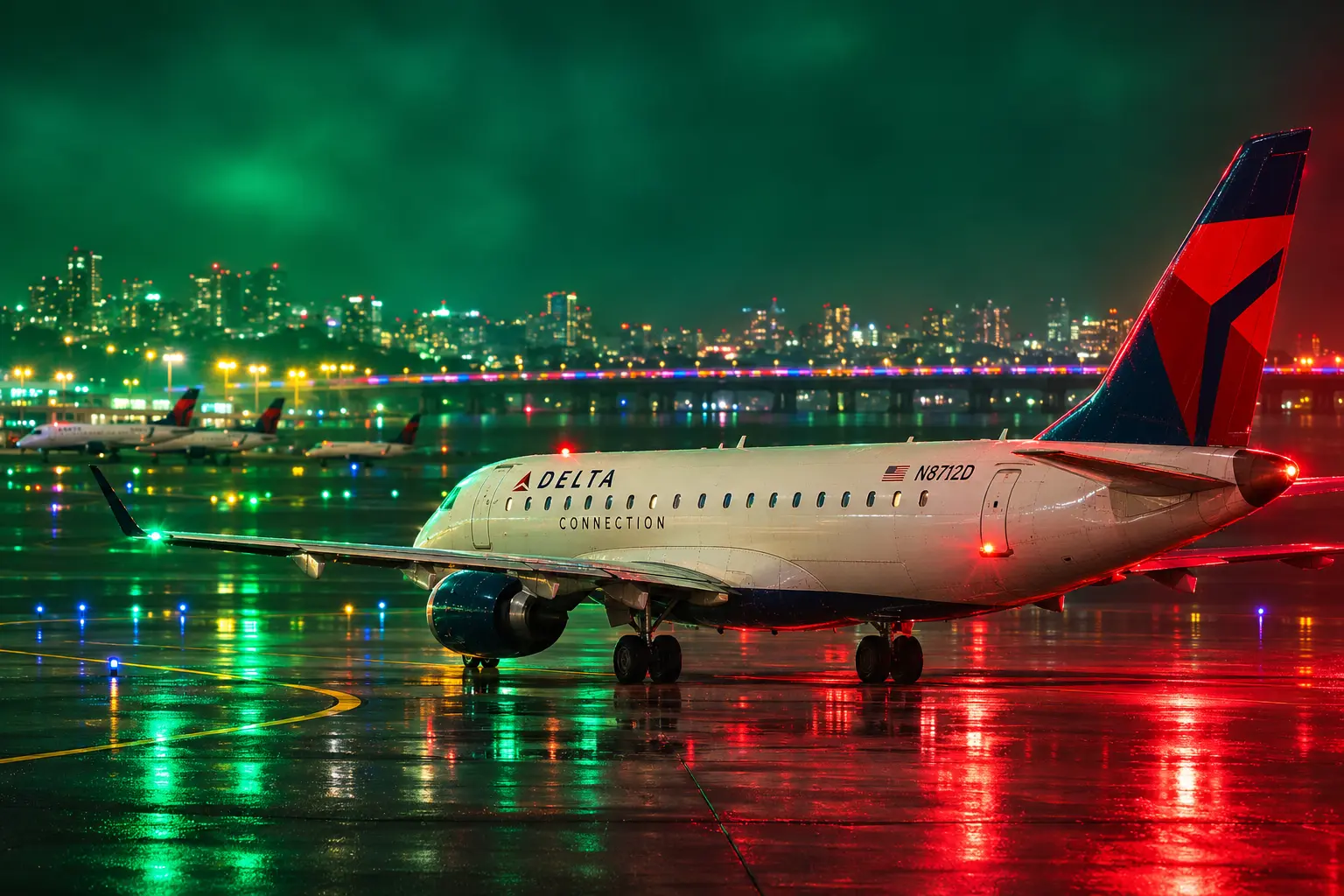
Why the Old Routers Overloaded
Duffy’s account is blunt. Analog switches and routers took more data than they could handle, then handed controllers mixed readings, so the agency shut departures down rather than trust the feed. He said the FAA is still running 1980s copper in places, and that technicians deployed fixes before the restart.
Our switches, our routers actually got overloaded with data and they started to give us inconsistencies in the data from those routers, and because of that we shut the system down.
Sean Duffy, U.S. transportation secretary, White House briefing
He added that IP switches already swapped in under the current rebuild stayed up. “It’s the old hardware that went down,” he said. Homeland Security Secretary Markwayne Mullin described the same failure from the other side of the patch: new technology was being laid onto older plant, and the older plant was overwhelmed. Duffy, asked whether new software caused the stop, said the system got overloaded with data during a new software patch. He denied that the FAA’s SMART traffic tool took the network down.
WHAT FAILED AND WHAT HELD
- What failed: Legacy analog switches and routers on the en-route telecom side, which Duffy said began sending inconsistent radar and radio data.
- What held: Newer IP switches already installed in the rebuild; Duffy said those units did not go down.
- What was never fully lost: Radar and voice, according to Duffy; airborne aircraft kept landing under existing procedures.
- What officials ruled out, so far: A cyberattack or a terrorist plot. Mullin said investigators had seen zero evidence of either, with “not complete certainty” until the review finishes. The NSA was working with Homeland Security on that review.
Ron Bartsch, a professor of international aviation law at the University of the South Pacific, put the question the industry always asks when a backup is slow to take over. Aviation is built on redundant paths, he said, so a redundant system that does not kick in at once “raises more questions than what we’ve seen answers to at this stage.” Duffy’s own warning sat next to that: without an upgrade, “you will have more of these.”
He first told the country about the stop on his official account, before the White House briefing that recast it as a funding emergency.
The @FAAnews issued a nationwide ground stop for all U.S. airports following a communication issue impacting all Air Route Traffic Control Centers. FAA technicians are investigating the issue. We will provide immediate updates as we have them.
— Secretary Sean Duffy (@SecDuffy) November 13, 2026
Duffy Raised the Ask to $50 Billion After the Stop
The money fight did not start at 8:15 p.m. Duffy and White House budget director Russell Vought had already sent Congress a $30.1 billion aviation package on Friday, including $10.1 billion for air traffic control modernization. That ATC slice names $7.2 billion for a common automation platform and controller workstations and $2 billion for cloud computing, with separate lines of $2 billion for towers and $18 billion for airport work.
In September Duffy had already been $30 billion to complete the overhaul he calls a brand-new air traffic control system, on top of a $12.5 billion down payment written into the 2025 reconciliation bill. Friday night he moved the number again.
THE FUNDING STACK
- Already law: $12.5 billion from the 2025 bill, which the Department of Transportation says is paying for copper-to-fiber swaps, radios, voice switches and hiring.
- Friday morning letter: $30.1 billion more for airports and air traffic control, with $10.1 billion aimed at the control system itself.
- Friday night: Duffy’s $50 billion figure for a complete overhaul. “This is an emergency,” he said. “The president’s asked for $30 billion. I want $50 billion.”
American Airlines, Delta Air Lines, United Airlines and Southwest Airlines have backed the $30.1 billion letter. The louder objection, including in replies to the White House briefing, is that Republicans already hold Congress, $12.5 billion is already in the pipeline, and the same analog plant is still in the path of live traffic. Duffy’s answer is that the down payment does not finish the job, and that a Friday night press conference is what you get until it does.
“With a brand new state of the art system, we wouldn't have these outages…
At 8:15 tonight, eastern time, we've opened up the air space…"
Secretary Mullin & Secretary Duffy provide an update on the FAA National Ground Stop. pic.twitter.com/twTyQ9UJQ0
— The White House (@WhiteHouse) November 14, 2026
1.5 Million Passengers Were Still Booked After 4 p.m.
Cirium, the aviation data firm, had about 11,000 U.S. departures carrying more than 1.5 million passengers still on the schedule after 4 p.m. Eastern, just after the national order. Duffy said tens of thousands of travelers were stranded. Getting them moving again depends on pilots and flight attendants still being legal for duty, and on aircraft sitting at the right gates rather than the ones they missed.
FRIDAY’S TALLY
- Canceled: More than 6,600 flights Friday, per FlightRadar24, with 1,500 already canceled for Sunday.
- Delayed: 8,600 flights Friday, same tracker.
- Diverted: 827 flights by 7:05 p.m. Eastern, Cirium said, including 670 that returned to their origin and 157 sent elsewhere.
- Still inbound at the low point: 336 flights bound for U.S. airports at 8:29 p.m. Eastern, FlightRadar24 said, against more than 3,600 on a normal night.
A ground stop does not only park airplanes. It burns crew legal time on the ground, breaks hub banks, and leaves the next day’s first wave short of aircraft. JetBlue told staff it would cancel the rest of Friday’s flying except European routes, and cut Saturday flying so crews and jets could be in place to start again. Todd Curtis, an aviation safety expert and chief executive of AirSafe.com, said even a clean technical fix would take more than a day to unwind because so many itineraries connect through a handful of hubs.
At Los Angeles International, passenger Nicholas Erdodi, inbound from New Zealand and trying to reach a Chicago conference, said he had already been traveling 16 to 18 hours, then sat another six hours after passengers were taken off a plane. “The challenge is you cannot ask anyone here what to do,” he said. “It doesn’t matter if someone tells us that we don’t know what’s happening, but please just let us know what’s going on.”
The Last Two Nationwide Stops Were 9/11 and a Deleted File
A ground stop at every U.S. airport is rare enough that Friday had only two modern comparisons, and they were not the same event. Friday was the first nationwide departure halt since January 11, 2023, and only the third on the public record if September 11, 2001, is counted. It was also the longest of those stops since 2001, because the 2023 order lasted about 90 minutes.
THREE NATIONWIDE STOPS
| Date | Trigger | How long departures were held | Aircraft already airborne |
|---|---|---|---|
| Sept. 11, 2001 | Hijackings | Civilian takeoffs banned from 9:25 a.m.; airspace closed until Sept. 13 | About 4,500 commercial and general aviation aircraft ordered to land |
| Jan. 11, 2023 | NOTAM database files deleted during a backup sync | About 90 minutes from 7:30 a.m. Eastern | Flights in the air continued to destination |
| Nov. 13, 2026 | Overloaded legacy telecom switches and routers | 3:54 p.m. to 8:15 p.m. Eastern | Flights in the air continued; 827 diversions by early evening |
The 2023 failure was a contractor accidentally deleting files in the Notice to Air Missions system, the feed that warns pilots about closed runways and other hazards. There was no failover. Friday’s failure sat one layer down, in the voice and data paths the en-route centers use to talk to each other and to aircraft.
It also sat on a year of smaller comms breakdowns. On September 21, 2026, primary and backup data links failed at the Philadelphia terminal radar approach control, and the FAA halted flights into New York, Philadelphia, Boston and Washington for eight hours. A Dallas terminal radar outage produced a separate fight over backups, with the FAA saying contractor L3Harris had not kept redundancies in place and L3Harris saying the analog circuits were end-of-life and still waiting on federal replacement money.
L3Harris Still Operates the FAA’s Telecom Backbone
People familiar with the network said an update to the private communications system that ties U.S. air traffic facilities together prompted a reboot, and that the reboot crashed. That system is the FAA Telecommunications Infrastructure, run by L3Harris Technologies, a Florida defense contractor whose Harris predecessor won the work in 2002. It carries the voice and data links among more than 4,400 FAA sites, including the radios controllers use to reach pilots. L3Harris did not comment. The FAA has confirmed only a temporary telecom outage.
Three days before the stop, the FAA said it would now use SMART in the airspace of all 22 centers. SMART, built by Air Space Intelligence, is a cloud tool that reads about 200 data streams and recommends reroutes. The agency said that since a September start around Washington it had helped reroute 180 flights, saving about 10 minutes and almost 80 gallons of fuel each. Air Space Intelligence said Friday’s stop was not based on or a result of SMART. Duffy said the same. The timing still made SMART the first suspect, because the radios went inconsistent after a national expansion of a new software layer sitting on top of analog plant.
WHAT WE KNOW
- The official cause: Duffy said legacy switches and routers overloaded and returned inconsistent data, and that newly installed IP switches stayed online.
- The official non-causes, so far: Mullin said there was no sign of a cyberattack or a terrorist plot, and no reason to tie the stop to a separate Microsoft outage the same day.
- The rebuild already in motion: The Transportation Department says the 2025 money has already replaced nearly 50 percent of copper wires, converted about 270 radio sites, put surface awareness systems at 54 airports, and moved 17 towers onto electronic flight strips.
WHAT IS UNCONFIRMED
- The L3Harris update: An update-and-reboot crash is the account from people familiar with the network. Neither the FAA nor L3Harris has confirmed it.
- How a patch hit analog gear: Mullin and Duffy both described new load on old plant. The exact software, switch model and facility that tipped first have not been named.
- Whether another stop is likely before Thanksgiving: Duffy would not rule out another outage on the current hardware. He also said he expected the operation to be back up as Thanksgiving travel builds.
NATCA president Nick Daniels has said controller staffing cannot be swapped out for software. The Department of Transportation says towers now have about 11,000 controllers and more than 4,000 trainees, with nearly 2,400 hires since March 2025. Friday was not a staffing event. It was a network event that staffing cannot talk around.
Thanksgiving Travel Starts With Jets and Crews Out of Place
Duffy told travelers it would be slow, and that the FAA would need time to get back to capacity. He still said he expected the system to be up as the Thanksgiving rush arrives. That is a crew-and-aircraft problem as much as a router problem. Jets that overnighted in the wrong city, and pilots who timed out on Friday, do not appear on Saturday’s first departure bank because a secretary held a briefing.
Passengers were told to check with their airlines, not with the FAA’s clock. International arrivals that had been handled case by case still had to find gates, customs lines and onward seats in a network that had been frozen in late afternoon. Curtis’s point about hub connections is the part that lasts after the lights on the switches go green: a missed Chicago or Atlanta bank on Friday becomes an empty Sunday seat and a hotel night someone else has to pay for.
Duffy used the open microphone to tell Congress the country should not have to hear why air travel shut down at 8:30 at night. The routers that failed were the old ones. The new ones, he said, kept working. The mix of the two is still what U.S. departures fly on, including the ones already booked for Thanksgiving week.

ADNOC Ship Hit in Hormuz Leaves One Crew Missing

SpiceJet’s Rs 5,500 Crore Plan Follows a Rescue That Failed

Hasina’s Return Fight Sets Fire to Yunus’s Bank

Bancroft Recants the 2018 Inquiry and Names the Team

Adhikari Ties the Saffron Saree Row to School Licences

Clancy Juror Says the Holdout Never Cited Evidence

The iPhone 18 Pro Max Splits Apple’s Fall in Two

OpenAI Calls GPT-6 Astra AGI Then Locks Its Exploits

Trump Claims Hormuz Control as Oil Holds Near $96

Russia Closes the Goethe-Institut Berlin Tried to Save

 NEWS2 months ago
Clancy Juror Says the Holdout Never Cited Evidence
- NEWS3 months ago
The iPhone 18 Pro Max Splits Apple’s Fall in Two
- NEWS3 months ago
OpenAI Calls GPT-6 Astra AGI Then Locks Its Exploits
- BUSINESS3 months ago
Trump Claims Hormuz Control as Oil Holds Near $96
- LIFESTYLE3 months ago
Russia Closes the Goethe-Institut Berlin Tried to Save
- AUTO3 months ago
Volkswagen’s Job Cuts Leave Four Plants Without Cars
- NEWS3 months ago
Dyson Puts Nurovi Robots on Sale Without the UV Flagship
- BUSINESS2 months ago
US Destroys Five Iranian Tankers as the Shock Hits Jordan










