
BUSINESS
The Tariff Edge India Was Promised Is Still Unwritten
The US promised India a tariff ranking over rival exporters, yet Indian goods still pay the same 10% forced-labour duty as several of those rivals.

The United States has told India it will hold a comparative tariff advantage over rival exporters once Washington finishes its tariff schedule, a senior Indian commerce official said on November 13. Both sides are still trying to close a first, goods-only slice of their interim deal by the end of India’s current financial year.
The promise is the condition New Delhi has repeated all year. It is also a ranking in a stack the United States has not published, while Indian goods already pay the same extra 10% forced-labour duty as several of the rivals India wants to beat.
A Ranking Washington Still Has Not Written
The official, speaking on condition of anonymity because the talks are private, said the United States had “assured us of a comparative advantage over our competitor countries.” Commerce and Industry Minister Piyush Goyal has said for months that India would sign only with that ranking in hand, pointing back to the February 6 joint statement in which the two governments pledged preferential market access on a sustained basis.
Commerce Secretary Rajesh Agrawal said a small US team was in India in the first week of November for customs and trade facilitation talks. “The discussions went off in a very positive direction. A lot of issues were closed, and there was convergence in a lot of areas,” he said. Chief negotiators still meet by video to “iron out some of the language issues or some of the small fixes that remain in the agreement.”
No US rate table was issued with the assurance. The official said the ranking would be set once the United States “finalises its tariff structure,” and that the promise already “takes into account” duties that could still be added. Indian political accounts treated the line as a finished win. Washington did not post a matching confirmation.
WHAT WE KNOW
- The promise: An Indian commerce official said on November 13 that the United States had assured India a comparative tariff advantage over competitor countries.
- The live extra duty: Indian goods pay an additional 10% Section 301 forced-labour tariff, in force since July 24, 2026.
- The first cut: Officials say the first tranche covers goods; services are left for a later round.
- The written escape: The February 6 joint statement already lets either country modify commitments if agreed tariffs change.
WHAT IS UNCONFIRMED
- Published rates: The United States has not issued the finished schedule that would make the promised ranking readable.
- A US on-record echo: No White House or USTR statement this week restated the comparative-advantage assurance.
- An excess-capacity duty: A second Section 301 file covering India still has no published rate.
- A December signing: A former US diplomat has floated the G20 in Florida as a political window; that is not the Indian official timeline.
Goyal told a New Delhi industrial conference on October 29 that the country would “stand at a very strong comparative advantage” once details were public, and that farm interests would not be traded away. The details are still the missing piece.
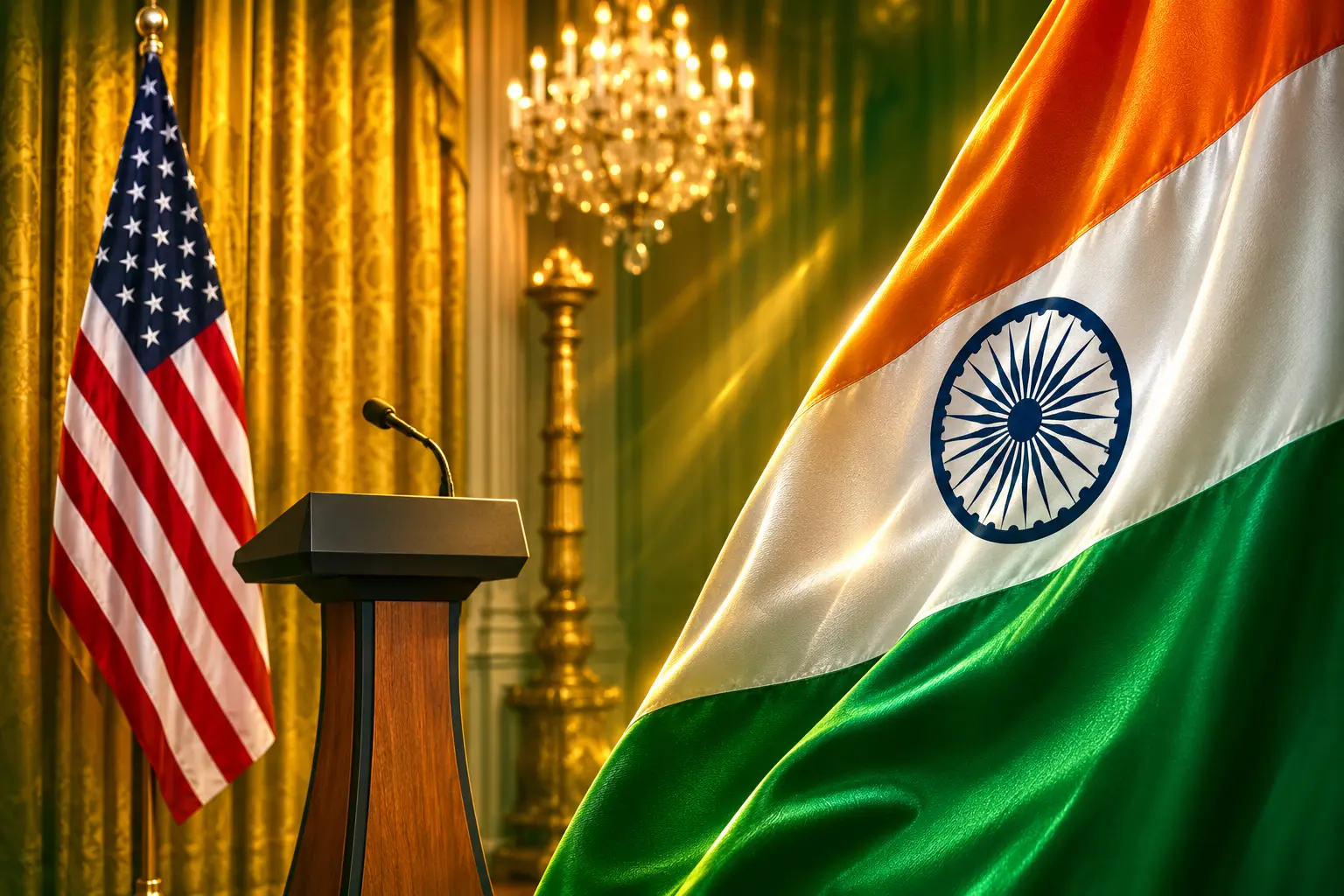
India Already Shares a 10% Duty With Named Rivals
The ranking India is chasing is easy to confuse with the 18% reciprocal rate announced in February. That figure sat on a different legal layer, and that layer did not survive the year intact.
On February 9 the White House said it would Reciprocal Tariff on India from 25% to 18% under the April 2025 reciprocal-tariff order, and that President Donald Trump had also signed an order lifting an extra 25% duty tied to Russian oil. The February 6 joint statement listed Indian textiles and apparel, leather and footwear, plastics, organic chemicals, home décor and some machinery among the goods that would face that 18% reciprocal rate. Subject to a finished interim deal, it also said the United States would take the reciprocal tariff off generic medicines, gems and diamonds, and aircraft parts.
On February 20 the Supreme Court held that the emergency-powers statute used for those reciprocal tariffs did not authorise them. Collection stopped. A temporary 10% surcharge under a different statute filled 150 days. On July 24 the surcharge lapsed, and a new extra duty landed under Section 301 of the Trade Act of 1974.
USTR, acting at the president’s direction, imposed 10 percent Section 301 duties for 17 economies that it said already ban forced-labour imports, have promised to do so in a reciprocal-trade deal, or run a partial ban. India is on that list with Bangladesh, Cambodia, Indonesia, Malaysia, Pakistan, Sri Lanka, Argentina, Canada, Mexico, the United Kingdom and six others. All other investigated economies, including Vietnam and China, were set at 12.5%.
LIVE SECTION 301 FORCED-LABOUR RATES
| Origin | Extra Section 301 duty | Same 10% list as India |
|---|---|---|
| India | 10% | Yes |
| Bangladesh | 10% | Yes |
| Indonesia | 10% | Yes |
| Malaysia | 10% | Yes |
| Pakistan | 10% | Yes |
| Sri Lanka | 10% | Yes |
| Cambodia | 10% | Yes |
| Vietnam | 12.5% | No |
| China | 12.5% | No |
On this live layer, India is 2.5 points below Vietnam and level with Bangladesh, Indonesia, Malaysia, Pakistan, Sri Lanka and Cambodia. Ambassador Jamieson Greer, the US Trade Representative, said the action followed two rounds of hearings, more than 2,100 public comments, and talks with more than 45 governments. USTR then took another 1,600 comments on the proposed remedy and heard more than 100 witnesses in July.
President Trump recognizes that decades of moral suasion have not eradicated forced labor from global supply chains. The United States has had a forced labor import ban for nearly a century, and rigorously enforces it; it’s well past time for our trading partners to do the same.
Jamieson Greer, US Trade Representative, July 23, 2026
The 10% charge is extra, on top of the normal US product rate, unless a listed exemption applies. It is the duty Indian exporters are paying now, not the 18% reciprocal figure from the February framework.
Zero-Duty Cotton Access Went to Bangladesh First
Goyal has named Vietnam, Thailand, the Philippines, China, Malaysia, Bangladesh and Sri Lanka as the manufacturing peers India wants to outrank. Several of those peers already have a paper trail India does not.
Bangladesh signed a reciprocal-trade agreement with the United States in February, in the same week as the India framework. Greer called Bangladesh the first South Asian country to complete such a deal. That pact cut the then-reciprocal rate on Bangladeshi goods to 19% and, more important for garments, gave zero-duty access to some apparel made with US cotton and other US inputs.
The July Section 301 notice then pointed to another cotton channel that again omits India. USTR said it would, when feasible, set quotas tied to US cotton inputs so a set volume of textiles and apparel from Bangladesh, Cambodia, Indonesia and Malaysia could enter free of the 10% forced-labour duty. The start date was left to a later notice. India is not on that four-economy list.
WHERE INDIA IS NOT ON THE COTTON PAPER
- Bangladesh’s February deal: Zero-duty access for some garments made with US cotton and man-made fibre, plus a signed reciprocal-trade text.
- The four-economy quota track: Bangladesh, Cambodia, Indonesia and Malaysia were named for tariff-rate quotas linked to US cotton and textile inputs.
- India’s position: In the 10% forced-labour bucket, with no matching cotton quota named in that notice.
For apparel buyers who can shift orders, that is already a relative ranking, and it does not run in India’s favour. Vietnam pays the higher 12.5% forced-labour duty, which is the one comparison that currently helps Indian goods on this layer. Bangladesh, the garment rival that most often sits in the same US shopping cart, does not.
What Comparative Advantage Would Mean for Exporters
Comparative advantage, in the way Indian negotiators have used the phrase, is a relative duty, not a headline rate. Goyal’s test is whether an Indian shirt, tyre, generic medicine, or auto part faces a lower US tariff than the same goods from Vietnam, Bangladesh, China or Malaysia after every US add-on is stacked.
The February framework sketched one version of that test and then lost its legal floor. It put Indian textiles and apparel on the 18% reciprocal list, promised to strip the reciprocal tariff off generic medicines if the interim deal closed, and offered a preferential tariff-rate quota on auto parts that now sit under a separate national-security tariff. It also tied generic-drug outcomes to a US Section 232 probe of medicines and ingredients that had not finished.
India, for its part, agreed to cut or scrap tariffs on all US industrial goods and on a wide farm list that includes distillers’ grains, sorghum for feed, tree nuts, fruit, soybean oil, wine and spirits. It also said it intended to buy $500 billion of US energy, aircraft and parts, precious metals, technology products and coking coal over five years, and to ease long-running blocks on US medical devices, some ICT goods, and farm products.
US Secretary of State Marco Rubio said in October that the two sides were close to an interim deal, then declined to say whether Washington would grant the competitive tariff edge India was seeking. Nisha Biswal, a former assistant secretary of state for South and Central Asia, later described the talks as complicated and said negotiators still had to work through India’s demand for a comparative advantage in textiles. That is the sector where Bangladesh’s cotton paper and India’s 10% duty sit side by side.
I have the courage of conviction to announce boldly that the US trade deal, once the details are out, the people of India will celebrate that not a single sensitive interest of our farmers or any stakeholder has been compromised. India will stand at a very strong comparative advantage.
Piyush Goyal, commerce and industry minister, ISID-IDRA National Conference, New Delhi, October 29, 2026
The first tranche now on the table is goods only. Services, including the IT and business-process exports that dominate India’s sales to the United States, are slated for a later round. A ranking that covers shirts and skip the software is a ranking in the slice New Delhi can still lose to Dhaka and Ho Chi Minh City.
February’s Text Already Lets Either Side Rewrite Terms
The insurance policy Indian officials are now describing as unusual was already in the February 6 joint statement. The commerce official said this week that the two sides had agreed that if either country changes tariffs on the other, the second country may modify its own commitments, and that such a clause is “not usual” in deals India signs. The White House text from February is the same idea in plainer English.
In the event of any changes to the agreed upon tariffs of either country, the United States and India agree that the other country may modify its commitments.
United States-India Joint Statement, The White House, February 6, 2026
That sentence is why the new assurance can be given before the schedule exists. If the United States later adds an excess-capacity duty, or rewrites the forced-labour rates, or rebuilds a reciprocal tariff on a different statute, India can reopen what it offered on industrial goods, farm products, medical devices and ICT licensing. The United States can do the same if India moves.
It is a useful clause in a year when US tariff law has already jumped from an emergency-powers order to a Supreme Court loss to a 150-day stopgap to a 60-economy Section 301 action. It is also a confession. A deal that needs an automatic rewrite rule is a deal both sides expect to reopen.
Sixteen Economies Await an Excess-Capacity Finding
The forced-labour duty is the Section 301 file that has already produced a number. A second file has not, and it is the one the November 13 official said the new assurance already prices in.
On March 11, USTR opened investigations under Section 301(b) into structural excess capacity and production in manufacturing. Sixteen economies were named, including India, China, the European Union, Vietnam, Bangladesh, Indonesia, Malaysia, Cambodia, Japan, Korea, Taiwan, Mexico, Thailand, Singapore, Switzerland and Norway. Hearings ran in May. As of mid-October no rate had been published for any of the sixteen.
The India passage in the initiation notice is short. It says that in 2025 India had a bilateral goods surplus with the United States of $42 billion, that India’s global surplus sectors include textiles, health, construction goods and automotive goods, that solar-module manufacturing is “nearly triple annual domestic demand,” and that India has “created significant excess capacity in petrochemicals, steel, and other industries.” Goyal has told G20 trade ministers that India does not have structural excess capacity in the sectors the US presidency listed, and that Indian factories serve domestic demand as well as exports.
On October 7, India then signed a US-led joint ministerial statement on excess capacity with 14 other economies, covering automobiles and electric vehicles, batteries, chemicals, foundational semiconductors and solar panels. Signing a statement of principle does not close the Section 301 file. The official who described this week’s tariff assurance said it already takes account of whatever duty that file may still produce.
THE TWO SECTION 301 CLOCKS OVER INDIA
- February 6, 2026: Washington and New Delhi announce an interim-trade framework, an 18% reciprocal rate, and a clause that lets either side modify commitments if tariffs change.
- February 20, 2026: The Supreme Court holds that the emergency-powers law used for reciprocal tariffs does not authorise them.
- March 11, 2026: USTR opens excess-capacity investigations covering India and 15 other economies.
- March 12, 2026: USTR opens 60 forced-labour investigations, including India.
- July 24, 2026: Additional duties of 10% or 12.5% take effect on goods of the 60 forced-labour economies.
- November 13, 2026: An Indian commerce official says the United States has assured a comparative tariff advantage that already factors in future duties.
Until USTR issues a determination in the excess-capacity case, any ranking India thinks it has bought can still be moved by a new add-on, then moved again under the rewrite clause.
December in Florida, Then the Fiscal-Year Close
Two clocks are now running, and they are not the same clock. The Indian official said both sides are trying to finish the deal by the end of the current financial year. Biswal, speaking as a former US diplomat rather than a negotiator, said there is a desire to close phase one “perhaps by the G20,” the leaders’ summit Trump will chair in Florida on December 14 and 15. Trump said on October 20 that the two countries were “pretty close.” Goyal said on October 26 that most of the bargaining was done and that the text was being fine-tuned.
A December political window would put a goods deal on stage before the ranking it is supposed to lock in has been printed. A financial-year close would give USTR more time to finish, or at least to signal, the excess-capacity file that the November 13 official said the assurance already includes. Neither calendar produces a rate table on its own.
Agrawal’s report from the November customs round is the most concrete recent fact: a small US team, a pile of closed technical issues, and language still being ironed out by video. The comparative tariff advantage India made a condition of signing is, for now, an Indian official’s account of a US promise about a schedule that has not been issued, against a live 10% duty India already shares with the rivals that promise is meant to beat.

ADNOC Ship Hit in Hormuz Leaves One Crew Missing

SpiceJet’s Rs 5,500 Crore Plan Follows a Rescue That Failed

Hasina’s Return Fight Sets Fire to Yunus’s Bank

Bancroft Recants the 2018 Inquiry and Names the Team

Adhikari Ties the Saffron Saree Row to School Licences

Clancy Juror Says the Holdout Never Cited Evidence

The iPhone 18 Pro Max Splits Apple’s Fall in Two

OpenAI Calls GPT-6 Astra AGI Then Locks Its Exploits

Trump Claims Hormuz Control as Oil Holds Near $96

Russia Closes the Goethe-Institut Berlin Tried to Save

 NEWS2 months ago
Clancy Juror Says the Holdout Never Cited Evidence
- NEWS3 months ago
The iPhone 18 Pro Max Splits Apple’s Fall in Two
- NEWS3 months ago
OpenAI Calls GPT-6 Astra AGI Then Locks Its Exploits
- BUSINESS3 months ago
Trump Claims Hormuz Control as Oil Holds Near $96
- LIFESTYLE3 months ago
Russia Closes the Goethe-Institut Berlin Tried to Save
- AUTO3 months ago
Volkswagen’s Job Cuts Leave Four Plants Without Cars
- NEWS3 months ago
Dyson Puts Nurovi Robots on Sale Without the UV Flagship
- BUSINESS2 months ago
US Destroys Five Iranian Tankers as the Shock Hits Jordan










