
NEWS
Hasina’s Return Fight Sets Fire to Yunus’s Bank
Hasina’s blocked December return has put paramilitary troops on Bangladesh’s roads, while arson keeps hitting Grameen Bank, the lender rural women still own.

Bangladesh deployed hundreds of paramilitary troops on November 18 after bomb blasts and arson spread ahead of Sheikh Hasina’s planned December return. Police recorded crude bombs and burned vehicles in at least 28 districts over the past 10 days, and Dhaka Metropolitan Police arrested at least 71 members of banned groups in 24 hours.
Hasina, 79, has lived in India since she fled on August 5, 2024. Her Awami League is banned. The most repeated target on the ground is Grameen Bank, the microcredit lender Muhammad Yunus founded, which attackers still call his bank.
Crude Bombs Across 28 Districts
A petrol bomb killed a Bangladesh Nationalist Party activist in Gopalganj, Hasina’s hometown, police said of the night of November 17. The same night a crude bomb exploded outside the Dhaka house of Cultural Affairs Minister Nitai Roy Chowdhury, and a BNP lawmaker’s house and shops tied to BNP supporters were set on fire in Gopalganj.
On the morning of November 18 a bus-company helper was burnt to death in Pirojpur after two buses were set ablaze. Attackers in Gopalganj also moved on police, with local accounts of a raid on Tungipara police station and burned vehicles. Border Guard Bangladesh units were sent into several districts as the troop deployment widened.
THE WEEK’S TARGETS
| Target | What happened | When |
|---|---|---|
| Gopalganj | BNP activist killed by a petrol bomb; BNP property set on fire | November 17 |
| Dhaka | Crude bomb outside Nitai Roy Chowdhury’s residence | November 17 |
| Pirojpur | Helper burnt to death after two buses were torched | November 18 |
| Grameen Bank | 37 branches hit since November 10; 14 more after midnight November 17 | November 10 to 18 |
Home Minister Salahuddin Ahmed said Awami League leaders based abroad were inciting supporters to destabilise the country and torch property, and that those involved would be identified and prosecuted. Police spokesperson Niaz Mehedi said the 71 arrests in Dhaka covered the Awami League and affiliated banned outfits.
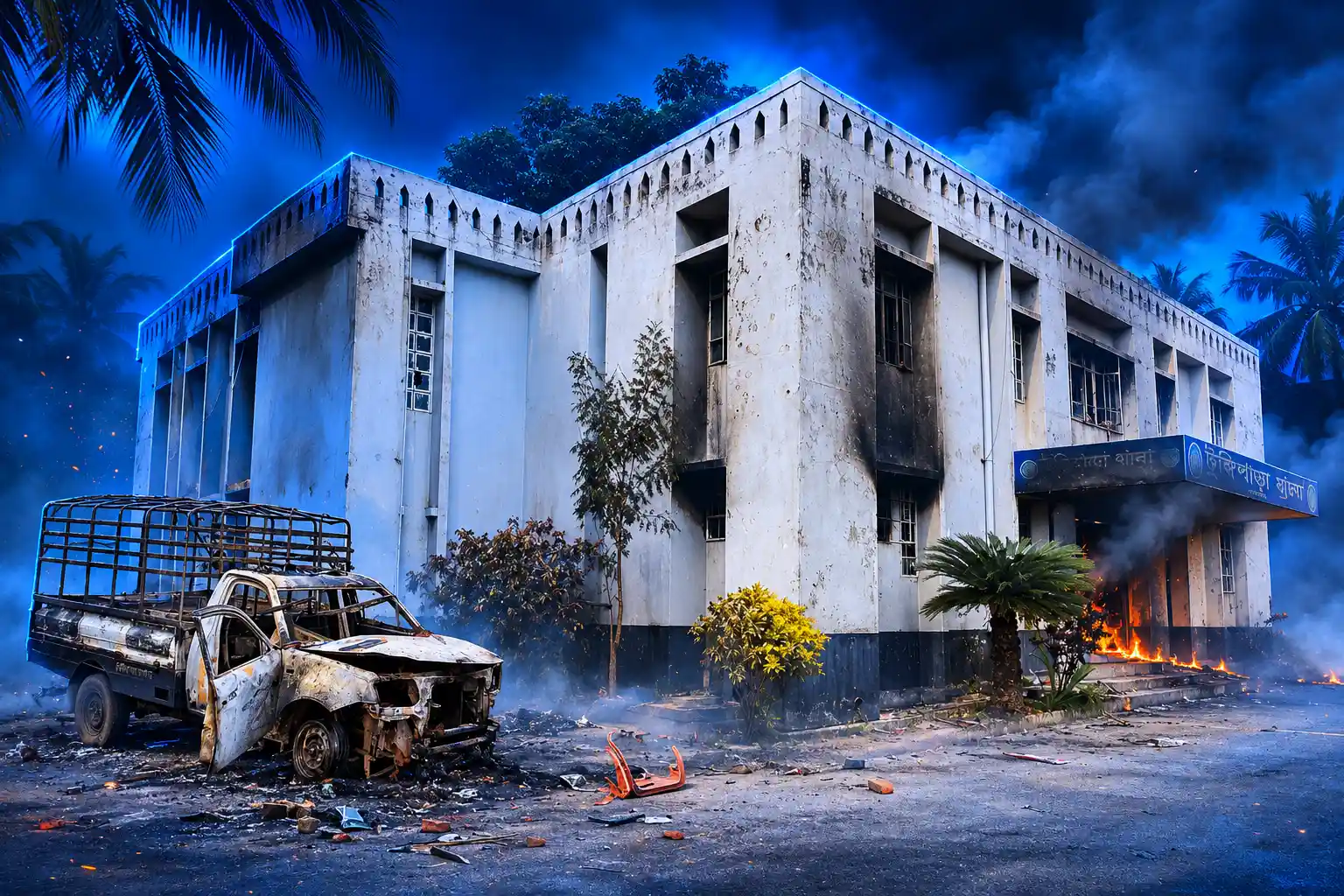
Grameen Bank Takes the Repeated Hits
The bank said at least 37 branches and offices had been targeted in arson attacks or attempted fires since November 10, with 14 more hit after midnight on November 17. The pattern ran through Gopalganj, Faridpur, Barishal, Rajshahi, Sylhet, Dinajpur and a long list of other districts, often before dawn, often with petrol in bottles.
On November 15, crowds chanting “Joy Bangla” wrecked the Ulpur branch in Gopalganj, smashed CCTV and took a hard drive, and burned almost the entire Patgati office in Tungipara. Attackers called the lender “Yunus’s bank.” Video from that night captured a loudspeaker line that named the founder and told the crowd to burn.
If necessary, we will give Yunus a drum of oil. Go and burn everything.
Voice on a loudspeaker, Gopalganj attack video
Yunus led the interim cabinet after Hasina fell and left office after the February 2026 vote. The bank is not his personal vault. In a November 17 statement it said borrower-shareholders own 90 percent and the government owns 10 percent, with nine directors elected from among those borrowers. It said misleading claims about ownership had been spreading while the fires were being lit.
GRAMEN BANK ON THE BOOKS
- Members: More than 10.67 million as of the bank’s October 2026 report.
- Network: 2,528 branches offering services in 81,678 villages nationwide.
- Ownership: 90 percent with borrower-shareholders, 10 percent with the state, under the Grameen Bank Act, 2013.
- Origin: A Jobra village project in 1976 that became a statutory bank in 1983.
United Nations deputy spokesperson Farhan Haq said national authorities should thoroughly investigate the violence and that protest must stay peaceful. The bank asked a simple question in its own statement: why set fire to a bank for poor people?
Hasina Asked for a Passport and Got a Refusal
Hasina’s lawyers at London’s Matrix Chambers emailed Bangladesh’s mission in New Delhi on November 9, asking acting High Commissioner Preeti Rahman for a new passport and national identity card “expeditiously.” The letter cited her nationality and duties under international human rights instruments, after the interim authorities revoked her old papers.
Aide Abu Obaidha Arin said she is determined to return by December and “will undoubtedly return home.” Hasina has said she wants to come back at any cost and to surrender before a court. Last week she put the stake in one line.
If death is my destiny, I would rather die on the soil of my own country, among my own people.
Sheikh Hasina, in remarks to an interviewer
Dhaka wants her handed over under the extradition treaty with India. India has declined. State Minister for Foreign Affairs Humaiun Kobir told reporters, “We want Hasina to be handed over. She will be handed over. She is a terrorist. She is a fugitive.” Chief war-crimes prosecutor Md Aminul Islam said she missed the 30-day window to appeal and that execution is the remaining option if she sets foot in the country.
A return without papers would mean a clandestine crossing of a long, partly open border. The party has not said how that would work. It does not need a boarding pass for the date to function. December is already doing political work in November.
What the November 19 Lockdown Is For
The Awami League called demonstrations for November 14, 15 and 16, named November 17 a Black Day on the anniversary of the death sentence, and set a dawn-to-dusk nationwide lockdown for November 19. Organising secretary SM Kamal Hossain said, “Bangabandhu’s daughter, Sheikh Hasina, will return to Bangladesh in December,” and that the party would resist wherever its people were blocked.
Presidium member Jahangir Kabir Nanak said the programme ran under the slogan “Save the Country, Save the People.” Party units were told to shut transport, shops, factories, government and private offices, banks, courts and schools, with ambulances, fire crews, hospitals and pharmacies left open. Leaders in Kolkata talked of pushing a similar campaign into 29 more districts after the Gopalganj clashes.
THE PARTY’S POLITICAL DEMANDS
- The tribunal: Abolish the International Crimes Tribunal that sentenced Hasina.
- The verdict: Withdraw the death sentence and the cases against her.
- The ban: Lift restrictions on the Awami League and let it operate again.
- The jails: Release detained party leaders.
The charter also asks for cheaper essentials, closed factories reopened, public safety and students’ right to study. Those lines dress a restoration fight as a cost-of-living protest. Former education minister Mohibul Hassan Chowdhury, speaking from exile, still described the enemy as an “interim government,” months after BNP leader Tarique Rahman came to power in the February 2026 election the League was barred from contesting.
That slip is the grievance. The party is not arguing with this year’s budget. It is still fighting the 2024 overthrow. Dhaka’s charge is that the orders come from leaders abroad. A leaked call circulating on November 18 purported to show former minister A.K.M. Mozammel Haque, in India, telling colleagues to burn BNP houses during the lockdown; a reply in the same thread called the audio fabricated. The clip is unproven. The government’s accusation does not depend on it.
A Death Sentence With No Appeal Window Left
The International Crimes Tribunal sentenced Hasina to death in absentia on November 17, 2025, for crimes against humanity over the crackdown on the student-led uprising. She called the trial illegitimate and the verdict politically motivated. She did not file an appeal in the 30 days the law allowed.
A UN Human Rights Office inquiry, sent at Yunus’s request, estimated that as many as 1,400 people may have been killed between 15 July and 5 August 2024, the vast majority shot by security forces. As many as 12-13 percent of the dead were children. Bangladesh Police reported 44 of its officers killed.
The brutal response was a calculated and well-coordinated strategy by the former Government to hold onto power in the face of mass opposition.
Volker Türk, UN Human Rights Chief, 12 February 2025
FROM UPRISING TO LOCKDOWN
- August 5, 2024: Hasina flees to India after the student-led uprising ends her 15-year rule.
- November 17, 2025: The tribunal sentences her to death in absentia for the crackdown.
- February 2026: The BNP wins a landslide. The Awami League is barred from the ballot. Tarique Rahman takes office.
- November 9, 2026: Her lawyers ask the New Delhi mission for a passport and identity card. Dhaka refuses.
- November 10, 2026: Arson and attempted arson against Grameen branches begin to stack up across the country.
- November 17, 2026: The party marks a Black Day on the sentence’s first anniversary.
- November 18, 2026: Hundreds of paramilitary troops deploy. A BNP activist and a bus helper are dead.
- November 19, 2026: The banned party’s dawn-to-dusk lockdown is due to run nationwide.
The legal door is shut, the electoral door was shut in February, and the passport door shut on November 9. What remains is the street, and a December date that does not need a flight number to pull cadres out at night.
Who Pays When a Village Branch Burns
Grameen’s own design is the reason the fires land on people who never sat in Hasina’s cabinet. The bank was built to extend collateral-free credit for rural borrowers, most of them women, who own the shares and elect the directors. Damage to ledgers, hard drives and branch rooms cuts savings and loan cycles in places where that branch is the financial system.
BNP offices and police posts are political targets in a familiar Bangladesh sense. A village microcredit office is not. Burning it does not put Hasina on a plane and does not overturn a death sentence. It punishes a lender still tied, in the attackers’ own slogans, to the man who took the chief adviser’s chair after she ran.
The November 19 lockdown is written to stop buses, banks and courts. If cadres also walk into the garment belts, where wage protests have already blocked highways, the same roads will carry two fights at once. Troops are already on those approaches.
Hasina can still say she will die on Bangladeshi soil. The prosecutor can still say the gallows are the remaining legal step. India can still hold the extradition file. None of that decides whether a night guard in Dinajpur or a branch manager in Gopalganj gets another bottle of petrol before December arrives.

ADNOC Ship Hit in Hormuz Leaves One Crew Missing

SpiceJet’s Rs 5,500 Crore Plan Follows a Rescue That Failed

Hasina’s Return Fight Sets Fire to Yunus’s Bank

Bancroft Recants the 2018 Inquiry and Names the Team

Adhikari Ties the Saffron Saree Row to School Licences

Clancy Juror Says the Holdout Never Cited Evidence

The iPhone 18 Pro Max Splits Apple’s Fall in Two

OpenAI Calls GPT-6 Astra AGI Then Locks Its Exploits

Trump Claims Hormuz Control as Oil Holds Near $96

Russia Closes the Goethe-Institut Berlin Tried to Save

 NEWS2 months ago
Clancy Juror Says the Holdout Never Cited Evidence
- NEWS3 months ago
The iPhone 18 Pro Max Splits Apple’s Fall in Two
- NEWS3 months ago
OpenAI Calls GPT-6 Astra AGI Then Locks Its Exploits
- BUSINESS3 months ago
Trump Claims Hormuz Control as Oil Holds Near $96
- LIFESTYLE3 months ago
Russia Closes the Goethe-Institut Berlin Tried to Save
- AUTO3 months ago
Volkswagen’s Job Cuts Leave Four Plants Without Cars
- NEWS3 months ago
Dyson Puts Nurovi Robots on Sale Without the UV Flagship
- BUSINESS2 months ago
US Destroys Five Iranian Tankers as the Shock Hits Jordan










