BUSINESS
Investors Buy 5.54% of Adani Airports at $18 Billion
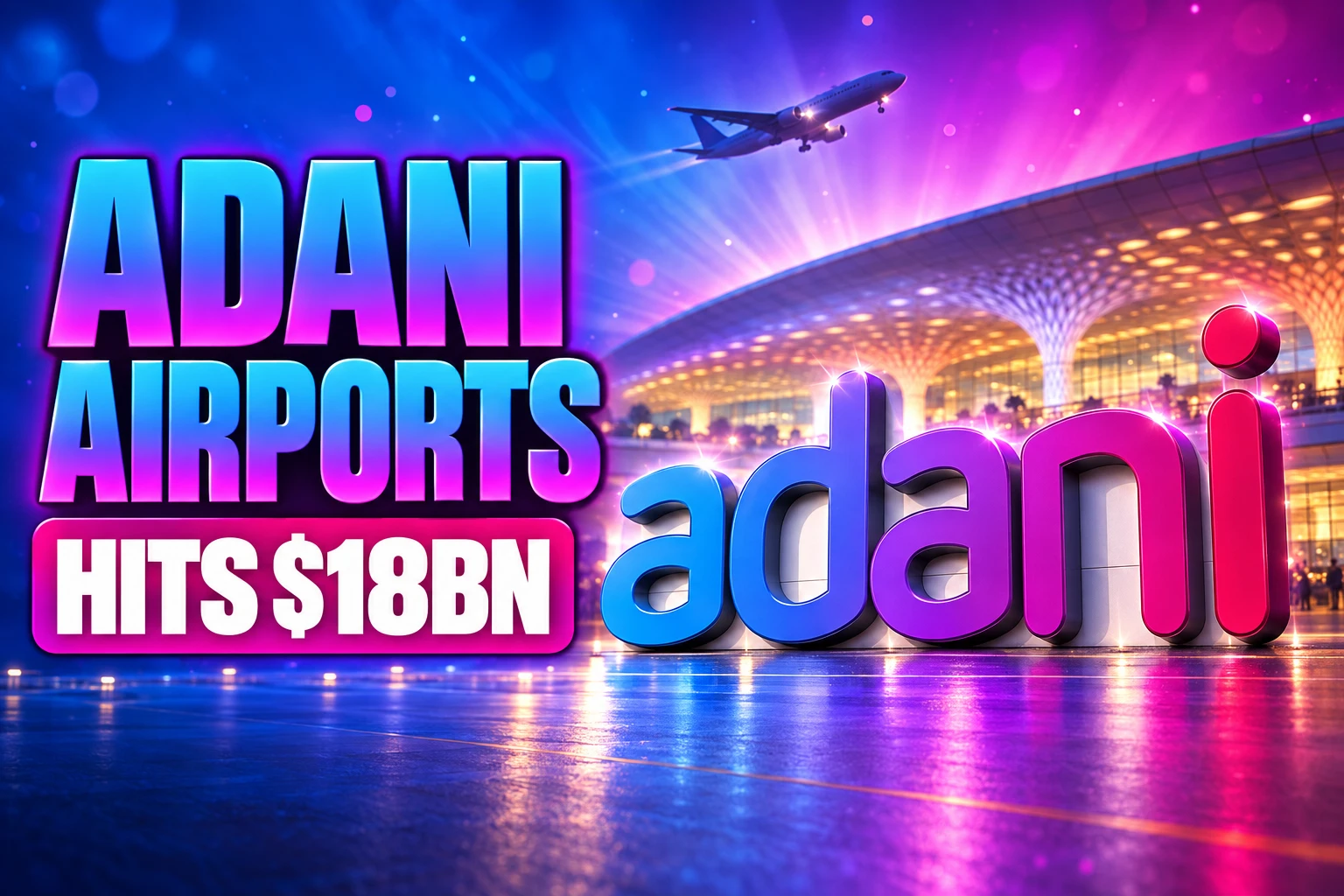
Temasek, Premji Invest, Alpha Wave and BlackRock-managed funds are taking 5.54% of Adani Airport Holdings in three tranches at an $18 billion pre-money mark.

Adani Enterprises shares closed 5.13% higher at ₹3,104.70 on September 9 after Adani Airport Holdings agreed a $1 billion primary equity sale. The session high was ₹3,142, and the stock had already gained 31.85% in 2026 through September 8, per ACE Equity.
Alpha Wave Global, Premji Invest, Temasek and BlackRock-managed funds will subscribe to new shares in three tranches and hold about 5.54% after the last one, due by July 2027. The binding deal prices the airport company at about $18 billion before the new money, and still needs customary conditions and approvals.
A 5.54% Slice, Priced at $18 Billion
Adani Airport Holdings, the airport arm of Adani Enterprises, signed binding agreements to raise ₹9,825 crore (~$1 billion) of primary equity. That is new paper in the airport company, not a sale of the parent’s existing shares, so Adani Enterprises stays in control when the three tranches are done.
The investor group is a mix of a global growth shop, Azim Premji’s family office, Singapore’s state investor and funds run by BlackRock. Premji Invest is the domestic name on the ticket. Temasek is the sovereign-linked cheque. The BlackRock line is funds it manages, not a claim that the asset manager is buying the stake on its own balance sheet.
THE SEPTEMBER 9 TERMS
- Fresh equity: ₹9,825 crore, or about $1 billion, in new shares of Adani Airport Holdings.
- Price tag: About $18 billion of equity value before that money goes in.
- Stake: About 5.54% for the four names together after the last tranche.
- Paperwork: A share subscription agreement and a shareholders’ agreement, with the last issue expected by July 2027.
A 5.54% holding at that mark is a valuation event more than a change of control. The listed parent still jumped, because the market treated the names and the $18 billion figure as a public price for a business that has never had one.
Three Tranches Stretch to July 2027
The cash does not land in one wire. The buyers take shares in three lots, and the company says the final lot should close by July 2027, roughly ten months after the September 9 announcement. Until then the 5.54% figure is a destination, not a holding that already sits on a cap table.
The company did not publish the size of each tranche, the split among the four buyers, or a calendar inside that window. It also did not name the regulators who still have to sign off. The deal is binding, and it is not done.
WHAT WE KNOW
- The contracts: Binding share subscription and shareholders’ agreements are signed.
- The end state: About 5.54% in the airport company after all three issues.
- The clock: Last tranche expected by July 2027.
WHAT IS UNCONFIRMED
- Tranche sizes: The company has not said how the ₹9,825 crore is split across the three issues or the four buyers.
- Approvals: The statement cites customary conditions and applicable approvals without naming the agencies.
- Governance rights: A shareholders’ agreement exists; its vetoes, board seats and exit terms are not in the public note.
That staged design is the risk control on an $18 billion mark. The buyers get a path into the airport company. They do not have to fund the whole cheque on day one, and they keep a walk-away if an approval fails.
Why Temasek and Premji Paid Up for Airports
The raise sits a month after a Brooklyn judge ended the U.S. criminal case against Gautam Adani. Judge Nicholas Garaufis dismissed the charges with prejudice on August 10, 2026. Adani Enterprises had already booked a $275 million (₹2,644 crore) Office of Foreign Assets Control settlement in the June quarter, and Gautam Adani and his nephew Sagar Adani had paid $18 million to resolve a parallel SEC case. The group has denied the underlying bribery claims throughout.
Foreign names writing equity into the airport company so soon after that sequence is the political fact inside the financial one. It is also a limited fact. The buyers are taking a thin slice, over many months, with conditions still open.
India’s aviation sector is one of the most powerful multipliers of the country’s GDP growth. Every expansion in air connectivity catalyses trade, tourism, employment and regional development well beyond the airport gate. With the backing of these partners, we will continue to invest ahead of that growth, scaling our infrastructure, city-side developments and non-aeronautical businesses to build one of the world’s leading integrated airport platforms.
Jeet Adani, Non-Executive Director, Adani Airport Holdings, September 9 statement
Jeet Adani, Gautam Adani’s son, is the family voice on the deal. Chief executive Arun Bansal said the company will keep building “to scale it into the world’s largest airports platform,” pointing to Indian traffic, consumer spending and city-side projects. That is a target, not a rank the company holds now.
BlackRock-managed funds are not new to these runways. In June 2025 the airport company raised $1 billion of Mumbai airport notes in an Apollo-led project-finance issue, with BlackRock-managed funds in the syndicate. The September equity cheque is a different claim on the same operating story: a small share of the whole platform, not more debt on Mumbai.
Temasek’s other Indian aviation holding sits next to this one. It is the majority owner of Singapore Airlines, which holds 25.1% of Air India. That does not block an airport stake. It does mean Singapore state-linked capital now has money in both a carrier and a large Indian airport operator.
95 Million Passengers Versus a 200 Million Target
The airport company manages eight airports and says it already handles more than 23% of India’s passenger traffic. Adani Enterprises told the exchanges it moved 95.3 million passengers in FY26. In the June quarter, traffic was 24.2 million, up 3% from 23.4 million a year earlier.
The new money is meant to lift capacity to serve about 200 million passengers a year. That is a capacity figure, not a traffic forecast, and it is a little more than twice last year’s headcount. Navi Mumbai, the eighth airport, started international flights on July 15, 2026, after Prime Minister Narendra Modi opened it on October 8, 2025. Putting that airport on the books in the March quarter also raised depreciation, and airport profit before tax in the June quarter was a ₹194 crore loss against a ₹204 crore profit a year earlier, even as airport EBITDA rose 49% to ₹1,633 crore.
THE EIGHT AIRPORTS
- Mumbai: Chhatrapati Shivaji Maharaj International, the network’s largest existing hub.
- Navi Mumbai: The greenfield airport now in ramp-up, with international flights from July 15, 2026.
- Ahmedabad: The group’s home-state gateway.
- Lucknow, Jaipur, Guwahati, Thiruvananthapuram, Mangaluru: The six Airports Authority of India concessions Adani won in the 2019-21 round.
Airport income in FY26 was ₹13,081 crore, with EBITDA of ₹5,394 crore. In the June quarter, aeronautical revenue grew 16% and non-aero revenue grew 53%, the company said. The equity story is that shops, handling and city-side rents can grow faster than ticketed passengers, if the new floor space actually leases.
GMR Still Handles More Traffic at a Lower Listed Mark
GMR Airports is the listed comparable, and it is larger on today’s traffic. Its May 27, 2026 investor deck put FY26 passengers at 121.6 million, up 0.9%, and 27.3% of India’s passenger traffic. Delhi alone handled 78.7 million people in that year; Hyderabad handled 30.5 million. GMR also told investors it is the second-largest private airport operator in the world on 2025 passenger counts.
The listed equity value of GMR Airports on September 9 was about ₹1.02 trillion. Adani’s private mark of about $18 billion sits well above that, even though GMR moved more people last year and already has Delhi. The gap is the bet: Mumbai plus Navi Mumbai plus seven other Indian airports, plus the city-side land, is being priced as a faster-growing, still-private platform, not as a copy of GMR’s listed stock.
ADANI VERSUS GMR
| Measure | Adani Airport Holdings | GMR Airports |
|---|---|---|
| FY26 passengers | 95.3 million | 121.6 million |
| India passenger share | More than 23% | 27.3% |
| Network | 8 Indian airports, including Mumbai | Delhi, Hyderabad, Goa Mopa and overseas assets |
| Equity value | About $18 billion pre-money | About ₹1.02 trillion listed on September 9 |
| Capacity plan | About 200 million passengers a year | About 197 million (172 million operating, 25 million being built) |
Those capacity numbers almost meet. GMR’s 197 million is a mix of what it already runs and what it is building. Adani’s 200 million is what it says the new equity is meant to support. If both land near those figures, India will have two private operators sized like one another, with Delhi in one camp and Mumbai in the other.
That split is already feeding a policy argument about the next Airports Authority of India sale. A batch of 11 airports has been discussed in smaller bundles, with talk of caps on how many a single bidder can win. Adani’s eight-airport map is the reason that talk exists. The ₹9,825 crore does not buy those 11 airports. It does put more cash in the only private operator that already matches GMR on count of Indian airports.
Airport Cities Get 22 Million Square Feet in Phase One
The company split the use of proceeds into three buckets, and only one of them is more terminals. The second is Adani Airport City projects, with about 22 million square feet of mixed-use space in the first phase. The third is passenger-facing work and other non-aero lines, including ground handling.
WHERE THE ₹9,825 CRORE IS MEANT TO GO
- Airside: Expansion and upgrades across the eight-airport map, toward capacity of about 200 million passengers a year.
- City side: About 22 million square feet of mixed-use Airport City space in phase one, around the existing airports.
- Commercial ops: Ground handling and other passenger-facing businesses that sit next to the regulated aeronautical tariff.
Twenty-two million square feet is the piece that makes an $18 billion equity tag easier to defend than a pure runway story. Aeronautical charges in India are still a regulated utility. Hotels, offices and retail around the fence line are not. Bansal called those city-side projects “powerful economic catalysts in the country’s major urban centres.” They are also the part of the plan that will take years to lease, and they are the part that will decide whether this mark looks cheap or expensive when the last tranche is issued in 2027.
A $1 billion primary issue at a subsidiary can be read as a sign the parent needs cash. The structure points the other way. Adani Enterprises is not selling its control block. The new shares sit in the airport company. The listed stock still rose 5.13%. What the buyers actually underwrote is a long-dated claim on traffic, shops and land, with a 5.54% ceiling and a July 2027 finish line.
The Parent Already Raised ₹15,000 Crore in July
This is the second large equity cheque into the Adani orbit in two months. In July 2026 Adani Enterprises completed a ₹15,000 crore qualified institutional placement, which it called India’s largest QIP by a non-financial company, with bids at 3.8 times the base size. Some of that parent-level money was earmarked for incubation businesses and for debt at subsidiaries, including the airport company. The September deal is extra capital sitting directly in the airport vehicle, with new minority names on the register.
In December 2025 Jeet Adani said the airports arm was looking at a demerger or an initial public offering between 2027 and 2030, and at about ₹1 trillion of spending on airports and adjoining land over five years. An $18 billion outside mark, even on a 5.54% slice, is the first public number a future listing can be hung on. It is also a number the buyers can be stuck with if traffic, rents or approvals lag.
THE CAPITAL CALENDAR
- June 24, 2025: Adani Airport Holdings raises $1 billion of Mumbai airport notes, with BlackRock-managed funds among the buyers.
- October 8, 2025: Navi Mumbai International Airport is inaugurated; commercial flights follow, then international services on July 15, 2026.
- July 2026: Adani Enterprises raises ₹15,000 crore in a QIP, 3.8 times subscribed at the base size.
- August 10, 2026: A Brooklyn judge dismisses the U.S. criminal case against Gautam Adani with prejudice.
- September 9, 2026: The airport company signs the ₹9,825 crore primary equity agreements at about $18 billion pre-money.
- July 2027: Final share tranche is expected, taking the four investors to about 5.54%, if remaining approvals come through.
Until that last issue is done, the $18 billion figure is a contracted mark, not a fully paid-in cap table. The names on the ticket are real, the slice is small, and the last rupee is still a 2027 event.
Disclaimer: This article is news reporting and analysis of a disclosed equity transaction and related share-price moves. It is for information only and is not investment advice, a solicitation to buy or sell any security, or a recommendation of Adani Enterprises, Adani Airport Holdings, GMR Airports or any of the named funds. Readers who may act on deal terms, valuations or listed prices should consult a SEBI-registered investment adviser or other qualified financial professional who can consider their own objectives and limits. Figures, stakes, approvals and close dates reflect company statements, exchange filings and market data as published on the dates named above and can change as later tranches, approvals or results come in.

Police Tighten the Ring Around Gyanesh Kumar’s House

Ravi Shankar Calls Hanuman Ansh a Slap to Big Spenders

Microsoft Puts Nvidia in the Surface Laptop Ultra Flagship

Adult Fires on an Armed Juvenile at Longmont Dollar Tree

Jordan Absorbs Iranian Missiles Aimed at Parked US Jets

The iPhone 18 Pro Max Splits Apple’s Fall in Two

OpenAI Calls GPT-6 Astra AGI Then Locks Its Exploits

Russia Closes the Goethe-Institut Berlin Tried to Save

Trump Claims Hormuz Control as Oil Holds Near $96

Volkswagen’s Job Cuts Leave Four Plants Without Cars

 NEWS1 month ago
The iPhone 18 Pro Max Splits Apple’s Fall in Two
- NEWS1 month ago
OpenAI Calls GPT-6 Astra AGI Then Locks Its Exploits
- LIFESTYLE1 month ago
Russia Closes the Goethe-Institut Berlin Tried to Save
- BUSINESS1 month ago
Trump Claims Hormuz Control as Oil Holds Near $96
- AUTO1 month ago
Volkswagen’s Job Cuts Leave Four Plants Without Cars
- NEWS1 month ago
Clancy Juror Says the Holdout Never Cited Evidence
- BUSINESS1 month ago
Cable Stocks Fall as UltraTech Copies the Paints Playbook
- BUSINESS1 month ago
Japan’s 3 Percent Yield Reprices Government Debt Worldwide