NEWS
Jordan Absorbs Iranian Missiles Aimed at Parked US Jets
Jordan destroyed 18 of 20 Iranian missiles bound for Muwaffaq Salti, where an A-10 lost a wing after US tanker strikes.

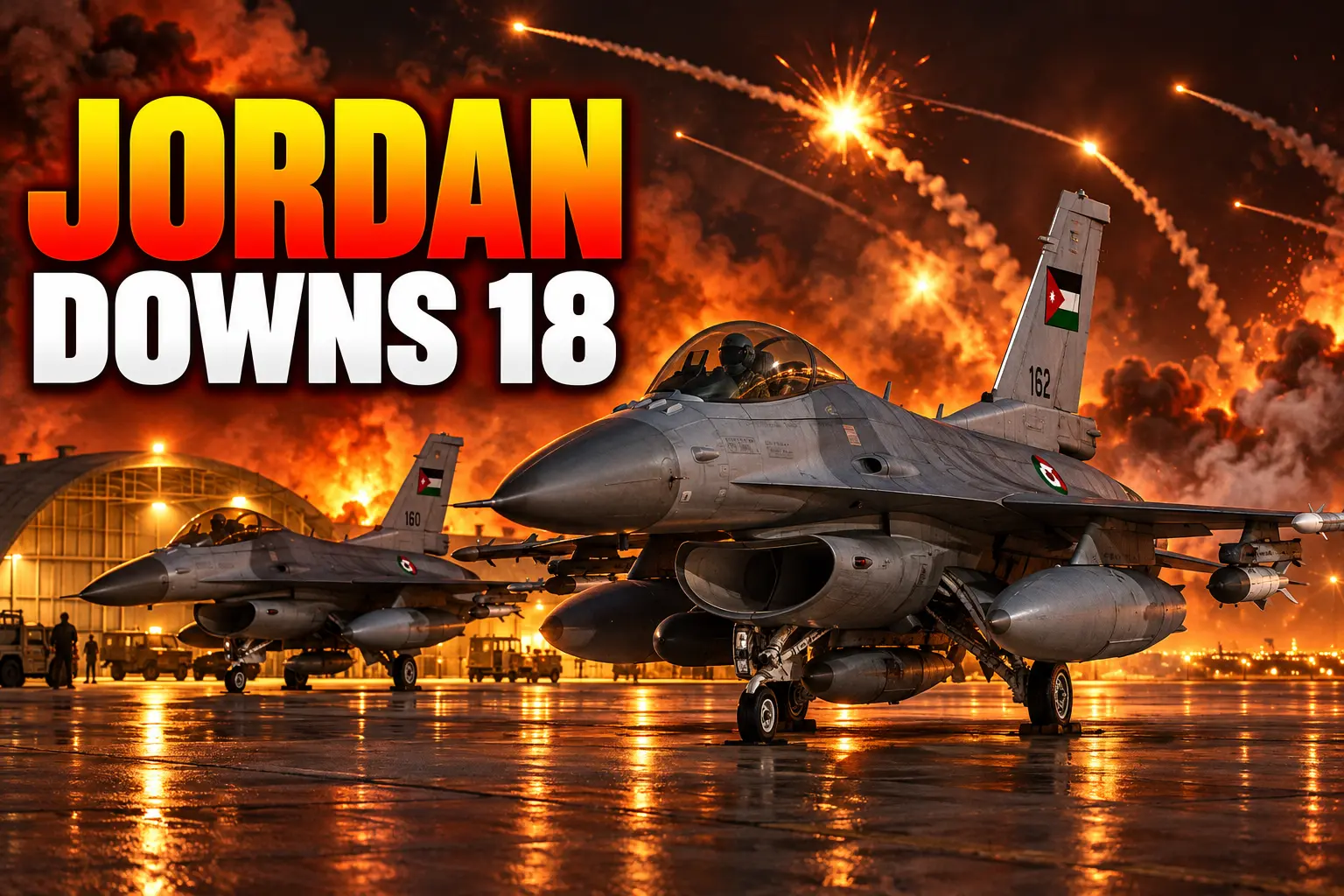
Jordan’s air defenses destroyed 18 of 20 Iranian ballistic missiles on the night of September 8, and an American A-10 still sat on the ramp at Muwaffaq Salti Air Base with a wing gone.
Sources told journalists Jennifer Jacobs and Jim LaPorta that roughly eight F-15s took light damage and went back into service. Jordan said no one was killed. The missiles were Tehran’s answer to a US tanker hunt at sea, and they fell on a Jordanian airfield Washington has long been careful not to call its own.
Eighteen of Twenty Missiles Never Reached a City
The Jordan Armed Forces spokesman said the kingdom came under fire from Iranian territory in the hours before dawn on September 9. Jordanian air defense systems engaged 20 ballistic missiles, intercepting and destroying 18 of them. Two missiles fell in unpopulated areas. Field checks found no casualties.
Specialized teams moved to secure debris and shrapnel sites. The army told civilians not to touch unidentified fragments and to report them. It also told the public to rely only on official statements, a line Amman uses when night-sky video outruns the communique.
Iran’s Islamic Revolutionary Guard Corps described a “punitive operation” against the US presence at Al-Azraq, the local name for Muwaffaq Salti, in Zarqa governorate. Through Tasnim, the Guards said missiles “struck the maintenance, preparation, and deployment sites of F-35, F-16, and F-15 fighter jets, as well as their shelters, inflicting heavy damage on the enemy.” Iranian state media released launch footage it said was aimed at Jordan.
A Trump administration official in Washington, speaking without attribution, said the barrage inflicted no casualties and that “the Iranian response was ineffective against integrated air and missile defences.” Jacobs wrote that American forces in Jordan launched more than 30 Patriot missiles while defending the strike. Night video from around the field shows a crowded intercept, the kind of shoot that drains a battery even when most incoming rounds never reach a city.
THE NIGHT’S THREE VERSIONS
| Account | What it says reached Jordan | What it says was hit |
|---|---|---|
| Jordan Armed Forces | 20 ballistic missiles engaged; 18 destroyed; 2 down in empty land | No casualties; debris teams deployed |
| IRGC | “Devastating” strikes on the US Al-Azraq presence | Heavy damage to F-35, F-16 and F-15 maintenance sites and shelters |
| US sources via Jacobs and LaPorta | More than 30 Patriots fired by American forces | One A-10 missing a wing; roughly eight F-15s with light damage, back in service |
Those three ledgers can sit together. Jordan can keep civilians alive and still host a ramp that is no longer intact. The Pentagon had not, by September 10, put its own numbers on the airframes.
Five Tankers Went Down Before the Missiles Flew
US Central Command said its forces destroyed five Iranian crude oil carriers on September 8 after the IRGC targeted a US Navy warship with ballistic missiles twice over two days. The warship evaded both attempts and stayed on patrol. No American personnel were harmed, the Tampa headquarters said.
THE FIVE TANKERS NAMED ON SEPTEMBER 8
- M/T Kaviz: Struck in the Gulf of Oman and rendered inoperable after the crew was told to leave.
- M/T Charminar: Hit in the same waters under the same abandon-ship order.
- M/T Horizon 1: Struck in the Gulf of Oman; a maritime security firm said all 16 crew left and were picked up by the bunker barge Savona.
- M/T Riesco: Hit in the Gulf of Oman; CENTCOM later posted video it said showed the ship sinking.
- M/T Derya: Struck near Kharg Island, Iran’s main crude-export hub inside the Persian Gulf.
Crews were directed to abandon ship before the vessels were struck. CENTCOM called the tankers part of a multibillion-dollar shadow network that funds the IRGC and its regional proxies, and said Iran has no way to defend them. On September 5 the same command said it had destroyed three other Iranian crude carriers after the IRGC tried to attack a US aircraft carrier and a guided-missile destroyer. That makes eight named tankers in four days. President Donald Trump told reporters Washington had knocked out nine of their ships, that “many of them are gone-zo,” and that “you’re going to see a lot more.”
Iran continues to try to hit US naval ships, and for every time they do that or try to do that, they’re going to lose tankers.
Marco Rubio, US Secretary of State, to reporters in Colombia
Adm. Brad Cooper, the CENTCOM commander, had set the ratio on September 5: if Iran shot at two US ships, America would take out three of Iran’s. Defense Secretary Pete Hegseth put the same rule in writing. Iran’s Foreign Ministry called the tanker hits a violation of the UN Charter and a “war crime,” and said armed forces had attacked US military bases and facilities in Jordan “which continues to support US military attacks against Iran,” along with several US vessels. The IRGC claimed ballistic missile damage to the destroyers DDG-119 and DDG-53, then said it had hit two American vessels and eight tankers. Washington did not immediately answer those ship claims. Brent crude traded above $100 a barrel on Wednesday after the Kharg-area strike.
A Jordanian Base the Pentagon Rarely Named
Muwaffaq Salti sits about 100 km (62 miles) northeast of Amman in the Eastern Desert, near Azraq. It is named for Lt. Muwaffaq Salti, a Jordanian fighter pilot killed in 1966. It has two runways. It is a Jordanian air base that also parks American jets, which is the arrangement Tehran treats as a US target and Amman treats as sovereign ground.
The 2021 Access Deal
Amman and Washington signed a defense cooperation agreement in 2021 that gave US forces and contractors access to 12 military installations across the kingdom. A 2026 Congressional Research Service tally puts nearly 4,000 American soldiers in Jordan. Some sit at Al-Azraq. Others are at King Faisal Air Base in the south and at Tower 22, a logistics outpost in the northeast near Syria and Iraq. Jordanian leaders have long insisted the country does not host a free-standing US base, and that foreign forces use Jordanian facilities under limits.
The CRS has noted that the United States never officially acknowledged its presence at Muwaffaq Salti before that 2021 agreement, even though satellite imagery showed US Air Force drones and fast jets there from at least 2016. In 2017, Congress authorized $143 million in Air Force construction funds to expand ramp space, then the largest such project of its kind. Jordanian airfields have been used for intelligence, surveillance, and reconnaissance flights over Syria and Iraq.
The Desert Airfield That Draws the Fire
Tahani Mustafa, who teaches international relations in the Department of War Studies at King’s College London, said Al-Azraq is among the few sites that host F-35s, F-16s, and F-22s, with hangars where the Americans can hide assets, “and that’s what the Iranians have been targeting.” David Schenker, a fellow at the Washington Institute, called the base a key logistics hub for C-17 transports and about 60 combat aircraft in the run-up to the war that began in February, and said Jordan “provides great strategic depth” because it sits farther from Iranian missiles than the Gulf Arab states. Early in the fighting, some US troops were moved there from Bahrain, the United Arab Emirates, and Qatar.
Iran has claimed strikes on Al-Azraq more than 10 times between March and September. The IRGC first announced air strikes on the field in early March. Each time, Jordan is the country that has to explain falling metal to its own public.
July Already Killed Three Missile-Defense Soldiers There
The last Americans killed at Muwaffaq Salti were not fighter pilots. They were Army air-defense soldiers, the same trade that now spends Patriots against the next barrage.
STRIKES ON MUWAFFAQ SALTI THIS YEAR
- Early March 2026: Iran first claims air strikes on the Al-Azraq field as the war that opened in February spreads to Jordanian airspace.
- June 10, 2026: The IRGC says long-range missiles destroyed hangars and command centres at Al-Azraq; authorities in the targeted countries say the projectiles were intercepted and that no one was hurt.
- July 17-18, 2026: An Iranian missile and drone attack kills three US soldiers assigned to air-defense units at the base; four other Americans are flown to a Jordanian hospital and later discharged.
- Night of September 8, 2026: Jordan engages 20 ballistic missiles, destroys 18, and records two impacts in empty land; US sources later describe an A-10 missing a wing and roughly eight F-15s with light damage.
The Pentagon identified Pvt. Isabella Gonzales, 19, of Carrollton, Texas, killed in action on July 17; 1st Lt. Tyler James Feehan, 25, of Ewa Beach, Hawaii, killed on July 18; and Sgt. Angel S. Rampersad, 28, of Ozone Park, New York, first listed as missing and then believed killed on July 17. Gonzales and Rampersad were assigned to 1st Battalion, 57th Air Defense Artillery Regiment, 52nd Air Defense Artillery Brigade, 10th Army Air and Missile Defense Command, in Ansbach, Germany. Feehan was assigned to 2nd Battalion, 55th Air Defense Artillery Regiment, 32nd Army Air and Missile Defense Command at Fort Bragg, North Carolina. The Defense Department said they were supporting Operation Inherent Resolve. CENTCOM originally reported two dead and one missing at the site, then said troops found unidentified remains during the search.
Those three names are why a “no casualties” night in September does not reset the ledger for the people who live and work on that ramp. The soldiers who died in July were there to stop the missiles that keep coming.
What Officials Called Ineffective on the Ramp
A Trump administration official said the September barrage inflicted no casualties and called it ineffective against integrated air and missile defenses. Jacobs’s sources, a day later, described an A-10 Thunderbolt, the Warthog, struck and left with a missing wing, and roughly eight F-15s with light damage already back on the line. Both accounts can be true at once, and they describe different things: people, and parked jets.
The IRGC’s target list was the fifth-generation story, F-35s and F-16s and F-15s in hardened shelters. The jet US sources put in the worst shape is a close-air-support aircraft known for flying low and slow, sitting still when a ballistic missile comes in. That is not air combat. It is a ramp problem, and ramps belong to whoever owns the concrete.
Intercept film from the night is thick with launches. Open-source accounts counted more than 60 Patriots; Jacobs’s sources stayed with more than 30. Some incoming rounds appeared on video to throw submunitions. Unverified clips of wrecked helicopters on flatbeds also moved online. That has not been matched by a Pentagon release, and the helicopter images are not treated here as confirmed. What the US-source account does fix is narrower, and harder to walk back: at least one A-10 is missing a wing, and a handful of F-15s were dinged and then flown again.
CENTCOM had spent earlier months denying Iranian claims that aircraft were destroyed at Al-Azraq, including F-35s. This leak is the first detailed US-side description of airframe damage at the Jordanian field. As of September 10, the department still had not put its own statement behind it.
Patriot Magazines Paid the Night’s Other Bill
American forces in Jordan fired more than 30 Patriot missiles at the raid, according to the same sources. Army budget books in this cycle put a PAC-3 MSE interceptor at about $4 million a round in flyaway terms. Thirty rounds at that price are more than $120 million before the extra missiles, the radar time, and the reload. The Army has already been buying as if this war will last: a $9.8 billion multi-year PAC-3 contract covering 1,970 missiles for fiscal years 2024 through 2026, with factories under pressure to raise output.
THE BILL FOR ONE NIGHT OF COVER
- Incoming count: Jordan engaged 20 ballistic missiles and said it destroyed 18, with 2 falling in empty land.
- US interceptors: American forces launched more than 30 Patriots over the same raid.
- Round price: About $4 million per PAC-3 MSE in current Army flyaway pricing, more than $120 million for a 30-round shoot.
- Host force: Nearly 4,000 US soldiers in Jordan under the 2021 access deal, on a field Amman still names as its own.
That is the cost of keeping a tanker war’s return fire off a desert city, and it is billed in magazines that take years to refill. Lockheed Martin has even begun selling the idea of a cheaper PAC-3 variant, because the current round is too expensive to fire at every incoming track. Jordan does not set that price. It supplies the sky.
Trump said he thinks the war will end immediately after the US midterm elections, accusing Tehran of trying to influence American voters so that “a nice, weak group of people” would take office and “let them have their nuclear weapon.” The calendar he is using is Washington’s. The debris teams walking the Eastern Desert on September 9 were Jordanian. The A-10 that is missing a wing is still sitting on their ramp.

Police Tighten the Ring Around Gyanesh Kumar’s House

Ravi Shankar Calls Hanuman Ansh a Slap to Big Spenders

Microsoft Puts Nvidia in the Surface Laptop Ultra Flagship

Adult Fires on an Armed Juvenile at Longmont Dollar Tree

Jordan Absorbs Iranian Missiles Aimed at Parked US Jets

The iPhone 18 Pro Max Splits Apple’s Fall in Two

OpenAI Calls GPT-6 Astra AGI Then Locks Its Exploits

Russia Closes the Goethe-Institut Berlin Tried to Save

Trump Claims Hormuz Control as Oil Holds Near $96

Volkswagen’s Job Cuts Leave Four Plants Without Cars

 NEWS2 months ago
The iPhone 18 Pro Max Splits Apple’s Fall in Two
- NEWS2 months ago
OpenAI Calls GPT-6 Astra AGI Then Locks Its Exploits
- LIFESTYLE2 months ago
Russia Closes the Goethe-Institut Berlin Tried to Save
- BUSINESS2 months ago
Trump Claims Hormuz Control as Oil Holds Near $96
- AUTO1 month ago
Volkswagen’s Job Cuts Leave Four Plants Without Cars
- NEWS1 month ago
Clancy Juror Says the Holdout Never Cited Evidence
- NEWS2 months ago
The Lincoln’s 286-Day War Cruise Ends at a Thai Pier
- BUSINESS1 month ago
Cable Stocks Fall as UltraTech Copies the Paints Playbook