BUSINESS
Bulk Scotch Still Faces Full Duty After India’s UK Deal
Investigators say bulk Scotch concentrate still owes 150 percent duty, leaving most UK whisky volume outside the CETA cut sold as a Scotch win.

Indian customs investigators have told Diageo and Pernod Ricard that bulk Scotch concentrate still attracts 150 percent duty, not the 75 percent rate in the India-UK trade deal. The two groups blend those tank loads into Royal Stag, Blenders Pride and McDowell’s, then sell them as Indian whisky. Their trade body has asked Commerce Minister Piyush Goyal to step in, and a British government spokesperson said London is talking to New Delhi so exporters can ship under the tariffs written into the pact.
The Letter to Piyush Goyal Asks for 75 Percent
The International Spirits and Wines Association of India, which speaks for both companies, wrote to Goyal on 23 October. The letter, described as confidential in accounts of its contents, is the first open clash over the Comprehensive Economic and Trade Agreement since that deal took effect on 15 July 2026. Whisky duty was a sticking point in the talks. India then cut the scheduled rate on qualifying UK-origin Scotch from 150 percent to 75 percent on day one, with a further fall to 40 percent in year 10.
Investigators from the Directorate of Revenue Intelligence have privately told importers that bulk Scotch concentrates do not get that cut and must be declared under a heading that still carries the full 150 percent levy. The companies, according to people familiar with their position, say concentrates shipped from Britain should get the lower rate. No finding of wrongdoing has been published. Both firms say they are cooperating.
The classification issue risks undermining, in practice, an important market-access benefit negotiated and agreed between India and the United Kingdom.
International Spirits and Wines Association of India, letter to Commerce Minister Piyush Goyal
ISWAI also warned that the preferential rate could become unavailable for these shipments if the DRI reading stands, and asked for a fast government clarification. Britain sold the cut as a gain for flagship products. In July the British government said “iconic UK products” such as whiskies would benefit. The letter now argues that a customs reading can take that gain away from the cargo that actually moves.
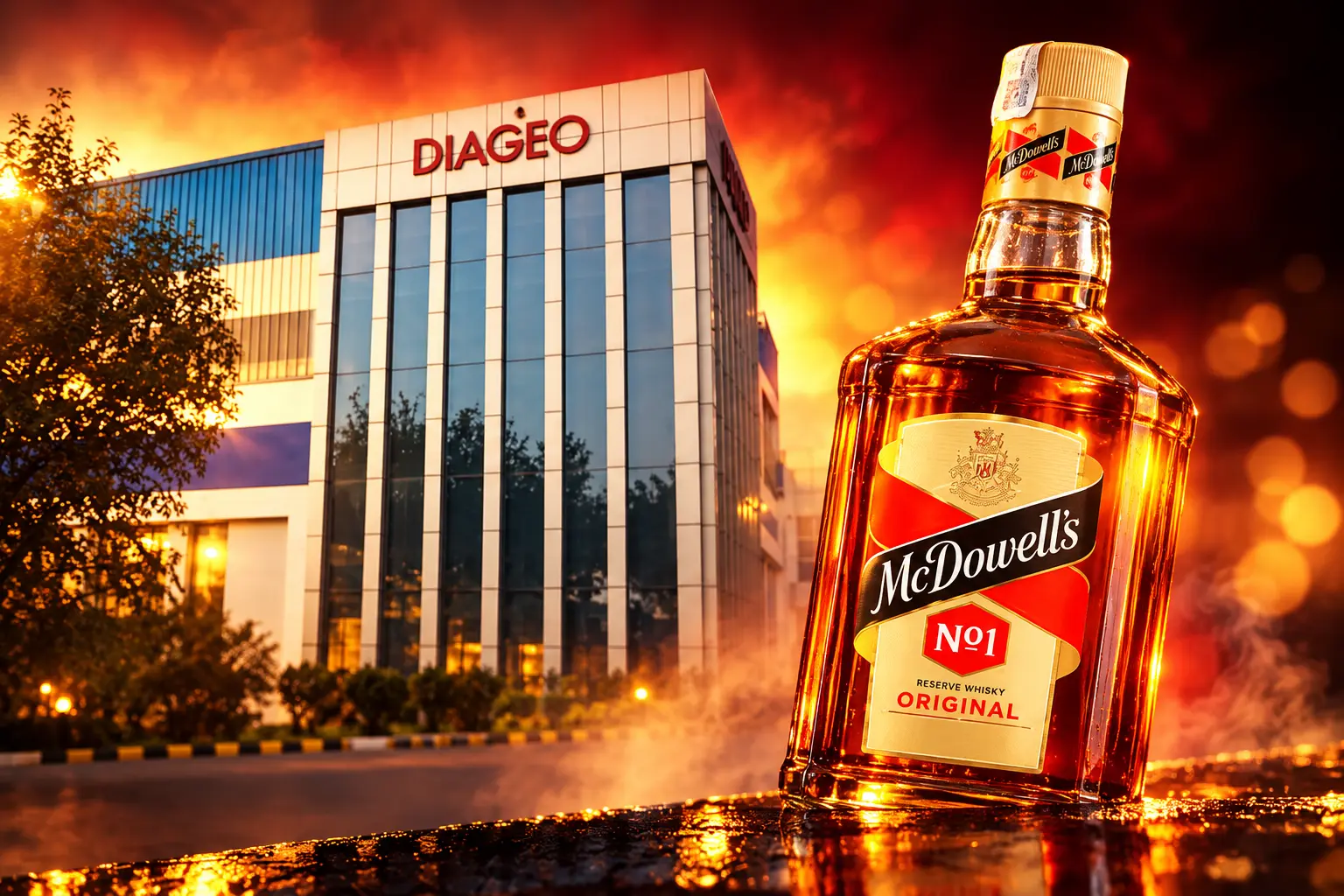
80 Percent of India’s Scotch Never Hits a Shelf
The political poster for the cut was a bottle. The cargo is a tank. Ian Duddy, international director at the Scotch Whisky Association, said some bulk whisky is bottled in India and some is used as an ingredient in Indian-made foreign liquor. That second use is the business Diageo and Pernod Ricard built here: imported concentrate mixed with other spirit, then sold under local names at a fraction of bottled Scotch prices, and in far larger volume.
SCOTCH VOLUME THAT NEVER REACHES A BAR
- Bulk share: About 80 percent of Scotch exports to India move in bulk, Duddy said.
- 2025 value: Those exports were worth £286 million in 2025, he said, making India the largest market by volume and third by value after the United States and France.
- 2025 volume: The flow was equal to about 220 million bottles, growing about 8 to 9 percent a year even before the cut.
- Market share: Scotch is still about 3 percent of India’s whisky market, the association has told UK lawmakers, inside an Indian alcohol market of about $65 billion.
On those figures, the bottled fifth is the part a tourist would recognise as Johnnie Walker or Ballantine’s. The rest is industrial malt and grain spirit that never sits on a bar as Scotch. Crisil Ratings has found that Britain already supplies almost 75 percent of India’s imported spirits, mostly as Scotch. A duty fight over bulk is therefore a fight over almost the whole import pipe, not a side dispute about a few luxury cases.
Why Investigators Put Bulk Concentrate Back at 150 Percent
The India-UK tariff commitments for goods do not apply one rate to every drink in a cask. Scheduled Scotch lines fall to 75 percent at entry into force if the goods meet origin rules. Gin and most other qualifying spirits sit on a slower “other alcohol” track that starts at 110 percent and reaches 75 percent only in year 10, and only if a minimum import price is met. Concentrates and other alcohol preparations are flagged in that annex as products that need a line-by-line check.
HOW CETA TREATS THREE SPIRIT PATHS
| Product path | Duty from 15 July 2026 | Duty in year 10 | Condition |
|---|---|---|---|
| Scheduled UK-origin Scotch lines | 75 percent | 40 percent | Must meet CETA origin rules |
| Other alcohol (gin, brandy and like products) | 110 percent | 75 percent | MIP of $5 per litre in bulk, or $6 per 750 millilitre bottle |
| Bulk concentrates, as DRI has told importers | 150 percent | 150 percent | Full duty, no CETA cut |
The other-alcohol track is a different schedule in the same annex, with a floor price. It is not the heading investigators have told the two companies to use. DRI’s line, as relayed to the firms, is the old 150 percent rate. Claiming the 75 percent Scotch cut also requires paperwork that proves UK origin. Exporters have to complete an origin declaration for CETA exports and send it to India for authentication before a preference claim can be made. A fight over the heading makes that paper trail expensive even when the spirit did come from Scotland.
Scotch Lobbyists Flagged This Tariff Line in London
The hole in the schedule is not a surprise cooked up after the raids. In written evidence to the UK Business and Trade Committee, the Scotch Whisky Association said the deal should cover bottled and bulk exports, with no minimum import price. It then named the code that, in its account, still sits off the fast track.
Tariff code 22089099, which is currently used for the majority of bulk Scotch whisky exports for regulatory reasons, was not liberalised to the same extent as the Scotch whisky specific tariff codes, despite industry raising the importance of this.
Scotch Whisky Association, written evidence to the UK Business and Trade Committee
That filing is the majority of bulk Scotch exports warning in black and white. The association said a large share of shipments might then miss the agreed cut, hurting both UK distillers and the Indian plants that bottle in country or use the spirit in other products. It asked the UK Department for Business and Trade to get the point fixed so the deal did what ministers said it would do. Mark Brenton, giving evidence on the same file, called it “a snag in the deal” and “a technical issue that we think we can resolve with the Indian Government.”
India emerged as the leading Scotch export destination by volume in 2024, with shipments of more than 191 million bottles, the association told the committee. The principle it recorded was simple: all Scotch should move from 150 percent to 75 percent and then to 40 percent over ten years. The code used for most bulk, it said, did not get that treatment. Three months after entry into force, DRI is now testing that gap against live cargo.
Royal Stag Economics Versus Bottled Scotch
If bulk stays at 150 percent, the cut still helps a case of bottled Scotch. It does little for the malt that flavours a peg of Royal Stag. Anant S. Iyer, director-general of the Confederation of Indian Alcoholic Beverage Companies, said at the signing that cheaper Scotch would also lower the cost of spirit used in Indian blends. That is the reading ISWAI wants restored. It is also the reading Indian single-malt investors feared, because cheaper imported malt squeezes local aged stock.
WHO FEELS A 150 PERCENT BILL ON BULK
- The two importers: Diageo and Pernod Ricard would keep paying the old levy on the concentrate that supports McDowell’s, Royal Stag and Blenders Pride, the brands that actually move volume.
- UK bulk plants: Distillers who fill tanks for India, not only bottling halls that ship retail-ready Scotch, lose the commercial logic used to sell the deal in Speyside.
- Indian revenue: The fat part of the flow stays on 150 percent, which is the outcome DRI is defending.
- Bottled Scotch: A full-duty tank of blend malt leaves imported bottles relatively less expensive against cheap Indian whisky, which is the opposite of what mass-market blenders wanted from CETA.
Pernod Ricard counts India as its largest market by volume. Diageo India, listed as United Spirits Limited and based in Bengaluru, runs 35 facilities and sells both McDowell’s No.1 and Johnnie Walker. The same companies therefore sit on both sides of the bottle-versus-tank split. A 75 percent rate on bulk would cheapen the local blends they already dominate. A 150 percent rate on bulk would protect the treasury and, at the margin, the price gap that bottled Scotch still has to climb.
DRI Searched United Spirits on 16 October
United Spirits told the exchanges on 17 October that DRI had opened a search at multiple locations the day before. Pragya Kaul, the company secretary, signed the Regulation 30 notice. The authority named is the Directorate of Revenue Intelligence in the Department of Revenue. The legal hook is Section 105 of the Customs Act, 1962. The company said it had handed over documents, clarifications and information sought during the search, and that it saw no impact on finances or operations as of that filing.
THE THREE MONTHS AFTER THE CUT
- 24 July 2025: India and the UK sign CETA in London, with the Scotch duty cut among the most advertised goods concessions.
- 15 July 2026: The agreement enters into force. Scheduled Scotch duty falls to 75 percent, with 40 percent due in year 10.
- 16 October 2026: DRI begins searches at several United Spirits sites; the last visit ends at 20:30 IST. The company calls it part of an industry-wide exercise.
- October 2026: Officers also visit Pernod Ricard India’s headquarters near New Delhi and question executives about Scotch imports. Pernod says it remains confident in its position and is answering questions.
- 23 October 2026: ISWAI writes to Piyush Goyal seeking urgent intervention so the 75 percent rate is available in practice.
- 24 October 2026: A UK government spokesperson says London is working with India to resolve the issue. The Scotch Whisky Association says bulk imports are key to whisky’s success in India.
United Spirits listed the BSE scrip as 532432 and the NSE scrip as UNITDSPR, and said it would keep cooperating as the matter proceeds. Pernod Ricard India said officials had visited its premises and that it had provided all information requested. The “industry-wide” line in the United Spirits notice matters, because other Indian blenders also buy Scotch for premium recipes. A heading that keeps bulk at 150 percent would not stop at two foreign parents.
The same import stream is already in another fight. Pernod Ricard faces a separate $314 million back-tax demand over alleged undervaluation of Scotch imports, which it denies. That case is about price and description, not the new CETA rate, and it shows DRI has been reading these bills of entry for years. The October searches are a new file, opened after the 75 percent line went live, not a first look at Royal Stag’s recipe.
London Wants the Agreed Tariffs Honoured
On 24 October a UK government spokesperson gave London’s first comment on the row: “We are working with the government of India to resolve this issue to ensure UK businesses can export under the tariffs agreed in the trade deal.” The Scotch Whisky Association, whose members include Diageo’s Scotch houses and Pernod’s Chivas Brothers, said the same day that bulk Scotch is central to the drink’s success in India and that the core principles of the pact should be upheld. It said the industry was “committed to working in partnership with the UK and Indian governments on the smooth implementation of the deal.”
That is a narrower claim than ISWAI’s warning that a market-access benefit is being undone. A customs probe of two importers does not tear up CETA. It does test whether the Scotch-speed cut reaches the code used for tanks. The association already told UK lawmakers that 22089099, used for most bulk for regulatory reasons, was not liberalised like the Scotch-specific lines. DRI has now told Diageo and Pernod Ricard to pay 150 percent on concentrates. Goyal has a letter on his desk asking him to say which reading the government will live with.
The searches have produced cooperation statements, not a duty order. Until that order or a clarification arrives, bulk Scotch that becomes Indian whisky sits in the gap between a headline rate of 75 percent and a working rate of 150 percent. London says it wants the agreed tariffs. The tanks are already here.

Bulk Scotch Still Faces Full Duty After India’s UK Deal

Typhoon Champi Loops Off Taiwan and Still Injures 527

PM Modi Opens Chinmaya’s AI Guru and Asks for Unity

Mahim Police Hold a JeM Suspect on Enmity Charges

Gold Falls Below $4,000 as Hormuz Oil Hits $117

The iPhone 18 Pro Max Splits Apple’s Fall in Two

OpenAI Calls GPT-6 Astra AGI Then Locks Its Exploits

Clancy Juror Says the Holdout Never Cited Evidence

Trump Claims Hormuz Control as Oil Holds Near $96

Russia Closes the Goethe-Institut Berlin Tried to Save

 NEWS2 months ago
The iPhone 18 Pro Max Splits Apple’s Fall in Two
- NEWS2 months ago
OpenAI Calls GPT-6 Astra AGI Then Locks Its Exploits
- NEWS1 month ago
Clancy Juror Says the Holdout Never Cited Evidence
- BUSINESS2 months ago
Trump Claims Hormuz Control as Oil Holds Near $96
- LIFESTYLE2 months ago
Russia Closes the Goethe-Institut Berlin Tried to Save
- AUTO2 months ago
Volkswagen’s Job Cuts Leave Four Plants Without Cars
- NEWS2 months ago
Dyson Puts Nurovi Robots on Sale Without the UV Flagship
- NEWS2 months ago
The Lincoln’s 286-Day War Cruise Ends at a Thai Pier