ENTERTAINMENT
Knopf Will Sell Sonia Gandhi’s Memoir Penguin India Dropped
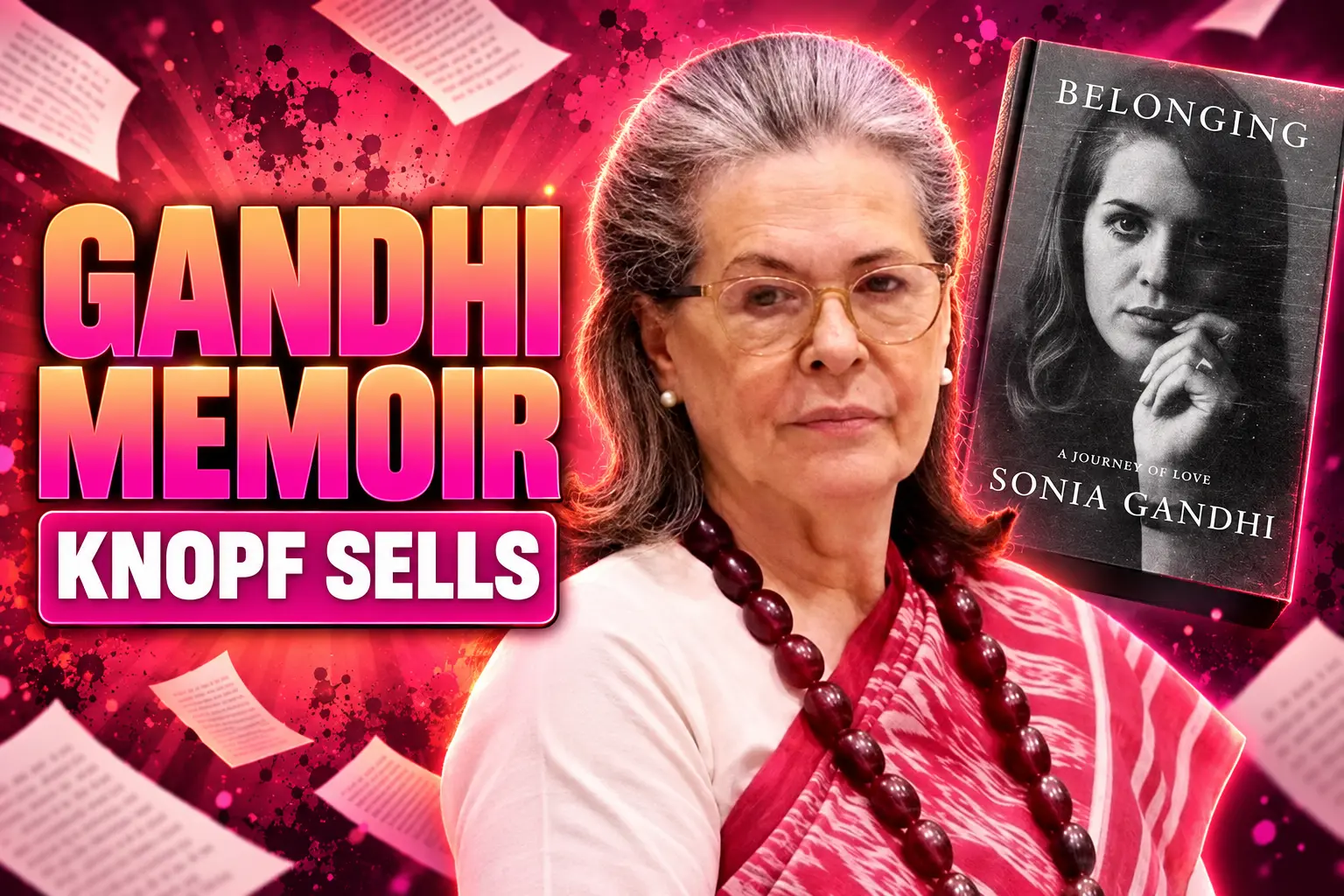
HarperCollins India will issue Sonia Gandhi’s Belonging on November 10, the same day Knopf, a Penguin Random House imprint, sells the book the Indian unit would not.

HarperCollins India will publish Sonia Gandhi’s memoir Belonging on November 10, 2026, the same day Alfred A. Knopf releases it worldwide. Knopf is an imprint of Penguin Random House, the parent of the Indian house that stepped away.
The Indian edition had been in doubt since August 28, when Penguin Random House India said it was not the publisher in India. Gandhi, 79, the longest-serving president of the Indian National Congress and now a Rajya Sabha MP, refused a split text. HarperCollins is printing the country the book is about; Penguin’s American arm is printing the rest.
Knopf Is Still Printing the Book
On August 18, Knopf set a worldwide date and a first printing of 100,000 copies. Its catalog still lists a hardcover at $38, an ebook, and an audiobook read by Sneha Mathan. Knopf’s 544-page November listing treats the manuscript as a finished lead title, not a file stuck in legal review.
That is the oddity the fight keeps running into. The same global group will sell the book in the United States and as audio, while its Indian company is out of the print run in Gandhi’s own country. HarperCollins takes the market in which the names in the manuscript still hold office.
WHO SELLS BELONGING WHERE
| Market | Publisher | Parent or imprint | Format notes |
|---|---|---|---|
| United States | Alfred A. Knopf | Penguin Random House | Hardcover $38, 100,000-copy first printing |
| India | HarperCollins India | HarperCollins | Print edition, November 10 |
| Audiobook | Penguin Random House | Penguin Random House | Read by Sneha Mathan |
The parent company still collects on the American edition and the audio. It does not, on present plans, collect on the Indian hardcover. A rival does.
Who Publishes Sonia Gandhi’s Memoir in India?
HarperCollins India does, on November 10, matching the international date. The house said Belonging is a personal story of love, identity, duty and belonging, and a rare insider view of India’s path. Anantha Padmanabhan, HarperCollins India’s chief executive, posted the same date and the same pitch on September 4.
The announcement ended a week of public confusion after Penguin Random House India walked off the Indian rights. Other Indian houses had been in touch with David Godwin, the book’s agent. HarperCollins closed the deal and put the cover out the same morning.
https://x.com/HarperCollinsIN/status/2095761345547559128
The post is a trade notice, not a polemic. It does not mention Penguin, the RSS, or China. It sells a November lead title. That choice is the bet: controversy will move copies, and the uncut pages are the product.
Penguin India Says It Wanted a Fact-Check
Penguin Random House India answered the first reports on August 28 with a statement that denied the simplest version of the break. It said it was not the Indian publisher, then rejected the claim that it had quit because Gandhi refused edits.
Any suggestion that Penguin Random House India decided not to publish Belonging because the author declined editorial changes does not accurately reflect the circumstances. As a publisher, it is both our prerogative and our responsibility to fact check and provide authors with recommendations that are in the best interests of their books.
Penguin Random House India, August 28 statement
The house added that this was a normal part of publishing, that it had stayed willing and keen to bring the book out, and that it would not discuss confidential talks with the author. Days later it described an impasse over a particular issue and denied any outside pressure.
Gaurav Shrinagesh, the company’s chief executive, was asked about the requested changes and was not available. Knopf and Godwin were also asked and did not comment. The public record from the Indian company is process language. It never named the pages it wanted changed.
WHAT WE KNOW
- The Indian rights: HarperCollins India will publish Belonging on November 10, 2026.
- The global edition: Knopf, a Penguin Random House imprint, still has the US book and a 100,000-copy first printing.
- PRHI’s line: The company says fact-checking is its job, that it remained keen to publish, and that it was not pushed from outside.
WHAT IS UNCONFIRMED
- The exact cuts: Penguin Random House India has not published a list of passages it wanted altered or removed.
- The pressure claim: Congress leaders say the government leaned on the house; the house says it did not.
- The Indian text: No page proof is public, so no one can yet show whether the HarperCollins printing matches Knopf word for word.
Those blanks are why the org chart does so much work. A sister imprint already cleared a text for the world. The Indian company, looking at the same author, would not sign off without a change it still will not specify.
Modi, the RSS, and China in the Fight
Ashok Gehlot, the former Rajasthan chief minister, put names to the fight on August 28. He said Penguin’s worldwide operation was ready to issue the book in its original form, while the Indian company wanted changes before a local launch.
After all, what is the reason, or what pressure is there, that what is being published across the world cannot be published in India? The real issue is that pressure was put on Penguin India to remove the portions related to Modi, the RSS, and the occupation of Indian territory by China during Modi’s rule. This is the murder of democracy.
Ashok Gehlot, former Rajasthan chief minister, on X
Gehlot said Gandhi was writing facts, not a story, and that hiding those pages from Indian readers was an attack on expression. Gaurav Gogoi, the Congress deputy leader in the Lok Sabha, said some people in the BJP government had become afraid of a book being read in India. Kamal Nath, the former Madhya Pradesh chief minister, asked whether a publisher would decide what Gandhi may write, and whether the house was acting on its own.
People involved in the talks described a narrower practical fear on the author’s side. Edits on Prime Minister Narendra Modi, the RSS, communal violence, the status of minorities, and the Galwan clash with China would have produced two books, one for India and one for everyone else. Indian readers would have had to buy the foreign edition to see what had been taken out.
Gandhi would not accept that split. HarperCollins is now the house that does not ask her to. Penguin Random House India still has not said Gehlot is wrong about the subjects. It has only said the walk-away story is the wrong story.
Joe Sacco’s India Edition Stopped at a Map
The Gandhi file did not arrive in a vacuum. In June 2026, the same Indian company halted distribution of Joe Sacco’s The Once and Future Riot, a 135-page graphic account of the 2013 Muzaffarnagar clashes that left more than 60 people dead. Shrinagesh said a pre-check had found a map with inaccurate Indian boundaries, plus content questions and citations that never came, and that Penguin UK did not close the points.
Sacco, the Maltese-American cartoonist who built a career on comics reportage from Gaza and Bosnia, said he was given a five-page list of changes. He described demands for extra consents and likeness checks, and a request to drop a closing judgment on Hindu political power after the riots. He refused. LeftWord Books in Delhi then took the Indian edition. Sacco said about six Indian publishers had already called him.
PRHI’S 2026 FLASHPOINTS
- Sacco’s riot book: Distribution stopped after a map and a change list the author would not accept; LeftWord picked up the Indian printing.
- General M. M. Naravane: The house said it had not printed Four Stars of Destiny, even after a hard copy was held up in Parliament and Galwan passages circulated.
- Gandhi’s memoir: Knopf kept the global book; the Indian company left the local rights; HarperCollins signed them.
Each case has a local explanation: a map, a citation, a particular issue, a fact-check. Taken together they show an Indian legal screen that is tighter than the screen in New York or London. The Gandhi memoir makes that gap visible because the rejected local book is still a Knopf title.
A Reticent Leader Writes the Private Years
The manuscript Knopf is selling is not a campaign pamphlet on its face. It opens in Cambridge in 1965, when Sonia Maino, a 19-year-old language student from Sangano and Orbassano near Turin, meets Rajiv Gandhi, then a young man and the grandson of Jawaharlal Nehru. They marry in 1968. She learns Hindi, wears saris, and raises two children, Rahul and Priyanka, now both in the Lok Sabha, Rahul as leader of the opposition.
THE BOOK KNOPF IS SELLING
- Length and price: 544 pages, US hardcover $38, ISBN 9780593803592.
- First printing: 100,000 copies for the Knopf edition.
- The hinge years: Sanjay Gandhi’s plane crash, Indira Gandhi’s assassination in 1984, Rajiv Gandhi’s assassination seven years later.
- The political turn: Years of refusal, then the Congress presidency, then the 2004 decision to decline the prime minister’s post.
She had already put out a pictorial book on Rajiv and edited her earlier Nehru-Indira letter volumes, Freedom’s Daughter and Two Alone, Two Together. People who have worked on Belonging call this the personal account. Knopf’s own copy promises present political struggles as well as family history, which is where the Indian legal read appears to have snagged.
It was heartbreak and loss that threw me into the public world of politics. Up till then I had guarded my privacy fiercely. Much has been written about my family, but few narratives were able to reach into the truth of their motivations, their actions and even their very human failings.
Sonia Gandhi, in Knopf’s announcement materials
She also said writing the life did not come easily, because it meant opening things she had kept inside. That is the voice HarperCollins is now taking to Indian shops: a guarded politician finally naming the private years, and, if Gehlot is right, naming the public ones Penguin India wanted shaved.
The Same Text Goes Out on One Date
November 10 now does double duty. It is Knopf’s street date in the United States and HarperCollins India’s street date. Anyone who wants to test the censorship charge can put the two printings on one desk. If the pages match, Penguin India’s particular issue was never about a different book. If they do not, the Indian reader was the person the fight was about.
THE PATH TO NOVEMBER 10
- June 2026: Penguin Random House India stops distributing Joe Sacco’s The Once and Future Riot after a map and unresolved content queries.
- August 18, 2026: Knopf announces Belonging for November 10, with a 100,000-copy first printing.
- August 28, 2026: Penguin Random House India says it is not the Indian publisher; Gehlot alleges cuts on Modi, the RSS, and China.
- August 31, 2026: The Indian house cites an impasse over a particular issue and denies outside pressure.
- September 4, 2026: HarperCollins India says it will publish the memoir in India on November 10.
- November 10, 2026: Knopf and HarperCollins India are due to put the same title on sale.
The Indian printing is now a commercial wager that the pages Penguin India would not bless will sell in the market that cares most. Knopf has already placed its bet, at 100,000 copies, on a book its own Indian colleagues would not carry. On November 10 the two houses will find out whether one manuscript can live in both ledgers.

Police Tighten the Ring Around Gyanesh Kumar’s House

Ravi Shankar Calls Hanuman Ansh a Slap to Big Spenders

Microsoft Puts Nvidia in the Surface Laptop Ultra Flagship

Adult Fires on an Armed Juvenile at Longmont Dollar Tree

Jordan Absorbs Iranian Missiles Aimed at Parked US Jets

The iPhone 18 Pro Max Splits Apple’s Fall in Two

OpenAI Calls GPT-6 Astra AGI Then Locks Its Exploits

Russia Closes the Goethe-Institut Berlin Tried to Save

Trump Claims Hormuz Control as Oil Holds Near $96

Volkswagen’s Job Cuts Leave Four Plants Without Cars

 NEWS1 month ago
The iPhone 18 Pro Max Splits Apple’s Fall in Two
- NEWS1 month ago
OpenAI Calls GPT-6 Astra AGI Then Locks Its Exploits
- LIFESTYLE1 month ago
Russia Closes the Goethe-Institut Berlin Tried to Save
- BUSINESS1 month ago
Trump Claims Hormuz Control as Oil Holds Near $96
- AUTO1 month ago
Volkswagen’s Job Cuts Leave Four Plants Without Cars
- BUSINESS1 month ago
Japan’s 3 Percent Yield Reprices Government Debt Worldwide
- NEWS1 month ago
Dyson Puts Nurovi Robots on Sale Without the UV Flagship
- NEWS1 month ago
The Lincoln’s 286-Day War Cruise Ends at a Thai Pier