BUSINESS
Putin Meets Modi With Jets and Reactors Under a Tariff Cloud
Modi and Putin meet September 11 on Su-57 jets and reactors while a U.S. tariff bill targets Russian oil buyers.

Kremlin spokesman Dmitry Peskov said Prime Minister Narendra Modi and President Vladimir Putin will meet on Friday, September 11, with Su-57 fighters and new nuclear plants on the list. The session is set three days before India hosts the 18th BRICS summit in New Delhi on September 12 and 13.
In February, a White House order said India had pledged to stop buying Russian oil. Peskov is now putting more Russian hardware on a Delhi agenda, while a U.S. bill that could tax the top buyers of that oil at up to 100 percent sits with the House.
India Already Cashed a Tariff Cut Against an Oil Pledge
On August 6, 2025, President Donald Trump imposed an extra 25 percent duty on Indian goods, citing India’s purchases of Russian oil. Executive Order 14384, signed February 6, 2026, then eliminated the extra 25 percent duty from 12:01 a.m. eastern time on February 7.
The order said India had committed to stop importing Russian oil, directly or indirectly, and had said it would buy U.S. energy. It also recorded a new 10-year defence framework with the United States. Commerce was told to watch whether those oil buys resumed and, if they did, to recommend putting the 25 percent duty back.
The Global Trade Research Initiative, a New Delhi trade research group, put Russian crude at 30.3 percent of India’s oil imports in the 2025-26 financial year, worth $40.8 billion. That figure covers a year that mostly predates the February order, so it measures the scale of the oil tie, not a clean before-and-after. The cleaner signal is political. Senator Roger Wicker, describing the Senate-passed bill on August 17, still listed India among the five largest buyers of Russian oil and gas, with China, Slovakia, Hungary and Azerbaijan.
THE U.S. TARIFF CLOCK ON INDIA’S RUSSIAN OIL
| Date | Move | What it did |
|---|---|---|
| August 6, 2025 | Executive Order 14329 | Added a 25 percent duty on Indian goods over Russian oil buys |
| February 6 and 7, 2026 | Executive Order 14384 | Lifted that duty after a recorded pledge to stop Russian oil and to buy U.S. energy |
| 2025-26 financial year | GTRI tally | Russian crude at 30.3 percent of India’s oil imports, worth $40.8 billion |
| August 7, 2026 | H.R. 5334 | Senate voted 86 to 11 for duties of up to 100 percent on goods from the top five buyers of Russian oil and gas |
| September 11, 2026 | Modi-Putin meeting | Friday talks on fighters, plants, payments and Ukraine, ahead of BRICS |
H.R. 5334, the Lindsey O. Graham Sanctioning Russia and Iran Act of 2026, passed the Senate 86 to 11 on August 7, on Record Vote 224. The House had passed an earlier version by voice vote on April 27. The Senate sent its amended text back on August 10. That version has not become law. The Congressional summary of the Senate text says the president would have to raise duties by as much as 100 percent on goods from a country among the five largest importers of Russian oil or gas if that country makes new purchases after the bill takes effect.
Peskov, speaking to Indian journalists on September 8, called the U.S. tariff plan illegal and unacceptable. Friday’s meeting is where that fight becomes a room, not a press line.
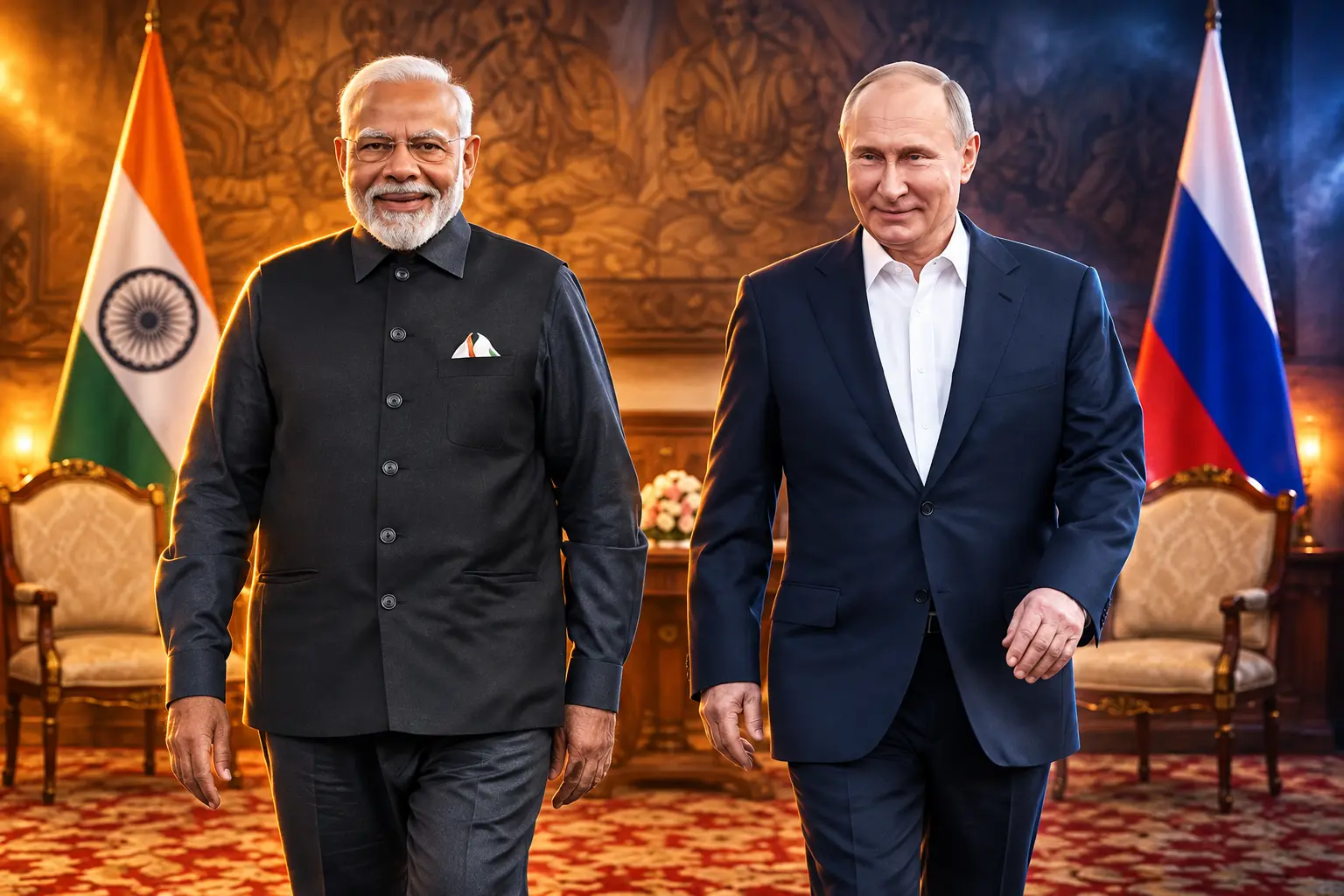
What Moscow Is Putting on Friday’s Table
The two men last met on August 31 in Bishkek, on the sidelines of the 26th Shanghai Cooperation Organisation summit, their first meeting of 2026. India’s Prime Minister’s Office said they reviewed defence, energy, space and trade work, and that Modi looked forward to welcoming President Putin in India for the summit. Modi’s office streamed the opening remarks.
They had met in Delhi on December 4 and 5, 2025, for the 23rd Annual Summit, which produced 21 announcements and 16 MoUs. External Affairs Minister S. Jaishankar then co-chaired the 27th Inter-Governmental Commission in Moscow on August 24. Peskov said the Friday session is scheduled, and that the leaders will start, as they usually do, with the bilateral file.
PESKOV’S FRIDAY LIST
- Trade talks: Peskov said trade and economic work has a very wide scope and will come first.
- Su-57 tech: He said India has been asking for technology transfer on the Su-57 and that the request is under discussion.
- New nuclear plants: He said Moscow is waiting for talks with India on setting up new nuclear plants, on top of work around Kudankulam.
- S-400 deliveries: He put outstanding deliveries on the agenda and said Russia is capable of fulfilling its obligations.
- National-currency payments: He said 90 percent of Russia’s transactions with BRICS countries now run in national currencies.
- Ukraine briefing: He said Putin will update Modi on how the war is going, and he welcomed India’s willingness to help find a peaceful end.
He also pointed to “unfriendly countries” trying to put obstacles in the way of India-Russia work. That is the Kremlin’s name for the sanctions file. He still described the two leaders as close enough to talk through the raw items.
If they don’t let us use their money, we use our own money.
Dmitry Peskov, Kremlin spokesman, briefing Indian journalists, September 8, 2026
He added that Russia is not aiming to get rid of the dollar, and that it is open to every acceptable method of payment. The complaint, in his telling, is that some countries use their currencies as a tool of political pressure and then layer sanctions on top.
The Fifth-Generation Jet India Left in 2018
The Su-57 line is not a new pitch. India and Russia signed an inter-governmental agreement in October 2007 on a joint fifth-generation fighter. Each side spent about $295 million on a preliminary design that ran from February 2011 to June 2013, Parliament was told in 2015. India walked away in 2018 over cost, workshare, engines and stealth, before any licensed airframe was built here.
Putin revived the offer on June 5, 2026, at the St. Petersburg International Economic Forum. “We offered we should do that together. Well, it didn’t work out in the past, but we did it on our own, and we stand ready to sell Su-57 even now,” he said. He said Russia had no issues or limitations, including on air defence systems.
Defence Secretary Rajesh Kumar Singh later said India had no plans to acquire a “new version of the Sukhois.” He did not name the Su-57 in that line, and the Indian Air Force has put its own Advanced Medium Combat Aircraft on a path that still points to the mid-2030s. Peskov’s September 8 version is softer than a sale and harder than a snub: India is asking for the source technology, and talks continue.
Algeria is the only publicly named export customer, with two jets delivered in November 2025 against an order of 12. Russia has used the type in Ukraine mainly for stand-off shots, not as a proven penetrator of modern air defences. Production has been slow, and a serious Indian order would have to live beside a 10-year U.S. defence framework signed on October 31, 2025, and beside France’s push to sell more Rafales.
The older contract is not closed either. Peskov put S-400 deliveries on the same Friday list and said Russia can still meet its obligations. Moscow is trying to finish a 2018 air-defence sale and open a fifth-generation fighter file in the same visit, which is a lot to ask of a buyer that has spent the year telling other suppliers it is not in the market for a new Sukhoi.
New Reactors Wait After Kudankulam Delays
Civil nuclear work is the quieter half of the hardware list, and it has the longer paper trail. Kudankulam is the live project. Rosatom has kept fuel and heavy equipment moving, including the reactor pressure vessel for Unit 5 and the first fuel load for Unit 3. Four additional units have still slipped by nearly three years, with costs up, after the Ukraine war hit the construction timetable.
Peskov said Russia is waiting for talks on new plants in India, not that a site or a price is agreed. India’s own target is 100 GW of nuclear capacity by 2047, which is a lot of concrete for one vendor to assume it will pour. The December 2025 summit already put nuclear work in the joint statement. Friday is another pass at the same door.
A new plant would be a 60-year bet on Russian design, Russian fuel and Russian spare parts. That is a different risk from a fighter that can, in theory, be parked. It is also a different signal to Washington than another oil cargo. Reactors do not fit on a shadow tanker, and they do not vanish when a waiver expires.
Almost All India-Russia Trade Now Clears in Rupees
Jaishankar told the Moscow commission on August 24 that goods trade had risen more than fourfold, from about $13 billion in 2021-22 to nearly $60 billion in 2025-26. The imbalance, he said, had grown from $6.6 billion to over $50 billion. “Addressing this imbalance is today one of our foremost priorities,” he said. The two governments still cite a $100 billion trade target by 2030. The Ministry of External Affairs recorded a record high of $68.7 billion in the 2024-25 financial year, before the flow eased.
Putin said in Bishkek that trade had dipped last year and then grown 2.6 percent in the first six months of 2026. The mix is still crude, fuel, sunflower oil, fertiliser, coking coal and metals coming in, against pharmaceuticals, chemicals, steel and seafood going out. That is why the rupee balances piled up, and why the payment rail became the part of the relationship that actually had to work.
THE RUPEE-RUBLE RAIL
- Share of settlements: Ivan Nosov, head of Sberbank in India, said on September 2 that rupees and rubles now cover 96 percent of bilateral trade.
- Speed: He said 90 percent of those deals are processed within 10 minutes, and more than 50 percent in under one minute.
- Banks: Twenty-two Russian banks, including Sberbank, and 17 Indian banks now service the trade.
- BRICS-wide claim: Peskov said 90 percent of Russia’s transactions with BRICS countries run in national currencies, a wider figure than the India-only 96 percent.
“There are no problems with settlements between Russia and India,” Nosov said. He called the channel one of Russia’s most reliable. Peskov’s 90 percent line is the political wrapper around that plumbing. The rail is how discounted crude, fertiliser and spares keep moving after Western banks stepped back. It is also how a 100 percent U.S. tariff, if it ever lands, would miss the settlement layer and hit Indian goods bound for America instead.
BRICS Week Packs Putin, Xi and a Tariff Bill Into Delhi
India assumed the BRICS chair on January 1, 2026, its fourth turn after 2012, 2016 and 2021. The official site sets India’s 2026 BRICS chairship theme as “Building for Resilience, Innovation, Cooperation and Sustainability.” Seventeen summits have already been held. This 18th gathering sits at Bharat Mandapam, the same complex that hosted the 2023 G20.
Putin is confirmed. Chinese President Xi Jinping is expected, though Beijing has not issued a formal public confirmation in the briefings available this week. If he comes, it would be his first trip to India since the 2019 Mamallapuram meetings. South Africa’s Cyril Ramaphosa, Egypt’s Abdel Fattah el-Sisi, Indonesia’s Prabowo Subianto, Iran’s Masoud Pezeshkian and Ethiopia’s Abiy Ahmed are on the expected list, with partner-country leaders from Belarus, Kazakhstan, Malaysia and Thailand also named in the run-up.
New Delhi wants the week to look like trade, digital public infrastructure, AI, energy and small-business work, not like an anti-Western caucus. Hosting Putin the day before that stage is set, with Su-57s and reactors in the briefing notes, pulls the other file into the same camera shot. So does the chance of a Modi-Xi pull-aside, if Xi boards the plane.
WHAT WE KNOW
- The meeting: Peskov said the Modi-Putin session is scheduled for Friday, September 11, ahead of the September 12 and 13 summit.
- The U.S. duty: The extra 25 percent tariff on Indian goods was lifted on February 7, 2026, with a written monitoring clause on Russian oil.
- The Senate bill: H.R. 5334 passed 86 to 11 on August 7 and still needs the House to accept the Senate text before it can go to the president.
WHAT IS UNCONFIRMED
- Any Su-57 contract: Peskov described technology-transfer talks, not a signed buy. Singh’s public line still points the other way.
- New nuclear sites: Moscow is waiting for negotiations. No new plant has been announced for this visit.
- Xi’s itinerary: His presence is widely expected and not, in the public record this week, formally confirmed by Beijing.
The House has not yet acted on the Senate text. The Commerce Department is still charged with watching whether India buys Russian oil. Those two files will be in the building on Friday even if no jet contract is.

Police Tighten the Ring Around Gyanesh Kumar’s House

Ravi Shankar Calls Hanuman Ansh a Slap to Big Spenders

Microsoft Puts Nvidia in the Surface Laptop Ultra Flagship

Adult Fires on an Armed Juvenile at Longmont Dollar Tree

Jordan Absorbs Iranian Missiles Aimed at Parked US Jets

The iPhone 18 Pro Max Splits Apple’s Fall in Two

OpenAI Calls GPT-6 Astra AGI Then Locks Its Exploits

Russia Closes the Goethe-Institut Berlin Tried to Save

Clancy Juror Says the Holdout Never Cited Evidence

Trump Claims Hormuz Control as Oil Holds Near $96

 NEWS2 months ago
The iPhone 18 Pro Max Splits Apple’s Fall in Two
- NEWS2 months ago
OpenAI Calls GPT-6 Astra AGI Then Locks Its Exploits
- LIFESTYLE2 months ago
Russia Closes the Goethe-Institut Berlin Tried to Save
- NEWS1 month ago
Clancy Juror Says the Holdout Never Cited Evidence
- BUSINESS2 months ago
Trump Claims Hormuz Control as Oil Holds Near $96
- AUTO2 months ago
Volkswagen’s Job Cuts Leave Four Plants Without Cars
- NEWS2 months ago
Dyson Puts Nurovi Robots on Sale Without the UV Flagship
- BUSINESS2 months ago
Cable Stocks Fall as UltraTech Copies the Paints Playbook