NEWS
Russia Ends the Kyiv Pause With Missiles After Envoys Leave
Russia hit Kyiv when a three-day capital halt expired, killing two after Kushner and Witkoff’s first visit, and leaving ballistic interceptors as the live gap.

Russia killed two people in Kyiv with drones and missiles in the early hours of September 8. The strike ended a three-day halt on the capital that had covered the first official visit by U.S. envoys Jared Kushner and Steve Witkoff.
Interior Minister Ivan Vyhivskyi later put the injured at 16 and said crews were still working under a new air-raid alert. The mix was ballistic missiles, cruise missiles, anti-ship missiles and jet-powered Shahed drones.
What the Three-Day Kyiv Pause Covered
The quiet over Kyiv was a visitor arrangement, not a ceasefire. Kremlin spokesman Dmitry Peskov said President Vladimir Putin had ordered that no strikes be carried out on Kyiv for three days starting at midnight on September 5, tied to the American trip.
Ukraine had asked for more. Kyrylo Budanov, head of the presidential office, said Ukrainian forces were told to hold fire from 00:00 on September 5 until 23:59 on September 8, and that the proposal sent to Moscow covered long-range strikes and the line of contact. Putin told the envoys he had never agreed to that wider halt.
“The Ukrainian authorities publicised their call for a broader three-day ceasefire, but we never agreed on that with them,” Putin said, according to Russian state agencies that transcribed the meeting. Witkoff thanked him for the capital pause.
THE WEEKEND CLOCK
- September 4: A Russian drone hits the Security Service building on Volodymyrska Street, across from St. Sophia Cathedral.
- September 5, midnight: Putin’s three-day halt on Kyiv begins. Ukraine’s own hold is written through 23:59 on September 8.
- September 5: Kushner and Witkoff sit with Putin in Moscow for more than three hours, after a long lunch with Kirill Dmitriev.
- September 6: The envoys reach Kyiv by train for their first talks in the city and meet President Volodymyr Zelensky.
- September 7, evening: Russian state media says the halt has expired. Jet-powered drones are reported over the wider Kyiv region, which the city-limit pause did not cover.
- September 8, early hours: Combined missiles and drones hit Kyiv and other regions.
The envoys left on Sunday. The missiles arrived after the three-day order ran out, a full day later. That is a timer, and it is the only product this round of talks has so far been able to buy.
Both Deaths Were in Solomianskyi
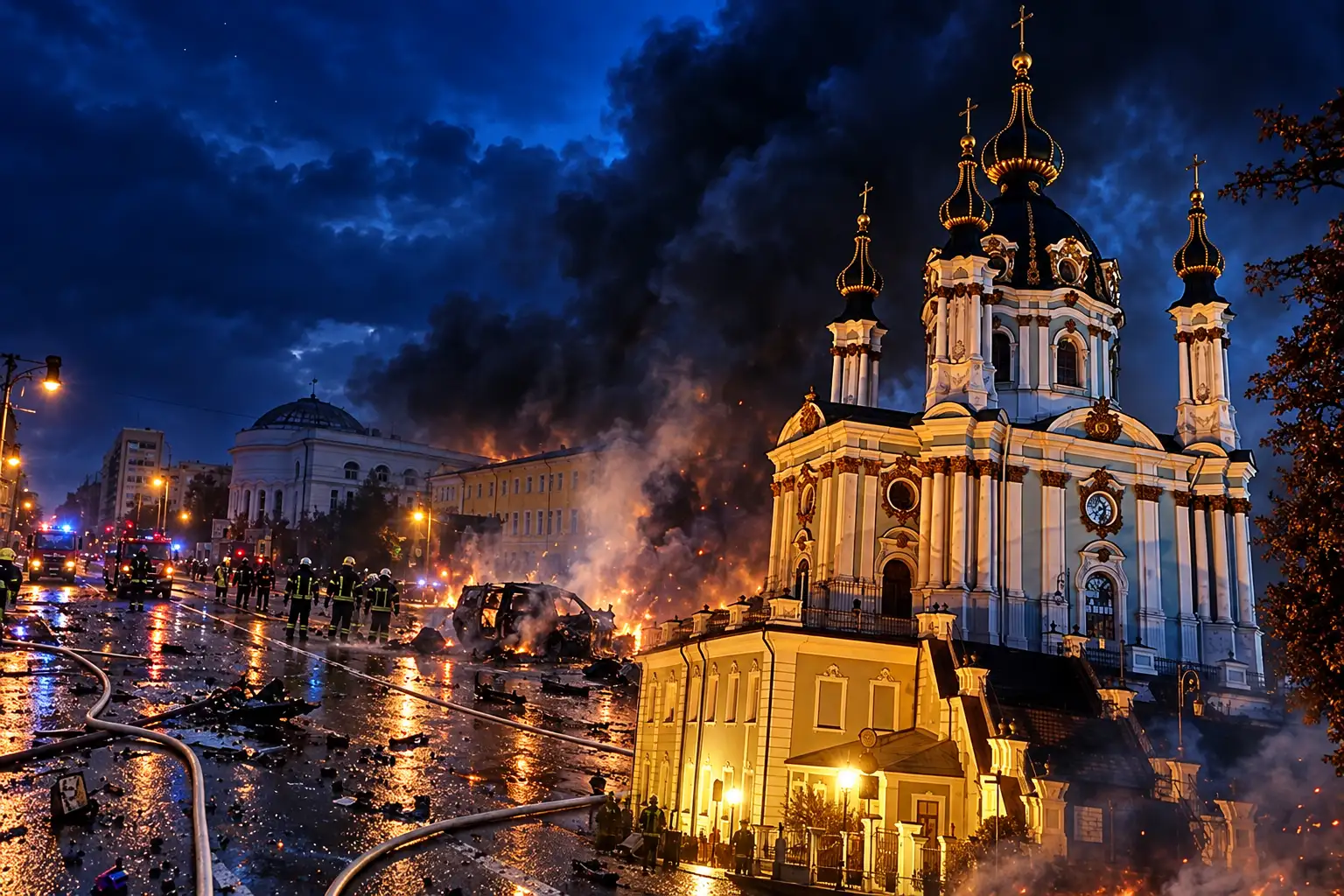
The National Police recorded damage in seven Kyiv districts: Shevchenkivskyi, Holosiivskyi, Darnytskyi, Obolonskyi, Podilskyi, Solomianskyi and Dniprovskyi. Both fatalities were in Solomianskyi, where eight people aged 22 to 65 were hurt with cuts and shrapnel wounds to the face, neck, torso and limbs.
A 29-year-old foreign national was injured in Darnytskyi. Iryna Barisenkova, 61, said she heard the explosions while riding public transport and was told of a large fire near the Darnytskyi Vehicle Repair Plant on the left bank.
Vyhivskyi said explosions ran for nearly five hours and that more than 50 damaged facilities included homes, a dormitory, school grounds, shops, gas stations and a flour plant. State Emergency Service vehicles were hit in a repeated strike. More than 300 rescuers and police were still at seven sites later in the morning, taking property reports and restoring documents from mobile ministry desks.
WHAT WAS HIT IN KYIV
- Housing: At least 14 apartment blocks, plus a five-story building in Solomianskyi where 10 people were trapped and a 16-story block from which two residents were brought out.
- The unfinished tower: Blast effect on the 23rd floor of a 26-story non-residential building in Holosiivskyi.
- Schools and clinics: Fires on educational grounds, including a private school, and damage to a clinic and a school building.
- Shops and fuel: A supermarket, a petrol station, warehouses in several districts, and 25 cars.
- Transit: Blast damage at the entrance to Tarasa Shevchenka metro station.
Mayor Vitali Klitschko said debris started fires on a private school grounds in Holosiivskyi, trapped people in a residential building, and fell on the unfinished tower. Rescuers pulled 13 people out across the city, matching the two from the 16-story block, the 10 from the five-story block, and one person found during a search in Holosiivskyi.
EU ambassador Katarina Mathernova said Kyiv was exploding and burning. The Russian defence ministry said it had hit military and logistic targets in Kyiv and the surrounding region, and in the Black Sea port of Chornomorsk.
175 Targets Down, Two Ballistic Missiles Through
Ukraine’s Air Force, in a Telegram update covering 18:00 on September 7 to 08:30 on September 8, said air defences shot down or jammed 175 targets. Cruise missiles were the success. Ballistic missiles were the leak.
AIR FORCE TALLY, 18:00 TO 08:30
| Weapon | Fired | Downed or jammed |
|---|---|---|
| Kh-101 / Iskander-K cruise missiles | 32, from Vologda | 31 |
| Iskander-M, KN-23, S-400, Onyx | Not disclosed | 2 |
| Shahed-type attack drones | 166, more than half jet-powered, plus Parodiya decoys | 142 UAVs of Shahed, Gerbera and other types |
Missiles and strike drones hit 29 locations. Debris from intercepted targets fell at nine more. Main axes were Kyiv and Odesa. Onyx anti-ship missiles came from Bryansk, Kursk and occupied Crimea. Ballistic missiles came from Bryansk and Voronezh. Drones came from Orel, Primorsko-Akhtarsk, occupied Donetsk and Hvardiyske in occupied Crimea.
Video from the night shows two ballistic missiles hitting one Kyiv target in close succession, a flash then a shockwave. That is the part of the package Ukraine still cannot count on stopping. Aircraft, missile units, electronic warfare, unmanned systems and mobile fire groups all took part in the defence.
Last night saw a complex Russian attack which the Russians deliberately attempted to calculate for maximum harm to life: ballistics, cruise and anti-ship missiles, jet-powered Shaheds. In total, our warriors shot down 175 air targets overnight, but unfortunately, not all. Despite very good results against cruise missiles, ballistics are particularly difficult, and every day we demonstrate this need for interceptors to our partners.
Volodymyr Zelensky, President of Ukraine, Telegram, September 8, 2026
Zelensky said meetings later on September 8 would include states and companies that can help with supplies and with Ukraine’s FREYJA anti-ballistic system. He also recorded two dead and, in that morning post, 10 injured, before the Interior Ministry raised the wounded count.
The War Did Not Pause Outside Kyiv
While the capital had its three quiet nights, the rest of the country did not. A strike monitor compiled on September 6 found that Russian attacks on September 5 and 6 killed eight people and injured 69 outside Kyiv.
The worst of those two days was at Kametstal, the Metinvest steel works in Kamianske, Dnipropetrovsk region, in the early hours of September 5. Five workers were killed, four of them on shift: a locksmith, an electrician, a hydraulics specialist and a machine operator. Oleksandr Hanzha, head of the regional military administration, called it terror against people who work and keep the economy going. Operations at the plant stopped.
Overnight into September 5, before the envoys reached the Kremlin, Russia also struck Kyiv’s Zhuliany and Boryspil airports, the fields then under discussion as arrival points. Zelensky called those hits demonstrative. Two women were injured at Boryspil and hospitalised.
Prime Minister Serhii Koretsky said crews were dealing with the September 8 night in eight regions as well as in Kyiv, with destruction in Zaporizhzhia, Kirovohrad and Dnipropetrovsk. A diesel locomotive on the Kyiv-Sumy train was attacked at a station in Sumy region; Zelensky said there were no casualties there and that passengers were being moved. In Odesa region, missiles hit an open-air market. Vyhivskyi said Russian forces were still attacking civilian sites in the regions that morning.
Ukraine did not freeze the other side of the map either. Overnight into September 6, Ukrainian drones set a fire at an industrial plant in the Ryazan region, identified by monitors as a Rosneft refinery that supplies fuel around Moscow. The pause covered two city limits. Nothing in it stopped Ryazan or Kharkiv.
Kushner and Witkoff Left With a Calendar
Sunday was the first time either envoy had held talks in Kyiv. Witkoff had already been to Moscow eight times. They came straight from a Saturday session with Putin that Kremlin aide Yury Ushakov called highly useful, then rode a train into Kyiv, were met by Rustem Umerov, and sat with Zelensky at the St. Sophia complex and later at Mariinsky Palace.
There were two rounds with the Ukrainian team and a third with national security advisers from the United Kingdom, France and Germany. Witkoff told reporters he felt good about the conversations in Moscow and in Kyiv and hoped a new round of U.S.-mediated talks would be announced in short order. Kushner said they wanted to go back to the trilateral format used about six months earlier, and that President Donald Trump wanted a framework for a durable peace, not only a halt in the fighting.
Those talks had stalled in February when Washington’s attention moved to the Iran war. Officials familiar with the file have said a 20-point plan had already been cut down to two open questions: how to run a Russian-occupied nuclear power plant, and who controls the parts of Donbas Ukraine still holds. Trump said before the trip that the pair were bringing a proposal to end a four-and-a-half-year war. No text was published in Kyiv.
Zelensky took the Americans to St. Sophia, opposite the Security Service building hit on September 4. At a press appearance he joked, “Please come more often, so that our people have the chance to live normally.” The line landed because the quiet was already understood as something that travels with the guests.
Interceptor Stocks Are the Live Constraint
Foreign Minister Andrii Sybiha put the political reading in one sentence: the ballistic missiles spoke louder than the diplomacy. He asked allies not to sit on stocks, including rounds near expiry, and said every delay is measured in lives.
https://x.com/andrii_sybiha/status/2097192925348212758
That ask sits on the Air Force numbers, not on the communiqués from Sunday. Thirty-one of 32 cruise missiles were stopped. Two ballistic or Onyx missiles were stopped, from an unstated larger salvo, and video from street level showed the ones that were not. Jet-powered Shaheds, more than half of the 166 attack drones, are already pulling cheap interceptor drones out of the fight because a propeller hunter cannot catch a target twice as fast.
Before this trip, Russia had been pushing jet drones on Kyiv in daylight as well as at night. The three-day hush reset that pattern only inside the city limit, and only until the order expired. Zelensky’s FREYJA meetings on September 8 are the practical sequel: more interceptors now, and a European anti-ballistic build that is still a program, not a shield over Solomianskyi.
By late morning, more than 300 rescuers and police were still putting out fires and clearing debris in Kyiv, taking reports of wrecked flats, while another alert ran overhead. The envoys had their calendar. The city was back on the other one.

Police Tighten the Ring Around Gyanesh Kumar’s House

Ravi Shankar Calls Hanuman Ansh a Slap to Big Spenders

Microsoft Puts Nvidia in the Surface Laptop Ultra Flagship

Adult Fires on an Armed Juvenile at Longmont Dollar Tree

Jordan Absorbs Iranian Missiles Aimed at Parked US Jets

The iPhone 18 Pro Max Splits Apple’s Fall in Two

OpenAI Calls GPT-6 Astra AGI Then Locks Its Exploits

Russia Closes the Goethe-Institut Berlin Tried to Save

Trump Claims Hormuz Control as Oil Holds Near $96

Clancy Juror Says the Holdout Never Cited Evidence

 NEWS2 months ago
The iPhone 18 Pro Max Splits Apple’s Fall in Two
- NEWS2 months ago
OpenAI Calls GPT-6 Astra AGI Then Locks Its Exploits
- LIFESTYLE2 months ago
Russia Closes the Goethe-Institut Berlin Tried to Save
- BUSINESS2 months ago
Trump Claims Hormuz Control as Oil Holds Near $96
- NEWS1 month ago
Clancy Juror Says the Holdout Never Cited Evidence
- AUTO2 months ago
Volkswagen’s Job Cuts Leave Four Plants Without Cars
- NEWS2 months ago
Dyson Puts Nurovi Robots on Sale Without the UV Flagship
- NEWS2 months ago
The Lincoln’s 286-Day War Cruise Ends at a Thai Pier