NEWS
The Lincoln’s 286-Day War Cruise Ends at a Thai Pier
The USS Abraham Lincoln’s first full port call in Thailand is the delayed bill for an Iran war cruise that outlasted the Navy’s seven-month model.

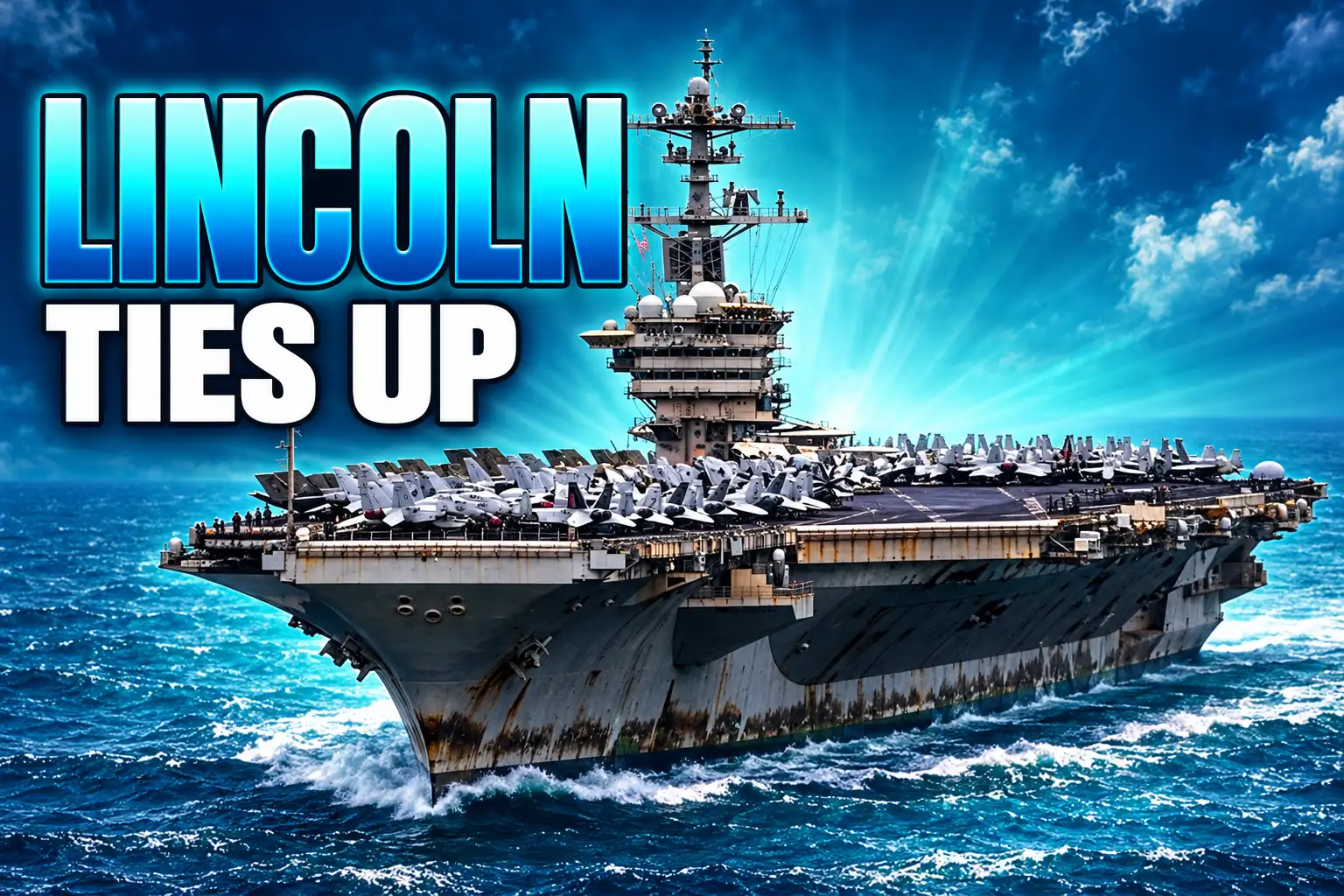
The USS Abraham Lincoln tied up at Laem Chabang on Wednesday after 286 days at sea. It was the carrier’s first full port call of a cruise that was supposed to end in May.
About 5,000 sailors and Marines now get five days ashore in and around Pattaya before the ship heads for San Diego. Rear Adm. Robert Loughran, commander of Carrier Strike Group 3, called it a well-deserved chance to rest and recharge. The same morning, U.S. forces launched fresh strikes on Iran.
A 286-Day Wait for the First Full Port
The 1,092-foot Nimitz-class ship left Naval Base San Diego on November 21, 2025, for a Pacific patrol. It was sent to the Middle East in January, before U.S. and Israeli attacks on Iran began in late February, and the calendar did not let go.
Carriers normally pull in every 30 to 45 days so crews can sleep off the ship, stores can be rebuilt, and the hull can get work that a replenishment ship cannot do. This crew had two brief stops and then a stretch of 208 consecutive days without a pier, a modern mark for a U.S. aircraft carrier.
Capt. Dan Keeler, the commanding officer, said Thailand was the first full port stop since November and called the cruise historic. The destroyer USS Frank E. Petersen Jr. tied up the same day at Sriracha. The cruiser USS Robert Smalls went to Map Ta Phut. Thai Defense Ministry spokesman Rear Adm. Surasant Kongsiri said the visit is strictly rest, with no joint drills planned.
THE LINCOLN CLOCK
- November 21, 2025: Leaves San Diego for a planned Pacific deployment due back in May.
- December 11-12, 2025: Stops at Guam, the first of only two brief calls before Thailand.
- January 2026: Diverted to the Middle East ahead of the war with Iran.
- July 7, 2026: Makes a one-day stop in Oman after the long stretch at sea.
- August 19, 2026: USS George Washington arrives in the Central Command area to take the station.
- September 2, 2026: Lincoln reaches Laem Chabang for the first full port call of the cruise.
Paint has worn off in sheets. Photographers on the jetty saw rust along the hull as tugs walked the ship in. Bryan Clark, a former Navy headquarters officer who now directs defense work at the Hudson Institute, said that after months of long shifts, even without nonstop flight ops, a change of scene is the relief.
Epic Fury Used Up the Calendar
The time ashore was not lost to weather or a slow transit. The strike group spent 200 days in the U.S. Central Command area on Operation Epic Fury and on a maritime blockade of Iranian ports that the strike group’s own arrival note called the largest naval blockade in decades.
Acting Secretary of the Navy Hung Cao put the combat load in a statement on August 14, when the ship was still 266 days into the cruise. Chief of Naval Operations Adm. Daryl Caudle later described Epic Fury as record-breaking combat work that pulled in naval forces from both coasts, more than two dozen ships, and more than 27,000 sailors supporting the fight.
WHAT CAO PUT ON THE RECORD
- Combat days: 200 days inside a combat zone by mid-August.
- Sorties: More than 10,000 flights launched from the cruise.
- Ordnance: 1.5 million pounds dropped in support of the war.
- Retention: Cao said the Lincoln’s re-up rates sat among the highest of all carriers.
Caudle has said he prefers seven-month deployments and pushes back on extensions. “The enemy gets a vote,” he said. That vote kept this West Coast carrier on station until another deck could take the load.
Families Took the Overboard Reports to Hung Cao
The fight over what those months did to the crew broke into public view in August, while the ship was still in the war zone. Family members told Navy leaders at an August 6 town hall in San Diego that sailors were exhausted, short of basics, and talking about going over the side.
One spouse told officials that her husband had written that day that he hoped he would not wake up tomorrow. A parent said a son on the ship talked about jumping just for relief. Rep. Mike Levin of California described moldy showers, broken toilets, laundry down for weeks, long stretches with no hot water, a meal of half a cup of rice and two tortillas, and no soap, deodorant, or toothpaste.
Cao Called the Coverage Dishonest
Cao answered on August 14 by saying the Lincoln was extended because the mission demanded it, and by accusing news reports of painting sailors as victims.
Unfortunately, the media are trying to paint our warriors as victims. Not only is that dishonest but it takes away the focus on the enemy and the threat it poses against our nation, people, and way of life.
Hung Cao, Acting Secretary of the Navy, August 14 statement
He said a small number of mental health cases were treated with no loss of life, that meal plans were adjusted when fresh stores ran out without a missed meal, and that calls home were limited when the threat was too high. Defense Secretary Pete Hegseth said the conditions reports were completely misrepresented. President Donald Trump, asked if the cruise had gone on too long, said it was not nearly long enough.
A Spouse Read a Suicide Text in the Town Hall
Adm. Brad Cooper, the Central Command chief, visited the ship in mid-August and said that of the Navy’s 11 active carriers, the Lincoln had among the lowest number of mental health cases. He also said food, hot water, and other complaints raised months earlier had been fixed, and called some of the coverage old news. A Navy statement said the command had not identified an increase in reported suicidal ideation or attempts, and that extra resilience counselors and social workers were being sent.
Those assurances sat beside a case the Navy did not keep off the books. A sailor jumped from the ship on August 3 and was recovered, then flown to San Diego on August 13. Charging papers later listed two counts under the Uniform Code of Military Justice, one for feigning illness or self-injury to avoid duty and one for unauthorized absence. In a July 21 message, 13 days before the jump, the sailor wrote that the boat was finally getting to him.
WHERE THE ACCOUNTS SPLIT
- Navy leadership: Cao, Hegseth, and Cooper say the cruise was hard, the reports overstated, meals continued, and mental health cases stayed comparatively low, with no deaths.
- Families and House Democrats: Levin, Sen. Richard Blumenthal of Connecticut, and a letter led by Rep. Joe Courtney of Connecticut describe supply gaps, plumbing failures, mail lost for months, and multiple attempts to go overboard.
- The overboard file: Officials confirmed at least one sailor in the water in August and treated it as a mental health episode; families have described more than one attempt across the cruise.
Courtney’s letter, signed by dozens of colleagues, said the crew had been extended more than once and was still in a combat zone three months after it was originally scheduled to return in May. It asked what lessons from the USS Gerald R. Ford’s long cruise had been applied to this one, and whether the department even considered there to be a food shortage or chronic hygiene problem on board.
Why the Navy Pulled George Washington out of Japan
The Thailand stop became possible only after the Japan-based carrier USS George Washington reached the Central Command area on August 19. Cao had said days earlier that the Lincoln crushed its deployment and would come home as part of a planned rotation. The timing followed the town hall, the overboard case, and a week of letters from the Hill.
George Washington is the Navy’s only carrier forward-based in Japan. Moving it west put two U.S. carriers in the Middle East with USS George H.W. Bush already there, and it left the Western Pacific without an American carrier strike group at a moment when Pentagon officials have been warning about China. Courtney’s letter asked, in plain terms, how the Navy planned to hold its posture in the Indo-Pacific if Washington stayed in Central Command.
Hegseth had said the Navy could hold the Iran station indefinitely by rotating ships. Rotation is exactly what this liberty cost: a hole in the Pacific so that one exhausted West Coast crew could walk down a brow in Thailand. Theodore Roosevelt, still in San Diego in August, was the named candidate to fill that gap later, which is another way of saying the fleet is paying for this war one hull at a time.
Pattaya Gets the Crew in Groups of 50
Pattaya sits about 19 miles from the pier and has hosted U.S. troops on liberty since the Vietnam War. That history is the easy caption, and it is the one that swallowed the online argument this week, turning a 286-day combat cruise into a joke about bar raids. The city staged a cleanup for the cameras. The liberty rules are tighter than the jokes.
Police Col. Anek Srathongyoo said sailors would come ashore in groups of about 50. Mayor Poramase Ngampiches said about 40 buses would run between the ship and the city until Sunday, and that the city would push fair prices so vendors do not take advantage of the crew. Provincial governor Narit Niramaiwong said about 600 officials would handle security and help. Local police arrested 25 women for soliciting on the beachfront promenade a week before the ship arrived. The mayor denied the sweep was timed to the visit.
WHAT THE CREW MAY NOT DO
- Water sports: Jet skis, bungee jumping, and other water sports are off limits.
- Fight sports: Wrestling and boxing are banned for the visit.
- Cannabis: Thailand’s loose cannabis rules are closed to the sailors.
- The clock: The carrier is due to sail on September 6, so the window is five days, not a second homecoming.
Poramase wrote that they come to relax, and he pointed them toward malls and religious sites. Outside one bar, a sign welcomed U.S. military personnel and thanked them for their service. A U.S. military official said each sailor would get three liberty days and one day of duty on the ship. The rest of the war did not pause for that math.
The Seven-Month Cruise Did Not Survive This War
The Navy’s stated model is a seven-month, 210-day deployment inside a three-year cycle. Median carrier cruise lengths have been climbing since 2020, and Iran has turned that drift into a habit. The Lincoln itself held the post-Vietnam mark, a 295-day cruise from 2019 to 2020, until the Ford went longer.
HOW LONG THE DECKS HAVE BEEN AWAY
| Ship and cruise | Length | What broke |
|---|---|---|
| Navy planning model | 210 days / 7 months | The length Caudle says he prefers |
| USS Dwight D. Eisenhower, COVID era | 206 consecutive days at sea | Prior modern consecutive-days mark |
| USS Abraham Lincoln, 2019 to 2020 | 295 days | Then the post-Vietnam deployment mark |
| USS Gerald R. Ford, 2025 to 2026 | 326 days | Longest U.S. carrier deployment since Vietnam |
| USS Abraham Lincoln, this cruise | 286 days at sea, 208 consecutive | First full port call only on September 2 |
The Ford’s cruise already produced the same complaints about strain and living conditions. Courtney’s letter called the two hulls a pattern in how the Iran war is being crewed. If the seven-month model still exists on paper, it did not survive contact with a war that has now run about six months and is still drawing fresh strikes on the morning a carrier finally finds a pier.
The Lincoln is due to leave Thailand on Sunday and continue toward San Diego. George Washington holds the Iran station. The Pacific stays thin until another carrier can get west. The crew that has been at sea since November gets five days of buses, beach rules, and sleep that is not in a rack.

Police Tighten the Ring Around Gyanesh Kumar’s House

Ravi Shankar Calls Hanuman Ansh a Slap to Big Spenders

Microsoft Puts Nvidia in the Surface Laptop Ultra Flagship

Adult Fires on an Armed Juvenile at Longmont Dollar Tree

Jordan Absorbs Iranian Missiles Aimed at Parked US Jets

The iPhone 18 Pro Max Splits Apple’s Fall in Two

OpenAI Calls GPT-6 Astra AGI Then Locks Its Exploits

Russia Closes the Goethe-Institut Berlin Tried to Save

Trump Claims Hormuz Control as Oil Holds Near $96

Volkswagen’s Job Cuts Leave Four Plants Without Cars

 NEWS1 month ago
The iPhone 18 Pro Max Splits Apple’s Fall in Two
- NEWS1 month ago
OpenAI Calls GPT-6 Astra AGI Then Locks Its Exploits
- LIFESTYLE1 month ago
Russia Closes the Goethe-Institut Berlin Tried to Save
- BUSINESS1 month ago
Trump Claims Hormuz Control as Oil Holds Near $96
- AUTO1 month ago
Volkswagen’s Job Cuts Leave Four Plants Without Cars
- BUSINESS1 month ago
Cable Stocks Fall as UltraTech Copies the Paints Playbook
- BUSINESS1 month ago
Japan’s 3 Percent Yield Reprices Government Debt Worldwide
- NEWS1 month ago
Dyson Puts Nurovi Robots on Sale Without the UV Flagship