BUSINESS
Bessent’s Hormuz Bypass Clock Collides With the Barrel Count
Scott Bessent gave the Strait of Hormuz two years to become worthless, but leftover oil and Qatar’s LNG still need the waterway.

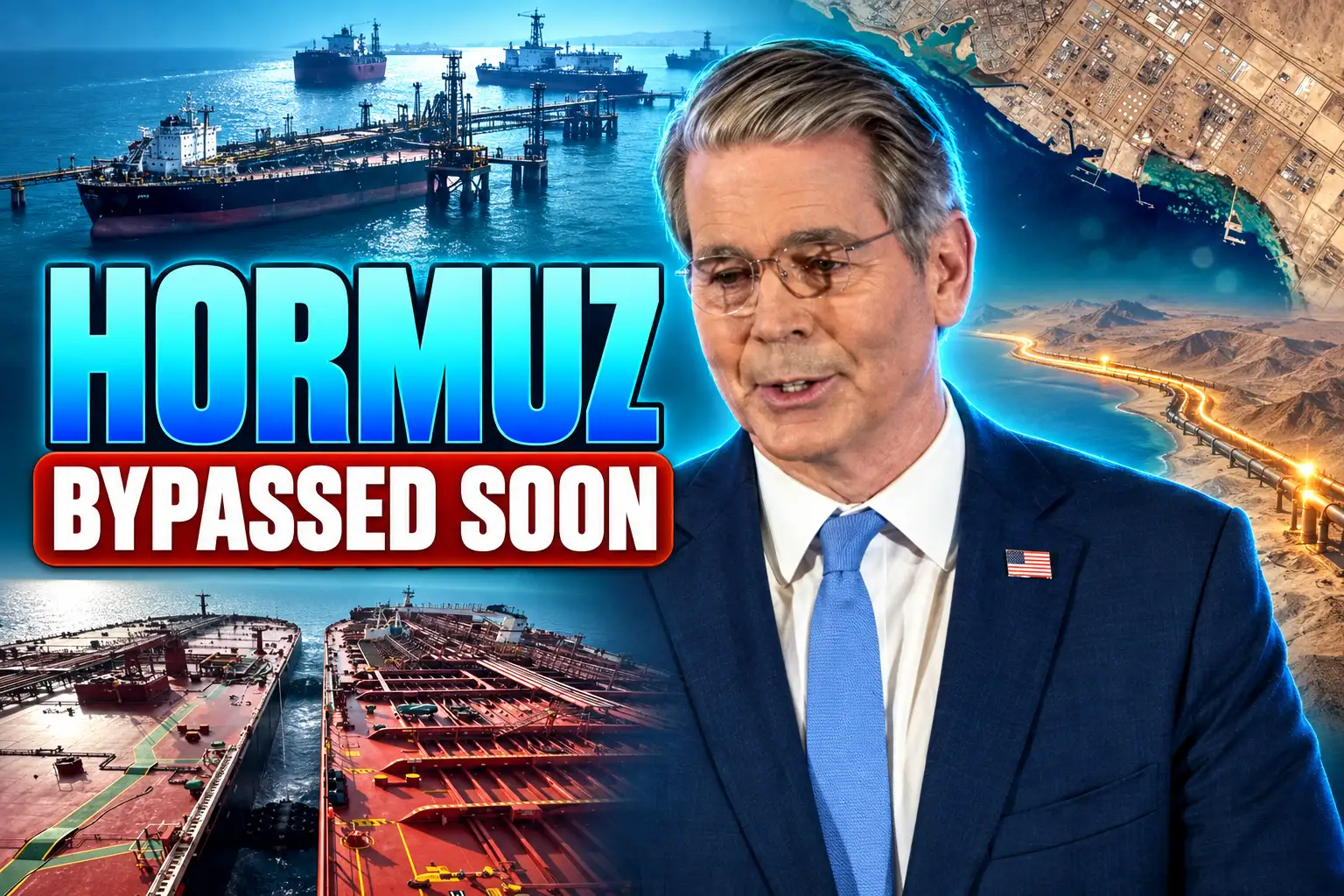
Treasury Secretary Scott Bessent said Tuesday that land pipelines will make the Strait of Hormuz a worthless piece of water within two years. He spoke with Larry Kudlow beside the G20 finance meeting in Asheville, North Carolina.
Gulf producers have already shoved record volumes overland since the war with Iran throttled the strait in late February. The pipes are not a rumor. They also do not swallow the waterway whole.
Bessent Puts a Two-Year Clock on the Strait
Bessent has been selling the same idea since August, when he said more than 50 or 70 percent of the energy now moving through Hormuz would shift into underground pipelines and leave “just another body of water.” On Tuesday he sharpened the line.
The Iranians are trying to use the Strait of Hormuz as a choke point. It’s not a choke point for the U.S., but it is a choke point for many other countries. That will be bypassed in two years. In two years the Strait of Hormuz will be like a worthless piece of water that the oil will be going on pipelines across land.
Scott Bessent, U.S. Treasury Secretary, G20 fireside chat in Asheville
The sentence is a message to Tehran as much as a construction schedule. Iran has used the strait as leverage through the war. Washington’s answer is to talk that leverage down in public, while Treasury pushes a sanctions drive Bessent has called Operation Economic Outcast.
Two tankers trying to leave Hormuz were hit by projectiles on Monday, according to maritime security consultant Marisks, after another round of U.S. and Iranian strikes. Bessent spoke the next morning anyway.
Twenty Million Barrels Still Prefer the Water
Before the war, the International Energy Agency counted 20 million barrels a day of oil moving through Hormuz in 2025, about a quarter of seaborne oil trade. Nearly 15 million of that was crude, about 34 percent of global crude trade, and about 80 percent was headed for Asia.
The strait was never a Saudi-only problem. Iraq, the UAE, Kuwait and Iran each put more than 2 million barrels a day on that water. Qatar’s oil slice was smaller. Its gas was not.
THE 2025 HORMUZ OIL LEDGER
| Origin | Crude and condensate | Products | Total (million b/d) |
|---|---|---|---|
| Saudi Arabia | 5.43 | 0.80 | 6.23 |
| Iraq | 3.32 | 0.31 | 3.63 |
| United Arab Emirates | 2.02 | 1.22 | 3.24 |
| Iran | 1.69 | 0.72 | 2.41 |
| Kuwait | 1.40 | 0.97 | 2.37 |
| Qatar | 0.73 | 0.69 | 1.43 |
| Neutral Zone | 0.35 | 0.00 | 0.35 |
| Bahrain | 0.00 | 0.21 | 0.21 |
| Total | 14.95 | 4.93 | 19.87 |
Only Saudi Arabia and the UAE had working crude lines that skipped the strait. The IEA put spare space on those two systems at 3.5 to 5.5 million barrels a day, a fraction of the waterway’s load. Iraq, Kuwait, Qatar, Bahrain and Iran still needed the gap in the coast.
The U.S. Energy Information Administration’s tanker tracking shows how fast that water emptied once fighting started. Hormuz oil flows ran at 21.6 million barrels a day in the fourth quarter of 2025, then 14.9 million in the first quarter of 2026, then Hormuz flows of 4.9 million barrels a day in the second quarter.
Can Pipelines Replace the Strait of Hormuz?
Not at the scale Bessent described, and not on his clock. Fujairah can double to about 3.6 million barrels a day in 2027, and Saudi Arabia already ran its East-West line at 7 million this spring. Iraq’s Syria route needs four years, and Qatar’s LNG has no pipe at all.
The proven bypasses did real work after 28 February. They also showed their ceilings in public.
WHAT TWO YEARS CAN AND CANNOT MOVE
- Saudi East-West line: The Petroline ran at 7 million barrels a day this spring, with about 2 million of that staying in Yanbu-area refineries and the rest headed for Red Sea berths.
- UAE Fujairah route: The Habshan line already moves about 1.8 million barrels a day to the Gulf of Oman. ADNOC’s new West-East pipe, about half built, is meant to double Fujairah export capacity to 3.6 million in 2027.
- Iraq’s northern exits: Kirkuk-Ceyhan restarted at about 250,000 barrels a day in March. A new Syria line to Banias is a four-year, 15 billion dollar job, not a 2028 finish.
- Qatar’s gas: There is no overland LNG export path. The Dolphin pipe feeds the UAE and Oman. It does not put Qatari gas on the world market.
The IEA’s wartime note is the cleanest measure of what the Saudi system actually delivered. Pre-war loadings from Yanbu sat near 2 million barrels a day. By early June, Yanbu exports above 5 million barrels a day were moving into the Red Sea. The pipe can cross the peninsula. Ships still have to load at the far end, and that port, not the steel in the desert, sets how much crude leaves.
Abu Dhabi had more room to start. The IEA put the Habshan-Fujairah line at about 1.8 million barrels a day of capacity, with about 1.1 million already in use and up to 700,000 barrels of spare space if Hormuz shut. The new parallel line is the piece that could matter inside Bessent’s window. Kpler has said mid-2027 is more likely than early 2027 because Fujairah’s port has to grow with the pipe.
Qatar’s LNG Has No Overland Exit
Oil is the part of Bessent’s forecast that can, in theory, walk across land. Gas cannot. The EIA found that about one-fifth of global LNG trade moved through Hormuz in 2024, almost all of it from Qatar, with a smaller slice from the UAE.
Qatar exported about 9.3 billion cubic feet a day through the strait that year. The UAE added about 0.7 billion. The IEA’s 2025 figures rhyme: about 93 percent of Qatar’s LNG and 96 percent of the UAE’s still took that water, equal to about 19 percent of world LNG trade. Qatar shipped over 112 billion cubic metres. The UAE shipped 7 billion.
The Dolphin pipeline moved almost 20.5 billion cubic metres to the UAE and Oman in 2025. The IEA says it has little spare room, and Oman’s own LNG plants were already running near full. That line is a neighbor-to-neighbor gas sale. It is not a Hormuz bypass for Japan, China, India or Europe.
The war made the gap physical. Hormuz LNG flows ran at 11.7 billion cubic feet a day in the first quarter of 2025 and 0.8 billion in the second quarter of 2026. Iranian strikes in March hit Ras Laffan. Two liquefaction trains, about 17 percent of Qatar’s capacity, were badly damaged. QatarEnergy has kept force majeure in place on cargoes into the autumn. Italian utility Edison said five more deliveries due from late September into early November would not arrive.
LNG carriers are fewer, costlier and easier to scare than oil tankers. A crude pipe to Yanbu or Fujairah does nothing for a Qatari cargo that has to sail past Iranian guns.
Baghdad Cannot Pipe Its Way Out by 2028
Iraq is the large producer with the least room to wait. It put 3.63 million barrels a day through Hormuz in 2025 and takes most of its budget from oil. People familiar with a revived Kirkuk-Banias system said the work would take about four years and cost at least $15 billion, because the old pipe is the wrong spec and cannot simply be patched. The U.S. has talked up an initial 2 million barrels a day on a new build. The mothballed line moved about 300,000.
Four years from a 2026 start lands in 2030, two years past Bessent’s date. A State Department welcome does not pour steel.
THE BYPASS CALENDAR
- February 28, 2026: War with Iran throttles tanker traffic; Hormuz flows later average 2.7 million barrels a day across March, April and May.
- March 2026: Saudi East-West throughput hits 7 million barrels a day; Kirkuk-Ceyhan restarts at about 250,000 barrels a day.
- March 18, 2026: Strikes hit Ras Laffan; QatarEnergy declares force majeure on LNG.
- Early June 2026: Yanbu crude exports exceed 5 million barrels a day; UAE total oil exports reach 4.3 million, about 85 percent of pre-war levels.
- July 2026: Goldman Sachs maps seven Gulf bypass projects and a 2027-28 capacity ramp.
- August 17, 2026: People familiar with the Iraq-Syria line put construction at four years and at least 15 billion dollars.
- September 1, 2026: Bessent calls Hormuz a worthless piece of water within two years.
The northern Iraq-Turkey system is the only Iraqi exit that already works. Shipments restarted on March 18 at 250,000 barrels a day. Baghdad has talked about lifting that toward 770,000, against a nameplate near 1.5 million if both old strings could be trusted. Even a full Ceyhan revival would cover only a slice of Basra’s pre-war loadings. Kuwait, which has no line of its own, has talked about tying into Saudi and UAE pipes so its crude can reach Yanbu or Fujairah. Talk is not throughput.
The Red Sea Route Has Its Own Ambush
Every Saudi barrel that skips Hormuz still has to find an ocean. From Yanbu, Asia-bound crude heads south toward Bab el-Mandeb or north toward Suez and the SUMED line. The EIA’s chokepoint table shows what that shift looked like in wartime: Bab el-Mandeb oil flows rose from 5.6 million barrels a day in the first quarter of 2026 to 8.1 million in the second, while Hormuz collapsed.
That is a swap of chokepoints, not an escape from geography. Houthi attacks near Bab el-Mandeb have already harassed Red Sea traffic in this war, the same way they did in earlier years. A pipe across Saudi Arabia moves the risk west. It does not delete it.
The IEA also noted a drone hit on an East-West pumping station in April that briefly cut throughput by 700,000 barrels a day. Overland steel is a target set, just a different one. Fujairah has taken drone fire too. A bypass that can be hit from the air is still a bypass. It is not a “worthless” waterway’s funeral.
Japan, which takes a heavy share of Gulf crude, has said it will put money into Gulf pipeline projects. Asian buyers have the most to gain if Fujairah grows, because that port sits on the Gulf of Oman and points at the routes they already use. A Banias or Ceyhan line points at the Mediterranean. That helps Europe more than it helps China or India, which took 44 percent of the crude that went through Hormuz in 2025.
Goldman Sees 60 Percent Bypass by 2028
Goldman Sachs, in a July note by analyst Alexandra Paulus, is the most bullish public math Bessent could point to. The bank counted about 6.9 million barrels a day of effective bypass capacity now, roughly 30 percent of pre-war exports from seven Gulf producers. Its base case adds 3.8 million barrels a day by the end of 2027 and a cumulative 7.3 million by the end of 2028, taking the total to about 14.2 million, or about 60 percent of pre-war Gulf exports of 23 million barrels a day. The bill is 30 billion to 48 billion dollars. A faster-build case goes as high as 75 percent.
GOLDMAN’S BYPASS BUILD
| Horizon | Added capacity | Total effective bypass | Share of pre-war Gulf exports |
|---|---|---|---|
| Now | Current systems | 6.9 million b/d | about 30 percent |
| End of 2027 | plus 3.8 million b/d | 10.7 million b/d | more than 45 percent |
| End of 2028 | plus 7.3 million b/d cumulative | 14.2 million b/d | about 60 percent |
Take the base case at face value. About 8.8 million barrels a day of Gulf oil still have no overland door at the end of 2028. Add Qatar’s LNG, which does not appear in that oil table at all. Add product exports that need ports, not crude lines. Add loading limits at Yanbu. The waterway that moved 19.87 million barrels a day in 2025 does not become empty ocean because 60 percent of a different export total can, on paper, go around it.
The IEA’s own wartime record is the other half of the argument. Cumulative supply losses from Middle East producers passed 1.3 billion barrels. Member countries released 400 million barrels from emergency stocks. North Sea Dated crude hit 144 dollars a barrel in April. Global demand in the second quarter is now seen down almost 5 million barrels a day from a year earlier. Those are the costs of a strait that still mattered after the first pipes were already running full.
Gulf states are no longer treating bypass capacity as a dusty contingency binder. Saudi Arabia proved the East-West line can hold 7 million barrels a day. The UAE is pouring a second string to Fujairah. Iraq is shopping Mediterranean exits. That is a lasting change in how Gulf oil leaves the ground. It is also a smaller change than a Treasury secretary calling the strait worthless on live television, two days after tankers in that water were hit again.

Police Tighten the Ring Around Gyanesh Kumar’s House

Ravi Shankar Calls Hanuman Ansh a Slap to Big Spenders

Microsoft Puts Nvidia in the Surface Laptop Ultra Flagship

Adult Fires on an Armed Juvenile at Longmont Dollar Tree

Jordan Absorbs Iranian Missiles Aimed at Parked US Jets

The iPhone 18 Pro Max Splits Apple’s Fall in Two

OpenAI Calls GPT-6 Astra AGI Then Locks Its Exploits

Russia Closes the Goethe-Institut Berlin Tried to Save

Trump Claims Hormuz Control as Oil Holds Near $96

Volkswagen’s Job Cuts Leave Four Plants Without Cars

 NEWS1 month ago
The iPhone 18 Pro Max Splits Apple’s Fall in Two
- NEWS1 month ago
OpenAI Calls GPT-6 Astra AGI Then Locks Its Exploits
- LIFESTYLE1 month ago
Russia Closes the Goethe-Institut Berlin Tried to Save
- BUSINESS1 month ago
Trump Claims Hormuz Control as Oil Holds Near $96
- AUTO1 month ago
Volkswagen’s Job Cuts Leave Four Plants Without Cars
- NEWS1 month ago
The Lincoln’s 286-Day War Cruise Ends at a Thai Pier
- BUSINESS1 month ago
Cable Stocks Fall as UltraTech Copies the Paints Playbook
- BUSINESS1 month ago
Japan’s 3 Percent Yield Reprices Government Debt Worldwide