
BUSINESS
Tusk Brings India a Defence Pitch and a Secrecy Ask
Donald Tusk meets Narendra Modi with almost 100 firms, a $10 billion trade goal, and a classified-information pact aimed at leaks Poland ties to Russia.

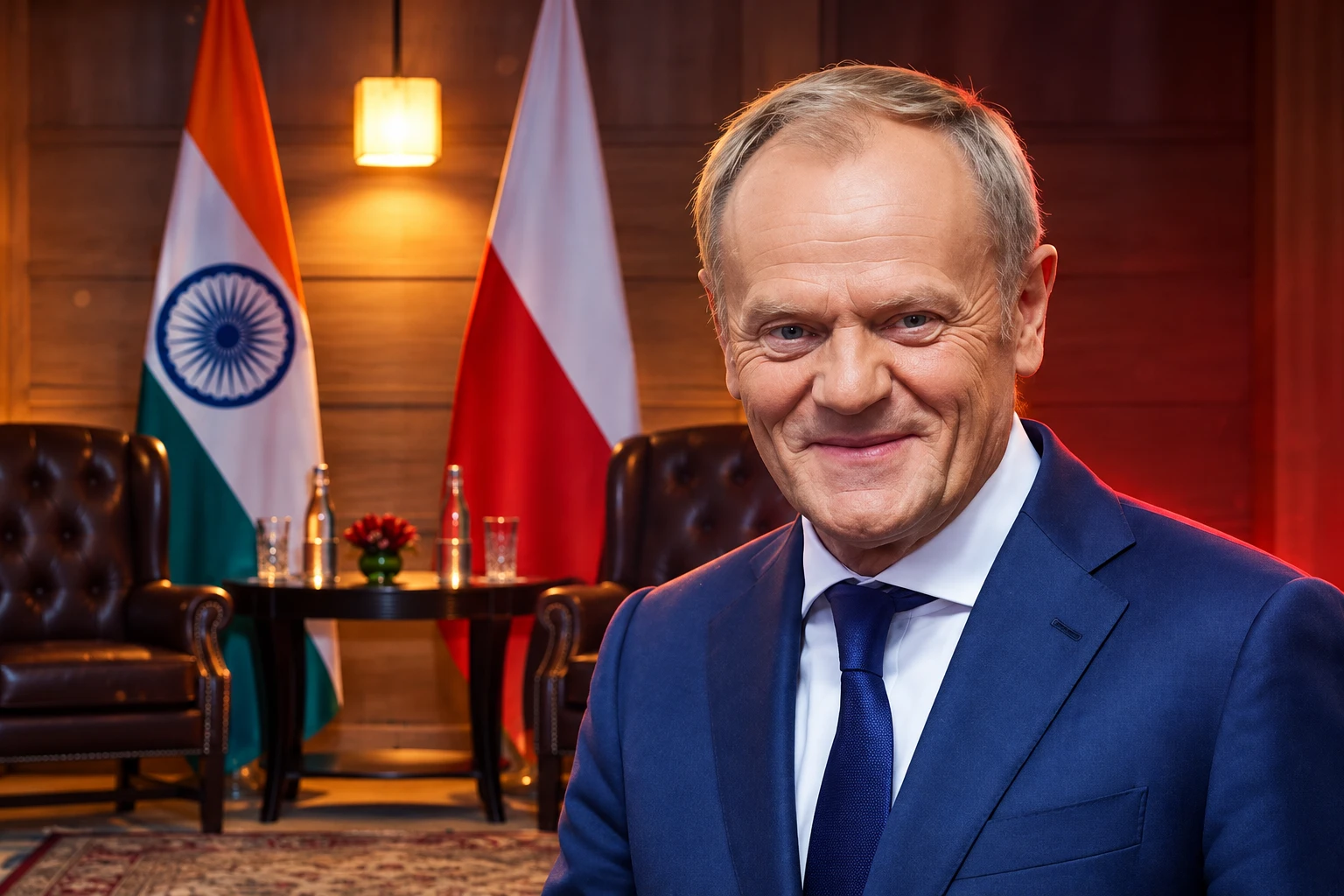
Polish Prime Minister Donald Tusk met Narendra Modi in New Delhi on October 22 with almost 100 companies in tow and a classified-information pact on the table. External Affairs Minister S. Jaishankar had called on Tusk that morning. The public welcome was warm. The harder ask from Warsaw is whether Indian partners can be trusted with Polish defence technology while India still buys Russian oil.
Tusk arrived on October 21 for a three-day visit, his first as Polish prime minister since 2010. Finance and Economy Minister Andrzej Domanski came with him. After Hyderabad House, Tusk goes to Bengaluru on October 23 for IT and space meetings that will test whether the commercial pitch can outrun the politics.
Tusk Landed With Almost 100 Companies and a Trust Problem
Minister of State Raj Bhushan Choudhary received Tusk at the airport. Jaishankar then saw him before the Hyderabad House session, and wrote that he looked forward to Tusk’s meeting with Modi “to advance our Strategic Partnership.”
Pleased to call on Prime Minister Donald Tusk @donaldtusk of Poland.
Appreciated his sharing thoughts on deepening India – Poland cooperation across a wide range of domains.
Look forward to his meeting with PM @narendramodi to advance our Strategic Partnership.
🇮🇳 🇵🇱 pic.twitter.com/tr1hnR3JfG
— Dr. S. Jaishankar (@DrSJaishankar) October 22, 2026
Before leaving Warsaw, Tusk said he wanted Poland “in constant contact with countries on which the future of the world will, one way or another, largely depend,” and named India as one of them. He said almost 100 Polish companies were on the trip, and that Domanski had a plan to double trade by 2030. India-Poland business forums were set for New Delhi on October 22 and Bengaluru on October 23.
Polish officials travelling with him have been blunter in private-briefing language. They have called building trust with India the biggest task in the relationship, because New Delhi was long seen as close to the Soviet Union and then to Russia. Poland’s own memory of Soviet-era rule sits behind that caution. One expected paper from the visit is an agreement on the protection of classified information, which Poland’s envoy has described as a guarantee there will be no technology leaks.
WHAT WE KNOW
- The dates: Tusk is in India from October 21 to 23, with leader talks in New Delhi on October 22 and Bengaluru meetings on October 23.
- The morning call: Jaishankar met Tusk before the Hyderabad House session and posted that the talks spanned a wide range of domains.
- The commercial train: Domanski is in the party, and Tusk said almost 100 Polish firms came to meet Indian partners in both cities.
WHAT IS UNCONFIRMED
- The secrecy paper: Polish officials have said a classified-information agreement is meant to be signed; no text had been published when the leaders sat down.
- The government list: Several state-to-state papers were billed for the visit, without a public inventory of titles.
- The Ukraine line: Both sides put the war on the agenda. No joint wording on Russian oil or on peace diplomacy had been released with the talks still under way.
That mix is the visit. Warsaw wants Indian orders and Indian capital. It also wants a legal lock on secrets before Polish plants share designs with a partner that still does business with Moscow.
$6.36 Billion Still Leaves Warsaw Short of Its Target
The Embassy of India in Warsaw, using figures from Poland’s Central Statistical Office, says bilateral trade reached $6.36 billion in 2025. Indian exports were $4.83 billion. Indian imports were $1.53 billion. The year before, the two-way total was $5.82 billion.
Poland is India’s largest trade partner in Central and Eastern Europe and the sixth-largest economy in the European Union, the same brief says. The flow still runs heavily India’s way. Former Polish ambassador Adam Burakowski said foreign ministers Radosław Sikorski and S. Jaishankar had set a goal of lifting yearly turnover to $10 billion. That is a political target. Tusk’s separate line, doubling by 2030, is a later, larger ambition, not the same figure.
INDIA-POLAND TRADE, US$ BILLION
| Year | Indian exports | Indian imports | Total |
|---|---|---|---|
| 2022 | 4.13 | 1.48 | 5.61 |
| 2023 | 3.97 | 1.75 | 5.72 |
| 2024 | 4.36 | 1.46 | 5.82 |
| 2025 | 4.83 | 1.53 | 6.36 |
Investment is even more lopsided. Indian money in Poland is valued at over $3 billion, the embassy brief says, with names that include Tata Consultancy Services, Infosys, HCL Technologies, Wipro, Jindal Stainless, Berger Paints, Uflex and Glenmark. Polish Ambassador Piotr Switalski has put Polish direct investment in India at around $750 million and said he is not satisfied with a rank near 35th among foreign investors.
About 3,500 Indian students study in Poland. The Indian community there is put at over 30,000. Those people-to-people stocks are real, and they are not a substitute for factories.
What Poland Wants From Indian Defence Factories
Domanski spent the eve of the talks selling Poland as a fast-growing production base that can also arm India. He said the Polish economy is “the fastest growing large European economy,” with GDP growth expected at 3.6 per cent this year, and claimed Poland would add more to European Union output this year than Germany or France. He invited Indian equity into Polish nuclear plants and small modular reactors, and into a clean-energy build he called the largest in Europe.
The defence line was sharper, because it is the one that runs into the secrecy ask.
Poland spends close to 5% of our GDP right now to modernise the Polish defence forces. But at the same time, we are really developing our defence industry, and I do believe that we can provide really great, and good value equipment for India.
Andrzej Domanski, Minister of Finance and Economy, interview in New Delhi
He named the WB Group, which supplies Poland and Ukraine, as a firm ready for joint research with Indian partners. Mutual trust, he said, is what makes that work. That is the same trust Polish officials say is still the hardest part of dealing with India.
A joint working group on defence met in September to turn the 2024-2028 action plan into industrial work. Joint production, repairs, and dual-use controls are all on that list. The classified-information paper is the gate in front of it. Without it, Polish plants that exist because of the war on their border are being asked to share know-how with a buyer that still takes Russian crude and still talks to Russian arms suppliers.
Bengaluru Is Where the Space Pitch Gets Tested
The capital session sets direction. Bengaluru is where Tusk has to show that Polish firms can sell into Indian IT, startups, and space buyers rather than only pose with ministers. Domanski said Poland is putting more money into space and named ICEYE for radar satellites. He said those companies would sit with Indian partners in Delhi and Bangalore.
Sikorski had already pointed at the same opening when he hosted Jaishankar in Warsaw on September 4. He said defence industry and new technology, including space, were the strongest bets, and he tied that work to the historic Ax-4 mission to the space station, flown with Sławosz Uznański-Wiśniewski of Poland and Shubhanshu Shukla of India.
SECTORS ON THE BENGALURU DOCKET
- Space hardware: Radar satellites and company-level follow-up to the Ax-4 flight, which both foreign ministers have used as a calling card.
- Software and AI: Indian IT names already employ staff in Poland; Tusk’s stop is meant to pull Polish digital firms the other way.
- Clean energy: Domanski is shopping for Indian equity in Polish nuclear and small modular reactors, and for joint work on a more balanced energy mix.
- Food, mining, machines: Agriculture, deep mining, and machinery sit behind the defence headlines as the slower, heavier trades Warsaw wants to rebalance.
A photo set from Delhi the day before the talks showed the capital dressed in Polish colours. That is the easy layer. The Bengaluru forum is the one that has to produce memorandums between companies, which Burakowski said would be many, rather than another round of leader language.
The 2024 Action Plan Has Not Filled Out Yet
Modi went to Warsaw on August 21-22, 2024, as the first Indian prime minister in 45 years to make that trip, on the 70th year of diplomatic ties. The two governments raised relations to a Strategic Partnership and issued a five-year Joint Action Plan for 2024-2028. Tusk had invited him. Modi invited Tusk back. This week is that return, 16 years after Tusk’s own last visit as prime minister and nine years after he came as president of the European Council for an India-EU summit.
THE ROAD TO HYDERABAD HOUSE
- September 2010: Tusk pays a state visit to India, including a stop in Bangalore, during his first stretch as prime minister.
- 2017: Tusk returns to New Delhi as president of the European Council for the India-EU Summit.
- August 21-22, 2024: Modi visits Warsaw, meets Tusk and President Andrzej Duda, and the two sides announce the Strategic Partnership and the 2024-2028 action plan.
- January 19, 2026: Sikorski meets Jaishankar in Delhi, the first cabinet-level follow-up after the upgrade.
- January 2026: EU and Indian negotiators conclude talks on a free trade pact after nearly two decades.
- September 4, 2026: Jaishankar meets Sikorski in Warsaw after talks in Kyiv, and both men put defence industry and space on the list.
- September 2026: The joint working group on defence meets to push industrial work under the action plan.
- October 21-23, 2026: Tusk is in India with Domanski and the company delegation.
The calendar is dense. The ledgers are not. Two years of “strategic” language have not closed a $3 billion-to-$750 million investment gap, and they have not produced a published defence-industrial contract that would justify the secrecy paper now being walked into the room.
December Is the Window for the EU Pact
The Ministry of External Affairs said the visit would also serve to deepen the India-EU strategic partnership. Polish diplomats have been more direct. They treat Tusk’s swing as a chance to place Polish firms before a free trade pact with the European Union is signed in December, after talks closed in January.
Burakowski called that pact the main tool for getting from today’s turnover to $10 billion, and “the biggest FTA that the European Union has signed with anybody.” Brussels writes the rules. Member states still have to win the orders. That is why a Polish prime minister brought a company army rather than a purely political one, and why Bengaluru sits on the itinerary next to Hyderabad House.
If the December signing holds, Polish machinery, food, and dual-use kit get a wider Indian door, and Indian software, drugs, and engineering goods get a wider European one. The classified-information agreement is the extra bolt Warsaw wants on the defence shelf of that door. Trade can move on tariffs. Weapons plants do not.
Ukraine Stays in the Room Without an Oil Bargain
Ukraine is on the agenda because Poland lives on the war’s border and because India has spent four years refusing to treat Russian oil as a loyalty test. In Warsaw on September 4, after Jaishankar had been in Kyiv, Sikorski gave Poland’s reading of the front. Jaishankar answered with a line he has used in other capitals.
These are wars without winners. Every additional day means more death, more destruction, more loss to the parties themselves, and more cost to the rest of the world. Our efforts must therefore focus on promoting dialogue and diplomacy. We must each do what we can, in whichever way we believe would be most effective.
S. Jaishankar, External Affairs Minister, Warsaw, September 4, 2026
He has already defended India’s Russian oil purchases on Ukrainian soil. Polish officials still want Indian channels to Moscow used for pressure, including on grain, mariners, and a ceasefire, without pretending New Delhi will join European sanctions. That is the bargain Tusk cannot force in a single afternoon at Hyderabad House.
So the visit splits in two. One track is invoices: almost 100 companies, a $10 billion ministers’ target, a doubling plan for 2030, radar satellites, and a defence industry that now spends close to 5% of GDP. The other is a paper that says those factories will not see their designs walk east. Tusk flies to Bengaluru on October 23 to work the first track. The second track either gets a signature in Delhi or it follows him south as unfinished business.

Bulk Scotch Still Faces Full Duty After India’s UK Deal

Typhoon Champi Loops Off Taiwan and Still Injures 527

PM Modi Opens Chinmaya’s AI Guru and Asks for Unity

Mahim Police Hold a JeM Suspect on Enmity Charges

Gold Falls Below $4,000 as Hormuz Oil Hits $117

The iPhone 18 Pro Max Splits Apple’s Fall in Two

Clancy Juror Says the Holdout Never Cited Evidence

OpenAI Calls GPT-6 Astra AGI Then Locks Its Exploits

Trump Claims Hormuz Control as Oil Holds Near $96

Russia Closes the Goethe-Institut Berlin Tried to Save

 NEWS2 months ago
The iPhone 18 Pro Max Splits Apple’s Fall in Two
- NEWS2 months ago
Clancy Juror Says the Holdout Never Cited Evidence
- NEWS2 months ago
OpenAI Calls GPT-6 Astra AGI Then Locks Its Exploits
- BUSINESS2 months ago
Trump Claims Hormuz Control as Oil Holds Near $96
- LIFESTYLE2 months ago
Russia Closes the Goethe-Institut Berlin Tried to Save
- AUTO2 months ago
Volkswagen’s Job Cuts Leave Four Plants Without Cars
- NEWS2 months ago
Dyson Puts Nurovi Robots on Sale Without the UV Flagship
- BUSINESS2 months ago
Japan’s 3 Percent Yield Reprices Government Debt Worldwide










