BUSINESS
Jaishankar Defends Russian Oil Buys on a Visit to Kyiv
In Kyiv, S. Jaishankar said Russian oil, metals and fertilizer buys will not end Ukraine’s war, as a U.S. 100 percent goods duty sits unpassed.

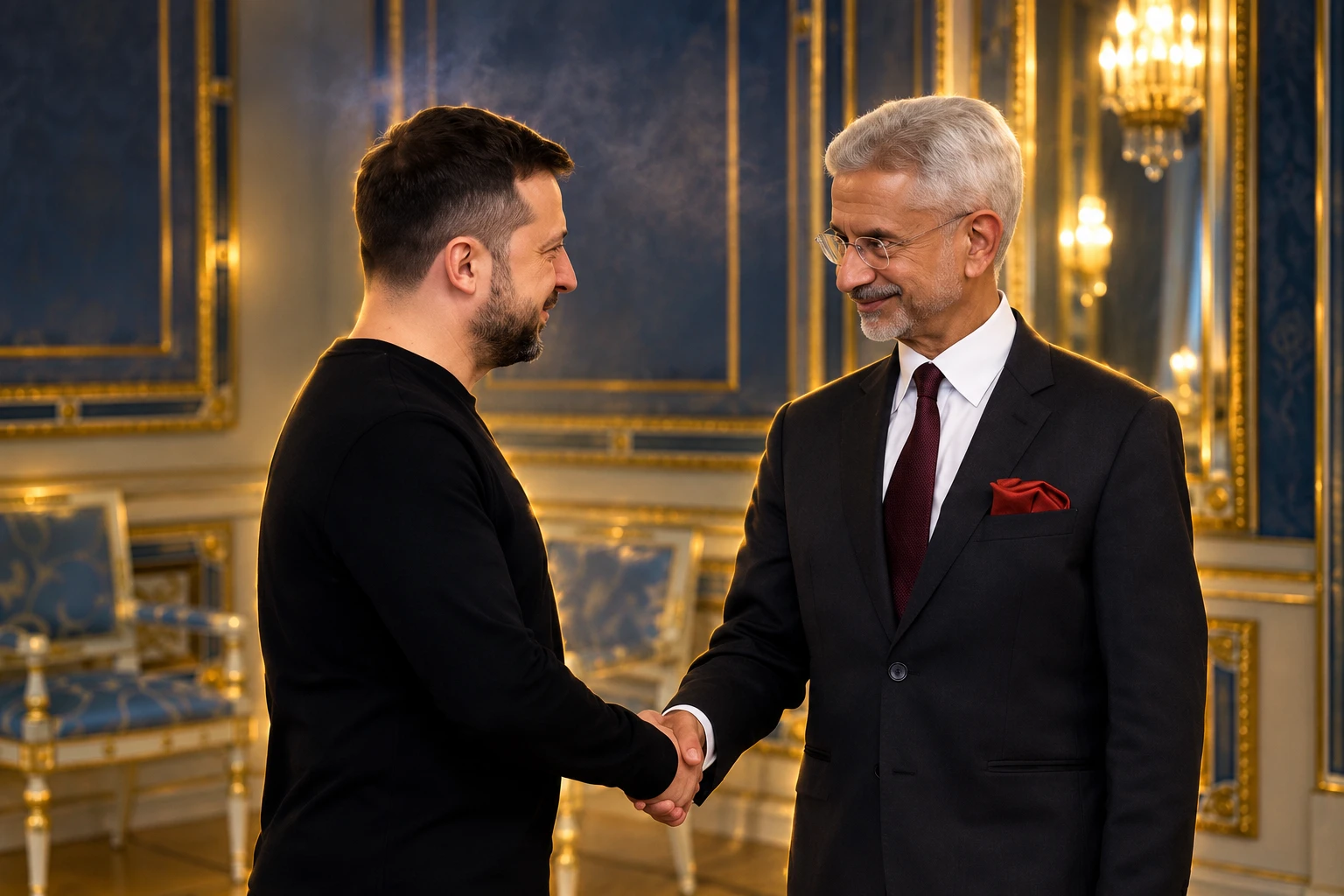
S. Jaishankar said in Kyiv on September 3 that buying Russian oil will not end Ukraine’s fifth-year war. The line came on India’s first dedicated foreign-minister visit to the capital, after talks with President Volodymyr Zelenskyy.
He offered Indian help to stop the fighting, then asked Kyiv to respect the job of fueling 1.4 billion people. The question that drew the answer was a U.S. bill that would let President Donald Trump tax Indian goods at up to 100 percent if New Delhi keeps taking Russian energy.
The First Dedicated Visit Landed Under Drones
Ukrainian Foreign Minister Andrii Sybiha called the stop the first dedicated bilateral visit by an Indian external affairs minister. Jaishankar had travelled with Prime Minister Narendra Modi in August 2024. This trip stood on its own, as an official visit to Ukraine and Poland from September 3 to 5.
Sybiha thanked him for coming while Russian strikes were hitting cities, ports and civilian shipping. Zelenskyy went further after they met. He wrote that Russia launched jet-powered Shahed drones while the Indian minister was in Kyiv, drones he said were built with Iranian help, and that Ukrainian fighter jets kept the delegation safe.
https://x.com/ZelenskyyUa/status/2095503225193365937
Jaishankar wrote that the conversation centered on ways to end the conflict and on deeper bilateral work. He had already told reporters India was ready to help “in any manner.” He also put Indian seafarers on the table. Indians crew ships under many flags, he said, and they have been among the dead. Five Indian seafarers have been killed since July in the Black Sea fighting.
https://x.com/DrSJaishankar/status/2095503718712062335
Jaishankar Says Oil Buys Will Not End the War
A Ukrainian journalist asked whether India would keep buying Russian crude if Washington passed a 100 percent tariff on countries that still take Moscow’s energy. Jaishankar did not give a volume target. He asked the room to sit with India’s scale first.
This conflict, which is today in its fifth year, will not be solved because somebody is buying or not buying oil or alumina or minerals or metals or fertiliser. This conflict will be solved by dialogue, diplomacy, and negotiation.
S. Jaishankar, External Affairs Minister of India, in Kyiv
He said Ukraine has its perspective, “which we respect,” and India has its own, “which I would expect others to also respect.” He repeated a stock Delhi line, that this is not an era of war and that solutions will not come from the battlefield. He pointed to Modi’s call in Bishkek on August 31 for an “endless war” to give way to an “end of war.”
The list beside oil was not filler. Alumina, minerals, metals and fertilizer are the other Russian cargoes that keep Indian factories and farms running while Western buyers stay out. The Kyiv question treated barrels as a switch on Russia’s war chest. The answer treated them as household fuel, farm input and industrial feed, priced in a tight world market.
Why India’s Russian Oil Imports Fell in August
The podium defense landed after a month in which Indian refiners already took fewer Russian barrels. Vessel-tracking data from Kpler, a commodity analytics firm, put India’s Russian crude at 2.08 million barrels a day in August, down from a record 2.82 million in July. Russia’s share of the Indian slate slipped to 45 percent from 55.9 percent. Total crude imports fell to 4.62 million barrels a day from 5.04 million.
KPLER’S AUGUST SLATE FOR INDIA
| Month | Russian crude | Russia’s share | Total crude imports |
|---|---|---|---|
| July 2026 | 2.82 million bpd | 55.9% | 5.04 million bpd |
| August 2026 | 2.08 million bpd | 45% | 4.62 million bpd |
Kpler’s own reading is that this is market normalisation, not a political retreat, with Russian flows likely to settle between 2.0 and 2.5 million barrels a day. Till 2021, Russian oil was about 0.2 percent of India’s crude. After February 2022, discounted barrels filled the gap left when Europe walked away. India still imports about 88 percent of the crude it refines.
Abu Dhabi-based energy analyst Natalia Katona said Russia is exporting less crude to India and overall, “just as China is competing more aggressively for available cargoes.” Ukrainian strikes on Russian export kit, especially around Novorossiysk, have raised the cost of Black Sea loadings. Moving a Suezmax from that port to India’s west coast now runs about $20 a barrel, against about $13 from Baltic ports. Russian exporters have pushed more ships onto the Northern Sea Route, which makes China the cheaper drop.
Refinery maintenance in India took some barrels off the slate as well. Venezuelan crude jumped to 350,000 barrels a day in August, up 60.2 percent from July, after Washington let more of that oil back into the market. About 40 percent of India’s crude usually moved through the Strait of Hormuz, and a large part of that supply has been knocked offline. The same import bill is the pressure already visible in the rupee buffer against an oil shock.
A 100 Percent Duty Would Hit New Purchases
The question in Kyiv was not a hypothetical. On August 7 the U.S. Senate passed the Lindsey O. Graham Sanctioning Russia and Iran Act of 2026 by 86-11. Graham, a South Carolina Republican and one of Kyiv’s loudest friends in Congress, had died on July 11. Colleagues moved the bill in his name. A message on the Senate action went to the House on August 10.
The Congressional Research Service summary of the Senate-passed text is narrower, and harsher, than a campaign slogan about “countries that buy Russian oil.”
WHAT THE SENATE TEXT WOULD DO
- Goods tariff: The president must raise the duty by up to a 100 percent duty on all goods from a country that was among the five largest importers of Russian crude or gas, if that country knowingly makes new purchases of those products after the bill becomes law.
- The five buyers: Senators have named China, India, Slovakia, Hungary and Azerbaijan as the present list, with a review of the ranking every 180 days.
- Russia itself: Visa and property-blocking sanctions would be required on named persons, including the Russian president and certain commanders, with bans on U.S. energy exports to Russia, new U.S. investment there, and purchases of Russian sovereign debt.
- Iran rider: The Iran Sanctions Act of 1996 would run through 2031.
The trigger is new purchases after enactment, not the stock of oil India already ran in June and July. That drafting choice is the second punch. Delhi can say August volumes already fell. Washington can still treat the next cargo as a fresh offence if the bill becomes law. The duty would land on shirts, drugs, auto parts and software services, not on the tanker.
Farmers, Refiners and a $50 Billion Gap
Jaishankar’s fertilizer line had a Moscow date attached. On August 23 and 24 he was in Russia for the inter-governmental commission and a call on President Vladimir Putin. Putin said Moscow was increasing mineral fertilizer shipments and was ready to keep doing so for Indian farmers. Russia now supplies about one fifth of India’s soil nutrients. Indian imports of fertilizer from Russia rose by almost 40 percent in 2025, after West Asian plants were knocked around by the fighting around Hormuz.
The same Moscow meetings put a number on how far the oil trade has bent the relationship. Jaishankar said goods trade had grown more than fourfold, from about $13 billion in 2021-22 to nearly $60 billion in 2025-26, while the imbalance widened from $6.6 billion to over $50 billion in Russia’s favour. Closing that gap, and a $100 billion trade goal by 2030, is now a stated Indian priority. Cheap crude and urea filled Indian tanks. They also left Indian exporters with a lopsided ledger and a U.S. tariff file with India’s name on it.
Refiners still want the barrels when they can get them. Kpler’s 2.0 to 2.5 million barrel band assumes Russian oil remains the mainstay. The constraint in August was availability and Chinese bidding, not a Delhi quota. That is why a Kyiv promise to “buy less if Washington asks” would have been theatre. The cargoes that vanished went to other Asian stills, or never left damaged Russian ports.
Modi Meets Putin Twice Around the Kyiv Stop
The Kyiv presser sat inside a ten-day corridor of Indian-Russian contact. Modi saw Putin in Bishkek on August 31, on the sidelines of the Shanghai Cooperation Organisation summit, and told him to move from endless war toward an end of war. Putin, in public remarks around that period, said Russia was moving in that direction. They are due to meet again at the BRICS summit in New Delhi on September 12 and 13.
THE TEN DAYS AROUND THE KYIV PRESSER
- August 7, 2026: The U.S. Senate passes the Graham Act 86-11 and sends it toward the House.
- August 23-24, 2026: Jaishankar is in Moscow. Putin pledges more fertilizer and both sides talk energy, nuclear work and the $50 billion gap.
- August 31, 2026: Modi meets Putin in Bishkek and calls for the war to end.
- September 3, 2026: Jaishankar meets Sybiha and Zelenskyy in Kyiv and defends the oil, metals and fertilizer trade on camera.
- September 12-13, 2026: Modi is due to host BRICS in New Delhi, with another Putin meeting on the calendar.
India has used the same diplomatic formula for years. A 2024 joint statement after the annual summit in Moscow already called for a peaceful resolution through dialogue and diplomacy, including engagement between both parties. Kyiv on September 3 was that formula spoken in a city under attack. Sybiha said Ukraine “stands ready for diplomacy” and welcomed Modi’s Bishkek line. He also invited work toward the next intergovernmental commission, and Jaishankar asked him to come to India for it.
The House Has Not Moved the Tariff Bill
The legal threat that framed the Kyiv question is not yet law. Speaker Mike Johnson has not put the Senate text on the floor in the House’s first days back from recess. Rep. Don Bacon, a Nebraska Republican, said he was briefed on a plan to bring it up the week of September 14, after a break around Labor Day, to win over hesitant members.
The Senate passed this 86-11, so it’s hard to believe there’s pushback. This is Congress’s opportunity to take a stand, and it would be wrong to make perfection the enemy of good.
Rep. Don Bacon, Republican of Nebraska
One congressional aide called the bill “dead again.” House Democrats have balked at handing Trump a fresh tariff tool after the Supreme Court curtailed other tariff powers. Rep. Gregory Meeks, the ranking Democrat on Foreign Affairs, said he would not give the president authority he does not have, and pointed to White House outreach to Moscow as proof that Trump is not serious about squeezing Russia. Libertarian Republicans, including Rep. Thomas Massie of Kentucky, object to writing more Russia sanctions into statute.
Ukraine is still lobbying. Vladyslav Vlasiuk, the presidential commissioner for sanctions policy, has been meeting House members and said things were “moving in the right direction.” Zelenskyy, who hosted Graham in Kyiv days before the senator died, had already told Washington in July that the bill was “not only about money” but a signal to Europe and to Ukrainians.
That is the bind Jaishankar walked into, and walked out of without a cut in writing. India will keep taking Russian barrels when they are on offer, because the stills have to run and the farms have to be fed. The United States may yet tax every Indian good to punish the next purchase. Or the House may leave Graham’s bill on the shelf, which would make the Kyiv warning a threat that never quite arrived. Zelenskyy, for his part, hoped other large powers would take “a clear stance that this war must end.” The Indian minister had just told him, on his own soil, that the stance would not be a stop on oil.

Police Tighten the Ring Around Gyanesh Kumar’s House

Ravi Shankar Calls Hanuman Ansh a Slap to Big Spenders

Microsoft Puts Nvidia in the Surface Laptop Ultra Flagship

Adult Fires on an Armed Juvenile at Longmont Dollar Tree

Jordan Absorbs Iranian Missiles Aimed at Parked US Jets

The iPhone 18 Pro Max Splits Apple’s Fall in Two

OpenAI Calls GPT-6 Astra AGI Then Locks Its Exploits

Clancy Juror Says the Holdout Never Cited Evidence

Russia Closes the Goethe-Institut Berlin Tried to Save

Trump Claims Hormuz Control as Oil Holds Near $96

 NEWS2 months ago
The iPhone 18 Pro Max Splits Apple’s Fall in Two
- NEWS2 months ago
OpenAI Calls GPT-6 Astra AGI Then Locks Its Exploits
- NEWS1 month ago
Clancy Juror Says the Holdout Never Cited Evidence
- LIFESTYLE2 months ago
Russia Closes the Goethe-Institut Berlin Tried to Save
- BUSINESS2 months ago
Trump Claims Hormuz Control as Oil Holds Near $96
- AUTO2 months ago
Volkswagen’s Job Cuts Leave Four Plants Without Cars
- NEWS2 months ago
Dyson Puts Nurovi Robots on Sale Without the UV Flagship
- NEWS2 months ago
The Lincoln’s 286-Day War Cruise Ends at a Thai Pier