
FINANCE
Rupee Holds 95.73 as RBI Buffer Absorbs Oil Shock
Rupee edges to 95.73 as RBI uses its FCNR inflows to counter Brent at $91.67 and West Asia risks, but the early window close leaves the support temporary.

The Indian rupee rose 1 paisa to 95.73 against the U.S. dollar in early trade on Wednesday, August 19, after opening at 95.72, helped by suspected Reserve Bank of India dollar sales even as Brent crude pushed higher and West Asia tensions kept markets tense.
Forex traders said oil-company bids capped gains while a softer dollar index and fresh foreign institutional buying provided offsetting support. The previous close was 95.74 after a 13-paise drop on Tuesday.
Session levels stay tight around 95.73
At the interbank market the pair opened 95.72, slipped a touch to 95.73 and held that level, up one paisa from Tuesday’s finish. Sensex fell 166 points to 77,070.93 and Nifty dropped 59 points to 24,096.75 in the same early window.
- Open: 95.72
- Early level: 95.73 (plus 1 paisa)
- Prior close: 95.74 (minus 13 paise Tuesday)
- FII net equity buy Tuesday: Rs 1,651.53 crore
The one-paisa lift left the pair almost unchanged from the prior close, a sign that neither oil bids nor support flows could force a wider move in the first hour. Equity benchmarks opened softer even as the currency held its ground, underlining how local stocks and the rupee are responding to different drivers on the same tape.
Anil Kumar Bhansali, Head of Treasury and Executive Director at Finrex Treasury Advisors LLP, summed up the tape: “The rupee was very range-bound yesterday (Tuesday). With oil prices above $91, there were bids from oil companies… the key point is that the rupee is showing reasonable resilience despite the oil shock, largely because of suspected continued RBI intervention.”
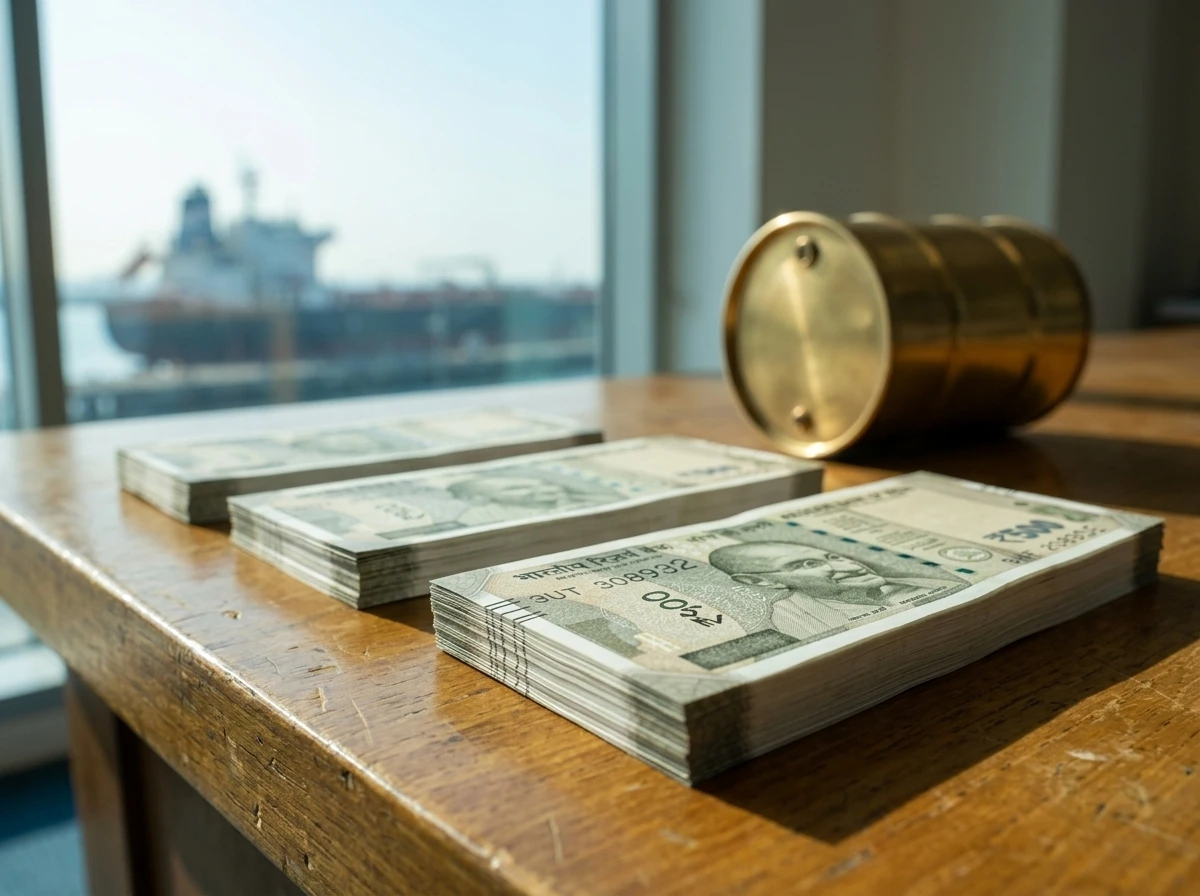
Oil bids and thin Hormuz traffic keep the pressure on
Brent crude futures traded 0.71 percent higher at $91.67 a barrel. Separate data put the contract near $91.55, up about 0.57 percent on the day and more than 36 percent higher than a year earlier. Oil importers remain active buyers of dollars whenever the local unit firms, and that demand has become a near-daily feature while crude stays above $90.
U.S. President Donald Trump said on Tuesday the United States has no talks planned with Iran yet insisted the Strait of Hormuz remains “open and operating,” even with limited traffic and a reported strike on a ship leaving the waterway. Earlier August saw further vessel attacks and sharply reduced transit, keeping the risk premium in oil alive.
- Brent above $91 for multiple sessions
- Oil companies bidding for dollars on any rupee firmness
- Hormuz traffic still thin after repeated incidents
- No fresh U.S.-Iran talks scheduled
Each time the rupee edges firmer, oil importers step in for dollars and blunt the move. That pattern turns crude strength into a ceiling on the local unit rather than a one-off shock. Thin Hormuz traffic keeps the premium embedded in the price, so the bids do not fade simply because a single session is quiet.
The same oil shock that once pushed the rupee toward record territory is still present; what has changed is the central bank’s ability to lean against it without fresh emergency measures.
How the FCNR haul now funds the daily defence
The resilience Bhansali noted is the second-order result of a June package that drew large non-resident inflows. The RBI’s concessional swap window for FCNR(B) deposits, external commercial borrowings and overseas foreign-currency borrowings pulled in substantial dollars. By August 13 the central bank had received $52.3 billion via FCNR deposits raised by banks, plus $1.7 billion through ECB swaps and $2.8 billion via overseas foreign-currency borrowings.
| Channel | Inflows (June 8-Aug 13) |
|---|---|
| FCNR(B) deposits | $52.3 billion |
| ECB swap facility | $1.7 billion |
| Overseas FX borrowings | $2.8 billion |
| Approximate total | ~$56.8 billion |
Those numbers exceeded many early forecasts. On August 14 the RBI brought the fresh-deposit deadline for the FCNR swap forward by a full month to August 31 from the original September 30, citing the “encouraging response” and the resulting forex inflows. The ECB and OFCB windows remain open until year-end. Details of the plain buy/sell swap covering principal (not interest) appear in the RBI swap facility for FCNR deposits.
The early close means banks are rushing to lock in remaining eligible deposits, but it also signals that the central bank already has enough ammunition. Traders report the RBI has sold dollars for multiple consecutive sessions, often through state-run banks just after the open, to keep the pair from sliding. That pattern is possible precisely because the special inflows rebuilt the war chest.
The rupee is showing reasonable resilience despite the oil shock, largely because of suspected continued RBI intervention.
Bhansali’s assessment matches the market’s working assumption: intervention is the binding constraint holding the range, not a sudden improvement in the trade balance.
In practice the June package turned a multi-week inflow surge into a daily supply tool. Dollars raised under the concessional window can be sold into the spot market when oil bids appear, without the need for a fresh emergency announcement each morning. That is why the pair can open soft and still finish almost flat even when Brent holds above $91.
Dollar index and FII flows supply the other side of the book
The dollar index stood at 99.56, down 0.09 percent, easing some external pressure. Foreign institutional investors bought Indian equities worth Rs 1,651.53 crore net on Tuesday, according to exchange data. That equity inflow supplies dollars on the spot market and reduces the need for the RBI to supply every bid itself.
Still, the net picture remains one of managed stability rather than organic strength. Equity inflows can reverse quickly if global risk appetite fades, and the dollar’s recent softness is modest. The combination has been enough to keep the rupee inside a narrow band while oil companies keep buying.
The offset is mechanical. When FIIs buy local shares they bring dollars that land in the same spot market where oil companies lift dollars. A softer dollar index trims the external push against the rupee at the same time. Neither force is large enough on its own to overpower oil demand, yet together they narrow the gap the central bank must fill after the open.
Who feels the range day to day
Oil marketing companies and refiners remain the most consistent dollar buyers. Any firming of the rupee meets their demand and caps the upside. Importers of other commodities face the same arithmetic: a stable 95.70-handle is better than a slide toward 96.50 or worse, yet the absolute level still raises the rupee cost of every barrel and every shipment.
Exporters gain little from a one-paisa move. Banks managing NRI deposit books are scrambling to complete last eligible FCNR raisings before the August 31 cutoff so they can still access the concessional hedge. Equity investors saw FII support on Tuesday but opened Wednesday with the main indices lower, a reminder that currency stability has not yet translated into broad risk appetite.
Households feel the oil price more directly through fuel and freight than through the exchange rate itself. The RBI’s defence keeps imported inflation from accelerating further; it does not reverse the higher baseline set by $90-plus crude.
- Oil firms: steady dollar bids that cap rupee upside
- Other importers: stable handle, still higher rupee costs
- Exporters: little benefit from a one-paisa drift
- Banks: final FCNR raisings before the August 31 cutoff
- Households: fuel and freight costs tied to $90-plus crude
From May lows to a $707 billion cushion
The current range sits well inside the worst levels of the year. The rupee’s all-time low of 96.96 was printed in May amid the sharper phase of the West Asia conflict. Reserves had slipped from a February peak near $728 billion as the central bank sold dollars and valuation effects hit non-dollar assets.
- May 2026: Rupee hits all-time low near 96.96; oil spike and capital outflows drain reserves.
- June 8, 2026: RBI launches concessional swap package for FCNR, ECB and overseas borrowings.
- July-early August: Inflows accelerate; reserves begin multi-week climb.
- August 7: Forex reserves reach $707 billion, up $14.1 billion in a single week, the largest rise since January.
- August 14: RBI advances FCNR fresh-deposit deadline to August 31 after more than $50 billion in overseas deposits.
- August 18-19: Rupee closes 95.74 then holds 95.73 with continued suspected intervention.
Foreign currency assets formed the bulk of the latest jump, rising to $574.6 billion. Gold holdings also increased. The stock of forex reserves at $707 billion as of August 7 gives the RBI ample room to keep selling dollars without endangering import cover. That buffer is exactly what earlier coverage of RBI inflow schemes quietly rebuild reserves had flagged as the quiet rebuilding story.
| Reserves marker | Level or change |
|---|---|
| February peak | Near $728 billion |
| August 7 stock | $707 billion |
| Week to August 7 | Up $14.1 billion |
| Foreign currency assets | $574.6 billion |
| Rupee May low | 96.96 |
The path from the May low near 96.96 to a mid-95 handle tracks the reserve rebuild almost session by session. Once the June window opened, inflows and intervention capacity rose together. The $14.1 billion weekly jump through August 7 marked the point at which the market began to treat dollar sales after the open as routine rather than exceptional.
Banks Race to Lock In Remaining Deposits
The decision to pull the FCNR fresh-deposit deadline forward to August 31 compressed the calendar for every bank still raising eligible money. Staff managing NRI books now have a short window to complete deposits that still qualify for the concessional principal hedge. After that date the cheap swap for new FCNR money stops, even though the ECB and overseas foreign-currency borrowing windows run to year-end.
That split matters for the daily defence. FCNR inflows supplied the bulk of the roughly $56.8 billion raised by August 13. When the fresh-deposit channel narrows, the pace of new cheap dollars slows even if older deposits remain on the books. Traders already treat post-open dollar sales through state-run banks as the visible edge of that stock. A thinner pipeline of new hedges does not erase the stock, but it changes how long the same intensity of sales can continue without drawing more heavily on the broader $707 billion reserve pile.
For the banks themselves the rush is commercial as well as regulatory. Deposits locked before the cutoff still receive the special swap terms on principal. Missing the date means hedging those flows at ordinary market cost. That incentive explains why the final stretch into August 31 is busy even though the central bank has already signalled that the response was strong enough to close early.
Intervention Capacity Meets a Shorter Inflow Pipe
Suspected RBI sales work because the June package rebuilt capacity faster than oil demand drained it. The mechanism is straightforward. Dollars taken in through the swap window and related channels sit ready for use. When the pair softens after the open, sales through state-run banks steady the print. When FII equity buying adds dollars, the central bank can do less. When oil firms bid on any firmness, the same stock covers the gap.
Capacity is not the same as a permanent fix for structural dollar demand. Crude near $91-92, thin Hormuz traffic and the absence of fresh U.S.-Iran talks keep importers active. The dollar index at 99.56 and Tuesday’s Rs 1,651.53 crore of FII equity buying only trim the net gap. They do not remove it. The range around 95.73 therefore reflects a managed balance: oil bids on one side, intervention stock plus modest external support on the other.
Once the FCNR fresh-deposit window ends, that balance leans more on reserves already in hand and on whatever ECB and overseas borrowing flows still arrive. The $707 billion cushion and the $574.6 billion foreign-currency asset stock give the RBI room. The market’s question is how far that room stretches if Brent stays above $91 and equity flows turn less reliable.
The same oil shock meets a thinner special window
Crowd discussion on X has already moved past the daily print. One widely shared note pointed out that $52.3 billion of FCNR money arrived yet the rupee still sits above 95.60, asking what happens once the extraordinary support mechanism winds down. Another macro account linked rising Indian bond yields with a weaker currency and higher oil into a classic policy bind: defending the rupee may eventually require tighter conditions just when oil is already squeezing growth and the fiscal arithmetic.
Those observations line up with the numbers. Attracting dollars through time-bound swaps is not the same as permanently reducing India’s structural dollar demand. Crude near $91-92, elevated global yields and residual Hormuz risk keep that demand alive. The RBI can keep intervening for now because the June package worked better and faster than expected. After August 31 the flow of new cheap hedges slows sharply.
An earlier climb that masked oil and flow risks already showed how quickly sentiment can flip when oil rebounds. Brent crude near $91.55 a barrel keeps that flip risk live. The one-paisa rise on Wednesday is real, the intervention is real, and the reserve rebuild is real. So is the fact that the special window that made the defence cheap is now on a short fuse.
Traders will watch whether oil company bids ease if Hormuz traffic normalises, whether FII equity flows stay positive, and how aggressively the RBI continues to appear after the open. For the moment the pair is range-bound and the central bank holds the upper hand. That hand rests on inflows that are already being wound down.

-
 TECH1 year ago
Where Garmin Watches are Made and How They are Assembled
-

 AUTO3 months ago
Tesla’s Roadster Is ‘a Few Weeks Away,’ Says Its Chief Designer
-
 NEWS10 years ago
Samsung Releases Galaxy Note7 TV Ad as Reddit AMA Leaks Specs
-
 NEWS10 years ago
Android 7.0 Nougat Rolls Out To Nexus Devices With New Emoji, Features
-
 FINANCE9 years ago
Cardano Price Surges as ADA Enters the Crypto Top Ten List
-
 NEWS10 years ago
Pre-Order the First Camera Made for Facebook Live Streaming Video
-
 FINANCE1 year ago
Binance Suspends Trading and Withdrawals for a System Upgrade
-
 FINANCE9 years ago
RChain Price Jumps Nearly 150% to a New All-Time High of $2.03