BUSINESS
A US Fighter Jet Disabled a Panama Cargo Ship
A US jet crippled Panama-flagged Ocean Molica in the Gulf of Oman, pulling ordinary bulk cargo into the Iran blockade.

A U.S. fighter jet disabled the Panama-flagged cargo ship Ocean Molica in the Gulf of Oman on Oct. 10. Central Command said the crew ignored warnings and tried to run the naval blockade on Iranian ports, and that a precision munition hit the stern and stopped propulsion without harming anyone aboard.
The ship is a bulk carrier, not a tanker. That is the part of the night that outlasts the clip. After three months of turning ships around and burning IRGC-linked oil hulls, U.S. forces put a round into a working cargo vessel that had already left an Iranian port and was still moving.
A Fighter Jet Stopped Ocean Molica in the Gulf of Oman
CENTCOM, writing from Tampa, said its forces disabled a commercial cargo vessel after repeated warnings failed. The Panama-flagged M/V Ocean Molica, which the command also named Arika Sun, had departed an Iranian port and was trying to transit regional waters when the jet fired.
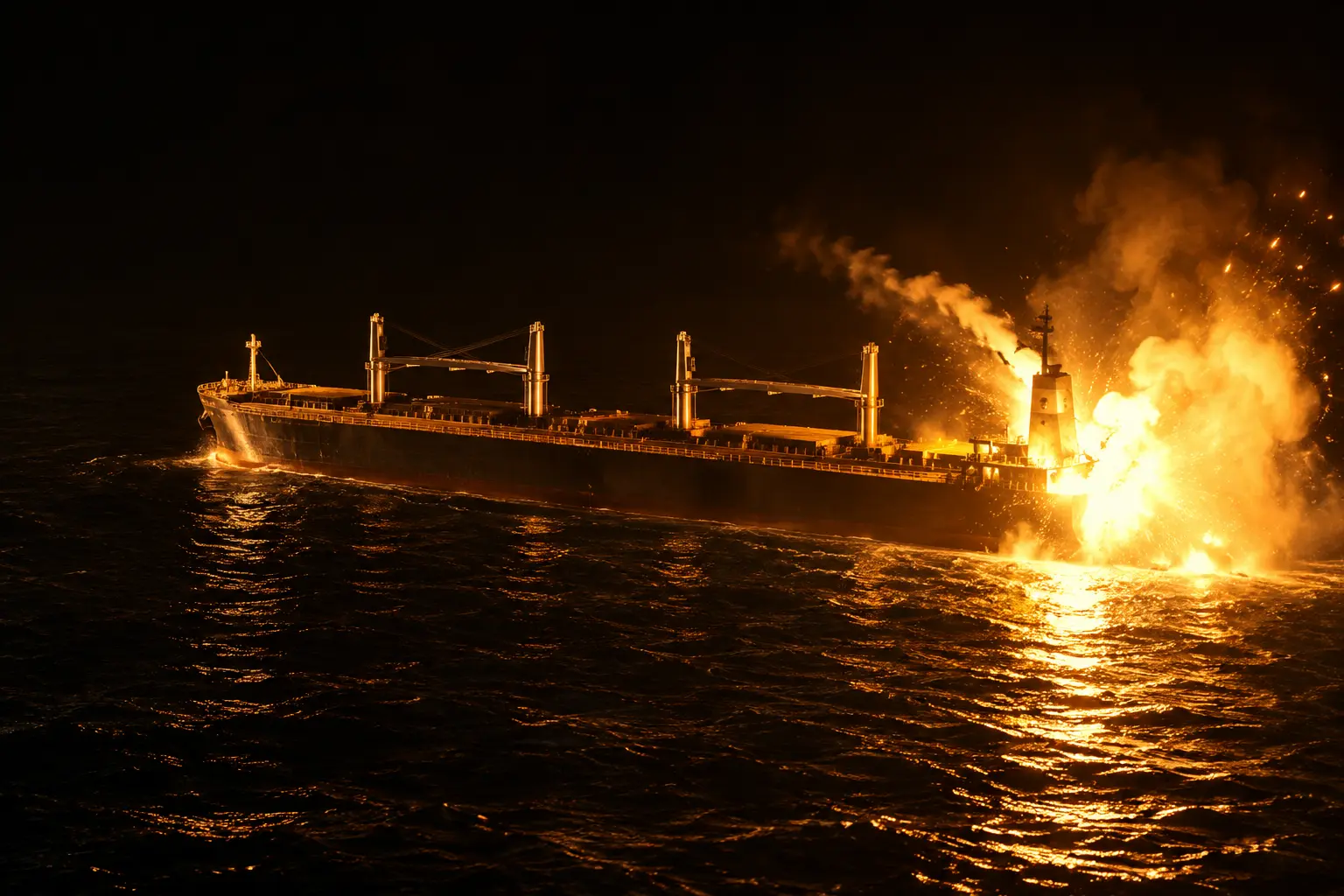
The round went into the stern, where a bulker keeps its engine plant. CENTCOM said propulsion was fully disabled and the crew was unhurt. The command posted a short video of smoke and fire at the transom, about 12 seconds of cockpit-view strike footage, and told mariners in the Gulf of Oman and the approaches to the Strait of Hormuz to watch Notices to Mariners and to call U.S. forces on bridge-to-bridge Channel 16.
The same clip is what the command released as the public record of the shot. It is a disable, not a sinking. The ship was left in the water with its plant wrecked, which is how this blockade has been teaching crews to turn around.
Who Owns Ocean Molica, and Where It Was Bound?
Ocean Molica is a 225-meter Panama bulk carrier built in 1996, now 30 years old, with a deadweight of 70,296 tons. Registry files also carry the name Akira Sun, close to the Arika Sun spelling in the U.S. release, and older names including Hua Xu and Victoria HK. IMO number 9139270, MMSI 374348000, call sign 3EWC4.
A commercial vessel listing names Western Bulk Shipping Co Ltd as registered owner and commercial manager, and Free Ocean Shipping Ltd as the safety manager. The same file shows the ship is not listed on major sanctions watchlists. That matters, because the ships Washington has been destroying are the ones it ties to the Islamic Revolutionary Guard Corps’ shadow oil network. This one was a Panama cargo hull on a declared run to Indonesia.
OCEAN MOLICA ON THE BOOKS
| Item | Record |
|---|---|
| Flag / type | Panama bulk carrier, built 1996 |
| Size | 225 m long, 32.26 m beam, 70,296 DWT |
| Draught | 13.3 m |
| Last AIS port | Khor al Fakkan, UAE, Oct. 3 |
| Declared destination | Tanjung Priok, Jakarta (ID TPP), ETA Oct. 27 |
| Speed after the strike | 0.3 knots, Arabian Sea |
The 13.3-meter draught is a loaded draught, so the ship was not running empty. Tracking pages do not name the cargo. Grain, ore, coal, and other dry bulk all move on a hull this size, and any of those would now sit behind a dead engine in the Gulf of Oman.
CENTCOM’s Iranian-port claim and the last public port call do not line up on a map. Vessel records show the last AIS departure as Khor al Fakkan, in the United Arab Emirates, at 04:14 UTC on Oct. 3. The U.S. command said the ship had previously left an Iranian port. Both can be true if the ship called in Iran with its transponder dark, which is common in this war. They can also describe two different legs. The command did not name the Iranian berth.
Hormuz Traffic Was Already Falling
The shot landed in a week when the strait was already thinning out. Kpler counted seven commodity vessels crossing on Oct. 6, the lowest daily total since July 23, and put crude moving through the waterway at 10.1 million barrels a day. That was 27 percent below the prior week’s wartime high and 74 percent of the pre-war level. Before the United States and Israel opened the war on Iran in February, the strait carried 20 percent of the world’s oil.
United Against Nuclear Iran, which tracks the fleet, counted 97 maritime incidents across the Persian Gulf, the strait, and the Gulf of Oman since the war began, and said the International Maritime Organization has recorded 24 seafarer deaths. The same note said Iran struck at least 13 tankers between Sept. 29 and Oct. 6. Those attacks are a separate ledger from the U.S. blockade. They are why ordinary crews were already jittery when a jet put a munition into a bulker’s stern.
The oil story is still the one most desks lead with, and it is not finished. UANI on Oct. 8 counted 51 oil-laden tankers still hugging the Iranian coast, said no crude tanker had got out of the Gulf of Oman since July 12, and said only eight handymax ships carrying Iranian LPG and naphtha had made it through since the blockade came back. It also counted 39 Iranian oil and petrochemical loadings since July 14, and about 50 Iranian-flagged cargo ships still working from the Indian Ocean to the Baltic. The Ocean Molica shot does not close that file. It opens a different one: dry cargo that touched Iran is now in range of the same disable playbook.
Four Disabled and 135 Turned Since July
CENTCOM’s Oct. 10 count is the working tally. Since forces resumed the blockade on July 14, 4 commercial vessels have been disabled and 135 ships have been turned around, and U.S. forces have destroyed 10 tankers linked to the IRGC’s shadow network. Ocean Molica is the fourth disable. Five days earlier the command had redirected the 130th commercial vessel, with three ships disabled for refusing to comply.
BLOCKADE TALLY SINCE JULY 14
- Turned around: 135 ships diverted after warnings, up from 130 on Oct. 5.
- Disabled: 4 commercial vessels, including Ocean Molica, with propulsion knocked out.
- IRGC tankers destroyed: 10 ships CENTCOM ties to the Guard’s shadow network.
- Mixed destruction count: On Oct. 5 the command also said it had destroyed 13 commercial vessels that were violating the blockade or part of that network, a wider category than the 10 IRGC tankers named on Oct. 10.
Adm. Brad Cooper, the CENTCOM commander, had already drawn the line in the Oct. 5 release, before this jet took off.
The U.S. military remains intensely focused on this mission. We will swiftly act against any vessels trying to run the blockade. Our forces are highly trained, professional, and lethal.
Adm. Brad Cooper, CENTCOM commander, Oct. 5 statement
Disable is the middle option. Most ships take the radio call and turn. A few eat a munition in the engine room and drift. The IRGC-linked tankers are the ones the command says it destroys. Boarding still happens, and UANI’s Oct. 8 note still carried two boardings in the post-July 14 phase, but Ocean Molica was not a boarding. It was a stern shot from the air.
Panama’s Registry Now Shares the Risk
A Panama flag is supposed to be a commercial convenience, a registry, a set of certificates. It is not a war ensign. The United States still put a munition into this hull because, in CENTCOM’s account, the ship had left an Iranian port and kept coming. Flag states, owners, and insurers now have to price that as a real outcome, not a tanker-only problem.
WHO TAKES THE HIT FROM A DEAD BULKER
- The registry: Panama’s maritime authority spent the same week starting to cancel three Panama-flagged tankers after a U.S. Treasury listing, so the flag is already under pressure on Iran trades.
- The owner and manager: Western Bulk Shipping Co Ltd and Free Ocean Shipping Ltd sit on the papers of a ship that is now a drifting casualty with a loaded draught.
- The cargo and the receiver: The declared destination was Tanjung Priok, with an ETA of Oct. 27 that a 0.3-knot ship will not make under its own power.
- The crew: CENTCOM said they were unhurt. They are still on a dead ship in a war zone, which is a different kind of danger from a clean turn-around.
Treasury, on Oct. 8, listed 22 ghost-fleet vessels in a separate oil action, according to UANI. Ocean Molica was not in that bucket. The legal fight that will follow this shot is the one about a neutral-flag cargo ship, not a designated shadow tanker. Some voices on the command’s own announcement called the strike a war crime. The command’s position is that warnings were given, the blockade is in force, and the round was aimed at the plant. Both arguments will travel with the next bulker that loads in Iran and tries to leave.
The Blockade Has Been On, Off, and On Again
This is the second phase of the same campaign, which is why the Ocean Molica number sits on top of an older pile.
TWO PHASES OF THE IRAN PORT BLOCKADE
- April 13, 2026: The United States first blocks maritime traffic entering and leaving Iranian ports and coastal areas.
- June 18, 2026: That first phase ends. CENTCOM later said it had redirected more than 140 compliant vessels, disabled nine non-compliant ships, and allowed over 50 humanitarian ships through in those two months.
- July 14, 2026: At 4 p.m. ET, at the commander in chief’s direction, CENTCOM resumes the blockade on ships going to or from Iranian ports, while saying it will keep supporting traffic that is not in violation.
- October 5, 2026: The command records the 130th redirect of the second phase, with three disables and a 13-ship destruction count over 12 weeks.
- October 8, 2026: UANI records the Treasury listing of 22 ghost-fleet vessels the same day it publishes the 51-tanker coastal pile-up.
- October 10, 2026: A fighter jet disables Ocean Molica. The running count becomes 4 disabled and 135 turned, with 10 IRGC-linked tankers destroyed.
The pause between June 18 and July 14 is the seam. When the first blockade came off, some owners treated Iranian port calls as thinkable again. When it came back, the rule was the same as before: enter or leave an Iranian port and you are in the intercept screen, whatever is in the holds. Ocean Molica is what that rule looks like when the ship is a bulker with a Jakarta destination and a Panama stack, not a dark VLCC.
Ocean Molica Is Not Under Command
After the strike, tracking data still had the ship in the Arabian Sea at 0.3 knots, course 157 degrees, destination unchanged. A loaded 70,296-ton bulk carrier with a wrecked plant does not steam to Tanjung Priok. It waits for tugs, a patch, or an order. CENTCOM did not say who holds the crew, whether a boarding team went aboard, or what happens to the cargo.
The operator did not offer a public comment in the hours after the release. Until that file fills in, the facts that are solid are the ones the command and the ship’s own AIS already gave: a jet hit the stern on Oct. 10, the people on board were reported unhurt, and a Panama bulk carrier that had been a commercial working ship is now a hull in the water off Oman.

Bulk Scotch Still Faces Full Duty After India’s UK Deal

Typhoon Champi Loops Off Taiwan and Still Injures 527

PM Modi Opens Chinmaya’s AI Guru and Asks for Unity

Mahim Police Hold a JeM Suspect on Enmity Charges

Gold Falls Below $4,000 as Hormuz Oil Hits $117

The iPhone 18 Pro Max Splits Apple’s Fall in Two

OpenAI Calls GPT-6 Astra AGI Then Locks Its Exploits

Clancy Juror Says the Holdout Never Cited Evidence

Trump Claims Hormuz Control as Oil Holds Near $96

Russia Closes the Goethe-Institut Berlin Tried to Save

 NEWS2 months ago
The iPhone 18 Pro Max Splits Apple’s Fall in Two
- NEWS2 months ago
OpenAI Calls GPT-6 Astra AGI Then Locks Its Exploits
- NEWS1 month ago
Clancy Juror Says the Holdout Never Cited Evidence
- BUSINESS2 months ago
Trump Claims Hormuz Control as Oil Holds Near $96
- LIFESTYLE2 months ago
Russia Closes the Goethe-Institut Berlin Tried to Save
- AUTO2 months ago
Volkswagen’s Job Cuts Leave Four Plants Without Cars
- NEWS2 months ago
Dyson Puts Nurovi Robots on Sale Without the UV Flagship
- NEWS2 months ago
The Lincoln’s 286-Day War Cruise Ends at a Thai Pier