
BUSINESS
A Second Hormuz Hit Leaves 21 Indian Seafarers Safe
Kuwait tanker Al Dasma was struck a second time in Hormuz with 21 Indian seafarers aboard, after New Delhi replaced a deployment ban with crew consent.

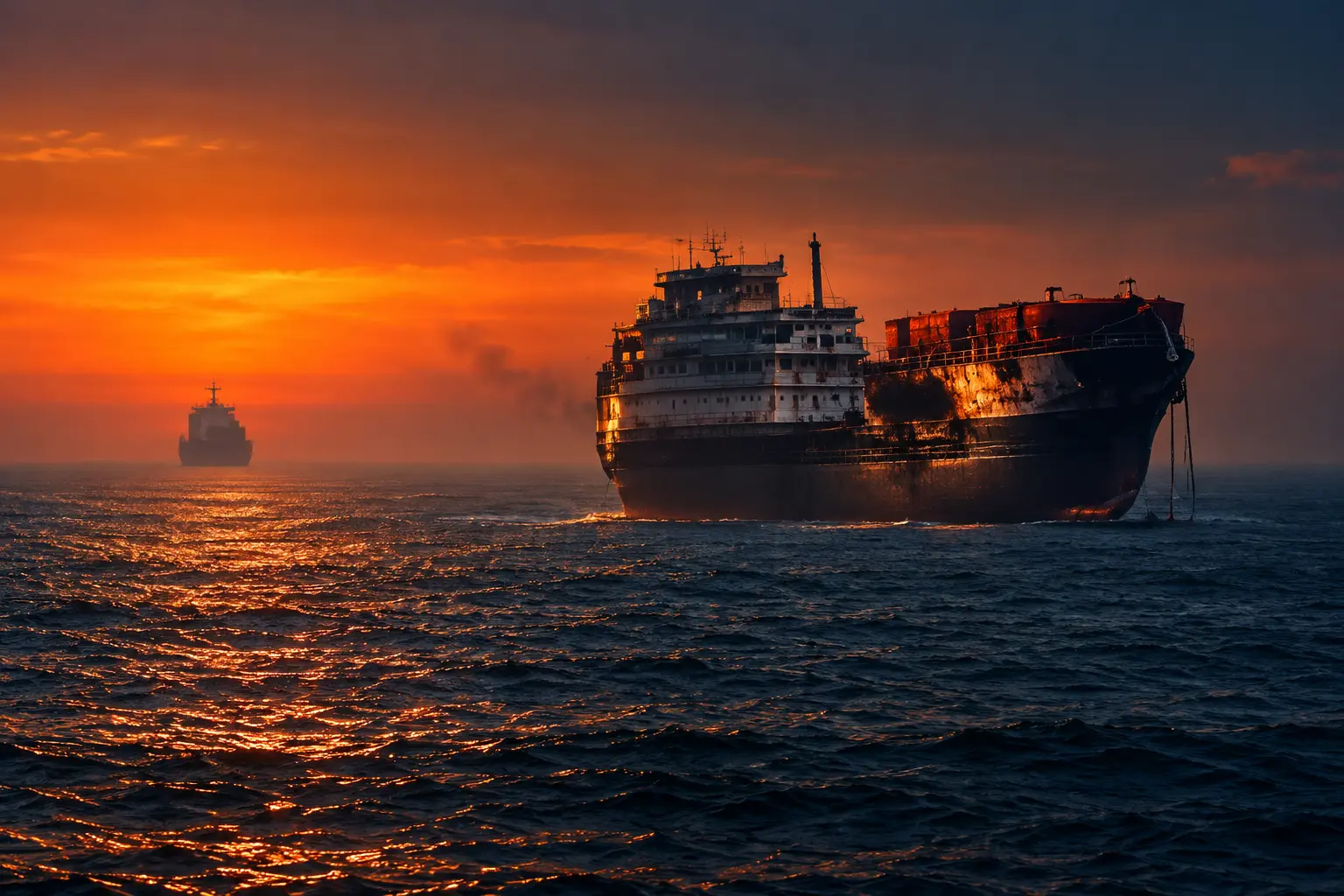
A Kuwait-flagged tanker carrying 21 Indian seafarers was struck by an unknown projectile in the Strait of Hormuz on October 21. The fire was put out, the ship went to anchor, and Union Minister of Ports, Shipping and Waterways Sarbananda Sonowal said every Indian on board is safe.
The hull already had a scar. International Maritime Organization records list Al Dasma as hit in September, then hit again.
What Happened to Al Dasma on October 21?
United Kingdom Maritime Trade Operations logged the strike at 0145 UTC, 11 nautical miles west of Bukha, Oman. Local authorities told the centre a tanker had been hit, a fire had started and then been put out, and the ship was at anchor, with all crew safe and no pollution reported at the time.
NAVAREA IX warning 393/26, issued at the same timestamp, said the ship was on fire and drifting before that fire was killed. UKMTO Warning 179-26 on the strike does not name the ship; Sonowal did.
On Oct 21, Kuwait-flagged oil product tanker M/T AL DASMA, carrying 21 Indian seafarers, was struck by an unknown projectile while transiting the Strait of Hormuz. All 21 of our Indian crew members, along with the rest of the crew are completely safe.
Sarbananda Sonowal, Union Minister of Ports, Shipping and Waterways, on X
⚠️ IMPORTANT UPDATE ⚠️
On Oct 21, Kuwait-flagged oil product tanker M/T AL DASMA, carrying 21 Indian seafarers, was struck by an unknown projectile while transiting the Strait of Hormuz.
All 21 of our Indian crew members, along with the rest of the crew are completely safe.…
— Sarbananda Sonowal (@sarbanandsonwal) October 21, 2026
He said authorities were in contact with the ship management company. That company is Kuwait Oil Tanker Co S.A.K., owner, commercial manager and ISM manager of Al Dasma. The ship is an Aframax delivered in 2014 from Daewoo in Geoje, IMO 9653446, 249.9 m long, 109,719 DWT, 63,066 GT.
WHAT WE KNOW
- The hit: An unknown projectile struck the tanker west of Bukha at 0145 UTC on October 21, starting a fire that was later put out.
- The crew: Sonowal said all 21 Indian seafarers, and the rest of the crew, are safe; UKMTO reported no pollution at the time of its warning.
- The ship: IMO lists the event as a second attack on Al Dasma, which is now at anchor.
WHAT IS UNCONFIRMED
- The attacker: UKMTO has not named who fired, and a circulating IRGC claim that tankers hit mines has not been evidenced.
- The damage: Beyond a fire that was extinguished, no public damage survey has been released.
Hours earlier, UKMTO Warning 180-26 recorded another unnamed tanker hit at 1830 UTC on October 20, 30 nautical miles southeast of Al Faw, Iraq, with the crew safe and no damage or pollution reported. The Joint Maritime Information Center had already lifted the Arabian Gulf threat to SUBSTANTIAL on October 18 and kept the Strait of Hormuz at SEVERE.
September’s Scar on the Same Hull
IMO’s confirmed-incident table dates a first Al Dasma strike to 7 September, southeast of the strait, with the ship damaged and no pollution. The October strike is logged there as the second attack, under 20 October, the calendar stamp for the same early-morning UTC event UKMTO timed at 0145 on 21 October. That is 44 days between hits on one Kuwaiti hull.
FROM THE FIRST HIT TO THE SECOND
- February 28, 2026: The United States and Israel strike Iran, and commercial passage through Hormuz becomes a pressure point.
- March 5, 2026: The International Bargaining Forum designates the strait and specified surrounding waters a Warlike Operations Area, with extra pay, higher death cover, and a right to refuse and be sent home for crews under its agreements.
- July 15, 2026: India’s Directorate General of Maritime Administration, in Circular 36, tells owners, managers and licensed recruiters to avoid sending Indian seafarers through Hormuz.
- August 5, 2026: Circular 47 replaces that instruction with precautions, transit reporting, and individual consent.
- September 7, 2026: Al Dasma is damaged southeast of the strait, with no pollution recorded.
- October 21, 2026: The same ship is hit again, this time with 21 Indians aboard.
A ship that has already been struck is not an abstract risk on a consent form. It is a hull whose name is already on the IMO list, still taking a Gulf cargo and still crewed from India.
Foreign Flags Carry Most of the Indian Dead
India is the world’s second-largest supplier of seafarers after the Philippines. The BIMCO-ICS Seafarer Workforce Report 2026 counts 311,936 Indian maritime professionals, 12.16% of the global workforce, including 140,718 officers (13.41%) and 171,218 ratings (11.29%). That labour is concentrated on other countries’ flags, which is why a Kuwait tanker can put 21 Indian families into a war they did not start.
INDIA’S EXPOSURE IN THE GULF WAR
- Deaths since February 28: Shipping Secretary Vijay Kumar said on October 8 that 11 Indian seafarers had died in West Asia and the Persian Gulf and 5 more in the Black Sea, 16 in all.
- Whose flag: Fifteen of those 16 had been serving on foreign-flagged ships.
- Brought home: The same briefing put repatriations from the Hormuz area at 4,232.
- Indian-interest traffic: 74 vessels of Indian interest had transited Hormuz since February 28, 25 of them Indian-flagged, with 8 Indian-flagged ships still in the area on October 8.
US Secretary of State Marco Rubio put the arithmetic in blunt terms, saying many Indian sailors have lost their lives in these strikes because there is such a large number of Indian sailors out there. External Affairs Minister S. Jaishankar, after India and Liberia formed a group of friends on seafarer safety at the UN General Assembly, called the pattern indefensible.
These actions that disrupt maritime commerce and cost innocent lives are simply indefensible.
S. Jaishankar, External Affairs Minister of India
IMO says around 20,000 seafarers, plus port and offshore crews, are affected in the region. Its Gulf evacuation plan is paused. Protection that stops at the Indian flag starts too late for the people actually on the tankers.
After Circular 47, the Ships Kept Sailing
New Delhi’s own instructions flipped in three weeks. Circular 36 of July 15 told companies not to deploy Indian seafarers on Hormuz voyages. Circular 47 of August 5 dropped the blanket stop, asked for precautions and reporting to the DG Communication Centre, and made individual consent the gate.
Consent is a weak gate at sea. Refusing a contract can mean a lost tour of duty. Refusing once already aboard raises a harder problem: where the ship can land the sailor, and who pays the ticket home. The International Transport Workers’ Federation said in March that it was handling a high volume of requests from crews trying to understand their right to refuse dangerous passages, while airspace closures made leaving harder.
IBF warlike-area terms do not automatically cover every Indian on every flag. A sailor needs to know, before signing, which extra wages and which repatriation rights actually apply if the route worsens after departure. Al Dasma shows what the August circular allows in practice: an Indian crew on a foreign-flagged tanker that had already been damaged, still transiting a strait graded SEVERE.
The objection that keeps coming back from mariners is not complicated. If the strait is a warlike operations area, if the same hull has already been hit, and if a government circular once said do not send people there, the remaining question is who still authorises the voyage.
How Many Indian Seafarers Have Died Since February?
Kumar’s October 8 count stands at 16 Indian dead across two theatres, 11 of them in West Asia and the Persian Gulf. The October log around Hormuz is mostly “crew safe” notices, until it is not. Two Indian seafarers from the Nicaragua-flagged tanker Petro Dolphin, struck by a drone at Sohar Anchorage on October 11, remain missing on IMO’s list, after 9 of 11 Indians on that ship were rescued.
Between October 9 and October 21, 80 Indian seafarers were aboard five tankers that were attacked.
INDIAN CREWS ON TANKERS HIT, OCTOBER 9 TO 21
| Ship | Date | Flag | Indians aboard | Outcome |
|---|---|---|---|---|
| GEM No. 2 | October 9 | Panama | 22 | All reported safe after a strike west of Al Jazeera, UAE |
| Valthera | October 10-11 | Marshall Islands | 11 | Fire on board; all 11 Indians reported safe |
| Petro Dolphin | October 11 | Nicaragua | 11 | Drone at Sohar; 9 rescued, 2 missing |
| ST 3 | October 16 | Not named in the minister’s note | 15 | Projectile near Al Jubail; crew safe and evacuated |
| Al Dasma | October 21 | Kuwait | 21 | Fire out, at anchor, all 21 Indians safe; second hit on the hull |
Earlier in October, the Indian Embassy in Oman coordinated the rescue of 5 Indians from another Kuwait-flagged KOTC tanker, Kazimah III, after a projectile strike in the strait. IMO also records GFS Pride sunk on 13 October with no pollution, and twelve seafarers injured on On Peace on 5 October, without publishing those crews’ nationalities.
Gulf Oil Recovered While Crews Stayed Exposed
The International Energy Agency put average oil and product flows through Hormuz in 2025 at about 20 million barrels a day. That is the pre-war reason governments and charterers keep pressing ships through. It is not a reason any one crew should sail.
Ship-tracker Kpler’s figures for the week ended October 18 show the workaround working. Middle East oil flows, counting Hormuz, Gulf of Oman ship-to-ship transfers, Fujairah and Oman loadings, and Red Sea exports, and excluding Iran, averaged more than 24 million barrels a day, above pre-war levels. Hormuz oil plus those offshore transfers averaged about 14 million barrels a day, 82% of Kpler’s own pre-war baseline, on about 19 commodity vessels a day against more than 100 before the war.
WHAT IS MOVING, AND ON HOW FEW SHIPS
| Measure | Figure | Source |
|---|---|---|
| Hormuz oil and products, 2025 average | About 20 million bpd | IEA |
| Hormuz plus STS, week to October 18 | About 14 million bpd, 82% of pre-war | Kpler |
| Wider Middle East oil flows, same week | More than 24 million bpd | Kpler |
| Daily commodity vessels in the strait | About 19, from more than 100 | Kpler |
| UKMTO weekly Hormuz transits | 125 outbound, 129 inbound, about 70% below pre-conflict | UKMTO via its 16 October overview |
India is back in that stream. Kpler data show West Asian crude to India at 2.10 million barrels a day in September, up 74% from 1.21 million in August, 39.5% of India’s imports, still below the 59.1% share in February. About 40% of India’s crude usually moved through Hormuz. Kuwait, whose tanker was hit on October 21, supplied 344,000 barrels a day to India in September. Ship-to-ship transfers in UAE and Omani waters, often with AIS off through the strait, have been the method.
The barrels got through. The people on the remaining ships took the fire.
JMIC Holds the Strait at Severe
UKMTO’s weekly overview to 16 October counted 12 attacks, 10 of them in the Strait of Hormuz, one in the Arabian Gulf and one in the Gulf of Oman. Six of those ships continued or reached port, one was lost, two were disabled or not under command, and three outcomes were unconfirmed. The centre also said it is struggling to count the true total, because most attacked ships are not reporting to it.
THE WEEK THE GULF THREAT ROSE
- Threat grades: JMIC kept Hormuz at SEVERE and raised the Arabian Gulf to SUBSTANTIAL on October 18, citing Iranian attacks since 7 October and navigation interference, and said another attack was a strong possibility.
- Idle tonnage: About 217 ships sat at anchor off Fujairah and Khor Fakkan, and about 166 between Dubai and Ras Al Khaimah, on that JMIC update.
- Confirmed toll: IMO’s Middle East list stood at 119 confirmed incidents and 24 deaths as at 21 October, the date of the Al Dasma strike.
JMIC has warned that ships sitting still for long periods, especially with AIS on, may face a higher chance of attack, and has told masters to avoid fixed patterns inside crowded anchorages. UKMTO’s advice to every ship in the log is the same thin line: transit with caution and report suspicious activity, while authorities investigate.
Al Dasma is at anchor west of Bukha with its fire out and its 21 Indian seafarers unhurt. IMO already had the ship on the damage list from September. The strait is still graded severe, and the next Indian crew is a signature away from the same water.

Bulk Scotch Still Faces Full Duty After India’s UK Deal

Typhoon Champi Loops Off Taiwan and Still Injures 527

PM Modi Opens Chinmaya’s AI Guru and Asks for Unity

Mahim Police Hold a JeM Suspect on Enmity Charges

Gold Falls Below $4,000 as Hormuz Oil Hits $117

The iPhone 18 Pro Max Splits Apple’s Fall in Two

OpenAI Calls GPT-6 Astra AGI Then Locks Its Exploits

Clancy Juror Says the Holdout Never Cited Evidence

Trump Claims Hormuz Control as Oil Holds Near $96

Russia Closes the Goethe-Institut Berlin Tried to Save

 NEWS2 months ago
The iPhone 18 Pro Max Splits Apple’s Fall in Two
- NEWS2 months ago
OpenAI Calls GPT-6 Astra AGI Then Locks Its Exploits
- NEWS1 month ago
Clancy Juror Says the Holdout Never Cited Evidence
- BUSINESS2 months ago
Trump Claims Hormuz Control as Oil Holds Near $96
- LIFESTYLE2 months ago
Russia Closes the Goethe-Institut Berlin Tried to Save
- AUTO2 months ago
Volkswagen’s Job Cuts Leave Four Plants Without Cars
- NEWS2 months ago
Dyson Puts Nurovi Robots on Sale Without the UV Flagship
- NEWS2 months ago
The Lincoln’s 286-Day War Cruise Ends at a Thai Pier










