NEWS
The Tiger Lived After a Man Entered Its Yorkshire Reserve
A man died after entering the Amur tiger reserve at Yorkshire Wildlife Park; police then had to confirm the cat was uninjured and still inside.

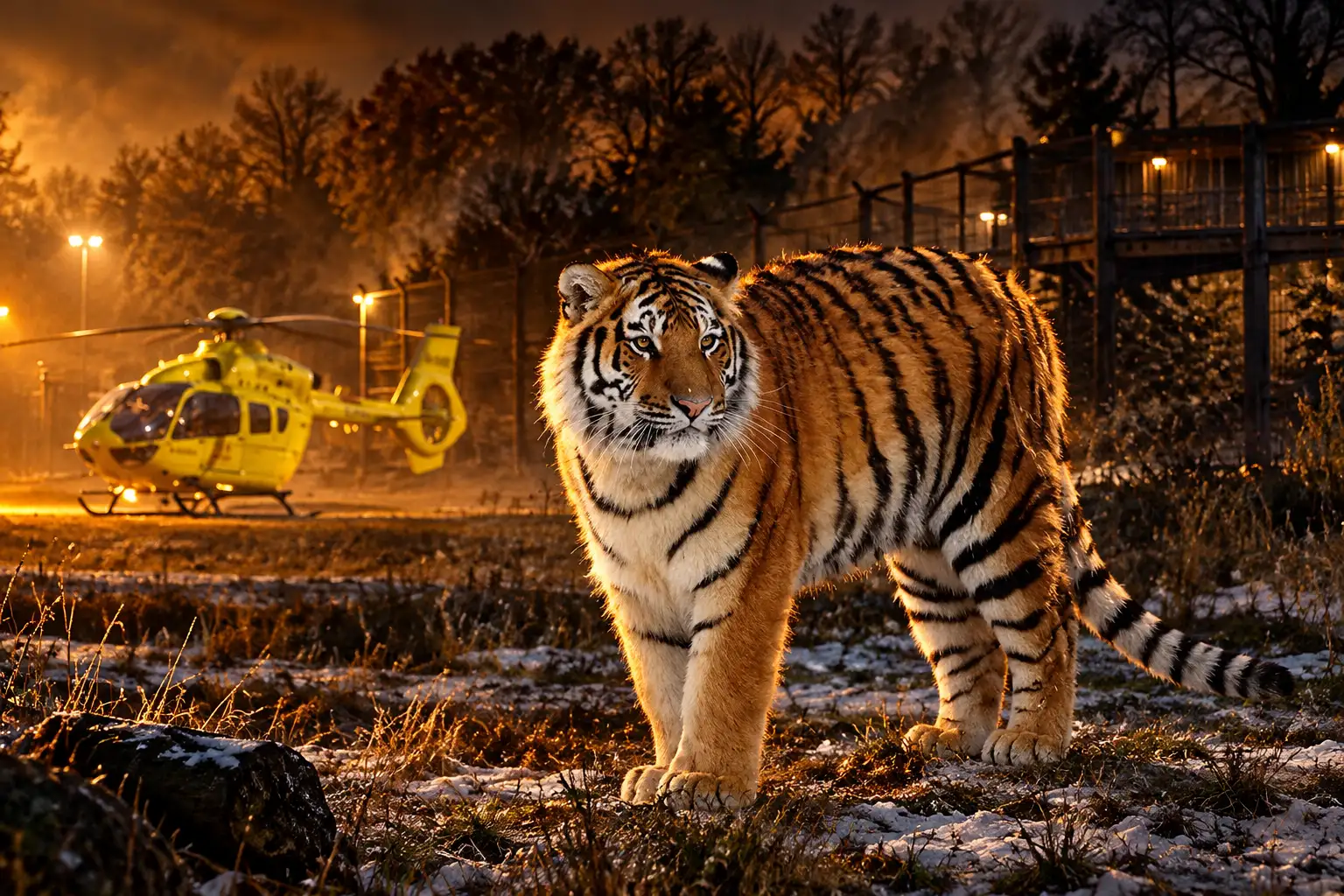
A man died at Yorkshire Wildlife Park near Doncaster on Saturday 10 October after entering a tiger enclosure and being attacked, South Yorkshire Police said. He was pronounced dead at the scene. The tiger was uninjured and stayed inside the reserve, the force said, after rumours spread that the animal had been destroyed.
The park evacuated visitors and said it would stay closed on Sunday 11 October. Police have not named the man, and they have not said how he got in. They asked people not to share video that appeared to show him inside the enclosure shortly before the attack.
A Fatal Attack in the Tiger Reserve
Yorkshire Wildlife Park sits at Branton, on the edge of Doncaster, and opened in 2009. Its Land of the Tigers reserve opened in 2011 as a home for endangered Amur tigers, also called Siberian tigers. That is where emergency crews were sent on Saturday afternoon.
The park said its emergency response procedures were “immediately activated” and that it was working with the authorities “to ascertain exactly what happened.” A later message said the park was “deeply saddened” and asked that the privacy of those affected be respected. “The safety and wellbeing of our visitors, staff and animals remain our highest priority,” it said.
SATURDAY 10 OCTOBER AT THE PARK
- 13:33 BST: Yorkshire Ambulance Service is called and sends two land ambulances, Yorkshire Air Ambulance and a doctor.
- 13:35 BST: South Yorkshire Police receive reports of a man entering the tiger enclosure.
- Around 14:00 BST: Visitor Tia Hanson finds the walkway between the tiger enclosure and the exit closed.
- Afternoon: The park is evacuated; a black screen is put up around the enclosure, according to people on site.
- Evening: Police confirm the man is dead, the tiger is uninjured, and they ask the public not to share circulating video.
Specialist officers were supporting the man’s family, the force said. Officers were still at the park on Saturday night.
Police Spent Saturday Night on the Tiger’s Fate
The first public argument after the death was not only about the man. It was about whether the cat would be shot. Witnesses reported hearing shots near the enclosure. By evening, rumours said the tiger had been destroyed. Police answered that claim in a dedicated line of their statement, before they had named the dead man or explained how he got in.
Regarding rumours surrounding the condition of the tiger, the animal was uninjured and remained in the enclosure following the incident and there is no wider risk to the public.
South Yorkshire Police statement, 10 October 2026
That sentence does two jobs at once. It tells other visitors the animal never left the reserve. It also tells keepers, and anyone who has followed earlier British tiger deaths, that this cat is still alive. The force used the singular “the tiger.” The park keeps two Amur tigers in Land of the Tigers. Police have not said which animal was involved, and the park has not named it either.
Keepers now have to live with a big cat that has killed a person in front of a Saturday crowd. That is a different burden from a failed slide or a broken bolt in a back-of-house corridor. The animal did what an Amur tiger does when a human is on the ground inside its reserve. The people who feed it still have to walk those same corridors on the next shift.
Tschuna, Altai and the 300-Metre Walkway
Land of the Tigers was built as a viewing show, not a cage you press your face against. The park invites visitors onto a 300 meter long raised walkway above woodland, grass and a waterfall pool. From that path, the cats are meant to look free. The point of the design is distance with a good view.
LAND OF THE TIGERS IN FIGURES
- Opened: The reserve opened in 2011, two years after the park itself.
- The path: A 300-metre raised walkway runs above the cats.
- The ground: The park has described a two-acre complex of woodland, grassland and a waterfall pool.
- The residents: Tigress Tschuna arrived in 2013; a young male, Altai, was announced on 10 March 2025 after a 1135-mile move from Norway.
The park welcomed a young male from Norway to join Tschuna as part of a breeding and conservation programme. Keepers at his former home, Dyreparken, had described him as calm and receptive. His favourite habit, the park said, was playing in water. The exhibit copy still tells visitors that Amur tigers, the largest living cats, can weigh up to 320 kg, that wild numbers once fell as low as 20 to 30, and that conservation programmes pushed the wild population back to over 500.
Those figures are why the cat’s fate became a public question so fast. This is not a disposable animal in a sideshow. It is the park’s endangered centrepiece, on a walkway sold as almost face to face.
What Witnesses Heard After the Alarm
People already in the park did not get a tidy account. They got a closed path, a rush of staff, and then an evacuation that pushed some groups further in before it pushed them out.
Tia Hanson, visiting with a friend, said that around 2pm the walkway between the tiger enclosure and the exit was shut. Karmelle Pelham, visiting from Worksop with her family, said they were at the lemur enclosure when they were told to leave, then ushered “further and further into the park.” Other visitors described a black screen or tarpaulin going up around the tiger area, and a heavy police and ambulance presence.
WHAT WE KNOW
- The death: A man entered the tiger enclosure, was attacked, and was pronounced dead at the scene despite medical treatment.
- The animal: Police say the tiger was uninjured, stayed inside the enclosure, and posed no wider public risk.
- The park: Yorkshire Wildlife Park evacuated, then said it would remain closed on Sunday 11 October.
- The family: Relatives have been told and are being supported by specialist officers.
WHAT IS UNCONFIRMED
- How he entered: Police have said only that a man entered. Some people on site described a jump; others described a climb. Motive is unknown.
- Which tiger: The park keeps Tschuna and Altai. No official has named the animal involved.
- The shots: Witnesses reported gunfire, and some spoke of five shots they took to be gas canisters or darts. Police have not confirmed any discharge.
Until those three points are settled, every version of Saturday afternoon is a sketch. The confirmed spine is still short: a man inside a Category 1 reserve, a tiger that did not leave it, and a park that sent everyone home.
Rosa King, Cicip and the Choice Not to Kill
Britain has lost people to tigers in licensed collections before. Those deaths were keepers at work, not visitors on a Saturday walkway, and the argument that followed was the same one police had to close on Saturday night: whether the cat should die as well.
UK TIGER DEATHS IN ENCLOSURES
| Date | Place | Who died | What followed for the cat |
|---|---|---|---|
| 24 May 2013 | South Lakes Safari Zoo, Cumbria | Sarah McClay, 24, keeper | Sumatran tiger Padang dragged her after a defective bolt on a den door failed to shut |
| 29 May 2017 | Hamerton Zoo Park, Cambridgeshire | Rosa King, 33, keeper | Malayan tiger Cicip attacked after an isolation slide was left open; the zoo later said Cicip was not put down, with her parents’ support |
| 10 October 2026 | Yorkshire Wildlife Park, Doncaster | Unnamed man, visitor | Police say the Amur tiger was uninjured and remained in the enclosure |
King had gone in to clean viewing windows before opening time. A metal slide meant to keep the tiger out of that space was found open. A visitor saw her body from the public viewing area. Keepers later ran to shut gates so Cicip could not reach a public zone. Hamerton reopened after a licence and public-safety inspection. The cat lived.
McClay was doing routine work when Padang pulled her into the enclosure. An inquest heard that a bolt on a den door was defective, four days after a zoo inspection. Owner David Gill said she had broken safety protocols. The mechanical story in both cases was a barrier that did not do what staff believed it was doing.
Saturday’s death does not fit that file. On the police account, a member of the public was inside a reserve built to be watched from above. If that holds, the failure mode is not a keeper door. It is a person on the public side of a barrier that was specified to stop a tiger getting out, and to stop casual contact, not to stop someone determined to go in.
Category 1 Barriers and Unauthorised Opening
English zoos are licensed under the Zoo Licensing Act 1981. Inspectors judge them against the Secretary of State’s minimum standards that zoos must meet, which cover animal welfare, public safety, conservation and education. The 2012 standards remain in force until 23 May 2027. A rewritten 2027 set takes effect from 24 May 2027.
Tigers sit in Category 1, the highest hazard class, alongside lions, leopards and jaguars. The current standards tell operators to lock enclosure gates so they cannot be opened without authority, to use barriers strong enough to hold animals that climb or jump, and, in general, to fit a double gate or door so that one breach does not open the whole space. Stand-off barriers are meant to keep the public back from the outer fence. After King’s death, Defra was pressed on double air-lock keeper gates for big cats; the 2027 standards add clearer double-door language for Category 1 carnivores.
WHAT THE RULES ASK OF A TIGER RESERVE
- Locked gates: Doors must be secured against unauthorised opening, not only against an animal pushing out.
- Double doors: A second gate is meant to hold if the first is breached, a lesson drawn hard after keeper deaths.
- Stand-off: A second line of fencing or rail should keep hands, and bodies, off the enclosure barrier.
- Daily checks: Electric fencing, where used, must be checked each day and have backup power.
Those lines are written around escape and around staff walking into a paddock. They are thinner on a visitor who leaves the walkway. Membership bodies also publish health and safety guidelines for zoos that run beside the statutory standards. None of that, on its own, tells you whether Saturday’s barrier was climbed, forced, or open. It does tell you what the inspection regime thinks a tiger fence is for.
Local licensing sits with the council, not with a national zoo police. If Doncaster’s inspectors return, they will be asking how a member of the public crossed from a 300-metre walkway into a two-acre Amur reserve in the middle of a busy Saturday. That question belongs to them, and to the inquest that will follow the death. It is not answered by the park’s conservation copy, and it is not answered by a viral clip.
The Video Police Asked People Not to Share
By Saturday evening the official account was still a handful of sentences. The unofficial account was a phone video. Police said they knew footage was circulating and asked people not to share “this distressing footage.” The clip moved anyway, attached to jokes about a man who “found out,” and to a smaller set of posts arguing that nobody of sound mind climbs into a tiger reserve and that the cat would be the one made to pay.
Both of those instincts showed up before anyone knew the dead man’s name. One treats the death as a punchline. The other treats the tiger as the defendant. Police had to answer the second in writing. They have not answered the first, except by asking people to stop passing the video on. The man is still unnamed. The park is closed on Sunday 11 October. The tiger, they said, is uninjured and still inside the reserve.

Bulk Scotch Still Faces Full Duty After India’s UK Deal

Typhoon Champi Loops Off Taiwan and Still Injures 527

PM Modi Opens Chinmaya’s AI Guru and Asks for Unity

Mahim Police Hold a JeM Suspect on Enmity Charges

Gold Falls Below $4,000 as Hormuz Oil Hits $117

The iPhone 18 Pro Max Splits Apple’s Fall in Two

OpenAI Calls GPT-6 Astra AGI Then Locks Its Exploits

Clancy Juror Says the Holdout Never Cited Evidence

Trump Claims Hormuz Control as Oil Holds Near $96

Russia Closes the Goethe-Institut Berlin Tried to Save

 NEWS2 months ago
The iPhone 18 Pro Max Splits Apple’s Fall in Two
- NEWS2 months ago
OpenAI Calls GPT-6 Astra AGI Then Locks Its Exploits
- NEWS1 month ago
Clancy Juror Says the Holdout Never Cited Evidence
- BUSINESS2 months ago
Trump Claims Hormuz Control as Oil Holds Near $96
- LIFESTYLE2 months ago
Russia Closes the Goethe-Institut Berlin Tried to Save
- AUTO2 months ago
Volkswagen’s Job Cuts Leave Four Plants Without Cars
- NEWS2 months ago
Dyson Puts Nurovi Robots on Sale Without the UV Flagship
- NEWS2 months ago
The Lincoln’s 286-Day War Cruise Ends at a Thai Pier