NEWS
Starlink Already Holds a Licence as Musk Attacks Ambani
Starlink already has an Indian satcom licence, Jio signed to sell its kits, and the wait is a shared Cabinet price plus Home Ministry clearance, not an Ambani veto.

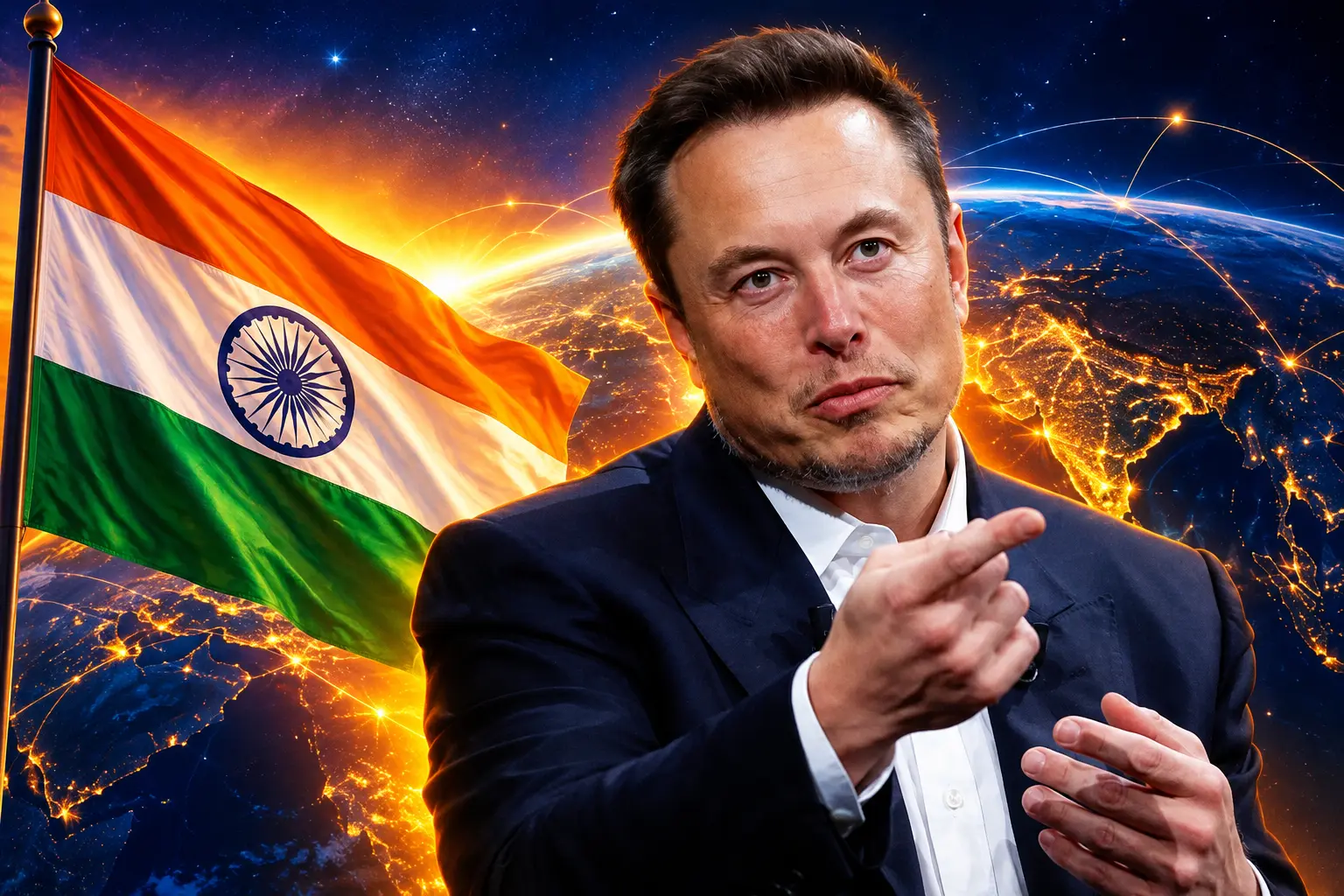
Elon Musk accused Mukesh Ambani of blocking Starlink in India, and called the camp around him hypocritical for saying the service is both too weak and too strong. Starlink already holds a satellite communication licence, one of three New Delhi has issued.
On 9 October, Communications Minister Jyotiraditya Scindia named the three holders. Starlink, Jio Satcom and Bharti-backed Eutelsat OneWeb can start once spectrum charges are set and each firm clears security rules.
Starlink Already Holds an Indian Satcom Licence
Musk’s complaint is that a company licensed in over 165 countries, after five years of Indian paperwork, still cannot switch on. He put that question on 8 October, then asked if Ambani was “the real boss of India.” The Department of Telecommunications had already issued Starlink a Global Mobile Personal Communication by Satellite licence in June 2025. IN-SPACe, the space authorisation body, followed in July 2025.
That is a 16-month gap between the licence and the posts. A licence is not a launch. Scindia, speaking at the India Mobile Congress, drew the line in public.
There are three parties that have got a licence. As and when the government decides the charge system on a revenue basis, that spectrum will be assigned to them, and as and when they individually fulfil the security conditions, then they can start operations.
Jyotiraditya Scindia, Union Communications Minister, India Mobile Congress, 9 October 2026
He also said India does not allow a monopoly in any sector, and that the department is technology agnostic: customers pick the service and the company. Amazon’s Kuiper has shown interest and still has to walk the same process. None of the three licensees has security clearance yet.
Musk is therefore punching at a closed door that is, on paper, already open. What is shut is the next room: money for spectrum, and a file at the Ministry of Home Affairs.
Three Licences and a Shared Security Queue
If Ambani were simply sitting on the switch, Jio Satcom would already be live and Starlink would be the only firm in the waiting room. That is not the queue Scindia described. All three names wait on the same two remaining steps.
WHERE THE THREE LICENCE HOLDERS STAND
| Operator | Licence | Still open |
|---|---|---|
| Starlink (SpaceX) | GMPCS, June 2025; IN-SPACe, July 2025 | Spectrum charges, Home Ministry security, FDI as a wholly foreign-owned firm |
| Jio Satcom (Reliance) | Satcom licence issued | Spectrum charges, Home Ministry security |
| Eutelsat OneWeb (Bharti-backed) | Satcom licence issued | Spectrum charges, Home Ministry security |
Minister of State for Communications Chandra Sekhar Pemmasani said the telecom department has issued the licences and that the hold-up is not about one company. “Now the issue is pending with MHA for security clearance. As soon as it is cleared, they will get it. It has nothing to do with one company,” he said.
Eutelsat OneWeb’s India director, Neha Idnani, said this month the firm has finished licensing formalities, is working through security clearances, and is ready on the infrastructure side. Starlink’s Lauren Dreyer, vice president of business operations, told the same congress the company has put up 20 gateway sites in India and will keep Indian user data in the country. “We’re standing ready to serve India once India is ready,” she said on 7 October.
A rival with towers in every district and a foreign LEO operator are in the same line. That is a poor fit for a story about one industrialist locking the gate.
Why Jio Still Planned to Sell the Kits
The other hole in the monopoly plot is on Jio’s own letterhead. On 12 March 2025, a day after Bharti Airtel announced a similar tie-up, Jio Platforms said it had an agreement with SpaceX to offer Starlink broadband in India, subject to SpaceX getting its own authorisations to sell here.
Jio said it would put Starlink equipment in its retail outlets and online stores, and set up installation and activation support. Starlink, in that telling, would sit beside JioAirFiber and JioFiber and reach places those products cannot. Mathew Oommen, then group CEO of Reliance Jio, called affordable high-speed broadband Jio’s top priority and said the SpaceX work would extend Jio’s reach.
We applaud Jio’s commitment to advancing India’s connectivity. We are looking forward to working with Jio and receiving authorization from the Government of India to provide more people, organizations and businesses with access to Starlink’s high-speed internet services.
Gwynne Shotwell, President and Chief Operating Officer, SpaceX, 12 March 2025 media release
So the firm Musk now paints as a monopolist signed, 19 months ago, to be his shopfront. Jio Satcom can still compete with Starlink in the sky. Jio’s stores can still sell the dish. Both things can be true at once, and both make the “Prime Minister Ambani” line harder to hold.
Musk did not leave the argument on spectrum. On 10 October he posted screenshots of older reports on a Reliance-funded political campaign outfit and on electoral-bond gifts by a Reliance-linked firm, Qwik Supply, of Rs 385 crore to the BJP and Rs 25 crore to Shiv Sena. Reliance has not answered the posts in public. The government has called claims of a selective authorisation process baseless and misconceived.
Musk Says SpaceX Will Cut the Price
The post that revived the fight on 10 October went at the economics, not the bonds.
The ridiculous arguments by Ambani’s army of Internet shills make no sense
On the one hand, they say Starlink couldn’t possibly compete with the amazing low prices offered by Ambani’s de facto monopoly in India and then, in the same breath, they essentially claim that Starlink… https://t.co/hKfeUKg6VY
— Elon Musk (@elonmusk) October 10, 2026
Musk wrote that Ambani’s supporters claim Starlink could not compete with “the amazing low prices offered by Ambani’s de facto monopoly in India” and, in the same breath, that Starlink would be too strong a competitor. “This is absurd hypocrisy and hyperbole,” he said. Competition would give ordinary Indians more choice. “Ambani’s profits will be lower, but he is not going out of business. And, obviously, if Starlink is too expensive in India, no one will buy it, so SpaceX will need to make pricing affordable.”
That last sentence is the concession. India’s mobile market is built on cheap data. Reliance Industries’ figures for the quarter ended 30 June 2026 put Jio’s average revenue per user at Rs 215.6 a month. Jio users consumed 43.7 GB of data a month, and the network carried 69.4 billion GB in the quarter, up 26.9 percent from 54.7 billion GB a year earlier. The company counted 285 million 5G users at the end of June.
THE PRICE WALL STARLINK HAS TO CLIMB
- Jio mobile ARPU: Rs 215.6 a month in the June quarter, the bill against which any new pipe will be judged.
- Usage on that bill: 43.7 GB per Jio user per month, with 5G traffic running about 1.5 times 4G traffic.
- Starlink’s India price: not announced. A December 2025 site glitch flashed dummy test figures of Rs 8,600 a month and a Rs 34,000 kit; Dreyer said those numbers were not the cost.
- Musk’s own test: if the service is too expensive, nobody buys it, and SpaceX has to cut.
India is a mobile-first market. Towers go up once and serve thousands of SIMs. Fibre is still a house-by-house job, which is why home broadband penetration lags the number of cheap data packs. Starlink’s useful market is the village, camp, or hill that has no decent fixed line, not the 5G colony where Jio already sells a fat pipe for a couple of hundred rupees. Musk is right that a second pipe helps people off the grid. He is also describing a product that has to land near Jio money, or stay a niche for resorts, mines and backup links.
The same cheap-data machine is why a US-style Starlink bill would fail here, and why SpaceX will have to invent a poorer-country price if it wants volume. That is not hypocrisy from Jio’s side. It is the market Jio made.
After the Auction Demand Collapsed in 2024
The fight Musk is having in public is, in large part, a fight he already won in the statute book. In 2024, Jio and Airtel argued that satellite spectrum should be auctioned, as mobile airwaves are. Starlink wanted administrative assignment. Musk called an auction unprecedented. The Telecommunications Act, 2023, allows administrative allocation of satellite spectrum, and the government took that route.
Jio had told the regulator to reject “any preferential treatment of satellite-based services.” Administrative assignment is the preference Starlink asked for. The remaining argument is the rate, not the method.
HOW THE FILE MOVED
- 11 July 2024: The Department of Telecommunications asks TRAI for terms and prices for NGSO fixed satellite services and GSO/NGSO mobile satellite services, including a level field with terrestrial access.
- 27 September 2024: TRAI issues the consultation paper; 30 stakeholders comment, 12 file counter comments, and an open house is held on 8 November 2024.
- 11-12 March 2025: Airtel, then Jio, announce separate deals to distribute Starlink, both subject to SpaceX authorisations.
- 9 May 2025: TRAI publishes its recommendations, including a 4 percent AGR charge and a floor of Rs 3,500 per MHz.
- June-July 2025: Starlink receives the GMPCS licence, then IN-SPACe authorisation.
- 3 September 2026: The Digital Communications Commission, the telecom department’s top body, approves a 5 percent AGR spectrum usage charge, with 4 percent in notified hard-to-connect areas.
- 7-10 October 2026: Musk attacks Ambani; Scindia answers that three licences are out and security still applies to each firm.
On 7 October Musk also wrote that Starlink beams are turned off over India, so claims that the terminals had been used inside the country were “absolutely false.” That is the security state’s starting point: a foreign constellation that can be switched on, or off, from outside. It is also why Home Affairs, not a Jio lobbyist, now holds the last stamp.
The 5 Percent Charge Still Needs Cabinet
TRAI’s May 2025 package set spectrum charges at 4 percent of adjusted gross revenue for GSO fixed satellite, NGSO fixed satellite, and GSO/NGSO mobile satellite, subject to a Rs. 3,500 per MHz minimum charge. For NGSO fixed satellite it added Rs 500 per urban subscriber per year and exempted rural and remote users from that extra. It also floated a subsidy for user terminals in unserved rural areas.
The commission did not take the package as written. On 3 September it approved 5 percent of AGR, cut to 4 percent in government-notified hard-to-connect areas such as borders, hills and islands, and kept the Rs 3,500 per MHz floor. It dropped the urban per-subscriber fee, citing the mess of splitting rural and urban users, and it dropped the terminal subsidy. Spectrum would be assigned for five years, with an option to extend by two, and not by auction. Operators still owe a separate annual licence fee of 8 percent of AGR under existing terms.
That 5 percent is not yet the law of the service. The proposal still needs an inter-ministerial panel and the Cabinet. On 9 October Scindia said TRAI and the department were close to a final decision on the pricing regime. Both statements can sit together: the commission has voted, the Cabinet has not.
WHAT STILL HAS TO HAPPEN BEFORE A DISH GOES LIVE
- Cabinet price: The 5 percent AGR charge, and the 4 percent hard-to-connect cut, need ratification before spectrum is assigned for money.
- Home Ministry: Each licensee has to clear security on its own; Pemmasani has parked that file at MHA.
- FDI for Starlink: As a wholly foreign-owned operator it also needs foreign direct investment approval, a step Jio Satcom does not face in the same way.
- Gateways on a clock: TRAI said satellite earth station gateways should be installed and commissioned within 12 months of permission, and that spectrum should be assigned within 30 days of application once in-principle network clearance exists.
Those terms will apply to Starlink, Jio Satcom and OneWeb together. A high charge raises everyone’s bill. A low one makes it easier for Starlink to price down, as Musk now says it must, and easier for Jio Satcom to do the same. The person with skin in the rate is not only Ambani. It is every licensee, and the Treasury.
Where the Security File Goes Next
Musk’s 9 October letter, addressed to “Prime Minister Ambani,” asked the industrialist to allow Starlink to compete, and said children without internet lose schooling and small firms lose a global market. A follow-up said Starlink has been essential in disasters when other networks fail. Leader of Opposition Rahul Gandhi replied, “Welcome to India, Elon. Wait till you discover the other guy.” Scindia used the exchange to needle Congress. None of that moves the MHA file.
The security objection is not a meme about oligarchs. Indian agencies have spent months on whether satellite operators can route traffic through gateways outside the country. Operators say they have run trials, adapted to Indian gateways, and given undertakings. Dreyer says 20 gateways are already in the ground and that Indian data will stay in India. The clearance still has not come, for Starlink or for the two Indian-backed licensees standing next to it.
Jio is not idle in space while it waits. It has outlined a plan for about 1,600 of its own low Earth orbit satellites, a domestic constellation beside the Jio Satcom licence, even as its stores remain listed as a Starlink channel from the March 2025 deal. Amazon’s Kuiper still has no Indian licence and, under the new authorisation rules, has been told to apply again. The field is crowded on paper and empty on the air.
There is a fair double-standard question in the other direction. Musk wants India opened to Starlink on competition grounds while the United States still treats Chinese carmakers such as BYD as a national-security problem, not a consumer-choice one. New Delhi is applying a similar instinct to a foreign satellite layer that can be switched off from abroad. You can call that caution or you can call it delay. You cannot call it a private veto by Mukesh Ambani when Jio Satcom is in the same queue, OneWeb is in the same queue, and Jio’s own shops were supposed to sell the dish.
Musk can keep posting until the Cabinet number is out and Home Affairs signs. Starlink can keep the 20 gateways warm. The average citizen he says he is fighting for still needs a price that looks like Rs 215.6, not a US bill, and a clearance that three companies have not received. Dreyer has the line for that wait: the company is ready when India is.

Bulk Scotch Still Faces Full Duty After India’s UK Deal

Typhoon Champi Loops Off Taiwan and Still Injures 527

PM Modi Opens Chinmaya’s AI Guru and Asks for Unity

Mahim Police Hold a JeM Suspect on Enmity Charges

Gold Falls Below $4,000 as Hormuz Oil Hits $117

The iPhone 18 Pro Max Splits Apple’s Fall in Two

OpenAI Calls GPT-6 Astra AGI Then Locks Its Exploits

Clancy Juror Says the Holdout Never Cited Evidence

Trump Claims Hormuz Control as Oil Holds Near $96

Russia Closes the Goethe-Institut Berlin Tried to Save

 NEWS2 months ago
The iPhone 18 Pro Max Splits Apple’s Fall in Two
- NEWS2 months ago
OpenAI Calls GPT-6 Astra AGI Then Locks Its Exploits
- NEWS1 month ago
Clancy Juror Says the Holdout Never Cited Evidence
- BUSINESS2 months ago
Trump Claims Hormuz Control as Oil Holds Near $96
- LIFESTYLE2 months ago
Russia Closes the Goethe-Institut Berlin Tried to Save
- AUTO2 months ago
Volkswagen’s Job Cuts Leave Four Plants Without Cars
- NEWS2 months ago
Dyson Puts Nurovi Robots on Sale Without the UV Flagship
- NEWS2 months ago
The Lincoln’s 286-Day War Cruise Ends at a Thai Pier