
NEWS
SpaceX Flies the Last ISS Solar Wings on CRS-35
CRS-35 is flying the last ISS roll-out solar arrays, closing a nine-year power upgrade NASA says will also support a controlled deorbit.

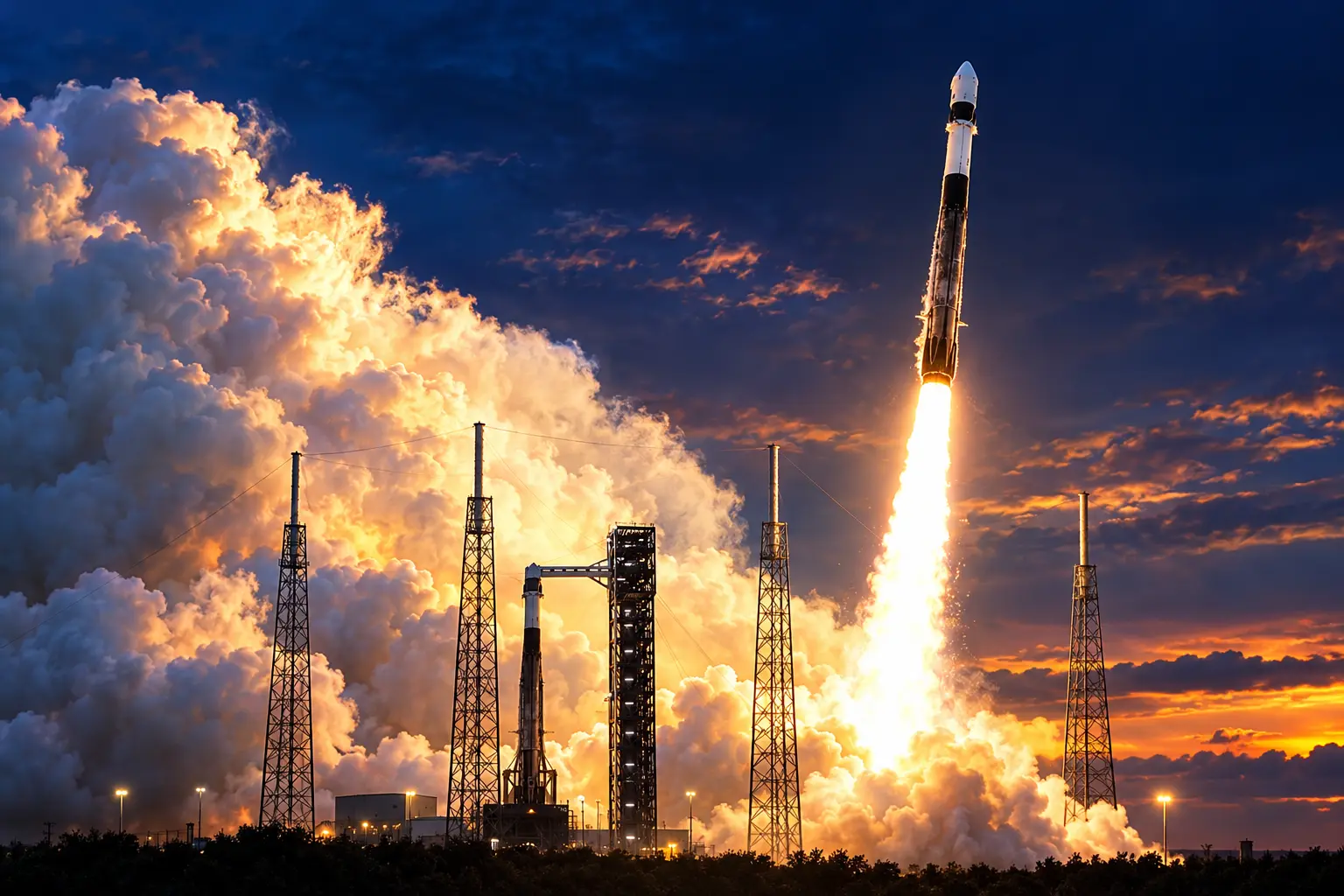
A Falcon 9 sent NASA’s CRS-35 Dragon toward the International Space Station at 6:33 a.m. ET on Oct. 13, 2026. The trunk holds the last pair of ISS roll-out solar arrays, plus more than 6,300 pounds of science and station hardware.
NASA says those wings complete a power upgrade that also supports a safe, controlled deorbit. Dragon C211 is due at Harmony on Oct. 15.
Falcon 9 Puts Dragon C211 on a 52-Hour Run
The rocket left Space Launch Complex 40 at Cape Canaveral Space Force Station with Cargo Dragon C211 on its fourth flight, after CRS-26, CRS-29, and CRS-33. SpaceX listed an approximate 52-hour flight to docking, with arrival at about 11 a.m. ET on Oct. 15 at Harmony’s space-facing port.
First-stage booster B1096 was on its eighth flight. SpaceX said it had previously launched KF-01, IMAP, NROL-77, GPS III-9, CRS-34, NROL-95, and one Starlink mission. The booster landed at Landing Zone 40, next to the pad, at 7 minutes 21 seconds, and a sonic boom rolled across the spaceport. Dragon separated at 9 minutes 18 seconds.
The pictures that moved after sunrise were of exhaust lit by the rising sun, not of the two arrays rolled in the unpressurized trunk. A 6:33 a.m. cargo flight still reads as ordinary from the ground, which is why the plume traveled farther than the payload.
THE RUN FROM PAD TO PORT
- Oct. 13, 2026, 6:33 a.m. ET: Falcon 9 lifts off from Space Launch Complex 40 with Dragon C211.
- T+7 minutes 21 seconds: Booster B1096 lands at Landing Zone 40 on its eighth flight.
- T+9 minutes 18 seconds: Dragon separates from the upper stage and opens its nose cone.
- Oct. 15, 2026, about 11 a.m. ET: Dragon docks on its own at Harmony’s space-facing port.
- Mid-November 2026: Dragon leaves the station and splashes down off California.
NASA astronaut Anil Menon and Canadian Space Agency astronaut Joshua Kutryk will monitor the Oct. 15 arrival. NASA plans to begin arrival coverage at 9:15 a.m. ET.
Falcon 9 launches the CRS-35 mission to the @Space_Station pic.twitter.com/QiHIqlDLTH
— SpaceX (@SpaceX) October 13, 2026
The Last Two Wings Close the Station’s Power Grid
NASA’s cargo list leads with the final pair of IROSAs for the station, the ISS Roll-Out Solar Arrays built by Redwire. Onboard cameras showed the two wings nested in Dragon’s trunk. NASA has been preparing the truss with spacewalks and modification kits so crews can mount them.
Redwire said in a Jacksonville statement dated Oct. 12, 2026, that this is the fourth and final pair, and that six of its ROSA wings have been deployed on the station since 2021. Each wing is rated at more than 20 kW for more than 10 years. The company said all eight together will supply more than 160 kW from eight wings.
THE EIGHT-WING POWER SET
- The cargo: Dragon lifted more than 6,300 pounds of science, crew goods, and station hardware.
- The wings on board: Two iROSA arrays, the seventh and eighth, ride in the trunk.
- The rating: Each wing is built for more than 20 kW and more than 10 years once it is unrolled.
- The full set: Eight Redwire wings are to supply more than 160 kW after this pair is installed.
That 10-year rating outlasts NASA’s public plan to operate the laboratory through 2030. Redwire said the six wings already on the truss have helped keep the outpost running toward that date. The last two are the remaining piece of the same job, not a new power architecture.
A 2017 Demo Grew Into Eight Arrays
Gaurang Patel, NASA’s operations integration manager for its Low Earth Orbit Program, tied the cargo to a test that flew on CRS-11. The original ROSA experiment launched in 2017, unfurled outside the station, and was later jettisoned after a short run of checks.
It’s been quite the journey. Folks may remember back in 2017 when we launched the ROSA on CRS-11 and that’s really where we demonstrated this innovative approach to deploying a solar array.
Gaurang Patel, NASA operations integration manager, Low Earth Orbit Program, post-launch remarks
Patel said the legacy arrays were not built for standard upgrades, so teams designed modification kits for non-standard interfaces before any iROSA wing could be bolted on. The first pair went up on SpaceX’s 22nd cargo flight in 2021. Redwire said a second pair launched on CRS-26 in 2022. By the time CRS-35 lifted off, six wings were already on the truss and two remained.
THE IROSA BUILD FROM DEMO TO FINAL PAIR
| Year | Flight | What arrived |
|---|---|---|
| 2017 | CRS-11 | ROSA demo wing, tested outside the station, then jettisoned |
| 2021 | 22nd cargo flight | First pair of iROSA wings for the ISS truss |
| 2022 | CRS-26 | Second pair of Redwire iROSA wings |
| 2026 | CRS-35 | Fourth and final pair, bringing the set to eight |
The original plan was six wings. NASA later asked for two more after power projections and wear on the old blankets. CRS-35 is that extra pair, nine years after the demo that proved a motorless roll-out could work in orbit.
Extra Power Is Also for a Controlled Fall
NASA’s overview is blunt about why the last arrays still matter. The agency said the final pair completes the power-system upgrade “to support critical operations, including its safe and controlled deorbit.” The wings are not a tug. They are the electrical margin the laboratory is supposed to keep while partners plan how to bring a city-size station down on purpose.
On June 26, 2024, NASA announced an U.S. Deorbit Vehicle contract with SpaceX with a total potential value of $843 million. NASA will take ownership after development and operate the vehicle. Ken Bowersox, then associate administrator for the Space Operations Mission Directorate, said the choice would help NASA and its partners “ensure a safe and responsible transition in low Earth orbit at the end of station operations.”
The United States, Japan, Canada, and the European partners have committed to operate the station through 2030. Russia has committed through at least 2028. NASA has said existing Progress craft do not give enough margin for a safe reentry on their own, which is why a dedicated U.S. vehicle was bought. The iROSA set is the power side of that same endgame: keep the lab alive, then keep it controllable, then drop it.
What Science Rides With the Arrays?
NASA said the flight also supports more than 40 scientific studies. The named stack mixes medical manufacturing, plant pathology, and a glass melt that does not start with sand. Dr. Liz Warren, deputy chief scientist in NASA’s ISS Office, described the glass work before launch.
Most ordinary glass forms from silica, she said, the main component in sand, while unconventional glass is made from heavier elements that are not traditionally used. Those melts “could have remarkable properties, including refractive indices higher than diamond, greater resistance to breaking, and even the ability to contract rather than expand when heated.” Warren said new glass of that kind could serve lunar rovers and lunar habitats as well as optics on Earth.
THE NAMED INVESTIGATIONS ON CRS-35
- LambdaVision-1: Builds artificial retinas one thin layer at a time, testing whether microgravity makes those layers more uniform.
- Stellar Spheroids: Grows 3D human heart tissue models and looks at whether spaceflight helps blood-vessel networks form.
- ELF-Unconventional Glass 2: Melts glass from non-traditional elements, then returns the solids for study on Earth.
- MINDS: Flies brain organoid “villages” that mix cells from several people, hunting treatment targets for Alzheimer’s, Parkinson’s, and multiple sclerosis.
- GEARS: Returns for a fourth and final stay to track antibiotic-resistant bacteria on station surfaces.
JAXA’s write-up of ELF-Unconventional Glass 2 says crews will record molten glass density and viscosity in microgravity, then ship the beads home. A separate NASA biological set sends small lab-grown brain models up for five weeks, a duration longer than Dragon’s planned stay, and compares them with identical samples kept on Earth. The same division is flying a crop-disease test against a fungus and the first on-orbit use of a compact plate reader that arrived earlier in 2026, so crews can read antibodies and proteins without waiting for splashdown.
Hardware for people is in the stack too. NASA is sending a collapsible contingency urinal and support gear as an Artemis III test, plus a toilet dose pump, a pretreat quality sensor, and a robot micro-conical tool for outside maintenance.
Redwire Already Built Bigger Wings for Mars
The same roll-out kit is already booked off the station. Redwire said it has built the most powerful ROSA wings in its history to help power NASA’s Space Reactor-1 Freedom mission to Mars, planned for December 2028. NASA’s Space Reactors Division describes SR-1 Freedom as the first fission-powered interplanetary spacecraft, a nuclear-electric pathfinder with more than 20 kW of electrical power from the reactor.
Mike Gold, president of Redwire Space, used the CRS-35 launch to point past the ISS truss.
The ROSA program demonstrates the extraordinary benefits of public-private partnerships to create new technologies that not only enable flagship NASA missions, but have transitioned to support a wide variety of commercial programs. We’re grateful to our customer, Boeing, for their support of Redwire and the development of the innovative ROSA technology, which can now be used for future commercial space stations as well as providing power on the surface of the Moon, Mars, and beyond.
Mike Gold, President of Redwire Space, Oct. 12, 2026 statement
Redwire has already flown ROSA hardware on NASA’s Double Asteroid Redirection Test and on commercial geostationary satellites. The company said it has more than 65 solar array wings delivered or in development. The ISS pair on CRS-35 is the last of one program, and a shop drawing for the next.
The Failed Arm Joint Comes Home in November
Dragon is scheduled to stay about a month, then leave in mid-November and splash down off California. NASA is using the empty trip home as a repair desk. A large foam clamshell launched empty so it can return the failed Canadarm2 joint replaced during a June 30 spacewalk, for analysis and refurbishment on the ground.
The same return manifest lists a spacesuit for ground work, a fluid- and pressure-control pump assembly from the urine processor, and a filtration unit from the water processor. Those are the unglamorous pieces that keep a 25-year laboratory habitable while the new wings wait for their spacewalks. NASA said the station has hosted research from scientists in more than 110 countries and more than 4,000 experiments.
C211 still has to close the last miles to Harmony on Oct. 15, with Menon and Kutryk watching the approach. The last two arrays remain rolled until crews take them out and pin them to the truss. Until then, CRS-35 is a cargo ship with a power grid in the trunk and a broken arm joint’s ride home already booked.

Bulk Scotch Still Faces Full Duty After India’s UK Deal

Typhoon Champi Loops Off Taiwan and Still Injures 527

PM Modi Opens Chinmaya’s AI Guru and Asks for Unity

Mahim Police Hold a JeM Suspect on Enmity Charges

Gold Falls Below $4,000 as Hormuz Oil Hits $117

The iPhone 18 Pro Max Splits Apple’s Fall in Two

OpenAI Calls GPT-6 Astra AGI Then Locks Its Exploits

Clancy Juror Says the Holdout Never Cited Evidence

Trump Claims Hormuz Control as Oil Holds Near $96

Russia Closes the Goethe-Institut Berlin Tried to Save

 NEWS2 months ago
The iPhone 18 Pro Max Splits Apple’s Fall in Two
- NEWS2 months ago
OpenAI Calls GPT-6 Astra AGI Then Locks Its Exploits
- NEWS1 month ago
Clancy Juror Says the Holdout Never Cited Evidence
- BUSINESS2 months ago
Trump Claims Hormuz Control as Oil Holds Near $96
- LIFESTYLE2 months ago
Russia Closes the Goethe-Institut Berlin Tried to Save
- AUTO2 months ago
Volkswagen’s Job Cuts Leave Four Plants Without Cars
- NEWS2 months ago
Dyson Puts Nurovi Robots on Sale Without the UV Flagship
- NEWS2 months ago
The Lincoln’s 286-Day War Cruise Ends at a Thai Pier










