
BUSINESS
Modi Wagers India’s Rise on Selling Trust Abroad
Modi asked 500 Delhi forum leaders to buy India as a trust export as the IMF raised growth to 7 percent.

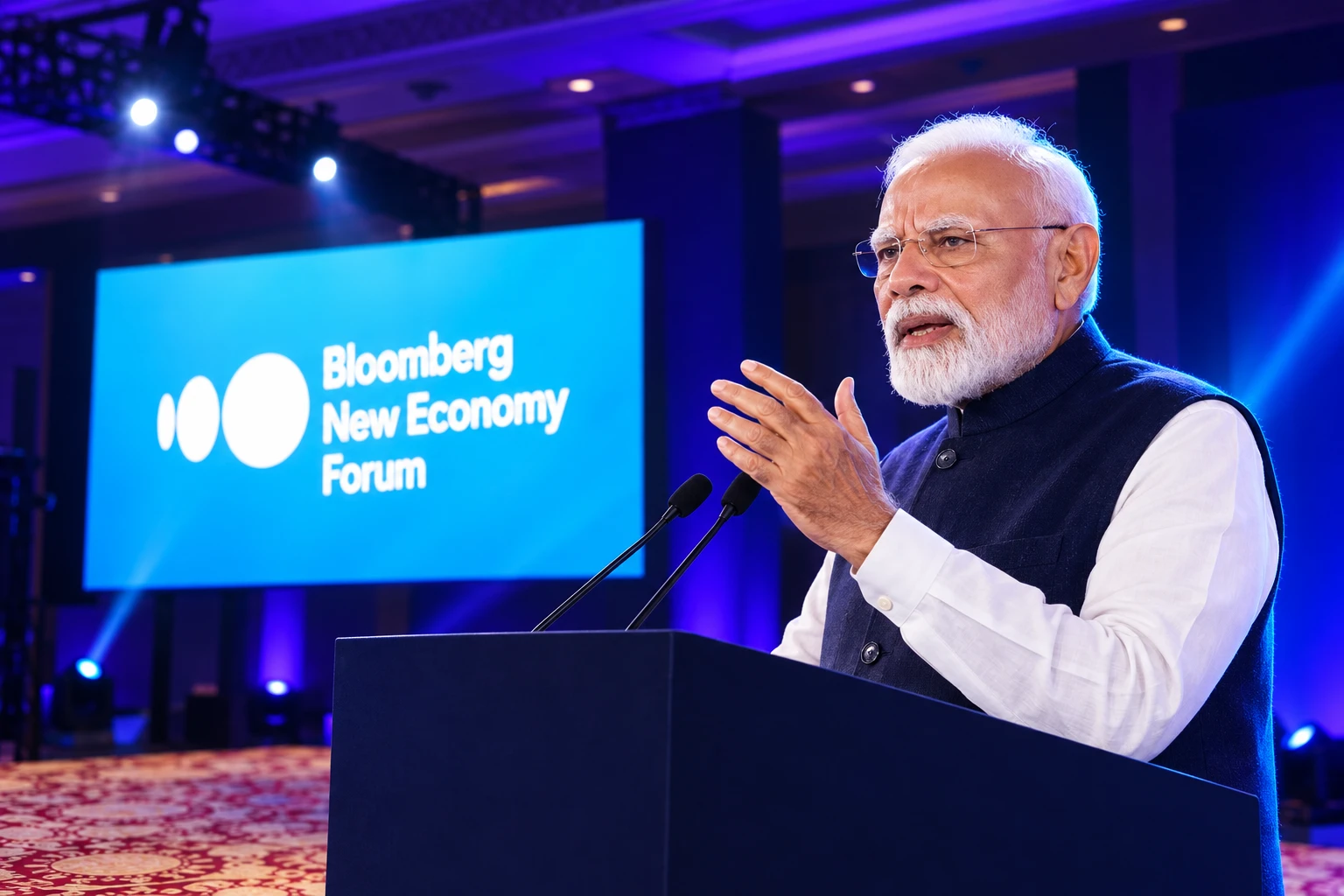
Narendra Modi told 500 leaders at the Bloomberg New Economy Forum on October 13 that India will sell trust as supply chains become weapons. The International Monetary Fund’s October outlook, out as the New Delhi gathering opened, raised India’s FY27 growth to 7% from 6.4 percent in July.
He was speaking to a capital room. The programme even names a session Return on India.
Modi Offers Trust as the Product India Can Sell
The prime minister addressed the forum in New Delhi on the opening day of Bloomberg’s first India edition, with Michael R. Bloomberg in the hall. He said the links that once bound trade, supply chains, energy, minerals, payments and technology, are being turned into tools of pressure. The scarce item, in his telling, is a partner who will still ship when a crisis hits.
We do not grow at anyone’s cost. We grow with the world, and for the world.
Narendra Modi, Prime Minister of India, at the Bloomberg New Economy Forum in New Delhi
He put specimens on the table rather than a slogan alone. India supplies about one-fifth of the world’s generic medicines, and more than 2,000 global capability centres in the country serve firms abroad. Digital identity and payment rails built at home are being shared with partner governments. During Covid, he said, Indian factories sent vaccines to more than 100 countries, and the open-source CoWIN software travelled with them.
That is the commercial offer: capacity other capitals can use without, in his phrasing, feeding a rival’s rise. He said a street vendor and a car showroom now clear payments on the same rail, and that cheap mobile data since 2014 turned connectivity into a market, not a privilege. Startups, he said, have gone from a few hundred in 2014 to more than 250,000, with more than 45 percent featuring women in leadership and nearly half born in smaller cities.
Speaking at the Bloomberg New Economy Forum. https://t.co/H91kiKqNQ8
— Narendra Modi (@narendramodi) October 13, 2026
He also reached for a political brand. India, he said, is the mother of democracy, with more than 100 languages, about 80,000 registered publications, more than 1,000 satellite channels, and more than 500 million users each on YouTube and Instagram. That line is the weak joint in a capital pitch, because it asks a buyer of labour and tax certainty to treat open argument as part of the same bundle as a 7.8 percent quarter. The growth arithmetic travels farther in a hall that came to price India.
The Guest List Came for Return on India
The gathering is the Forum’s first gathering in India and the eighth edition overall, running October 13 to 15 under the title A World in Play: Defining the New Levers of Power. Organisers put more than 500 public and private leaders in the room, with six senior Indian ministers among more than 50 speakers from nine countries.
Michael Bloomberg, founder of Bloomberg L.P. and Bloomberg Philanthropies, said India’s place as one of the world’s fastest growing economies and a global centre of innovation made New Delhi the right location. Founding partners include DP World, Hitachi Energy, HSBC, Hyundai Motor Company and Tata Sons. Infosys, Mubadala, PwC and Suzlon are presenting partners.
The session list reads like a buying memo: The Self-Sufficiency Scramble, Technological Sovereignty, Is This the Middle Power Moment, and Return on India. The last of those is the wager. Modi is asking that room to treat reliability as a line item, next to labour, tax and power prices.
Finance Minister Nirmala Sitharaman, External Affairs Minister S. Jaishankar, Commerce Minister Piyush Goyal and Railways and IT Minister Ashwini Vaishnaw are on the Indian slate. So are Tata Sons Chairman Natarajan Chandrasekaran, Infosys Chairman Nandan Nilekani, Blackstone President Jonathan Gray, BlackRock Chief Operating Officer Robert Goldstein, Cisco Chair Chuck Robbins, and former UK prime minister Rishi Sunak. Modi later posted that he had met Sunak at the forum. This is a placement note delivered as a state speech.
IMF and RBI Lift India While the World Slows
The Fund held FY28 at 7 percent as well, up from 6.7 percent in July, and pointed to stronger-than-expected momentum, domestic demand that held up, and strong services. Its data mapper lists India at 7 percent on that outlook. On October 7 the Reserve Bank of India had already projected FY27 growth at 7.1%, up from 6.7 percent in August.
Governor Sanjay Malhotra’s committee also raised the policy repo rate by 25 basis points to 5.50 percent and shifted the stance to calibrated tightening. The hike was unanimous. Two members, Nagesh Kumar and Ram Singh, wanted the stance left at neutral. NSO figures cited in that RBI statement put real GDP growth in the April to June quarter at 7.8 percent, the number Modi read out. Private consumption, fixed investment, a rebound in merchandise exports and strong services exports did the work, the central bank said. Manufacturing grew at a strong pace on the supply side.
GROWTH CALLS AROUND THE SPEECH
| Source | What it covers | Figure |
|---|---|---|
| IMF October outlook | India, 2026-27 | 7% |
| IMF October outlook | India, 2027-28 | 7% |
| RBI, October 7 | India, 2026-27 | 7.1% |
| NSO, cited by RBI | April to June quarter | 7.8% |
| IMF October outlook | World, 2026 | 3.1% |
The Fund’s world number is slower. Global growth is projected at 3.1 percent in 2026, then 3.4 percent in 2027, with inflation rising to 4.7 percent in 2026 before easing to 4.1 percent. India is being priced as an exception inside that grind. The RBI’s own quarterly path still slopes down a little: 7.2 percent in the second quarter, 6.9 percent in the third, 6.8 percent in the fourth, then 7.1 percent again in the first quarter of 2027-28.
The same RBI note is less calm on prices. CPI inflation is projected at 5.2 percent for 2026-27, with a weak monsoon, El Niño, and high energy prices still in the pipeline. August headline inflation was 4.8 percent, up from 4.5 percent in July, and core rose to 4.2 percent. Rate cuts, the committee said, are off the table in the near term; the next step can only be a hike or a pause. The following meeting is set for December 2 to 4. So the stability pitch arrives in the same fortnight as a rate rise. Growth is the exhibit. Inflation is the clause underneath.
What the Reform List Still Leaves Unfinished
Modi said reforms are a conviction, not a compulsion, and that India’s reform express is moving at high speed. He listed a unified GST market, insolvency law, the folding of 29 labour laws into four codes, and the stripping of criminal penalties from hundreds of minor business offences. The list is long. The unfinished part is where a factory actually files a return.
THE REFORM LIST, ITEM BY ITEM
- Labour codes: Four codes replaced 29 central laws on November 21, 2025, and the Centre notified its rules on May 8, 2026, but states still have to issue their own.
- GST process: The GST Council’s 57th meeting backed automatic sanction of 90 percent of export and inverted-duty refunds and the removal of arrest powers, with some changes dated April 1, 2027.
- Prosecution bar: The same Council voted to lift the GST prosecution threshold to Rs 5 crore from Rs 1 crore; that is a recommendation until notifications and law changes land.
- Insolvency and offences: Modi cited the insolvency law and the decriminalising of hundreds of minor business offences as proof the direction will not reverse.
Labour is a Concurrent List subject, so each state still writes a rulebook. Several large industrial states were still on draft rules in the weeks before he spoke. Definitions such as wages already apply. Forms, overtime limits and registers still depend on which government an employer answers to. Investors who treat the speech as a finished labour event will be pricing a gazette that is only half posted.
GST is older, and it is still being rewritten. Automatic refunds, no arrest power, and a higher prosecution bar are the business-friendly turn the Council just took. They take effect only through notifications and amendments. The codes are in force. The state rulebooks are not all in force. That gap is now part of the case he is selling.
Rating Houses Have Not Moved as One
Modi said India’s sovereign ratings are being upgraded because the banking system is in its strongest position in many decades and because the external accounts have tightened. The upgrade wave is real. It is also uneven.
THE RATING MOVES BEHIND THE CLAIM
- August 14, 2025: S&P Global Ratings raises India to BBB from BBB-, its first upgrade of India in 18 years.
- September 2025: Moody’s Ratings affirms Baa3 with a stable outlook and does not follow S&P up the scale.
- August 2026: Fitch Ratings remains at BBB-, the floor it has held since 2006.
- September 2, 2026: Japan Credit Rating Agency raises India to A- from BBB+, the highest grade any house has assigned.
S&P’s 2025 move ended a long stay at the lowest investment grade. Fitch has not followed. Moody’s has not followed. JCR has jumped a full band, citing growth near 7 percent, GST and digital public infrastructure, and a healthier financial system, while still flagging high public debt. A treasurer who can tap Japanese paper and a treasurer who needs a Fitch letter are not looking at the same India. The upgrades he cited are a split decision across houses.
In the Same Hall, Goyal Recalled Closed Doors
Commerce Minister Piyush Goyal, speaking at the same forum, gave the room a different origin story for Indian policy. During Covid, he said, India saw how exposed a country of 1.4 billion people is when supply chains snap.
When we needed vaccines from Pfizer and Moderna, Western countries refused to provide them.
Piyush Goyal, Union Minister of Commerce and Industry, at the Bloomberg New Economy Forum in New Delhi
India kept sending medicines, Goyal said, and that experience prompted Modi’s call for Atmanirbhar Bharat, a self-reliant India, now in its sixth year. That memory does not erase the open-hand speech. It shares the bill. The wager Modi is placing is that capital will read self-reliance as a buffer, not as a door that shuts. Goyal’s account is the version in which doors did shut, and India built around them.
If the product is trust that supplies will continue in a crisis, Goyal just told the buyers that supplies did not continue when India was the buyer. A room that came for Return on India now has both prospectuses: one that says we grow with you, and one that says we learned not to wait for you.
A Current Account Gap the Speech Left Aside
Modi put three external and social buffers on the table, then added a green build-out meant to show the same temperament abroad.
THE BUFFERS HE PUT ON THE TABLE
- Current account: Last year’s deficit was 0.61 percent of GDP, he said, down from more than 4 percent 12 to 13 years ago.
- Reserves: Foreign exchange reserves exceed $700 billion, and he said the banking system is at its strongest in many decades.
- Poverty: He said India has lifted 250 million people out of poverty over the past decade, a count larger than many countries.
- Power mix: Renewable capacity, he said, has gone from about 75 gigawatts in 2014 to about 300 gigawatts, and India hit a Paris pledge of 40 percent non-fossil power capacity in November 2021, nine years early.
PM Surya Ghar and PM-KUSUM, he said, have added more than 30 gigawatts and cut more than 30 million tonnes of carbon a year. He recalled that India met its 2015 Paris share-of-capacity pledge first among G20 countries, and he folded that into the same “power to empower” line he used for payments, vaccines and startups. Direct benefit transfers into bank accounts, he said, cut leakage and put the state next to the citizen without a middleman.
The Fund’s working assumption on the external account is less tidy. It sees India’s current account deficit widening to 1.5 percent of GDP in 2026-27, then easing to 1.3 percent the year after, as oil and portfolio flows bite. Last year’s 0.61 percent is the exhibit. This year’s 1.5 percent is the path. He said India’s confidence is at an “unprecedented high.” Five days earlier the central bank had said inflation is not benign and that the next move is a hike or a pause.
The forum runs through October 15. Return on India is on the agenda. Goyal’s vaccine memory and Modi’s open-hand line are now both on the record in the same hall.
Disclaimer: This article is news reporting and analysis of a public speech, official forecasts and credit-rating actions. It is for information only and is not investment, legal or financial advice, and it should not be used to buy or sell securities, currencies or other assets. Readers who may act on growth forecasts, sovereign ratings or reform timelines should consult a licensed financial adviser or qualified investment professional who can assess their own position. Figures and policy statuses reflect the official statements and outlooks cited here as of the dates on those documents and can change with later data, committee decisions and rating reviews.

Bulk Scotch Still Faces Full Duty After India’s UK Deal

Typhoon Champi Loops Off Taiwan and Still Injures 527

PM Modi Opens Chinmaya’s AI Guru and Asks for Unity

Mahim Police Hold a JeM Suspect on Enmity Charges

Gold Falls Below $4,000 as Hormuz Oil Hits $117

The iPhone 18 Pro Max Splits Apple’s Fall in Two

OpenAI Calls GPT-6 Astra AGI Then Locks Its Exploits

Clancy Juror Says the Holdout Never Cited Evidence

Trump Claims Hormuz Control as Oil Holds Near $96

Russia Closes the Goethe-Institut Berlin Tried to Save

 NEWS2 months ago
The iPhone 18 Pro Max Splits Apple’s Fall in Two
- NEWS2 months ago
OpenAI Calls GPT-6 Astra AGI Then Locks Its Exploits
- NEWS1 month ago
Clancy Juror Says the Holdout Never Cited Evidence
- BUSINESS2 months ago
Trump Claims Hormuz Control as Oil Holds Near $96
- LIFESTYLE2 months ago
Russia Closes the Goethe-Institut Berlin Tried to Save
- AUTO2 months ago
Volkswagen’s Job Cuts Leave Four Plants Without Cars
- NEWS2 months ago
Dyson Puts Nurovi Robots on Sale Without the UV Flagship
- NEWS2 months ago
The Lincoln’s 286-Day War Cruise Ends at a Thai Pier










