AUTO
Hyundai Stakes $15.5 Billion on a 30-Year India Bet
Hyundai Motor Group pledged $15.5 billion through 2032 after a fourth-place FY26 finish, betting Indian plants and parts can claw back share.

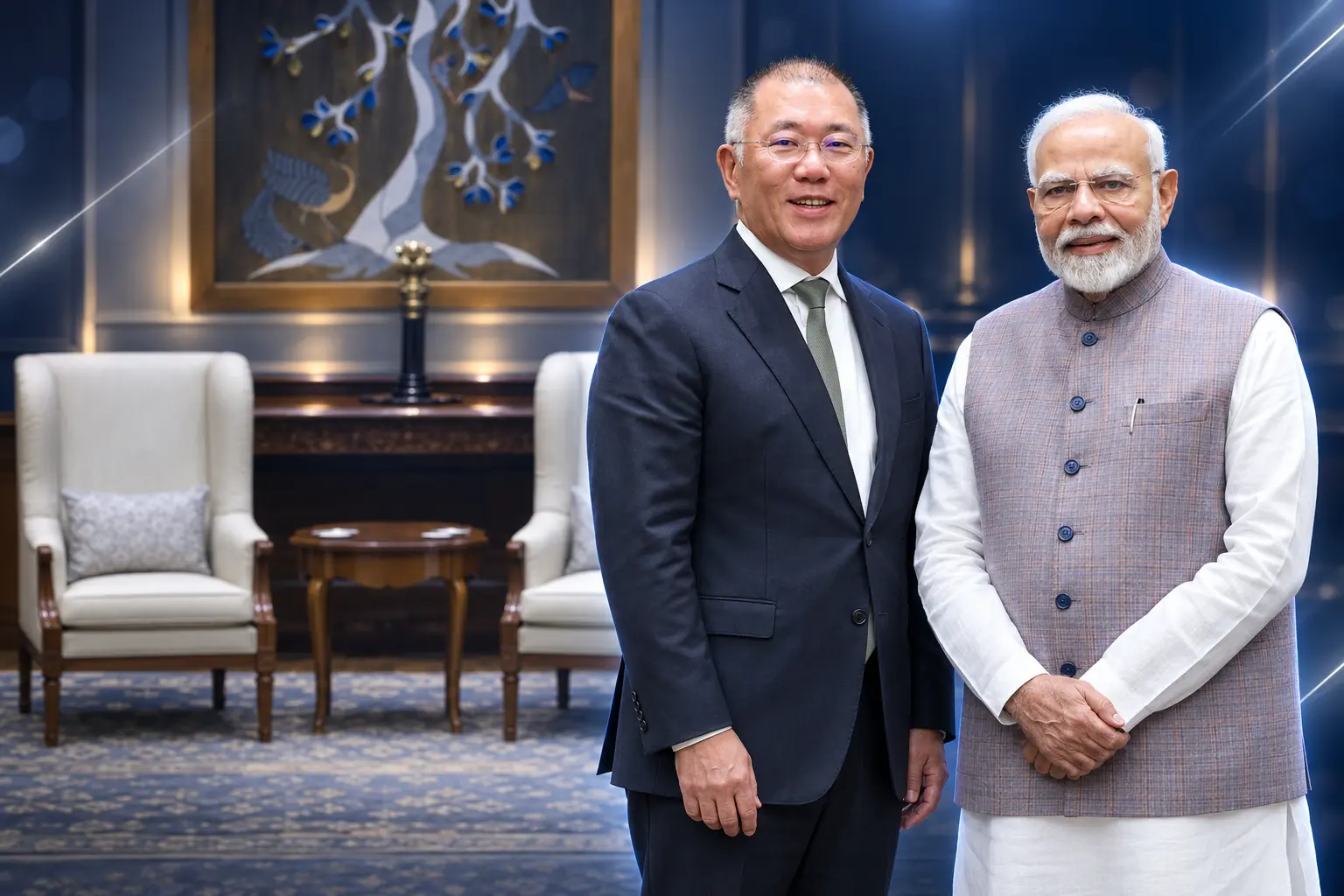
Hyundai Motor Group pledged USD 15.5 billion from 2026 through 2032 after Executive Chair Euisun Chung met Prime Minister Narendra Modi in New Delhi on October 13. The seven-year sum covers Hyundai and Kia plants, a bigger Indian research centre, local parts partners, and new mobility lines.
The cheque arrives after a lost rank. Hyundai Motor India was the only top-four passenger-vehicle maker to post a domestic sales drop in FY26, finishing fourth behind Maruti Suzuki, Mahindra and Tata Motors. Shares of the listed India unit still rose more than 2 percent on October 14.
Hyundai Motor Group Stakes $15.5 Billion Through 2032
Chung used the Prime Minister’s Office to put a 30-year clock on a market the group entered in 1996. He said the past three decades had been defined by that commitment, and that the new spend “reaffirms our commitment to India for the next 30 years and beyond.”
India remains one of Hyundai Motor Group’s most important and strategic markets globally. The past 30 years have been defined by our commitment to India. This investment reaffirms our commitment to India for the next 30 years and beyond. Through this investment, we will create more employment opportunities and work together with our partners and stakeholders to support India’s continued industrial development.
Euisun Chung, Executive Chair, Hyundai Motor Group
The plan is a group plan, not a Hyundai Motor India plan. Kia India is inside the envelope, and so are parts partners, labs, and side businesses the group does not run as car plants. India is already a critical platform for the group’s mid-to-long-term mobility strategy, and this figure is meant to lock that in.
THE FOUR SPEND BUCKETS
- Car plants: Expand capacity at Hyundai Motor India and Kia India so India can take higher domestic volume and more exports.
- Labs: About $700 million for the Indian research centre, including a vehicle test track, plus local engineering staff.
- Parts partners: Put money into regional suppliers so more components are made in India and the chain is less import-heavy.
- New lines: Look at auto finance, EV charging, end-of-life recycling, startups, and mobility services tied to the vehicle business.
The group already employs more than 24,000 people in India and said the programme would add jobs in plants, labs, engineering and the supplier net. It did not publish a hiring number. A Hyundai Academy for Technical Skills is planned in Chennai.
The New India Vehicle Will Steer Plants, Labs and Parts
To run the programme, the group will set up a dedicated investment entity in India. That vehicle is supposed to coordinate capital, find local partners, and back supplier deals, rather than leaving each plant and affiliate to spend on its own clock.
That structure is the tell. A single India cheque of this size, spanning two car brands and a parts hunt, is harder to execute as a string of factory MoUs. The entity also lets Seoul talk to New Delhi in one voice after Chung sat with Modi.
WHAT WE KNOW
- The ceiling: $15.5 billion is the group figure for 2026 through 2032, covering Hyundai, Kia and the wider spend list above.
- The R&D slice: About $700 million is earmarked for the Indian research centre and its test track.
- The headcount now: More than 24,000 people work for the group in India, with no figure given for net new jobs.
- The export aim: Extra plant space is meant to make India a leading export base for the group, not only a local showroom market.
WHAT IS UNCONFIRMED
- The split: The group has not said how much goes to Hyundai Motor India, how much to Kia India, and how much to suppliers or new businesses.
- The increment: It has not said how much of the $15.5 billion is fresh cash versus plant money already pledged for Chennai and Pune.
- A third plant: The October 13 release names no new site and no extra capacity total, even though a third location has been discussed in the market.
- The $700 million overlap: The release does not say how that R&D slice sits against an earlier Telangana research-centre proposal.
Until those four blanks are filled, $15.5 billion is a ceiling Chung is willing to defend in public, not a line-item budget. The dedicated entity is how he wants that ceiling managed on the ground.
Why Hyundai Slipped to Fourth in India
Hyundai Motor India lost a rank it had held for years, and it lost it to two Indian SUV houses at once. Full-year domestic wholesale declarations for FY26 put Mahindra at 660,276 utility vehicles, up 20 percent from 551,487, and Tata Motors Passenger Vehicles at 631,387 units, up 14 percent from 553,585. Hyundai’s domestic tally fell 2.3 percent to 584,906 units from 598,666, the only contraction among the top four.
FY26 DOMESTIC WHOLESALE, THREE-WAY FIGHT
| Brand | FY26 units | FY25 units | Change |
|---|---|---|---|
| Mahindra | 660,276 | 551,487 | +20% |
| Tata Motors | 631,387 | 553,585 | +14% |
| Hyundai | 584,906 | 598,666 | -2.3% |
Mahindra’s lead over Hyundai is 75,370 units. Tata’s lead is 46,481. Those gaps would have looked implausible two years ago. Maruti Suzuki stayed well out in front; the fight that changed Hyundai’s standing was the one for second.
The mix explains more than the marketing. Mahindra sells only SUVs in the domestic passenger market, and the Scorpio-N, XUV700, Thar and Thar Roxx carried the year. Tata’s rise was broader: hatchbacks, SUVs, CNG and electric, with EV volumes up 43 percent to 92,120 units. Hyundai still fields hatchbacks, sedans and SUVs, but that spread did not grow in a market that has tilted toward utility vehicles.
The January-March quarter made the split sharper. Tata sold 198,743 units in Q4, up 36 percent, and outsold Mahindra’s 183,800. Hyundai’s 166,578 units were its highest domestic quarter, up 8.5 percent, and still third of the three. Hyundai led passenger-vehicle exports in FY25 with 163,386 units, yet that overseas flow did not cover the domestic loss.
The passenger-car market itself is not the drag. Industry body SIAM recorded 439,000 units in August, 36 percent higher than a year earlier. Chung is betting into a rising market in which two Indian brands have already learned to sell the body style buyers want.
Three Indian Plants Already Hold 1.425 Million Units
The group’s Indian factories are already large. Hyundai’s Chennai works are rated at 824,000 units a year, the Pune plant at 170,000, and Kia’s Anantapur plant at 431,000. Added up they are 1,425,000 units, which the group describes as more than 1.4 million. Pune is the former General Motors site at Talegaon, and it is still being scaled.
CURRENT GROUP CAPACITY IN INDIA
| Plant | Brand | Annual units |
|---|---|---|
| Chennai | Hyundai | 824,000 |
| Pune (Talegaon) | Hyundai | 170,000 |
| Anantapur | Kia | 431,000 |
| Combined | Group | 1,425,000 |
Hyundai Motor India’s manufacturing office has already mapped a Talegaon rise from 170,000 vehicles toward 250,000 units a year by 2028. The October 13 group release only says Pune will be scaled in phases. Kia has been studying extra Anantapur space; that line is not in the new pledge either.
Local plants are not optional. India is the world’s third-largest car market after China and the United States, and import tariffs can run from 70 percent to 110 percent, so a company that wants volume has to stamp metal in the country. In 2025, Hyundai and Kia together sold 852,164 vehicles in India for an 18.7 percent passenger-vehicle share, second behind Maruti Suzuki. That is the group standing. The brand standing is the fourth-place FY26 finish above.
Hyundai Motor India listed in 2024 and raised $3.3 billion, then the largest IPO in the country. The $15.5 billion is a different instrument: a seven-year group ceiling, announced beside the prime minister, covering two brands and the supplier hunt. It is also several times the IPO cash, if the ceiling is spent in full.
Maruti Suzuki’s ₹77,500 Crore Plan Sets the Bar
Chung is not the first chair to put a long-dated cheque on India this year. Maruti Suzuki India managing director Hisashi Takeuchi told the company’s 45th annual general meeting on August 31 that Maruti plans ₹77,500 crore of capital spending from FY27 through FY31. FY27 alone is budgeted at ₹14,000 crore, up from about ₹10,000 crore the prior year.
The two figures are not twins. Maruti’s rupee plan is five years, one listed Indian company, and a mix of capacity, new models, labs, plant upkeep, sales kit, carbon work and logistics. Hyundai’s dollar plan is seven years, two Korean brands plus parts and side businesses, and a political meeting. One is a market leader defending a small-car base and adding SUVs. The other is a group that just lost second place and is writing a larger, wider cheque.
Takeuchi also said Maruti would bring 10 new SUVs in five years. Hyundai Motor India chief executive Tarun Garg has pointed to an upgraded Verna and Exter as FY27 levers. Those are not the same class of answer. The Korean group’s $15.5 billion can fund a lot of metal. It cannot, by itself, design the SUV that takes share off a Scorpio-N or a Nexon.
Parts Makers Stand Closer to This Cash Than Dealers
A lot of the public noise treated the pledge as a win for Hyundai and Kia showrooms. The more direct cash path runs through components. The dedicated entity’s stated job is to find Indian partners and raise local content, and the group already operates parts and service arms here through Hyundai Mobis, Hyundai Transys, Hyundai Wia, Hyundai Capital and Hyundai Glovis.
That is why a seven-year localisation drive is a different story from a new hatchback. Precision parts, electronics, wiring, seats, castings and transmissions are where extra volume shows up first if the entity does what the release says. Dealers feel it later, if at all, and only if the cars those parts go into actually gain share.
The calendar is seven years, not five, even if some posts compressed it. Spending starts in 2026 and is dated through 2032. Anyone reading the number as a near-term volume spike is ahead of the plants, the entity, and the product cadence Garg still has to prove.
Cheer that Hyundai and Kia will now run Indian roads also runs into the FY26 board. Combined capacity of 1,425,000 units did not stop Mahindra and Tata from passing Hyundai on domestic wholesale. The group’s 18.7 percent share in 2025 still sat behind Maruti. The money is a response to that math, not a victory lap around it.
A 30-Year Pledge Still Has to Win the SUV Lane
Chung’s political bet is clear. He sat with Modi, promised 30 more years, and put $15.5 billion on plants, labs, local parts, charging, finance and recycling. The industrial bet is narrower. Hyundai has to sell more of the vehicles Indian buyers are already taking from Mahindra and Tata, while Kia grows beside it, without a published split of the cash.
Pune is still climbing off 170,000 units. Anantapur’s extra line is still a study. No third factory was named on October 13. Garg’s named FY27 tools are a Verna refresh and an Exter refresh in a market that rewarded pure SUV houses and a multi-fuel Tata. The dedicated entity has not been formed, and the group has not said when it will be.
The $15.5 billion is the ceiling Chung is now on the record for. How much of it is new, which brand gets which rupee, and which model takes back the 75,370 units Mahindra already owns, are the questions the next product cycle has to answer.
Disclaimer: This article is news reporting and analysis of a corporate investment announcement and related vehicle-sales figures. It is for information only and does not constitute investment advice, a recommendation to buy or sell any share, or guidance on how to allocate capital in auto stocks or supplier firms. Readers who are considering securities of Hyundai Motor India, Hyundai Motor, Kia, Maruti Suzuki, Mahindra, Tata Motors or related parts makers should consult a qualified registered investment adviser or broker. Figures, ranks, plant ratings and programme details reflect the company statements and sales declarations cited here as of the dates given and can change as later filings, capacity updates and monthly wholesale numbers are published.

Bulk Scotch Still Faces Full Duty After India’s UK Deal

Typhoon Champi Loops Off Taiwan and Still Injures 527

PM Modi Opens Chinmaya’s AI Guru and Asks for Unity

Mahim Police Hold a JeM Suspect on Enmity Charges

Gold Falls Below $4,000 as Hormuz Oil Hits $117

The iPhone 18 Pro Max Splits Apple’s Fall in Two

OpenAI Calls GPT-6 Astra AGI Then Locks Its Exploits

Clancy Juror Says the Holdout Never Cited Evidence

Trump Claims Hormuz Control as Oil Holds Near $96

Russia Closes the Goethe-Institut Berlin Tried to Save

 NEWS2 months ago
The iPhone 18 Pro Max Splits Apple’s Fall in Two
- NEWS2 months ago
OpenAI Calls GPT-6 Astra AGI Then Locks Its Exploits
- NEWS1 month ago
Clancy Juror Says the Holdout Never Cited Evidence
- BUSINESS2 months ago
Trump Claims Hormuz Control as Oil Holds Near $96
- LIFESTYLE2 months ago
Russia Closes the Goethe-Institut Berlin Tried to Save
- AUTO2 months ago
Volkswagen’s Job Cuts Leave Four Plants Without Cars
- NEWS2 months ago
Dyson Puts Nurovi Robots on Sale Without the UV Flagship
- NEWS2 months ago
The Lincoln’s 286-Day War Cruise Ends at a Thai Pier