
NEWS
Mecca Pact Binds Saudi Pakistan Turkey Into Untested Deterrence Layer
The Mecca Joint Defence Agreement commits Saudi Arabia, Pakistan and Turkiye to treat an attack on one as an attack on all.

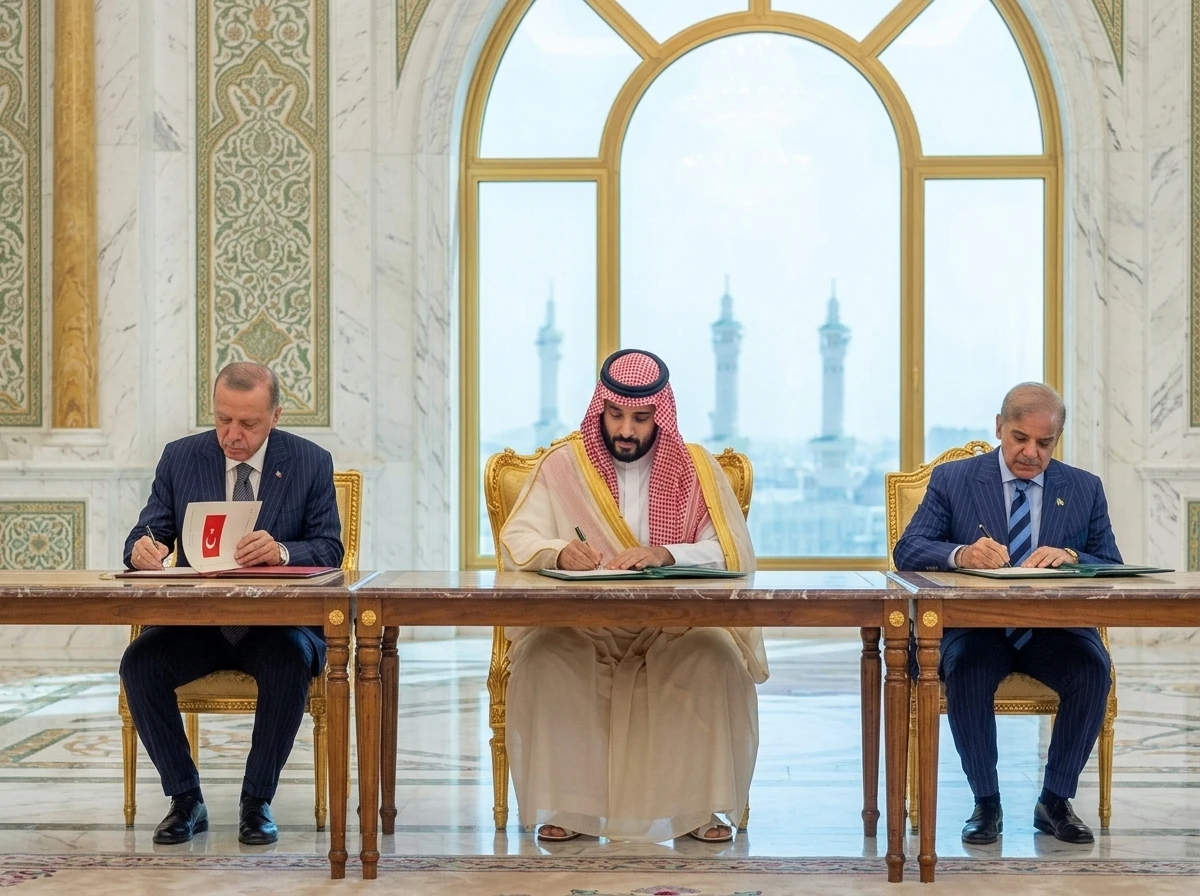
Saudi Arabia, Pakistan and Turkiye signed the Mecca Joint Defence Agreement on August 7, committing that any armed attack on one shall be regarded as an attack on all three. The move deepens long-running military ties at a moment of missile and drone strikes on Gulf targets and open questions about the old American security cover.
Leaders Crown Prince Mohammed bin Salman, President Recep Tayyip Erdogan and Prime Minister Shehbaz Sharif sealed the pact at Al-Safa Palace after a summit in Islam’s holiest city. The full text remains private, but the public clause and the setting give it weight far beyond a routine communique.
What the Leaders Put on Paper in Mecca
The official joint statement from the summit frames the deal as guided by historical ties, Islamic solidarity and shared strategic interests. It states the agreement is intended to strengthen collective deterrence against any act of aggression. It further provides for the enhancement of all aspects of defence cooperation among the three states.
Pakistan’s Foreign Ministry underlined the collective clause in nearly identical language. Saudi deputy minister for public diplomacy Rayed Krimly stressed on X that the pact “does not represent any intention to build a military axis or a sectarian/religious bloc” and is “not linked to nuclear ambitions or an arms race, but rather to building sustainable, self-reliant capabilities.”
Erdogan described it as based on collective deterrence while pledging continued diplomacy and respect for international law. Sharif called it a historic endeavour serving the interests of the three homelands and regional stability. The agreement does not supersede existing bilateral arrangements, according to a Turkish official.
- Core trigger: armed attack on one treated as attack on all
- Scope: all aspects of defence cooperation to be enhanced
- Framing: defensive, open in principle, not directed at a named party
- Symbolism: signed in Mecca after Umrah by the Pakistani delegation
Specific force commitments, decision timelines and thresholds for activation stay unpublished. That gap already shapes how analysts read the document. Without those details, capitals and outside observers are left to judge the pact by political signals, prior bilateral habits and whatever joint activity follows the signing.
The public framing still matters. Leaders chose language that stresses deterrence and cooperation while ruling out an axis, a sectarian bloc or a nuclear storyline. That choice sets the terms of debate even while the operational annexes remain closed.
The Year of War That Made the Summit Inevitable
The signing sits inside a conflict that began on February 28 2026 when the United States and Israel struck Iranian targets. Iran and its partners, including Houthis in Yemen and Shia groups in Iraq, answered with repeated strikes on Saudi Arabia and other Gulf states. Oil exports and Vision 2030 projects came under direct pressure.
Just hours before the Mecca ceremony a senior Saudi official told reporters the kingdom was bracing for fresh attacks from Yemen and Iraq. Pakistan had already moved several thousand troops plus aircraft, drones and air-defence systems into Saudi Arabia earlier in the year. Turkiye and Pakistan, less exposed to direct fire, still faced economic spillover and wider instability risks.
- February 28, 2026: US and Israeli strikes open the Iran war phase
- Months following: Iranian and proxy missile and drone attacks hit Saudi and Gulf targets, disrupt shipping
- September 17, 2025: Saudi Arabia and Pakistan sign their bilateral Strategic Mutual Defence Agreement
- Nearly a year of talks: trilateral negotiations build toward Mecca
- August 6-7, 2026: Sharif and army chief Asim Munir arrive, perform Umrah; Erdogan flies in; pact signed
The sequence turned longstanding bilateral habits into a public trilateral framework. The recent US strikes and Hormuz tensions kept the urgency high right up to the signing day.
Pressure on energy exports and flagship development projects gave Riyadh a concrete stake in wider deterrence. Islamabad’s earlier troop and systems deployments showed the bilateral channel was already active under fire. Ankara’s entry then widened the political and industrial base without waiting for the crisis to cool.
Three Complementary Toolkits Under One Clause
Each partner brings a distinct set of assets that the others lack in full. Al Jazeera’s Osama Bin Javaid noted the pact “essentially puts three of the largest Muslim populations together” and begins a “different security architecture.” Pakistan supplies a battle-hardened force, munitions pipelines and the only nuclear arsenal in the Muslim world. Turkiye brings advanced drones, munitions systems and NATO membership. Saudi Arabia supplies finance, energy leverage and the religious-political weight of the Two Holy Mosques.
| Country | Primary assets in the mix | Prior links highlighted |
|---|---|---|
| Saudi Arabia | Oil revenues, funding capacity, holy sites legitimacy | Decades of Pakistani training and technical support for its forces |
| Pakistan | Conventional forces, combat experience, nuclear capability | Troop and system deployments already inside the kingdom; 2025 SMDA |
| Turkiye | Drone and defence industry, large NATO army, training exchanges | 2023 largest-ever drone export deal to Riyadh; warship and aircraft swaps with Pakistan |
Defence analyst Mansoor Ahmed of the Australian National University said Pakistan’s nuclear posture remains oriented toward India and that the pact is better read as a framework for regional security and defence-industrial cooperation than a NATO carbon copy. Still, the political shadow of that arsenal travels with every mention of the deal.
The mix is complementary on paper because no single partner holds the full stack. Finance without platforms is limited. Platforms without sustainment budgets stall. Combat experience without industrial depth is hard to scale. The clause gathers those pieces under one political roof; the work of combining them remains ahead.
Hedging the Fraying American Cover Without a Rupture
For Riyadh the second-order move is diversification. Years of conflict raised hard questions about whether the longstanding US security umbrella still opens on demand. The kingdom has not walked away from Washington. It has layered a parallel arrangement on top of it.
Michael Kugelman of the Atlantic Council called the trilateral alliance a logical outgrowth of deepening ties and said its focus on collective regional deterrence with an eye to Iran would be received well in Washington, which wants more burden-sharing from top allies. The pact therefore functions as both insurance and a signal that Gulf states will build their own options.
That same logic explains why nuclear language was publicly shut down. Parallel Saudi nuclear discussions under Congress review already generate scrutiny. Officials moved quickly to separate the Mecca document from any arms-race narrative. The real work sits in training, joint exercises, intelligence sharing, technology transfer and defence-industrial projects that Erdogan flagged as possible implementation paths.
Layering does not require a break. It requires enough political space to train, procure and plan with additional partners while older channels stay open. The public insistence on a defensive, non-sectarian reading is part of protecting that space.
Skeptics Already Ask Whether the Trigger Will Fire
Iranian lawmaker Ebrahim Rezaei dismissed the document on X as a paper agreement that would not deliver security any more than years of reliance on the Americans had. “Reform your policies so that you do not need to beg for security from others,” he wrote.
If Saudi Arabia were attacked by Iran tomorrow (entirely plausible), I doubt Riyadh would truly expect Ankara and Islamabad to treat it as an attack on them.
H.A. Hellyer of the Royal United Services Institute made that point on X. The skepticism is structural. Collective defence clauses look clean on signing day and turn messy once proxies, ambiguous attribution or distant geography enter the picture. Pakistan already carries the 2025 bilateral obligation; adding Turkiye multiplies coordination demands.
- Proxy fire and unclear attribution complicate any automatic reading of the trigger
- Geography and differing threat exposure slow joint political decisions
- The 2025 bilateral duty already binds Pakistan; a third capital adds clearance steps
- Public expectations can outrun what unpublished thresholds actually require
Crowd reaction on X split along similar lines. Some accounts tallied combined troop numbers, aircraft, tanks and warheads and framed the pact as Ummah deterrence. Others noted that earlier Saudi-Pakistan language did not stop Iranian drones and called the new text symbolic until proven. Those conflicting readings are now part of the information environment the three governments must manage.
Where the Pact Can Grow Beyond the Clause
Al Jazeera’s Resul Serdar Atas reported from Ankara that while the deal is purely defensive, such agreements open doors in other sectors. Expectations there include boosted economic ties with Riyadh and Islamabad. Abdulaziz Alghashian of the Gulf International Forum described the formula as merging deterrence and diplomacy to move the region toward stability. Retired Pakistani Major-General Zahid Mahmood said the three would collectively approach regional challenges.
The industrial channel looks concrete. Turkiye’s defence exports have surged in recent years; the 2023 drone contract with Saudi Arabia was already its largest at the time. Pakistan and Turkiye exchange platforms and training. Saudi capital can fund joint production, maintenance hubs and technology offsets. None of that requires the automatic trigger to fire. It only requires political trust and budgets.
- Joint production lines and maintenance hubs funded by Saudi capital
- Technology offsets tied to existing drone, warship and aircraft links
- Expanded training exchanges building on Pakistani and Turkish practice
- Intelligence sharing and exercises that Erdogan listed as implementation paths
The September 2025 bilateral Saudi-Pakistan pact already converted decades of informal cooperation into written mutual defence. Mecca simply widened the circle and raised the public profile. Possible expansion talk has included Egypt in earlier ministerial discussions, though nothing has materialized.
Diplomacy Stays on the Table Beside Deterrence
Erdogan’s public pledge of continued diplomacy and respect for international law was not a side note. It sits beside the collective clause as a second track the three governments can use without waiting for an activation test. Alghashian’s reading of the formula as deterrence merged with diplomacy points the same way: the pact is meant to steady the region, not only to answer fire.
That dual track also helps explain the careful public language from Riyadh. Krimly’s rejection of an axis or sectarian bloc keeps diplomatic room open with partners who would bristle at either label. A defensive frame is easier to defend in third capitals than a project that sounds like permanent alignment against a named rival.
Collective approaches to regional challenges, as Mahmood described them, can therefore run through quiet coordination and industrial projects long before any capital has to decide whether a given strike meets the unpublished threshold. The clause is the headline. The daily work is the quieter track.
Early Tests Will Decide if Paper Becomes Practice
Saudi Arabia continues to face the threat of strikes from multiple directions. The new clause now sits on the table the next time intelligence points to imminent fire. How the three capitals consult, what they say publicly, and whether any joint posture appears will set the precedent faster than any communique.
Washington gains a partner network that can absorb more of the regional load, yet loses some exclusive leverage. Tehran faces a thicker political-military wall without a clear new adversary to name. Israel’s normalization track with Riyadh looks more distant for now. India watches the nuclear-adjacent language carefully even as officials insist the posture remains India-focused.
The Mecca Joint Defence Agreement does not rewrite the map overnight. It formalizes a second layer of security cooperation that the three states can deepen through industry, training and quiet coordination whether or not the attack clause is ever invoked. That layer is the part that will still be operating long after the current crisis cycle turns.

-
 TECH1 year ago
Where Garmin Watches are Made and How They are Assembled
-

 AUTO3 months ago
Tesla’s Roadster Is ‘a Few Weeks Away,’ Says Its Chief Designer
-
 NEWS10 years ago
Samsung Releases Galaxy Note7 TV Ad as Reddit AMA Leaks Specs
-
 NEWS10 years ago
Android 7.0 Nougat Rolls Out To Nexus Devices With New Emoji, Features
-
 FINANCE9 years ago
Cardano Price Surges as ADA Enters the Crypto Top Ten List
-
 NEWS10 years ago
Pre-Order the First Camera Made for Facebook Live Streaming Video
-
 FINANCE1 year ago
Binance Suspends Trading and Withdrawals for a System Upgrade
-
 FINANCE9 years ago
RChain Price Jumps Nearly 150% to a New All-Time High of $2.03