
NEWS
Meta Child Trial Echoes Tobacco Playbook States Used Before
States open Meta trial seeking addictive-design penalties and app changes, recycling the 1998 tobacco settlement model that curbed youth marketing and.

A bipartisan coalition of 29 U.S. states opened its federal case against Meta Platforms on August 18, 2026, in Oakland, accusing the company of designing Facebook and Instagram to hook children, collecting data from kids under 13 without consent, and misleading the public about the risks. Prosecutors want design overhauls plus penalties they put near $200 billion; Meta calls the figure closer to a theoretical $1.4 trillion and the claims unsubstantiated.
California Deputy Attorney General Megan O’Neill told the eight-person jury the business model was simple: “hook the users, hold them for as long as they can, harvest their data, and then hide the truth from the public.” It worked especially well on kids, she said.
The filing lands more than three years after the coalition first sued. Oakland is the venue where the four lead states will try to turn that 2023 complaint into findings the judge can convert into lasting product rules and civil penalties.
Opening day sets the core charges
Four lead states, California, Colorado, Kentucky and New Jersey, are trying the case for the group that first sued in 2023. They allege three main violations: deceptive public statements about safety for minors, features built to drive compulsive use (including time-limit tools that are easy to bypass), and illegal gathering of data on children under 13 under the Children’s Online Privacy Protection Act.
Those tracks run in parallel. Deception goes to what the company told the public. Design goes to how the apps keep young users scrolling. The COPPA count goes to whether Meta collected data from children it should never have had on the service without parental consent.
Colorado Attorney General Phil Weiser said the states stepped in where Congress did not. In a pre-trial statement he wrote that Meta knew its platforms could harm young people, yet kept practices that sacrificed sleep, school focus and, in some cases, led teens to consider suicide because more time online meant more money.
Meta has built their business around addictive feeds and features that put children’s mental health at serious risk.
New York Attorney General Letitia James, part of the wider coalition, released that line on the trial’s first day. Meta’s lawyer Paul Schmidt told jurors there is no dispute some users have negative experiences, but research shows no clear link between adolescent social media use and reduced well-being. The company, he said, tried to build tools to help and does not succeed if people dislike the service. Meta spokeswoman Liza Crenshaw said the states’ limited claims are unsubstantiated and the financial demands vastly disproportionate; the company has worked with parents, experts and law enforcement.
U.S. District Judge Yvonne Gonzalez Rogers will decide liability. The jury’s verdict is advisory. The trial is scheduled for six to eight weeks.
That split matters for every later remedy fight. The eight jurors can signal what they believe about deception, design and data collection. The judge alone turns those signals into orders the company must live with.
The product changes states want on Instagram and Facebook
Beyond money, the states want the court to force operational fixes. They list elimination of likes and infinite scroll, enforceable time limits for younger users, and tighter blocks that keep children under 13 offline. Meta has said it already offers parental tools and age gates.
| Requested change | States’ rationale | Meta position (from openings and filings) |
|---|---|---|
| Remove likes / public metrics | Drive compulsive checking and social comparison | Features users value; company has tested alternatives |
| End infinite scroll | Removes natural stopping points, extends sessions | Core product design shared across industry |
| Hard time limits for minors | Current tools easy to circumvent | Parental controls and screen-time features already exist |
| Strict under-13 exclusion | COPPA violations via data collection without consent | Age verification industry-wide challenge; company enforces rules |
O’Neill told the jury Meta researched how kids’ brains react to stimuli and treated “teen time spent” as a goal. Internal messages, she said, compared Instagram to a drug and employees to pushers. Schmidt called some language loose and said jurors would hear what those same employees did to improve safety.
Each requested fix aims at a different lever of engagement. Likes and public metrics feed social comparison. Infinite scroll removes the pause that once came at the end of a page. Soft time limits, the states say, fail when a determined minor can bypass them. Under-13 exclusion is the statutory floor the coalition says Meta never truly policed.
Meta’s reply is consistency across the industry and tools already shipped. Parental controls, screen-time features and age gates, in the company’s account, show effort rather than indifference. The court will have to decide whether effort is enough when the states call the same tools easy to defeat.
Arturo Bejar takes the stand first
Former Meta engineering director Arturo Bejar, a safety lead over two stints totaling eight years, was the states’ first witness. Meta tried to bar his testimony days earlier; the judge refused. Bejar has testified in prior cases against the company.
He described a “don’t ask, don’t tell” approach to under-13 users and said safety was often an afterthought when products shipped fast. “Move fast and break things” shaped early culture. On Reels, he said safety was not a consideration at initial deployment.
- Internal surveys vs public metrics: Bejar testified that company surveys of more than 200,000 users found younger people reported higher rates of harmful encounters (bullying, self-harm, violence) for almost every issue. He said Meta’s standard prevalence numbers created a false impression of safety and were far narrower than what users actually experienced.
- Personal stake: He returned to Meta in 2019 after his own 14-year-old daughter received sexual requests and unsolicited explicit images on Instagram and could not easily report them.
- Leadership contact: Bejar estimated he spoke with Mark Zuckerberg at least 100 times and raised concerns with senior leaders including Chris Cox.
He told the court Instagram shifted from a tool people use to “a product that uses you.” Meta disputes the broader case and will cross-examine. Zuckerberg and Instagram head Adam Mosseri are expected to appear later; California Attorney General Rob Bonta would not confirm Zuckerberg’s exact schedule.
Bejar’s value to the states is the mix of inside access and personal motive. Eight years across two tours gave him a view of how safety ranked when launch pressure rose. The account of his daughter’s experience on Instagram supplies a reason the jury can grasp without a technical background. Meta will try to cast his language as selective and his timeline as incomplete once cross-examination begins.
The refusal to bar him also signals how Judge Rogers is managing the proof. Prior testimony in other matters did not keep him off this stand. Jurors will hear the surveys, the leadership contacts and the Reels deployment story in full before the defense gets its turn.
The tobacco settlement that still writes the script
Experts and the attorneys general themselves keep returning to the 1998 Master Settlement Agreement with the major cigarette makers. That deal resolved dozens of state Medicaid suits over health costs and youth targeting. It is the closest historical match for structure and remedies.
Under the MSA, the companies agreed to:
- Pay the settling states an estimated $206 billion over the first 25 years, with annual payments to the Settling States in perpetuity as long as cigarettes are sold by participating manufacturers.
- Stop any action to target youth in advertising, promotion or marketing, including prohibiting tobacco companies from taking any action to target youth.
- Ban cartoons in ads, brand-name merchandise, many event sponsorships, and payments for product placement in media.
- Fund the Truth Initiative and eliminate industry groups that had downplayed risks.
Cigarette consumption fell more than 50 percent between 1998 and 2019. High-school regular smoking dropped from 36.4 percent near its peak in 1997 to 6.0 percent in 2019. The states here seek analogous design limits and civil penalties calculated per violation. Vincent Joralemon of Berkeley’s Life Sciences Law and Policy Center told reporters it really feels like tobacco in the 1990s: the focus is business practices and deception, not just individual harm.
The parallel the states want the court to see is structural. Tobacco’s settlement paired money with lasting limits on how the product could be marketed to the young. The coalition’s ask for likes, scroll, time caps and under-13 blocks is an attempt to write the same kind of rulebook for feeds.
| Benchmark | Figure |
|---|---|
| States’ penalty target in Oakland | Near $200 billion |
| Meta’s theoretical exposure figure | Closer to $1.4 trillion |
| MSA payments, first 25 years | Estimated $206 billion |
| Tobacco payments under various settlements | Well over $176 billion |
| New Mexico teen mental-health fund order | $567 million |
| Los Angeles verdict (Meta and Google) | $6 million |
Tobacco companies have paid well over $176 billion under the various settlements. Meta’s market value sits near the high end of the theoretical penalty range the company itself floated, which is why the stock closed down 4.4 percent on the first day at $543.67.
Joralemon’s point tracks the opening arguments. O’Neill framed a business model. Schmidt framed disputed science and existing tools. The tobacco story gives the states a finished example in which practice-and-deception claims, once locked in, outlasted any single damages check.
Who carries the cost if the states prevail
A large penalty would hit Meta’s cash and capital returns. Forced removal of engagement features would touch the core advertising model that depends on time spent and data. Competitors facing parallel suits, TikTok, Snap, YouTube, would watch the remedies closely; this is the first federal trial in a larger wave of state, school-district and individual cases.
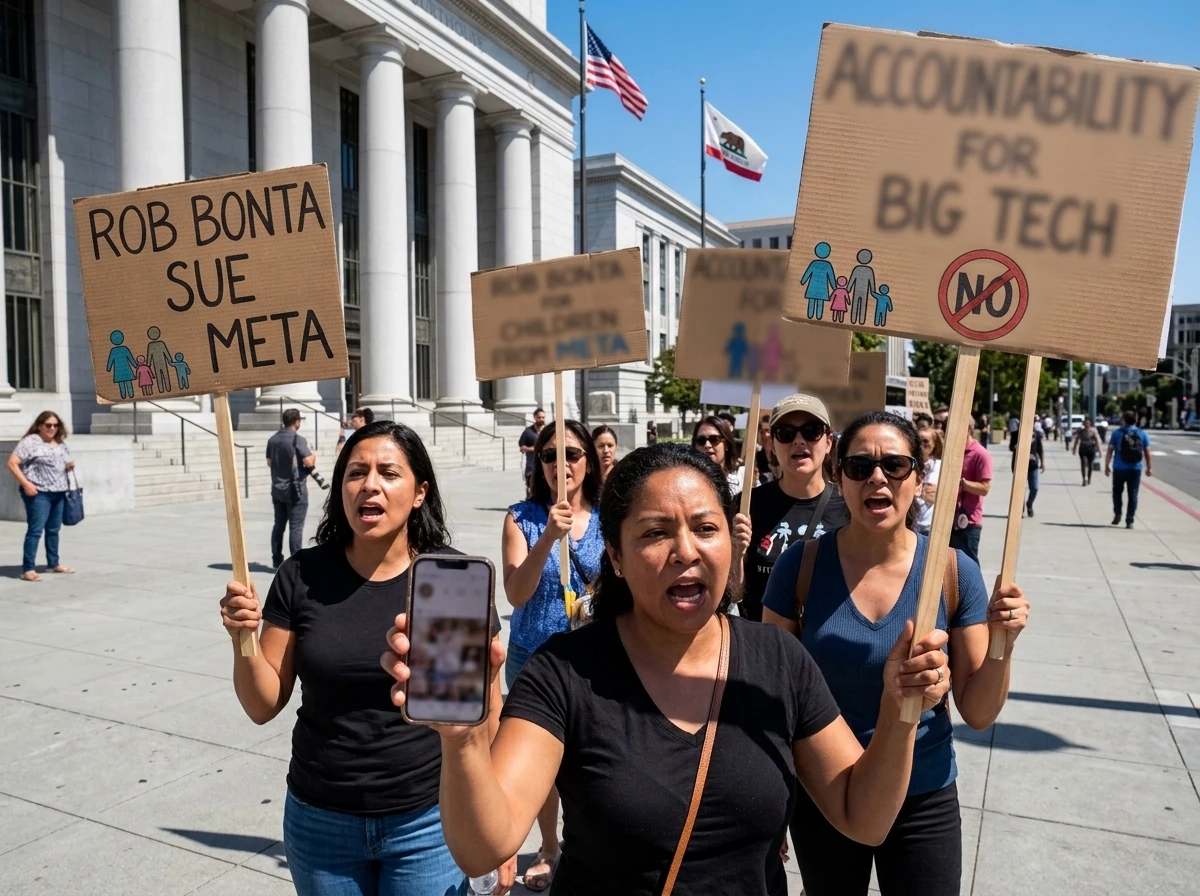
Parents who lost children to suicide or predation rallied outside the courthouse. Lori Schott said Zuckerberg and Mosseri built one of the most powerful companies in the world, but power does not excuse harm. Mary Rodee, whose 15-year-old son died by suicide in 2021 after predation on Facebook, called the outcome the predictable result of a system that protects corporations over children.
Meta argues the states offer no proof anyone in their jurisdictions was misled and that they are trying to penalize the company for industry-wide problems such as age verification. The company points to existing safeguards and research collaborations.
Cash and product design are different pressure points. A penalty lands on the balance sheet and on capital returns. A forced change to likes, scroll or time limits lands on the ad engine that prices attention. Rivals have reason to treat every remedy draft as a preview, because the same theories are already live in their own dockets.
The parents outside the courthouse keep the human stakes visible while lawyers argue models and metrics. Schott and Rodee name executives and describe loss in plain terms. Their presence does not decide liability. It frames why the coalition says the case belongs in a public courtroom rather than a private settlement room.
Related verdicts already on the books
- March 2026: A Los Angeles jury ordered Meta and Google to pay $6 million to a young woman who said she became addicted to Instagram and YouTube as a child.
- August 2026 (earlier this month): A New Mexico judge ordered Meta to pay $567 million into a teen mental-health fund after that state’s attorney general labeled the platforms a public nuisance.
- Ongoing: Tennessee’s attorney general is trying a similar Instagram case in Nashville. Thousands of individual and municipal suits remain in the pipeline.
The path from those smaller orders to Oakland is one of scale. Los Angeles tested addiction claims in a single-plaintiff frame. New Mexico tested a public-nuisance theory and a nine-figure fund. Tennessee is running a parallel Instagram theory in state court. Oakland is where 29 states ask a federal judge for design rules and a penalty in the same breath.
Penalty Benchmarks Show the Scale
The money fight is already a tale of two ceilings. Prosecutors put the figure near $200 billion. Meta answers with a theoretical $1.4 trillion and calls the demand vastly disproportionate. Both numbers hang over every day of testimony.
Against that backdrop, the tobacco MSA’s estimated $206 billion over the first 25 years sits in the same order of magnitude as the states’ ask. Payments that later climbed well over $176 billion show how a stream tied to ongoing conduct can outlive the original headline. The New Mexico $567 million fund and the Los Angeles $6 million verdict mark the lower rungs the coalition has already climbed in other courts.
First-day trading gave a market read. Shares closed down 4.4 percent at $543.67 after the openings. Investors priced the risk that either a large check or a hard product rule could land once Judge Rogers rules.
Meta’s fairness argument turns on proof and proportion. The company says the states have not shown anyone in their jurisdictions was misled and that age verification is an industry-wide problem. The coalition’s answer is the per-violation math and the design list already on the table.
Judge Rogers Holds the Final Call
The eight-person jury will be heard. It will not have the last word. Judge Yvonne Gonzalez Rogers decides liability, and any lasting order on likes, scroll, time limits or under-13 access will carry her signature.
That structure shapes trial strategy on both sides. The states must persuade jurors who can only advise, then translate that advisory signal into findings the judge will adopt. Meta must blunt the narrative for the jury while building a record for the bench on science, tools already shipped and the limits of what a single company can fix alone.
The calendar is compact. Six to eight weeks is the scheduled window. Zuckerberg and Mosseri are expected later in the slate, though Bonta would not lock the exact dates. Bejar’s turn came first because the states wanted an insider account of culture, surveys and product launches on the record early.
Kentucky Attorney General Russell Coleman called the Oakland case the largest consumer-protection action of its kind. Size alone does not dictate the remedy. It does explain why every design proposal and every penalty theory is being watched beyond the Bay Area courthouse.
The Oakland trial is the largest consumer-protection action of its kind. Whether the judge ultimately orders the design changes or a nine-figure-to-hundreds-of-billions penalty, the tobacco precedent shows that once states lock in marketing and product rules, the restrictions tend to stick for decades. The six-week clock is now running.

-
 TECH1 year ago
Where Garmin Watches are Made and How They are Assembled
-

 AUTO3 months ago
Tesla’s Roadster Is ‘a Few Weeks Away,’ Says Its Chief Designer
-
 NEWS10 years ago
Samsung Releases Galaxy Note7 TV Ad as Reddit AMA Leaks Specs
-
 NEWS10 years ago
Android 7.0 Nougat Rolls Out To Nexus Devices With New Emoji, Features
-
 FINANCE9 years ago
Cardano Price Surges as ADA Enters the Crypto Top Ten List
-
 NEWS10 years ago
Pre-Order the First Camera Made for Facebook Live Streaming Video
-
 FINANCE1 year ago
Binance Suspends Trading and Withdrawals for a System Upgrade
-
 FINANCE9 years ago
RChain Price Jumps Nearly 150% to a New All-Time High of $2.03