
FINANCE
Sensex Nifty Rebound Snaps Streak but Oil Shadow Lingers
Sensex rose 628 points and Nifty snapped its longest losing streak in 11 months on Treasury yield relief, though high crude keeps the recovery guarded.

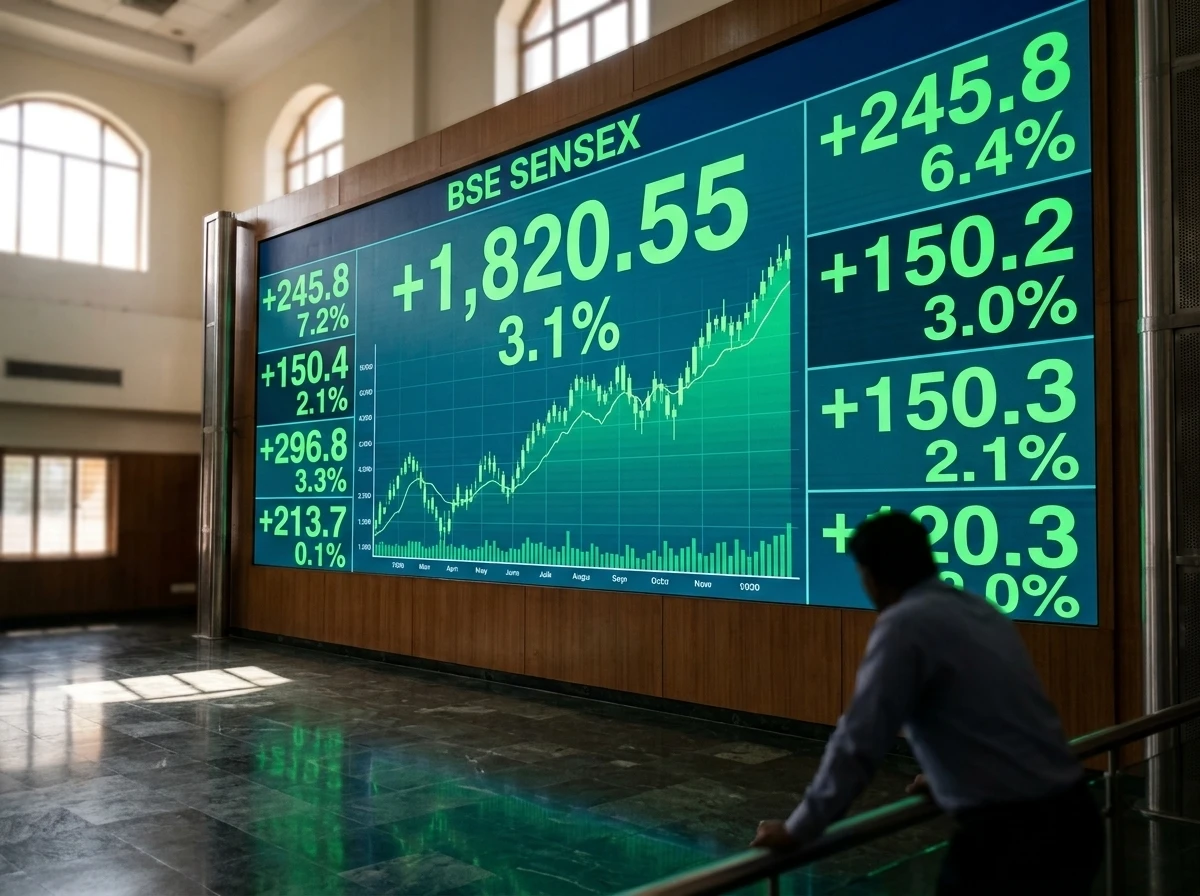
The BSE Sensex jumped 628.04 points, or 0.82 percent, to close at 77,537.72 on Thursday while the NSE Nifty 50 gained 153.55 points, or 0.64 percent, to 24,231.85, snapping a seven-session losing streak that was the longest in nearly 11 months.
The rebound tracked a global risk-on move after the US Treasury moved to calm long-end bond yields. Fresh foreign buying and strength in IT and financial stocks carried the day, yet Brent crude’s climb to $93.91 kept the mood guarded.
Breadth backed the headline gains. Fourteen of 16 major sectoral indices finished higher, and both mid-caps and small-caps participated. That mix left the session looking less like a narrow blue-chip squeeze and more like a broad relief move after a draining stretch.
What the Closing Numbers and Breadth Showed
Intraday the Sensex had surged as much as 701.43 points to 77,611.11 before settling. Fourteen of 16 major sectoral indices finished higher. Mid-caps rose about 0.4 percent and small-caps advanced 0.7 percent.
| Index / Group | Close | Change | Pct |
|---|---|---|---|
| BSE Sensex | 77,537.72 | +628.04 | +0.82% |
| NSE Nifty 50 | 24,231.85 | +153.55 | +0.64% |
| Nifty IT | – | – | +0.8% |
| Financials | – | – | +0.7% |
| Mid-caps | – | – | +0.4% |
| Small-caps | – | – | +0.7% |
Only chemicals and PSU banks lagged among the majors. The recovery held early gains through the session rather than fading into profit-taking.
Holding the open strength mattered. Recent sessions had seen morning lifts fade by the close. Thursday’s pattern ran the other way: the market kept most of the early pop, and the Nifty finished well clear of Wednesday’s 24,078.30 close.
Small-caps outpacing the Nifty added another layer. A 0.7 percent small-cap advance beside a 0.64 percent Nifty gain suggested the bounce reached beyond the heaviest index names, even if traders still wanted confirmation above nearby resistance.
How the US Treasury Step Shifted Risk Appetite Overnight
The immediate catalyst was the Treasury’s announcement on Wednesday that it would double long-end buyback sizes to at least $4 billion per operation from the prior $2 billion maximum. The change covers the 10-to-20-year and 20-to-30-year nominal coupon sectors and takes effect September 9 through the November 4 refunding quarter.
Thirty-year Treasury yields, which had touched a 19-year high near 5.337 percent earlier in the week, fell roughly 9 basis points. The dollar eased and global equities firmed. Asian markets followed: South Korea’s Kospi rebounded 5.89 percent while Japan’s Nikkei, Shanghai and Hong Kong also closed higher. US stocks had ended the prior session in the green.
Markets found much-needed relief after the US Treasury stepped in to contain the surge in global bond yields, triggering a strong broad-based rebound and ending the domestic market’s week-long losing streak. The intervention has dragged down the dollar, which, along with a firmer rupee and easing yield pressures, boosted attractiveness to EMs.
Vinod Nair, Head of Research, Geojit Investments Ltd
Nair noted that a cooling yield environment supports spending and helped IT and financials lead. Hitesh Tailor of Choice Broking called near-term sentiment “cautiously positive” after the measures eased bond-market stress.
The mechanism is straightforward. Larger long-end buybacks add a bid where duration supply had been pressing yields higher. A roughly 9 basis point drop from a 19-year high near 5.337 percent was enough to ease the dollar, firm the rupee slightly, and reopen the door to emerging-market risk.
That handoff showed up first in rate-sensitive Indian sectors. Banks, NBFCs and IT tend to reprice quickly when global yields retreat and the dollar softens. Thursday’s leadership map matched that script.
Rate-Sensitive Names Led While a Handful Lagged
Among Sensex constituents the biggest winners were Eternal, Kotak Mahindra Bank, ITC, Bajaj Finance, Axis Bank and UltraTech Cement. Eternal also topped Nifty gainers with a rise of roughly 2.2 percent on heavy volume.
- Eternal led index gainers on volume spikes near 2.4 crore shares.
- Gold-loan lenders Manappuram Finance and Muthoot Finance climbed 2.7-3.9 percent as gold prices hit multi-month highs on lower yields and a softer dollar, lifting collateral values.
- Turtlemint Fintech jumped after Jefferies initiated coverage with a buy rating.
- HDB Financial rose on a Morgan Stanley upgrade to overweight.
- Power Finance Corp and REC fell 2.6-2.8 percent after Morgan Stanley downgrades.
Tata Steel, InterGlobe Aviation, HCL Technologies and Titan finished among the laggards. The IT index two-session rise near 2 percent reversed part of a prior three-session drop of about 4 percent.
Broker actions split the financial complex. Upgrades lifted HDB Financial and the Jefferies initiation helped Turtlemint, while Morgan Stanley downgrades weighed on Power Finance Corp and REC. Stock-specific flows therefore cut across the same rate-sensitive tape that the Treasury move had favoured.
Gold-loan names added a collateral channel to the yield story. Lower yields and a softer dollar pushed gold to multi-month highs, and Manappuram Finance and Muthoot Finance rose 2.7-3.9 percent as that lift fed into perceived collateral values.
Crude’s Jump and the Shadow It Still Casts
Brent crude, the global benchmark, rose 2.67 percent to $93.91 a barrel on unresolved US-Iran tensions and fresh supply concerns. That move kept inflation and corporate-margin worries alive even as equities bounced.
- Brent crude: $93.91, +2.67 percent
- Rupee: edged up 0.05 percent to 95.7050 per dollar
- FII/FPI net: +₹407.99 crore on 19 August (combined exchanges)
- DII net: +₹3,973.72 crore the same day
Nair cautioned that stubbornly high oil prices continue to cast a shadow over inflation and profitability. The rupee’s modest firming and the dollar’s pullback helped, but India’s oil-import bill remains sensitive to any further spike.
Foreign Institutional Investors recorded FII net purchases of ₹407.99 crore on Wednesday according to exchange data. Domestic institutions bought far more, continuing a pattern of DII support during the prior selling.
The cross-currents were visible in a single session. Equities could rally on easier yields while crude’s 2.67 percent jump to $93.91 kept the inflation overhang intact. For an oil-importing market, that pairing caps how far relief can run without a softer energy print.
The Seven-Day Slide That Preceded the Snap
The Nifty had fallen for seven straight sessions, losing roughly 2.1 percent in its longest such run in 11 months. The Sensex had declined for four consecutive days before Thursday. Higher oil and rising global bond yields had drained risk appetite through the stretch.
- Seven sessions: Nifty lost roughly 2.1 percent in its longest losing run in 11 months.
- Four sessions: Sensex declined on consecutive days heading into Thursday.
- Wednesday close: Sensex fell 325.78 points, or 0.42 percent, to 76,909.68; Nifty slipped 76.60 points, or 0.32 percent, to 24,078.30.
- Wednesday catalyst: US Treasury said it would double long-end buyback sizes to at least $4 billion per operation.
- Thursday rebound: Sensex rose 628.04 points to 77,537.72; Nifty gained 153.55 points to 24,231.85.
On Wednesday the Sensex dropped 325.78 points, or 0.42 percent, to 76,909.68 while the Nifty slipped 76.60 points, or 0.32 percent, to 24,078.30. Traders on X noted the market looked oversold, with one options voice pointing to a Nifty put-call ratio near 0.69 and the potential for short-covering once a trigger appeared. The Treasury announcement supplied that trigger.
Hariselvan Radhakrishnan, founder and CEO of HST Wealth, described the Thursday recovery as a decisive shift from the cautious tone of recent sessions, with benchmarks holding early gains all day.
| Session | Sensex | Nifty 50 |
|---|---|---|
| Wednesday close | 76,909.68 (-0.42%) | 24,078.30 (-0.32%) |
| Thursday close | 77,537.72 (+0.82%) | 24,231.85 (+0.64%) |
The two-day swing reversed more than Wednesday’s losses alone. A put-call ratio near 0.69 had already hinted that positioning was stretched; the Treasury step gave shorts a reason to cover into a firmer global tape.
Domestic Buyers Outpaced Foreign Flows Again
Flow data from 19 August underlined who carried the tape through the weak stretch. FIIs bought a net ₹407.99 crore across the combined exchanges. DIIs bought a net ₹3,973.72 crore the same day.
That gap fits the pattern described during the prior selling. Domestic institutions kept supplying bids while foreign flows stayed lighter. Thursday’s rebound still drew fresh foreign buying, yet the heavier DII print shows local support was already in place before the Treasury headline hit.
A firmer rupee at 95.7050 per dollar, up 0.05 percent, and a softer dollar improved the backdrop for both sets of buyers. Easier yield pressure and a steadier currency reduce one source of hesitation for overseas accounts, while DIIs had already been leaning against the seven-day slide.
Even so, scale still matters. A single session of FII purchases near ₹408 crore does not rewrite a multi-day risk-off stretch on its own. Sustained foreign participation will depend on whether yields stay calmer and whether crude stops climbing from $93.91.
Asia Advanced While Europe Stayed Cautious
The overnight risk-on move did not travel evenly across regions. South Korea’s Kospi rebounded 5.89 percent. Japan’s Nikkei, Shanghai and Hong Kong also closed higher. US stocks had finished the prior session in the green.
Europe traded mostly lower even as Asia advanced. That split left the global handoff uneven and warned against reading Thursday’s Indian close as part of a perfectly synchronized worldwide turn.
For India the Asian firmness mattered more in the near term. Local open strength tracked the regional bounce after the Treasury announcement, and the domestic indices then held those gains rather than giving them back into the European hours.
Uneven global leadership also frames the caution still attached to the move. When Asia and the US tape improve while Europe lags, the signal is relief in the zones most sensitive to the overnight yield drop, not a clean bill of health for every risk asset.
Why the Bounce Still Feels Temporary to Many
The buyback expansion is liquidity support, not a change in issuance or fiscal path. It begins only on September 9 and runs through early November. Analysts have already flagged that the relief could prove short-lived if debt-supply concerns or inflation reassert themselves.
For Indian markets the second-order effects matter more than the overnight pop. Lower US yields and a softer dollar improve the relative attractiveness of emerging-market equities and ease some pressure on the rupee. Rate-sensitive sectors such as banks, NBFCs and IT benefit first. Yet India’s twin exposure to imported crude and global risk sentiment means any renewed climb in oil or a re-steepening of the US curve can reverse the flows quickly.
Crowd conversation on X treated the move as a classic relief bounce after an oversold stretch rather than a structural turn. Broader mid- and small-cap strength outpaced the Nifty, a detail some read as healthier internals, while others simply waited for confirmation above nearby resistance before calling the skid fully behind the market.
Europe traded mostly lower even as Asia advanced, underscoring that the global handoff remains uneven. With Brent still near multi-week highs and the Treasury’s larger operations weeks away from starting, Thursday’s green close ends one streak without erasing the constraints that built it.
Calendar risk cuts both ways. Until September 9, the market is trading the announcement, not the larger operations themselves. Any renewed climb in thirty-year yields or another leg higher in Brent can test whether Thursday’s short-covering has further room.
Sector math points the same way. IT’s two-session rise near 2 percent only partly offsets a prior three-session drop of about 4 percent. Financials led on the day, but PSU banks still lagged among the majors, and stock-specific downgrades hit Power Finance Corp and REC. Leadership was real, yet it was not uniform.
The indices closed higher and the seven-day losing run is over. The oil price and the calendar on the buybacks will decide how long the relief lasts.

-
 TECH1 year ago
Where Garmin Watches are Made and How They are Assembled
-

 AUTO3 months ago
Tesla’s Roadster Is ‘a Few Weeks Away,’ Says Its Chief Designer
-
 NEWS10 years ago
Samsung Releases Galaxy Note7 TV Ad as Reddit AMA Leaks Specs
-
 NEWS10 years ago
Android 7.0 Nougat Rolls Out To Nexus Devices With New Emoji, Features
-
 FINANCE9 years ago
Cardano Price Surges as ADA Enters the Crypto Top Ten List
-
 NEWS10 years ago
Pre-Order the First Camera Made for Facebook Live Streaming Video
-
 FINANCE1 year ago
Binance Suspends Trading and Withdrawals for a System Upgrade
-
 FINANCE9 years ago
RChain Price Jumps Nearly 150% to a New All-Time High of $2.03