
NEWS
Modi’s Space Startup Bet Pays Off With Talent Aura Push
After Skyroot’s first private orbital launch and $618 million in investment, PM Modi urges consistency and a talent magnet to lock India’s space hub status.

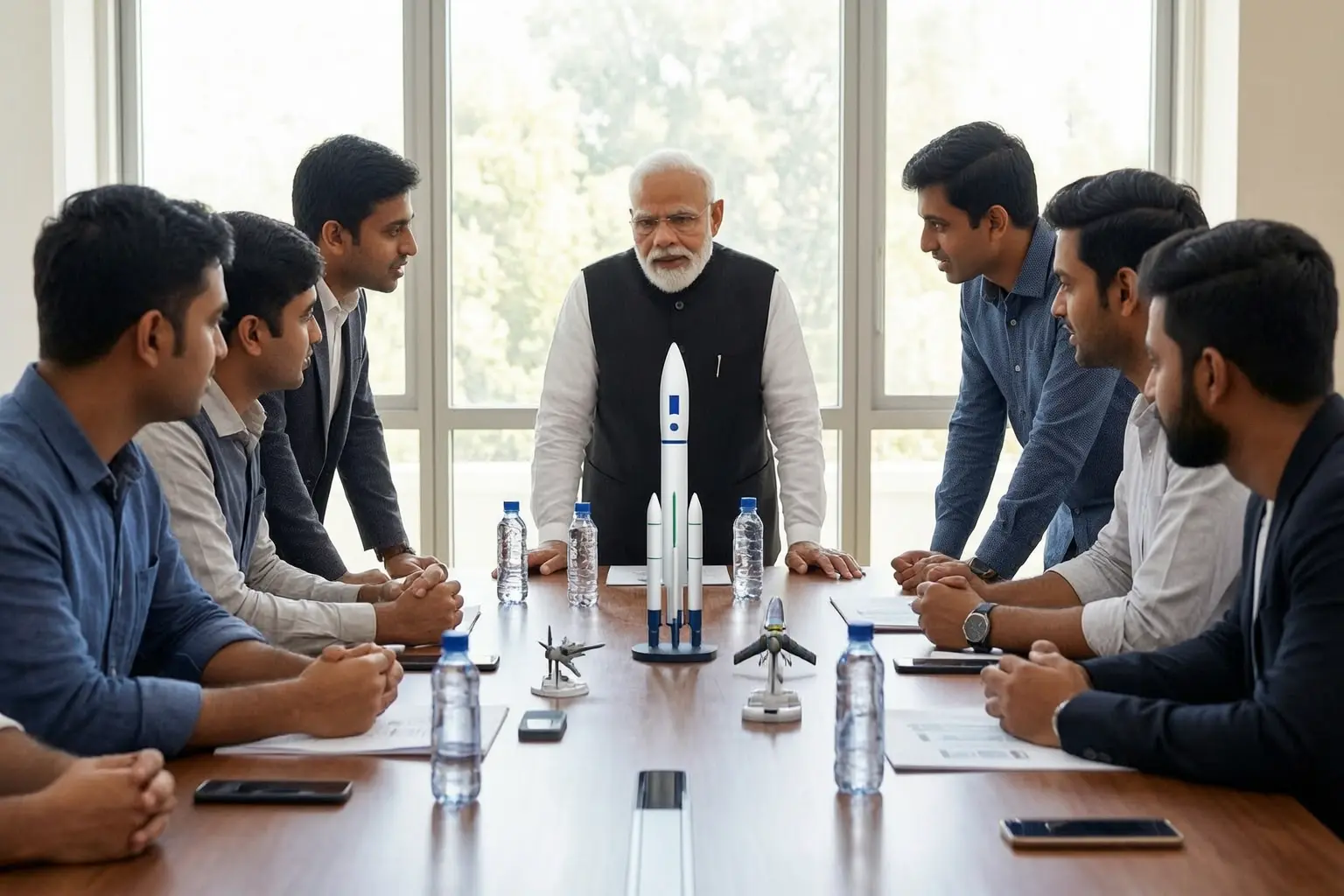
Prime Minister Narendra Modi told founders of 20 private space firms that India can claim its place in the global sector very quickly on cost competitiveness, talent and risk appetite, urging them to build an aura that draws people worldwide to Indian startups and agencies. The Friday interaction at Seva Teerth, with details and video released Sunday for National Space Day, marks the latest step in a bet placed when the government opened the sector in 2020.
That wager is already showing returns. Private investment has climbed nearly six-fold and Skyroot Aerospace flew India’s first privately developed orbital rocket in July. Modi framed the next move as consistency that keeps risk-takers confident and turns early breakthroughs into a lasting magnet.
The meeting tied those three advantages to a single practical ask. Founders who already raised capital and flew hardware were told to keep delivering so that outsiders treat Indian firms as the default place to build careers and place orders. Early contracts after the July flight give that pitch a concrete base rather than a promise alone.
Twenty Founders, One Clear Message on Trust
Modi met CEOs and founders including those from Skyroot Aerospace, Agnikul Cosmos, Pixxel, Dhruva Space, GalaxEye, Bellatrix Aerospace, Digantara and others working on launch vehicles, satellites, propulsion, debris removal, docking, refuelling and in-orbit manufacturing. He thanked them for trusting the government’s word when they entered a new field.
My view has always been that whatever decisions we make, we must remain consistent. We shouldn’t keep changing them constantly; that way, anyone willing to take a risk can feel assured-knowing that if something goes wrong due to their own error, that’s one thing, but no one will abandon them. That is the trust we are striving to build.
Narendra Modi, Prime Minister of India, interaction transcript
He told them the world must now be searching for Indian startups after breakthroughs. “We must create such an aura that people all over the world feel that if they want to build their life, they should come to Hindustan. Join some Indian start-up. Join some Indian space agency,” he said. On X he posted video of the meeting and wrote that he came away impressed by their energy and ambition, asking followers what excites them most about India’s space journey.
Trust, in this framing, is less a slogan than a capital condition. Founders who left safer careers or raised early rounds needed to know the rulebook would not flip mid-flight. Consistency is the mechanism that converts a policy opening into multi-year factory and constellation bets.
The Numbers That Show the Wager Working
Government figures released around National Space Day put India’s space economy at about $9 billion, with a target of $40-45 billion over the next decade. The global industry sits near $600 billion in recent estimates. Private capital has moved fastest.
| Period | Private Investment (USD) | Notes |
|---|---|---|
| 2021-22 | 100.5 million | Baseline after opening |
| 2023-24 | 348.5 million | Cumulative climb |
| By 31 March 2026 | 618.5 million | Nearly six-fold rise |
| 2026 alone | 187 million | Partial-year inflow |
According to the private investment crossing USD 618.5 million reported by Minister of State Jitendra Singh to the Rajya Sabha, active space startups rose from one in 2014 to over 400 (around 440 on the DPIIT portal by August). IN-SPACe had issued 105 authorisations to non-government entities by mid-July, later tallies reaching 113 to 52 entities including 17-18 startups. Private firms have placed more than 30 satellites and flown nearly 45 payloads via platforms such as POEM.
- $9 billion current Indian space economy share
- $40-45 billion target over the next decade
- 440 registered space-tech startups
- ₹1,000 crore Venture Capital Fund plus ₹500 crore Technology Adoption Fund among support tools
The same release notes concessional ISRO facility access, technology transfers and the IN-SPACe Seed Fund. These instruments sit inside the framework set by the Indian Space Policy 2023 guidelines, which opened the full value chain to non-government entities.
Read together, the investment curve and the authorisation count show the same shift. Capital followed clearer rules; authorisations turned those rules into flight hardware and on-orbit assets. The gap between a $9 billion national share and a $600 billion global market is the room the target of $40-45 billion is meant to close.
Skyroot’s July Orbit Flipped the Script
Skyroot Aerospace’s Vikram-1 lifted off from Sriharikota on 18 July 2026 on Mission Aagaman and reached a roughly 450 km orbit about 15 minutes later. The four-stage vehicle (three solid stages plus a 3D-printed liquid upper stage) can loft up to 350 kg to low Earth orbit. It made India the third country after the United States and China with private orbital launch capability, and Skyroot the first firm to succeed on its maiden attempt.
Co-founder and CEO Pawan Kumar Chandana told Modi the company already runs three factories able to build one rocket a month. By mid-2027 the plan is one launch per month, with an ultimate goal of multiple launches a day. After the single flight the firm secured eight launch contracts in a month, most international. Chandana described Skyroot as India’s first space-tech unicorn. Investor confidence rose sharply after the success, CEOs told the Prime Minister.
Other founders described robotic spacecraft for dead-satellite removal, docking and refuelling systems for a space fuel station, satellites that could manufacture pharmaceuticals in orbit and return them, global ground-station networks, advanced propulsion and agriculture applications. One CEO noted many Indian professionals in the US and Europe now want to return and join domestic firms.
The flight mattered because it compressed proof into a single afternoon. A maiden orbital success, eight contracts in a month, and a unicorn label together told investors that Indian private launch was no longer a slide-deck claim. Cadence plans through mid-2027 turn that one data point into a production story.
Why Consistency Matters More Than New Announcements
Modi returned repeatedly to the point that decisions must stay steady so capital and talent can commit. He said the founders had shown courage by entering a demanding domain and that government support would continue even if they stumbled through their own mistakes. The 2020 reforms created IN-SPACe as single-window authoriser and promoter. The 2023 policy clarified roles for ISRO, NSIL and private players across end-to-end activities. Liberalised FDI rules followed. The ₹1,000 crore Venture Capital Fund and related schemes supply growth capital.
Crowd reaction on X tracked the same thread. Users pointed out that one private orbital success opened doors for contracts and capital that earlier monopoly structures blocked. Several posts noted CEOs saying the Prime Minister pressed them on how ordinary citizens and school students could enter the field through Atal Tinkering Labs and everyday applications in farming, dairy and environment. The reforms broke a long state monopoly; the meeting signalled the next phase is commercial scale and global pull.
Steady rules lower the political discount investors apply to long-cycle hardware. A rocket factory, a debris-capture system or a pharma-return capsule needs years of predictable licensing. The 2020 opening, the 2023 policy and the funds named above form that chain; the Friday meeting was a public reminder that the chain still holds.
What the Startups Brought to the Table
Beyond launches, the group sketched near-term commercial paths:
- Skyroot: scale launch cadence and international manifests after Vikram-1
- Debris and logistics firms: capture systems, docking, in-orbit refuelling
- Imaging and data players (Pixxel, GalaxEye, Digantara and others): higher-resolution constellations and space-domain awareness
- Propulsion and bus specialists: reusable elements, satellite buses, ground networks
- Downstream: hyperlocal weather, agriculture decision tools, pharma microgravity production
They reported rising international contracts and export support. Modi urged them to partner with agricultural universities, environmental groups and government departments so space tech reaches daily life. He also encouraged links with Atal Tinkering Labs to spark student interest.
That mix spans the full stack from launch to farm-level data. Export contracts test whether cost and schedule can win abroad; university and department ties test whether the same stack changes life at home. Both tests feed the aura Modi described.
The Path From Opening To Orbital Proof
The arc from monopoly to private orbit is short when listed by date, and each step unlocked the next.
- 2014 – A single active space startup marked the pre-reform baseline.
- June 2020 – Reforms opened satellites, launch systems and applications to non-government entities and created IN-SPACe as single-window body.
- 2021-22 – Private investment registered USD 100.5 million as the first full baseline after opening.
- 2023 – The Indian Space Policy detailed end-to-end roles; Chandrayaan-3’s Vikram lander soft-landed near the lunar south pole on 23 August.
- 2023-24 – Private investment reached USD 348.5 million on the cumulative climb.
- Mid-July period – IN-SPACe authorisations to non-government entities stood at 105, with later tallies at 113 to 52 entities.
- 18 July 2026 – Skyroot’s Vikram-1 reached roughly 450 km orbit on its maiden flight from Sriharikota.
- By 31 March 2026 – Cumulative private funding hit USD 618.5 million, with USD 187 million in 2026 alone.
Authorisations without capital would stall at paperwork. Capital without a successful private orbit would stall at prototypes. The sequence above shows both arriving in time for the National Space Day message on trust and aura.
National Space Day Marks Three Years Since Chandrayaan-3
August 23 commemorates the 2023 soft landing of Chandrayaan-3’s Vikram lander near the lunar south pole, the first such achievement by any country in that region. ISRO Chairman V. Narayanan and others joined celebrations; Modi posted a separate video on dreaming bigger and pushing frontiers. The private-sector meeting sat deliberately beside that anniversary, pairing government science milestones with the commercial layer the reforms created.
India’s cost edge, large engineering talent base and cultural comfort with risk remain the stated advantages. The bet now is whether steady rules plus visible private success can pull global talent and capital at the pace Modi described. Early contracts after Vikram-1 and the investment curve give the claim concrete footing. The aura he wants is less slogan than the visible result of those two ingredients working together.
Cost Talent And Risk Appetite Still Compound
Modi’s pitch to the twenty founders rested on three existing strengths rather than a new subsidy. Cost competitiveness keeps manifests attractive when international buyers compare quotes. A large engineering talent base fills factories and mission teams. Comfort with risk, already visible in the jump from one startup in 2014 to around 440 registered firms, keeps founders in the game after setbacks.
Those strengths reinforce one another only when policy stays put. Talent returns from the US and Europe, as one CEO reported, when domestic firms look stable enough to join. International contracts, such as the eight Skyroot secured in a month, arrive when buyers trust both the vehicle and the regulatory backdrop. The nearly six-fold rise in private investment is the scoreboard for that loop so far.
The $40-45 billion decade target remains a stretch against a $600 billion global industry, yet the tools already named (concessional facility access, technology transfers, the Venture Capital Fund, the Technology Adoption Fund and IN-SPACe authorisations) are built to narrow the gap. Visible cadence from firms that can already build a rocket a month will decide how fast the aura travels.
Frequently Asked Questions
When did India open its space sector to private companies?
The government announced reforms in June 2020 that allowed non-government entities to participate across satellites, launch systems and applications; IN-SPACe was created as the single-window body, and the Indian Space Policy 2023 later detailed end-to-end roles and a stable regulatory frame.
What is National Space Day in India?
It falls on 23 August each year to mark the successful soft landing of Chandrayaan-3’s Vikram lander on the Moon’s south polar region on that date in 2023, the first by any nation in that area.
How much private investment has India’s space sector attracted?
Cumulative private funding reached USD 618.5 million by 31 March 2026, up from USD 100.5 million in 2021-22, with USD 187 million recorded in 2026 itself according to the ministerial reply in Parliament.
Which company flew India’s first private orbital rocket?
Skyroot Aerospace’s Vikram-1 reached a roughly 450 km orbit on 18 July 2026 from Sriharikota on its maiden flight, carrying customer payloads and making India the third country with private orbital launch capability.

-
 TECH1 year ago
Where Garmin Watches are Made and How They are Assembled
-

 AUTO3 months ago
Tesla’s Roadster Is ‘a Few Weeks Away,’ Says Its Chief Designer
-
 NEWS10 years ago
Samsung Releases Galaxy Note7 TV Ad as Reddit AMA Leaks Specs
-
 NEWS10 years ago
Android 7.0 Nougat Rolls Out To Nexus Devices With New Emoji, Features
-
 FINANCE9 years ago
Cardano Price Surges as ADA Enters the Crypto Top Ten List
-
 NEWS10 years ago
Pre-Order the First Camera Made for Facebook Live Streaming Video
-
 FINANCE1 year ago
Binance Suspends Trading and Withdrawals for a System Upgrade
-
 FINANCE9 years ago
RChain Price Jumps Nearly 150% to a New All-Time High of $2.03