
LIFESTYLE
BlueAlp Bets Big on KraussMaffei to Crack Chemical Recycling’s Yield Problem

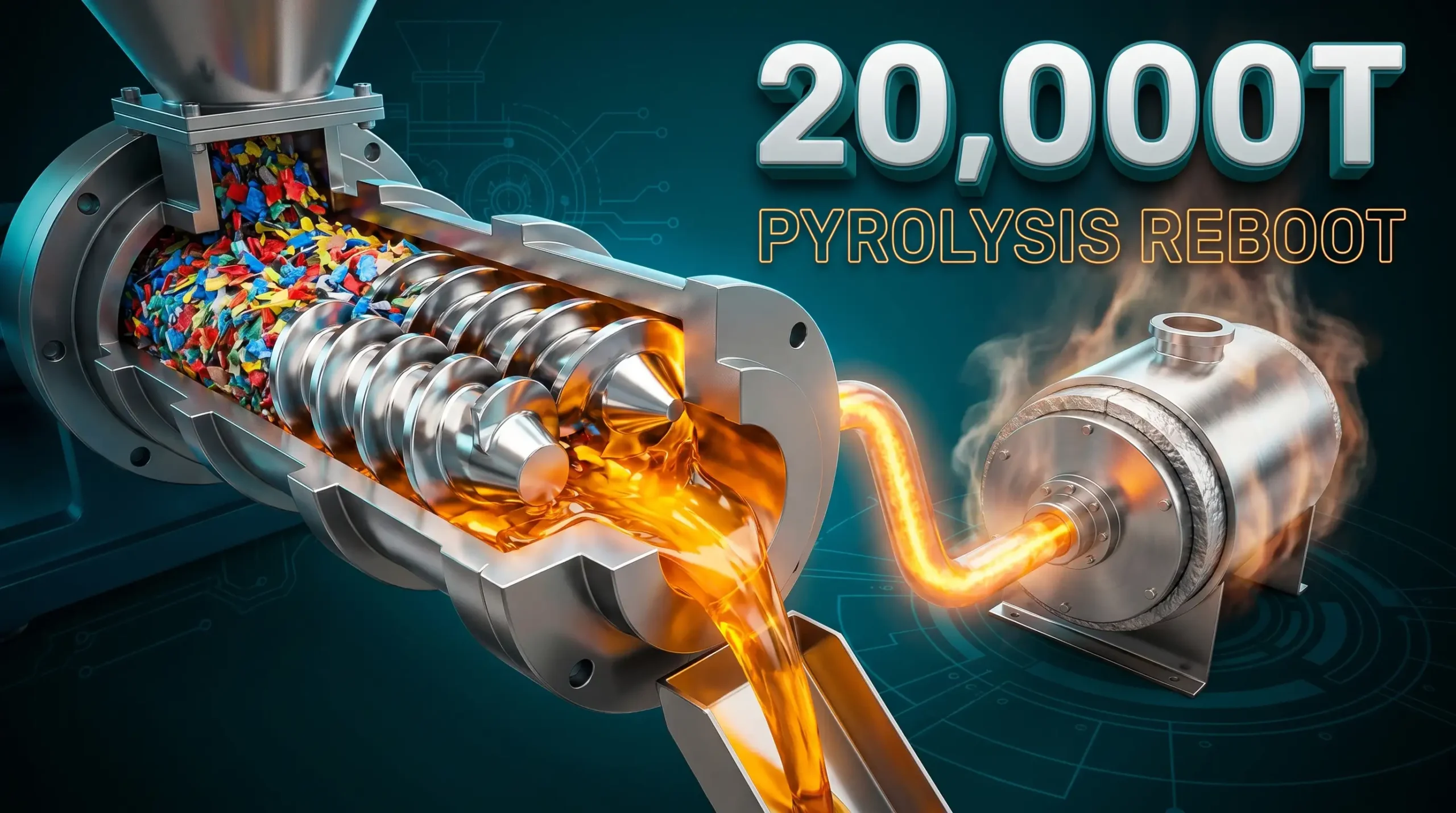
Chemical recycling has pulled in more than $10 billion in dedicated capital over the past decade, and most of it is still chasing one stubborn promise: that pyrolysis can turn dirty plastic film into virgin-grade polymer at industrial scale. On May 6, BlueAlp signed the partnership it needs to test that promise. The Eindhoven-based recycler hired KraussMaffei Extrusion to bolt its ZE BluePower co-rotating twin-screw extruder onto two pyrolysis sites, one already running in Ostend, Belgium and one about to fire up in Italy.
The deal, announced at the Plastics Recycling Show Europe in Amsterdam, is being framed as routine machinery procurement. It isn’t. It’s a bet that the sector can clear its yield problem before regulators and courts decide the marketing claims have outrun the chemistry.
Inside the Amsterdam Handshake
BlueAlp CEO Valentijn de Neve and KraussMaffei Extrusion managing director Ralf Benack appeared together in Amsterdam to confirm the agreement. The Dutch company will install ZE BluePower extruders to handle the conditioning step that sits in front of every pyrolysis reactor: dewatering, degassing, and pulling out the metal flakes, paper fibers, and ink residues that ride along with shredded plastic packaging.
That conditioning is where most chemical recycling plants live or die. Run dirty feedstock into a pyrolysis chamber and the resulting oil is unusable for steam crackers. Run too clean a feedstock and the economics collapse because someone already paid for that sorting work.
De Neve said the proven performance of KraussMaffei Extrusion in BlueAlp’s growth roadmap made it the right partner to industrialise the next round of plants. KraussMaffei tested the integration at its Technology Center in Laatzen, Germany, and confirmed the extruder can hold stable output under the high melt temperatures and pressures up to 200 bar that pyrolysis feedstock conditioning demands.
The first installations target the existing 20,000-tonne-per-year plant in Ostend run by Renasci, and the new 20,000-tonne BlueAlp-RES facility in Pettoranello del Molise, southern Italy. The Italian plant is Italy’s largest pyrolysis-based advanced recycling facility by capacity. First modules have already shipped from Eindhoven. Start-up is targeted for summer 2026.
The Regulatory Window That Just Opened
The partnership lands three months after the European Union finally settled the rule that determines whether any of this output can be sold as recycled content. On February 6, 2026, EU member states voted 20 to 1, with six abstentions, to approve the European Commission’s mass-balance implementing act for the Single-Use Plastics Directive.
The act adopts a fuel-use-excluded methodology. Volumes destined to become fuel cannot be claimed as recycled content. Char and other dual-use solid outputs are also excluded from the calculation. The math is tighter than industry lobbyists wanted, but it is now the math.
What the Numbers Actually Look Like
Strip away the announcement language and the scale picture comes into focus.
- 20,000 tonnes: Combined annual capacity of the two BlueAlp sites that get the new extruders, Ostend plus Pettoranello.
- $298 million: Estimated 2026 size of the global pyrolysis equipment market, projected to reach $2.78 billion by 2035 at a 27.1 percent compound rate.
- 25 percent: Investment cost reduction KraussMaffei claims its integrated extruder setup delivers versus separate degassing, filtering, and compounding lines.
- 50 percent: Share of the original carbon in plastic feedstock that critics say is lost during pyrolysis before the oil ever reaches a steam cracker.
Those last two numbers explain why the partnership exists. Chemical recycling cannot compete with mechanical recycling on cost or carbon footprint when half the input ends up as off-gas, char, or fuel-grade product. Every percentage point of yield improvement at the conditioning step is a percentage point that doesn’t have to be made up at the back end.
BlueAlp’s slow-cracking design runs continuously, without catalysts. That keeps operating costs down. The partnership with KraussMaffei is aimed at the bottleneck the slow-cracker can’t solve on its own: getting dirty feedstock clean enough that the reactor actually performs to spec.
Borealis Quietly Restructured the Cap Table
The Amsterdam announcement only makes sense in the shadow of a deal signed in December 2025. Austrian polyolefins maker Borealis transferred its majority stake in Renasci, the Belgian operator of that 20,000-tonne Ostend plant, directly to BlueAlp. In exchange, Borealis took a 10 percent stake in BlueAlp itself.
The financial terms were not disclosed. The structural meaning is harder to hide. BlueAlp is no longer a technology vendor licensing equipment to operators. It now owns and runs the most mature pyrolysis plant in its own portfolio.
The deepening of the partnership with BlueAlp, combining assets and technology, will accelerate progress in chemical recycling for the industry. It will allow Borealis to accelerate serving our customer base with an ever-broadening range of polymers based on chemically recycled feedstock.
That statement came from Stefan Doboczky, who took over as Borealis CEO in July 2024, in the company’s December 2025 transaction announcement. Borealis is now wired into BlueAlp’s revenue, the Italian plant’s output, the Ostend plant’s output, and any future site that licenses the technology. Customers preparing for the EU Packaging and Packaging Waste Regulation, which lands in 2030, get a single point of contact for chemically recycled polymer supply.
BlueAlp’s other backers are not small names. Shell holds a stake. So do Rumali, Den Hartog, and Mourik. The company employs roughly 100 people, excluding Renasci staff, and is led by a CEO who came out of Bain & Company and Shell before taking the top job. De Neve also serves as president of Chemical Recycling Europe.
The cap table reads like an industry that decided pyrolysis was the bet, then rearranged itself to make sure no single player could be squeezed out of the supply chain.
The Yield Critique That Won’t Die
None of the regulatory tailwind makes the underlying chemistry any less contested. Beyond Plastics, the U.S. Network for Pollutant Prevention, and the Natural Resources Defense Council have spent years arguing that pyrolysis is incineration with better marketing.
Dr. Neil Tangri of the Global Alliance for Incinerator Alternatives put it bluntly in an analysis published by the Institution of Engineering and Technology: “If you are going to call it recycling, you are going to have turn plastic back into plastic, and you have to have a pretty decent yield. If you’re talking about a yield of one- or two-thirds of your feedstock becoming a waste product or carbon dioxide, that’s not recycling; that’s mostly converting plastic into carbon dioxide.”
That is the yield problem the BlueAlp-KraussMaffei deal is built to chip away at. Not eliminate. Chip away at.
The California Test
While Europe locked in mass-balance accounting, California built the opposite kind of legal infrastructure. SB 343, the Truth in Labeling law, takes effect in October 2026. It requires companies to demonstrate that a product will actually be recycled in the state before they can label it recyclable.
Industry groups representing dairy producers, grocers, packaging makers, and restaurants are already suing California to block implementation. The case will determine whether a pyrolysis-derived polymer claimed under EU mass-balance rules can carry a recyclable label on a yogurt cup sold in San Francisco.
If California holds the line, the regulatory map for chemical recycling fragments. EU companies will have a usable framework. U.S. companies will face a state-by-state patchwork. The pricing model breaks. The investment thesis cracks.
BlueAlp’s exposure here is mostly indirect. The company sells technology, not finished consumer goods. But its customers, including ExxonMobil’s Baytown and Beaumont expansions and Dow’s U.S. Gulf Coast advanced recycling pyrolysis oil agreement with Freepoint Eco-Systems, do sell into California.
Where The Pipeline Goes Next
BlueAlp is also engineering a pyrolysis unit at its Eindhoven headquarters for the BioBTX plant in Delfzijl, Netherlands. Modules ship to Delfzijl from December 2026 onwards. BioBTX uses BlueAlp’s vapor output as feedstock for its own catalytic process to produce circular aromatics, the building blocks for everything from solvents to polyester.
The Dutch government has awarded BlueAlp, Renewi, Shell, and Utrecht University 1.5 million euros for Project CLEAN, a chemical recycling research effort focused on flexible plastics. Flexible film is the segment mechanical recycling cannot touch and the segment most likely to determine whether chemical recycling earns its place in the hierarchy or stays a sideshow.
De Neve has told industry press that the company expects to announce another technology license and engineering contract before the end of 2026.
The partnership announced in Amsterdam is one piece of equipment selection. Read alongside the Borealis transaction, the Italian plant ramp-up, the Delfzijl engineering work, and the EU vote, it reads as something else: an industry that has roughly four years to prove that pyrolysis can hit yield, output quality, and pricing targets before the next round of legislation, litigation, and lifecycle analysis decides whether the $10 billion already spent was worth it.

-
 TECH1 year ago
Where Garmin Watches are Made and How They are Assembled
-

 AUTO3 months ago
Tesla’s Roadster Is ‘a Few Weeks Away,’ Says Its Chief Designer
-
 NEWS10 years ago
Samsung Releases Galaxy Note7 TV Ad as Reddit AMA Leaks Specs
-
 NEWS10 years ago
Android 7.0 Nougat Rolls Out To Nexus Devices With New Emoji, Features
-
 FINANCE9 years ago
Cardano Price Surges as ADA Enters the Crypto Top Ten List
-
 NEWS10 years ago
Pre-Order the First Camera Made for Facebook Live Streaming Video
-
 FINANCE1 year ago
Binance Suspends Trading and Withdrawals for a System Upgrade
-
 FINANCE9 years ago
RChain Price Jumps Nearly 150% to a New All-Time High of $2.03