
NEWS
SpaceX Stage Hits Moon and Hands Science a Free Crater Lab
A leftover Falcon 9 upper stage will strike near Einstein Crater on August 5, giving researchers a calibrated impact while exposing cislunar debris gaps ahead.

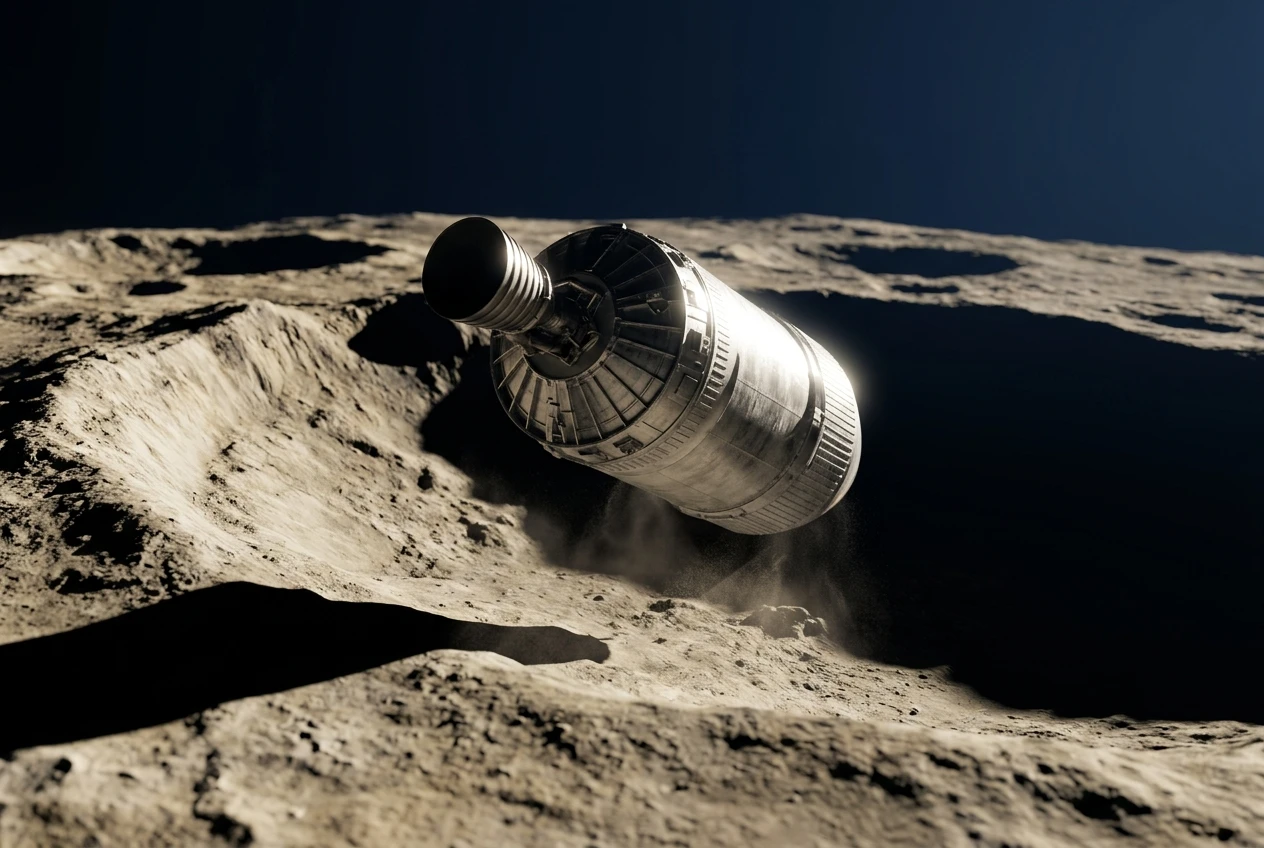
A discarded SpaceX Falcon 9 upper stage will strike the Moon near Einstein Crater at roughly 5,400 mph on August 5, carving a fresh crater about 27 metres across and giving researchers a rare calibrated look at how human hardware alters the lunar surface.
The 12-metre stage, catalogued 2025-010D, has drifted in a high Earth-Moon orbit since boosting Firefly Aerospace’s Blue Ghost and ispace’s Resilience landers in January 2025. The collision is accidental. Scientists have tracked it for months and now treat it as a free experiment.
The Stage That Drifted More Than a Year
Bill Gray of Project Pluto, who first flagged the trajectory, computes impact at 06:34:33 UTC on August 5, give or take a few seconds. That is 2:34 a.m. Eastern Daylight Time. The point sits at about 19.5° N, 93.6° W, on the sunlit western limb as seen from Earth.
The stage weighs roughly 4,000 to 4,900 kilograms once propellant is spent. It will arrive at 2.43 km per second. Gray’s calculation puts the kinetic energy near 14.5 billion joules, equal to about three tonnes of TNT. An independent team led by Benjamin Fernando of Los Alamos National Laboratory estimates 11.8 GJ for a 4,000 kg mass.
| Estimator | Mass basis | Kinetic energy |
|---|---|---|
| Bill Gray | ~4,000-4,900 kg spent stage | ~14.5 GJ (three tonnes TNT) |
| Fernando team | 4,000 kg | 11.8 GJ |
The spread is modest. Both teams start from the same velocity and the same spent-stage mass range, so the difference is mainly how much dry mass each model assigns. Either figure still places the strike well above ordinary lab-scale shots.
Gray’s page lists local times across continents and notes the Moon will be a little more than half illuminated. Eastern North America and much of South America offer the best viewing windows if any plume appears. The flash itself will last under a second and is probably too faint for naked-eye detection.
- Speed: 5,400 mph (2.43 km/s), roughly seven times the speed of sound in air
- Mass: ~4,000-4,900 kg
- Energy: ~12-14.5 GJ, or three tonnes of TNT equivalent
- Expected crater: ~27 m wide and 5 m deep
Fernando’s group and Gray both expect orbiting cameras to catch the new scar. South Korea’s Danuri orbiter is predicted to pass within a few kilometres of the stage only two minutes before impact. NASA’s Lunar Reconnaissance Orbiter will image the site before and after.
That near-miss geometry is unusual. Danuri’s pass gives a last look at the intact stage, while LRO’s later frames will lock down the crater’s final shape. Together they bookend the event with hardware already on station.
How Scientists Turned Leftover Hardware Into a Lab
Natural meteoroids strike the Moon constantly, but their masses and speeds are guesses after the fact. This stage’s size, mass range and velocity are known in advance. That turns the hit into a controlled source for crater scaling, ejecta dynamics and dust behaviour.
Fernando and co-authors published an observational planning paper on the impact that spells out the science return. The impact angle is roughly 34° from vertical. The flash may be dim because 2.43 km/s is slower than most natural impactors and may not generate strong shock waves in bedrock. The plume of dust and rock could rise several kilometres and linger minutes because lunar gravity is low and there is no wind.
At 34° from vertical the stage will still drive most of its energy into the surface rather than skipping, yet the oblique path can stretch the ejecta curtain downrange. Models that assume vertical hits will need the measured asymmetry to stay honest.
“Part of the reason for our interest in this event is to figure out how much of a hazard debris impacts pose to future astronauts,” Fernando wrote. Professionals and amateurs are both invited to watch.
The data will help calibrate models used for future seismic networks and surface operations. Dust kicked high can settle slowly and foul equipment or spacesuits. A known slow, massive impactor supplies numbers no lab shot or remote meteor flash can match.
- Crater diameter and depth against a known mass and speed
- Flash brightness at a relatively low 2.43 km/s
- Plume height and hang time in vacuum and low gravity
- Ejecta reach for later surface-safety planning
Einstein Crater and the Expected Hole
The strike zone lies in heavily cratered highland terrain close to Einstein Crater. Pi-scaling and hydrocode runs both point to a simple crater roughly 27 metres across and 5 metres deep. That is too small for Earth-based telescopes to resolve, but LRO’s cameras will record it within weeks or months.
| Impact | Year | Mass (approx.) | Speed | Crater(s) | Notes |
|---|---|---|---|---|---|
| Falcon 9 2025-010D | 2026 | 4-4.9 t | 2.43 km/s | ~27 m × 5 m | Near side, sunlit, predicted |
| Chang’e-5 T1 stage | 2022 | ~4 t (est.) | ~2.5 km/s | Double: 18 m + 16 m | Far side, unexpected shape |
| LCROSS Centaur | 2009 | 2.3 t | ~2.5 km/s | ~22 m | Deliberate, polar shadowed |
The Chinese stage left a double crater that still puzzles researchers; one theory holds that mass was concentrated at both ends. The Falcon stage is expected to stay more intact until contact, so a single bowl is the baseline forecast. Any residual propellant could add an explosive component.
Highland rock is already fractured from older impacts, so the new hole may excavate loose regolith more than fresh bedrock. That soft target can widen the rim relative to a hard-rock strike of the same energy. LRO’s before-and-after pair will show whether the 27-metre forecast holds or whether the fractured ground opens a broader scar.
If leftover propellant vents or detonates at contact, the crater could deepen or grow a small secondary pit. Even a modest chemical kick would show up against the purely kinetic baseline Gray and Fernando have already published.
Earlier Artificial Hits Set the Pattern
This will be only the second known accidental rocket-body crash on the Moon. The first was the Chang’e-5 T1 upper stage in March 2022. NASA’s LRO later returned LRO images of the 2022 double crater near Hertzsprung on the far side. The scar measures about 28 metres across its longest axis.
- 1959: Luna 2 becomes the first deliberate artificial impact.
- 1969-1972: Apollo Saturn IV-B stages and lunar modules are deliberately crashed for seismic calibration.
- 2009: LCROSS Centaur stage hits a shadowed polar crater; water ice is confirmed in the plume.
- 2022: Chinese Long March stage leaves the unexpected double crater.
- 2026: Falcon 9 stage arrives on a well-tracked trajectory on the near side.
Apollo-era impacts supplied the best lunar seismic data for decades. Modern high-cadence cameras and orbiters can now capture both the flash and the plume in ways unavailable then. The upcoming event sits in that lineage, only this time the hardware was never meant to hit.
The shift from deliberate to accidental is the new variable. Luna 2, the Apollo stages and LCROSS were aimed. The 2022 Chinese stage and the coming Falcon stage were not. Tracking quality is what separates a surprise double crater on the far side from a predicted near-side strike that teams can instrument in advance.
Future Bases Face the Same Leftover Hardware
No one on the surface is at risk on August 5. The Moon is empty of crewed outposts. That will change. NASA’s Artemis programme, Chinese landers and commercial vehicles all plan long-term surface presence. A stage the size of a bus arriving unannounced would become a real hazard.
Retired astrophysicist Jonathan McDowell put it plainly: “This impact will not be a problem. But in a future where there are long-term bases on the moon, similar impacts would be an issue and we need not to leave rocket stages in chaotic orbits of this kind.”
Dust is the quieter problem. Ejecta can travel far in vacuum and coat solar arrays, radiators and seals. Fernando’s team wants the plume measurements precisely because future crews will need to know how far and how long debris travels after a strike. The same concern appears in proposals to protect the Moon from asteroids, where even small impactors raise surface-safety questions.
Gray notes that natural impacts still dominate the hazard budget for now. A recent natural crater measured 225 metres across. Artificial stages remain rarer, yet their numbers will climb with every commercial lunar shot. SpaceX’s expanding launch cadence already multiplies the hardware left in high orbits.
- Ejecta can foul equipment kilometres away
- Untracked stages complicate traffic management near the Moon
- Future seismic stations need calibrated sources; this one arrives free
- Disposal policy lags the flight rate
Once crews and cargo landers share the surface, an unannounced 27-metre crater is no longer a curiosity. It becomes a planning constraint for habitat siting, rover routes and dust mitigation. The free data from August 5 will feed those rules before the first long-stay base is built.
Sun Orbits Already Solve Part of the Problem
Gray’s advice is simple. After the translunar injection burn, residual propellant can place the upper stage on a trajectory that escapes Earth-Moon space and enters solar orbit. The stage then becomes someone else’s problem for centuries.
The simplest is to put upper stages in orbits where they will leave the earth and moon, and end up in orbit around the sun.
That is Bill Gray writing on Bill Gray’s full impact prediction page. ESA has studied the same options for years under its ESA end-of-life disposal guidelines. Recent Chinese lunar launches have begun sending stages into solar orbits. At least one later Falcon 9 mission, EscaPADE in late 2025, appears to have done the same.
The January 2025 dual-lander flight did not. The stage stayed in a chaotic Earth-Moon path until gravity selected the Moon as the final destination. The fix costs a little extra propellant and a planning step. For missions already headed beyond low Earth orbit, the delta-v is modest.
Operators already know the path. Chinese flights and the later EscaPADE mission show the burn is practical. The January dual-lander case simply skipped that step, and months of tracking followed.
Orbiters Close In on the Final Minutes
Danuri’s predicted pass within a few kilometres only two minutes before impact is the tightest pre-strike look any accidental stage has received. The orbiter can frame the intact body against the highland terrain while the clock still runs.
LRO then takes over. Its before-and-after imaging will fix the crater’s rim, depth and ejecta blanket once the dust settles. Because the site is on the sunlit near side, lighting geometry favors clear photography in the weeks that follow.
Ground observers still matter. Eastern North America and much of South America hold the best windows if a plume climbs high enough to catch sunlight. The flash itself should last under a second and stay too faint for casual naked-eye work, so the scientific return rides on instruments already in lunar orbit and on prepared telescopes on Earth.
One Free Strike Sharpens Every Later Model
Seismic networks planned for future bases need known sources. Apollo-era crashes once filled that role; this stage repeats the service without a dedicated targeting burn. Mass, speed and impact time are already published, so any seismic or optical signal can be tied straight back to those inputs.
Dust transport is the second payoff. Low gravity and no wind let a plume rise several kilometres and hang for minutes. Measuring that hang time and fallout distance gives surface teams numbers they can use when siting solar arrays, radiators and airlocks.
The same figures feed traffic models for cislunar space. Untracked stages already complicate planning near the Moon. A well-documented accidental hit shows both the science gain and the operational cost of leaving hardware in chaotic Earth-Moon paths.
Observers will watch the sky on August 5 for a brief flash or a rising dust cloud. Orbiters will photograph the new hole. The numbers they return will improve models for every future landing and base. They will also remind operators that the next leftover stage does not have to follow the same path.
The Moon gains one more crater. The real product is data, and a clearer warning that cislunar space is no longer empty enough to treat disposal as an afterthought.

-
 TECH1 year ago
Where Garmin Watches are Made and How They are Assembled
-
 AUTO3 months ago
Tesla’s Roadster Is ‘a Few Weeks Away,’ Says Its Chief Designer
-
 NEWS10 years ago
Samsung Releases Galaxy Note7 TV Ad as Reddit AMA Leaks Specs
-
 NEWS10 years ago
Android 7.0 Nougat Rolls Out To Nexus Devices With New Emoji, Features
-
 FINANCE9 years ago
Cardano Price Surges as ADA Enters the Crypto Top Ten List
-
 NEWS10 years ago
Pre-Order the First Camera Made for Facebook Live Streaming Video
-
 FINANCE1 year ago
Binance Suspends Trading and Withdrawals for a System Upgrade
-
 FINANCE9 years ago
RChain Price Jumps Nearly 150% to a New All-Time High of $2.03