
NEWS
Skyroot’s Vikram-1 Chases Orbit on the Day India First Reached It
Skyroot’s Vikram-1 attempts India’s first private orbital launch on the same date ISRO first reached orbit in 1980, against tough historical odds.

Skyroot Aerospace will try to reach orbit Saturday from the same stretch of Indian coastline where the country’s own space program failed, then succeeded, on this exact date 46 years ago. The Hyderabad company’s Vikram-1 rocket is scheduled to lift off at 11:30 a.m. from the Satish Dhawan Space Centre in Sriharikota, attempting to become the first privately built launch vehicle to place a satellite in orbit from Indian soil.
Prime Minister Narendra Modi called it a “historic new frontier” in a post on X ahead of liftoff. Nearly every private rocket company that has tried the same maneuver, reaching orbit on a debut flight, has failed on the first try.
A Four-Stage Bet Lifts Off From Sriharikota
Mission Aagaman, Sanskrit for arrival, is Skyroot’s second launch ever and its first attempt at orbit. The company’s only previous flight, the suborbital Vikram-S in November 2022, proved the firm could build a rocket that reaches space. Saturday asks something much harder: whether Vikram-1 can execute a precise sequence of stage separations and settle a payload into a 450 kilometer orbit at a 60 degree inclination.
Vikram-1 is a 24 metre, four-stage vehicle built around a carbon-composite airframe, with three solid-fuel stages and a liquid-fueled fourth stage for orbital adjustment, according to Skyroot. It is rated to carry up to 350 kilograms to low Earth orbit, the region of space within a few hundred kilometers of the planet where most communications and imaging satellites operate.
The rocket is not flying empty. Its manifest mixes hard engineering with a bit of theater:
- Grahaa Space, an Indian earth-observation nanosatellite maker, has a technology demonstrator onboard.
- Cosmoserve, an Indian space debris removal company, is testing its own payload.
- DCubed, a space component developer, is flying a demonstration unit.
- Skyroot’s in-house SCOPE platform rounds out the technical payloads.
- Bengaluru-based Cosmos Diamonds is flying a lab-grown diamond artwork called Diamond Lotus, along with a micro-art payload.
- Handwritten postcards from engineers, scientists and Indian astronauts are aboard, including one from Modi reading “Vande Mataram.”
Skyroot co-founder and chief executive Pawan Kumar Chandana said the company had done what it could on the ground. “On July 18, we are eager to see how Vikram-1 performs in a real flight environment for the first time,” he told reporters, according to Business Standard.
The Same Date India First Reached Orbit
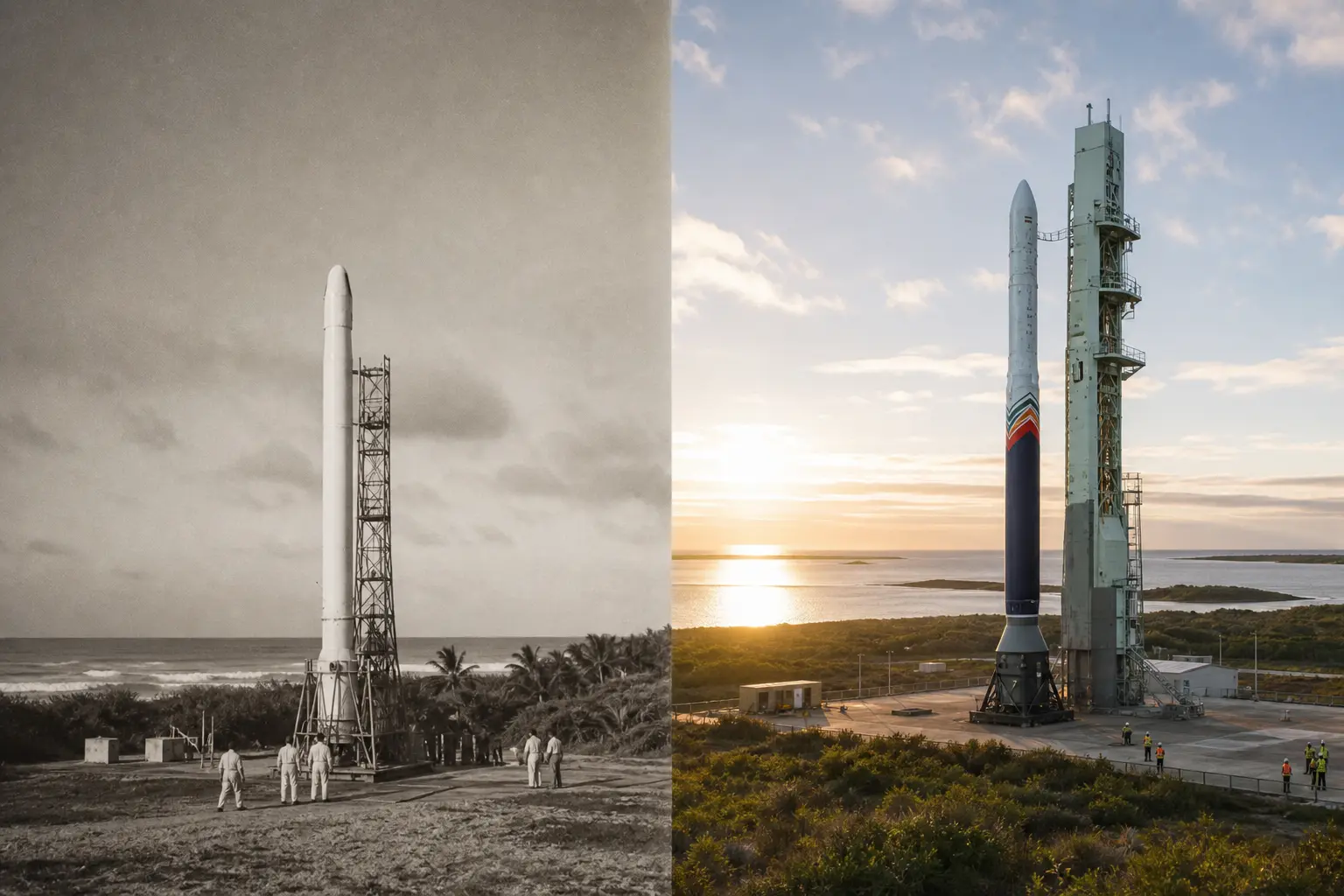
The calendar detail is not incidental. On August 10, 1979, India’s own first satellite launch vehicle, the SLV-3, lifted off from the same coastline and appeared to fly a flawless first stage before a second-stage control failure sent it splashing into the Bay of Bengal roughly 317 seconds after launch.
Eleven months later, on July 18, 1980, a rebuilt SLV-3 flew again from Sriharikota and placed the Rohini RS-1 satellite into orbit, making India the sixth nation to reach space on its own launch vehicle. India’s first experimental satellite launch vehicle weighed 17 tonnes and stood 22 meters tall, according to the Indian Space Research Organisation, or ISRO, the government agency that has run India’s space program since the 1960s.
Vikram-1’s launch window falls on that same date 46 years later, a coincidence Skyroot did not choose but one that frames the day neatly. Even India’s state space agency needed a failure before it got a success on this stretch of coast.
That pattern is not ancient history for ISRO either. Its most recent mission from Sriharikota, the PSLV-C62 flight in January, failed because of a stage-three anomaly, according to ThePrint. It was the second consecutive ISRO launch failure heading into this year, TechCrunch has reported, a reminder that even an agency with five decades of experience still loses rockets.
Why Do Most Maiden Rocket Launches Fail?
Most new orbital rockets, built by governments or private companies, fail their first flight; only a handful of debut vehicles worldwide have reached orbit cleanly on the first attempt, and rocket makers themselves treat a clean debut as the exception rather than the rule.
The pattern holds across five decades and three continents. Lockheed Martin’s first commercial launch vehicle failed to reach orbit on its 1995 debut. SpaceX’s Falcon 1 shut down shortly after liftoff on its first flight in 2006 and needed three more tries before it reached orbit in 2008. More recently, Relativity Space’s Terran-1 suffered a partial failure on its 2023 debut and the program was cancelled soon after, while ABL Space Systems lost its RS1 rocket on its own maiden flight the same year.
| Company (Country) | Rocket | Year | Debut Result |
|---|---|---|---|
| ISRO (India) | SLV-3 | 1979 | Crashed into the Bay of Bengal after a second-stage fault |
| Lockheed Martin (US) | LMLV-1 | 1995 | Failed to reach orbit with its satellite |
| SpaceX (US) | Falcon 1 | 2006 | Shut down after liftoff; reached orbit on its fourth try in 2008 |
| Relativity Space (US) | Terran-1 | 2023 | Partial failure; program cancelled afterward |
| ABL Space Systems (US) | RS1 | 2023 | Failed maiden launch |
| Gilmour Space (Australia) | Eris | 2025 | Broke apart 14 seconds after liftoff |
| Space Pioneer (China) | Tianlong-3 | 2026 | an engine bay explosion 33 seconds into its debut flight |
Gilmour Space, whose Eris rocket broke apart shortly after its own 2025 debut, put the odds plainly beforehand: the company itself said reaching orbit on a first attempt is “almost unheard of” for a new launch vehicle. Skyroot’s Chandana has made a similar point about his own rocket.
We were very optimistic that we will get to an orbital launch in maybe two, three years from there. However, rocket science is rocket science.
Chandana made that remark to Space.com, reflecting on how long Vikram-1 actually took to reach the pad after Skyroot’s early timelines proved optimistic. Falcon 1’s first launch ended in a vehicle shutdown shortly after liftoff, a venture capital firm’s own review of commercial launch history noted, before SpaceX eventually turned the rocket into a working vehicle.
A Billion-Dollar Valuation Rides on Today
Skyroot is not a scrappy garage operation betting its last dollar on one flight. The company became India’s first space-tech unicorn in May, raising $60 million to push its valuation to about $1.1 billion, up from roughly $500 million in 2023, in a round co-led by Singapore’s GIC and Sherpalo Ventures with participation from BlackRock and several other investors.
That round brought Skyroot’s total funding to about $160 million since 2018, built up through a seed round, an $11 million Series A in 2021, a $51 million Series B in 2022, and a $27.5 million pre-Series C led by Temasek in 2023. The company now employs more than 900 people, roughly 200 of whom make up the launch team overseeing Saturday’s flight, according to Space.com.
Investors appear to have priced in the possibility that Vikram-1 stumbles. Forbes India reported that backers had already modeled a launch failure into their calculations before committing capital, treating a rough debut as a cost of entry rather than a dealbreaker. Chandana has said the money will fund Vikram-1’s production scale-up and development of the larger Vikram-2, regardless of how the flight results.
The bet extends beyond one company. India’s space economy is valued at roughly $8.4 billion and projected to grow to $44 billion by 2033, TechCrunch has reported, and a successful private orbital launch would give that growth story its first real proof point.
Four Hundred Startups, One Rocket
The regulatory groundwork for Saturday’s attempt dates to 2020, when the Indian government created the Indian National Space Promotion and Authorisation Centre, known as IN-SPACe, and opened ISRO’s facilities and technology to private companies for the first time.
Rajesh Jothi, IN-SPACe’s technical director, described the resulting growth to the news agency ANI. “We started with hardly five or six startup companies, and today we have more than 400 startups,” he said, crediting the sector opening for the shift.
Skyroot is not flying alone in that broader field. Business Standard has reported that only Skyroot and fellow Hyderabad-based Agnikul Cosmos have so far demonstrated any kind of rocket launch in India, suborbital or otherwise, out of that startup population. Every one of those companies has a stake in whether a private Indian rocket can clear the bar Saturday.
Former ISRO chairman S Somanath framed the mission in similarly broad terms in his own post on X, writing that the flight “marks the arrival of India’s private rocket building capability” regardless of the technical outcome of any single flight.
Two More Flights Are Already on the Calendar
Skyroot has built its own cushion against a bad day. Mission Aagaman is publicly described as the first of three planned development flights meant to validate Vikram-1 before regular commercial service begins, so a rough debut would feed engineering data into the next attempt rather than end the program outright.
That approach has precedent elsewhere. LandSpace’s Zhuque-3 reached orbit successfully in December even though the Chinese company failed to land the rocket’s booster back on target, a result an outside space analyst called an impressive result for the vehicle’s maturity despite the miss. Reaching orbit and nailing every objective are not the same test.
- What we know: Vikram-1 is fully stacked at Sriharikota, targeting an 11:30 a.m. liftoff, carrying six distinct customer and cultural payloads toward a 450 kilometer orbit.
- What we know: Skyroot holds a $1.1 billion valuation and has three development flights planned before commercial launches begin.
- What remains unconfirmed: whether Saturday’s flight actually reaches its target orbit, how each of the four stages performs in sequence, and whether the onboard payloads deploy as designed.
- What remains unconfirmed: how any anomaly, should one occur, would affect the timing of Skyroot’s next two development flights.
Chandana has told Via Satellite that Skyroot is targeting four to six launches this financial year, though he acknowledged that plan could shift depending on what Saturday’s flight reveals. The current launch window, which opened July 12, stays open through August 4 regardless of what happens today.
Frequently Asked Questions
What happens if Vikram-1 does not reach orbit on Saturday?
Skyroot has repeatedly described Mission Aagaman as a technology demonstration and the first of three planned development flights, not a one-shot bet on commercial service. The current launch window stays open through August 4, leaving room for another attempt if Saturday’s flight comes up short or slips for weather.
What engines power the Vikram-1 rocket?
Vikram-1’s first stage uses the Kalam-1200 solid rocket motor, named for former Indian president and rocket scientist APJ Abdul Kalam, which completed its first static test in August 2025. Its upper stage runs on the liquid-fueled Raman-1 engine, named for physicist C V Raman, according to company disclosures compiled by Wikipedia.
How did Skyroot’s first rocket, Vikram-S, perform?
Vikram-S flew a single suborbital hop on November 18, 2022, under the mission name Prarambh, reaching an altitude of about 89.5 kilometers before falling back to Earth. It never attempted orbit, but it made Skyroot the first Indian private company to reach space with its own rocket.
Which other Indian companies are racing to build orbital rockets?
Agnikul Cosmos, also based in Hyderabad, is the only other Indian firm to have flown any kind of rocket so far, per Business Standard. A wider group including Pixxel, Bellatrix Aerospace and Dhruva Space is building satellites and propulsion systems for the same emerging market, though none has yet attempted an orbital launch of its own.

-
 TECH1 year ago
Where Garmin Watches are Made and How They are Assembled
-
 AUTO3 months ago
Tesla’s Roadster Is ‘a Few Weeks Away,’ Says Its Chief Designer
-
 NEWS10 years ago
Samsung Releases Galaxy Note7 TV Ad as Reddit AMA Leaks Specs
-
 NEWS10 years ago
Android 7.0 Nougat Rolls Out To Nexus Devices With New Emoji, Features
-
 FINANCE9 years ago
Cardano Price Surges as ADA Enters the Crypto Top Ten List
-
 NEWS10 years ago
Pre-Order the First Camera Made for Facebook Live Streaming Video
-
 FINANCE1 year ago
Binance Suspends Trading and Withdrawals for a System Upgrade
-
 FINANCE9 years ago
RChain Price Jumps Nearly 150% to a New All-Time High of $2.03