
NEWS
West Bengal’s Purged Voters Face a 25-Year Wait to Get Their Names Back
West Bengal’s top court fight over voter deletions shows 34 lakh appeals stuck for years and ration benefits already cut, even as judges say citizenship isn’t at stake.

The Supreme Court told the Election Commission of India on Friday, again, that deleting a voter’s name from the rolls does not make that person a foreigner. Roughly 34 lakh, or about 3.4 million, people in West Bengal are still waiting to find out what that promise is worth.
A bench led by Chief Justice of India Surya Kant repeated that only the Union government, not the poll body, can rule on someone’s citizenship. But the appeal system built to catch wrongful deletions is moving so slowly it could take 25 years to clear. West Bengal’s new government has already cut ration and cash benefits to thousands still waiting for a hearing.
Bose’s Petition Puts Welfare Denials Before the Court
The petition came from Prasenjit Bose, chairperson of the West Bengal Pradesh Congress Committee’s SIR panel and a longtime convenor of the Joint Forum against the National Register of Citizens (NRC). His counsel, senior advocate Gopal Sankaranarayanan, addressed the bench, which also included Justices Joymalya Bagchi and V Mohana. He said roughly 34 lakh appeals were still pending before 19 appellate tribunals reviewing West Bengal’s Special Intensive Revision, or SIR.
Only about 38,000 of those appeals had been decided, Sankaranarayanan said, and 70% of that small number were allowed, meaning the appellant’s name went back on the rolls. Meanwhile, he told the court, the state government had cut deleted voters off from the Public Distribution System (PDS) ration network and the Annapurna Yojana welfare scheme. Caste certificates were being denied too.
Justice Bagchi pointed back to the bench’s own Bihar SIR ruling from May 27, which found the Election Commission’s revision power real but limited. “The EC has a corresponding duty to refer the matter to the government for adjudication under the Citizenship Act,” he said, repeating the line from that earlier judgment.
Sankaranarayanan pushed back that the legal position offered no comfort to people already losing their food rations. “Neither you (Court) nor us apprehended that all these welfare schemes would be taken away from them,” he told the bench. The court issued notice to the Election Commission, the West Bengal government and the state’s chief electoral officer, and posted the case for further hearing on August 25.
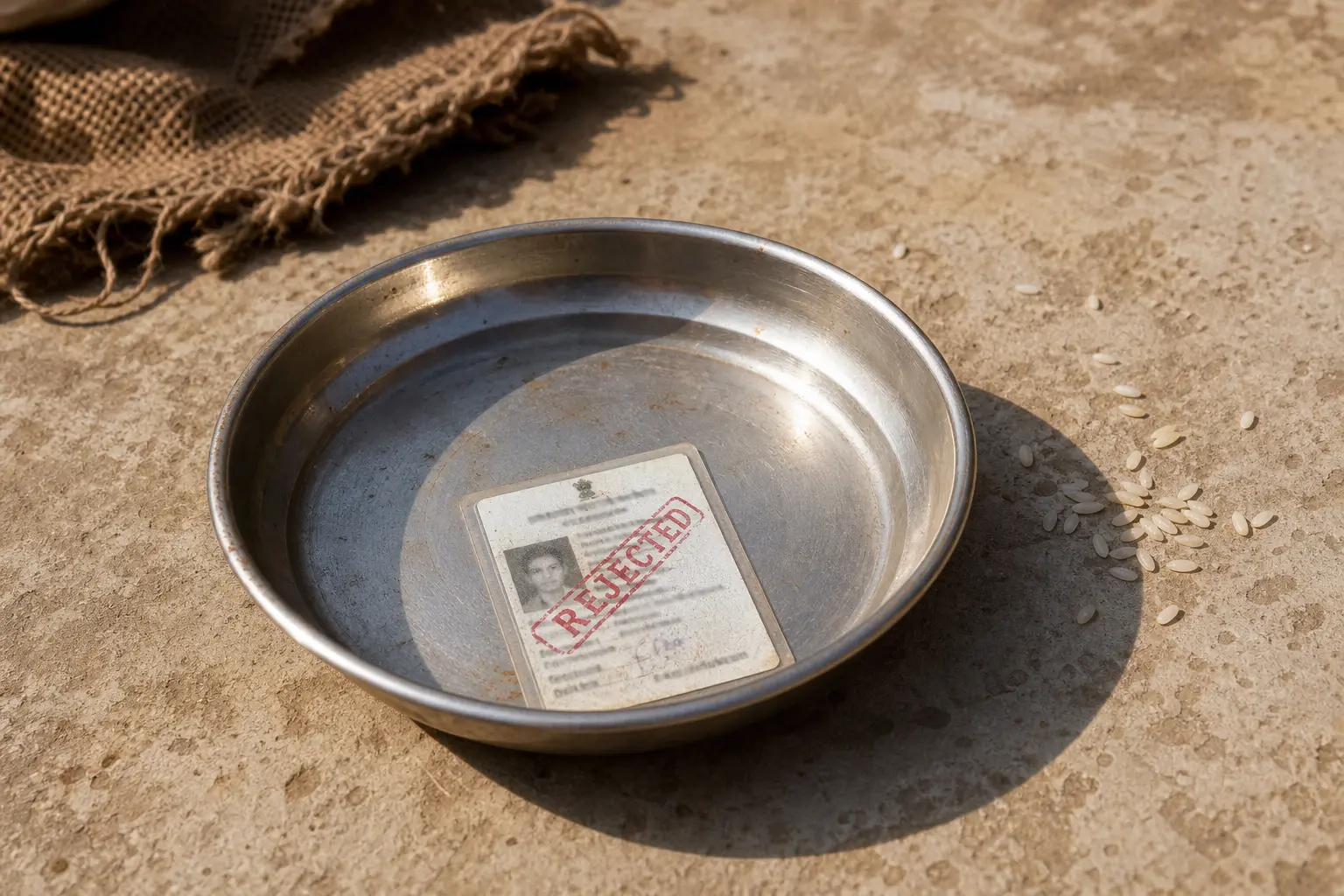
How a Voter Purge Reshaped Bengal’s Government
The numbers argued over Friday trace back to a revision that began with draft rolls published in December. Those rolls flagged more than 58 lakh, or 5.8 million, electors for possible exclusion during the enumeration phase. Of 9.64 lakh people who then applied for reinclusion, only about 1.82 lakh made it back onto the roll published on February 28. Election officials later put the net deletion before voting at more than 27 lakh names.
Bihar’s own SIR pilot the year before had already removed close to 4.7 million voters, about 5% to 6% of its electorate. Critics called it a preview of what a much larger, more politically charged Bengal revision could bring.
West Bengal voted in two phases, on April 23 and 29. Mamata Banerjee’s Trinamool Congress, in power for 15 years, defended its record against a BJP campaign built partly around the SIR process. When results came on May 4, the BJP had won 207 of 294 seats, reducing Trinamool to 80.
Suvendu Adhikari, the party’s Nandigram MLA and a former state transport minister, took the oath as West Bengal’s first Bharatiya Janata Party chief minister on May 9. Prime Minister Narendra Modi attended the ceremony at Kolkata’s Brigade Parade Grounds. Adhikari had contested, and won, both his home seat and Bhabanipur, the constituency Banerjee herself held for years.
Within a month of taking office, his administration issued the first of the orders linking ration and Annapurna Yojana eligibility to SIR status. That is the same policy Bose’s petition is now fighting in Delhi.
Why Could Clearing the Backlog Take 25 Years?
Nineteen retired High Court judges now sit on tribunals the Supreme Court itself ordered into existence after the Bihar case, hearing challenges to West Bengal’s voter deletions. As of early July they had resolved only about 38,000 of some 34 lakh combined appeals. One widely cited estimate put the time needed to finish at more than 25 years if the pace does not pick up.
That estimate came from a Times of India count, cited directly in Bose’s petition. It found fewer than 1% of appeals resolved 100 days after the tribunals opened, with just 30,000 of roughly 33 lakh filings disposed of. Two months earlier, the picture was bleaker still: only 6,581 of about 25 lakh appeals, or 0.26%, had been cleared.
| Snapshot Date | Appeals Filed or Pending | Disposed | Share Resolved |
|---|---|---|---|
| May 22, 2026 | About 25 lakh | 6,581 | 0.26% |
| July 2, 2026 (TOI count) | About 33 lakh | About 30,000 | Under 1% |
| July 17, 2026 (SC hearing) | About 34 lakh | About 38,000 | About 1% |
Roughly 61% to 70% of decided appeals across these snapshots ended with the appellant’s name restored. That consistency suggests the tribunals are finding most challenged deletions wrong, once a case actually reaches a judge. Getting a case that far is the problem.
The tribunals have also been losing judges. Ranjit Bag, a former Calcutta High Court judge handling appeals from North 24 Parganas, resigned on July 1 citing health concerns. T S Sivagnanam, the former chief justice of the Calcutta High Court who headed the Kolkata tribunals, quit on May 4, the same day election results confirmed the change of government. A retired judge from Bihar has also stepped down, and two sitting tribunal heads have since been assigned to lead unrelated state commissions on corruption and women’s safety.
Border Districts Carry the Heaviest Load
The backlog is not evenly spread. Murshidabad, a Muslim majority district bordering Bangladesh, had resolved just 112 of more than 6.29 lakh appeals as of May. Neighboring Malda had cleared 185 of over 5.26 lakh. The joint tribunal covering Kolkata North and Kolkata South carried more than 51,000 pending cases even before its presiding judge resigned.
- Murshidabad – 112 appeals resolved out of more than 6.29 lakh filed as of May
- Malda – 185 appeals resolved out of more than 5.26 lakh filed as of May
- Kolkata North and Kolkata South – over 51,000 appeals pending under one joint tribunal whose head has since resigned
Bose has spent years campaigning against a citizenship register in Bengal. The districts with the worst tribunal backlogs are also the ones where fears of statelessness run deepest. Many of the same border districts produced the bulk of a separate pool of more than 60 lakh electors flagged for what officials called logical discrepancies, things like parent to child age gaps or repeated family linkages. Bose’s petition argues those criteria appear nowhere in the Representation of the People Act.
A Ration Card Now Depends on a Voter Slip
West Bengal’s Food and Supplies Department issued an order in June. Ration cards belonging to anyone removed from the rolls as absent, shifted, duplicate or dead would be marked inactive, part of a wider verification drive. The Public Distribution System feeds nearly 90 million people in the state.
Officials said about 2.3 million people who have formally appealed their deletion would keep receiving rations until their cases are decided. On the ground, residents describe a different experience: appeals rejected without a hearing, then a demand to resubmit lengthy paperwork just to keep an existing ration card active.
The state also rebranded Banerjee’s Lakshmir Bhandar cash transfer as Annapurna Yojana, raising the monthly payout to Rs 3,000, about $32, for an estimated two crore women. Eligibility now ties to the same SIR data. Agnimitra Paul, the state’s minister for women and child development, defended the link directly: “So, why should such a person get Rs 3,000 to be provided through the Annapurna Yojana?”
The Paschim Banga Khet Majoor Samity, an agricultural workers’ union, took the ration order straight to the Supreme Court in June. It argued the policy could deactivate between 3.5 million and 6 million cards. The court declined to hear it urgently and sent the union to the Calcutta High Court instead.
Rights lawyer Sanjay Hegde argues there is no legal basis for the link at all.
Welfare benefits have no nexus with electoral rolls.
Hegde made that argument on Article 14 grounds, the constitution’s equality guarantee. Children under 18 and other legal residents never appear on any electoral roll either, he told reporters, yet cannot be denied benefits on that basis. Asaduddin Owaisi, the Hyderabad member of parliament who leads the All India Majlis-e-Ittehadul Muslimeen (AIMIM), pushed back in a social media post. He argued that welfare schemes exist to serve eligible citizens regardless of voter status.
Two Deadlines Arrive Before the Case Returns
Bose’s case is not the only one testing this link. In a separate matter, the same bench directed an individual petitioner seeking restored ration benefits to first approach the Calcutta High Court. Chief Justice Kant observed orally that deletion from the rolls does not automatically strip a person of welfare entitlement.
The Calcutta High Court is due back first. A division bench there has ordered the state government to submit a full report by July 21. It must detail what provision has been made for ration and Annapurna Yojana coverage for people deleted during the SIR, a deadline landing more than a month before the Supreme Court reconvenes.
The Supreme Court will not revisit Bose’s petition, formally titled Prasenjit Bose v Election Commission of India and Others, until August 25. It plans to hear the case alongside other SIR challenges, including one filed by Banerjee herself. Until then, the bench said, faster adjudication of pending appeals is a matter to raise with the Calcutta High Court’s chief justice, not with the Supreme Court directly.
The mechanism being tested in Bengal is about to be tried elsewhere. The Election Commission has ordered a third phase of SIR, covering 16 states, three union territories and roughly 36.73 crore electors, according to its own press note on the phase three rollout. Final rolls in those states are due between September and December, with no dedicated appellate system yet built to handle whatever disputes follow.
Frequently Asked Questions
What is India’s Special Intensive Revision?
It is a full, house by house re-verification of the electoral rolls, carried out by Booth Level Officers who visit every address in person rather than relying on residents to file their own paperwork. India ran similar nationwide revisions annually until 1966, before switching to periodic updates tied to elections, making the current SIR the first exercise of this scale in decades.
Can the Election Commission decide if someone is a citizen?
No. Under Section 16 of the Representation of the People Act, the Commission can examine citizenship only to decide inclusion or exclusion from the electoral rolls, not to make a binding determination. The Supreme Court has ruled that doubtful cases must be referred to the Union government for adjudication under the Citizenship Act.
Does losing a ration card mean losing citizenship in India?
No, and West Bengal’s government has said as much publicly while still enforcing the link. People who have separately applied for citizenship under the Citizenship Amendment Act (CAA) keep their ration cards active regardless of their SIR status, according to the state’s own verification guidelines.
How many ration cards are actually at risk in West Bengal?
Estimates vary sharply. The state government says only about 2.3 million people with pending appeals are guaranteed continued benefits, while the farm workers’ union that sued in June put the number of cards that could ultimately be deactivated at between 3.5 million and 6 million.
What happens at the Supreme Court’s next hearing on August 25?
The court plans to hear Bose’s petition together with other pending SIR challenges, including one filed by former chief minister Mamata Banerjee, and is expected to review responses it has demanded from the Election Commission, the West Bengal government and the state’s chief electoral officer.

-
 TECH1 year ago
Where Garmin Watches are Made and How They are Assembled
-

 AUTO3 months ago
Tesla’s Roadster Is ‘a Few Weeks Away,’ Says Its Chief Designer
-
 NEWS10 years ago
Samsung Releases Galaxy Note7 TV Ad as Reddit AMA Leaks Specs
-
 NEWS10 years ago
Android 7.0 Nougat Rolls Out To Nexus Devices With New Emoji, Features
-
 FINANCE9 years ago
Cardano Price Surges as ADA Enters the Crypto Top Ten List
-
 NEWS10 years ago
Pre-Order the First Camera Made for Facebook Live Streaming Video
-
 FINANCE1 year ago
Binance Suspends Trading and Withdrawals for a System Upgrade
-
 FINANCE9 years ago
RChain Price Jumps Nearly 150% to a New All-Time High of $2.03