
NEWS
JioTag 2 Dual Tracker Undercuts AirTag Lock-In at Rs 1249
JioTag 2 brings native Apple Find My and Google Find Hub tracking in one Rs 1249 device, solving mixed-phone homes that previous Jio tags and AirTags left stranded.

Reliance Jio has put the JioTag 2 on Amazon India for Rs 1,249, a compact Bluetooth tracker that pairs natively with both Apple Find My and Google Find Hub. The dual support is the upgrade earlier Jio tags never fully delivered in one device.
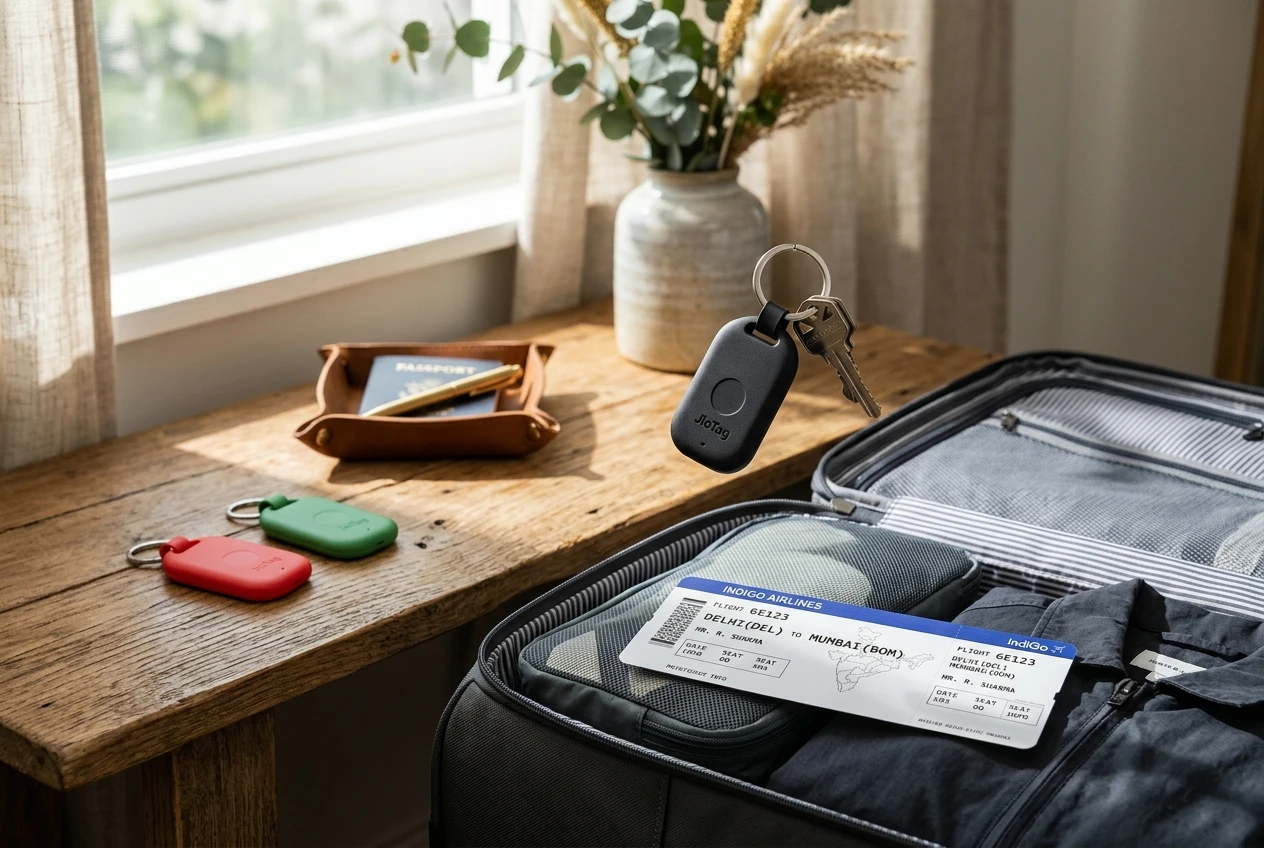
Bank offers can drop it to Rs 1,199. It ships in black, red and green with a redesigned shape built from polycarbonate and rated IP64.
Price Drop and Core Specs Arrive Together
The tag is listed as JioTag 2nd Gen and sold only through Amazon India at launch. It attaches via a built-in loop to keys, wallets, luggage or bags.
Key hardware points include a built-in speaker that hits 120 dB, Bluetooth Low Energy for nearby finding, and a replaceable battery rated for up to one year with a spare cell in the box. No SIM and no subscription are required.
- Native pairing to Apple Find My on iPhone and iPad
- Native pairing to Google Find Hub on Android
- Community network location when out of Bluetooth range
- IP64 dust and splash resistance
- Polycarbonate body, ultra-compact form with attachment loop
FoneArena notes the same global community locating that powers both major phone networks, giving semi-real-time updates without cellular hardware.
How the Dual Networks Work
Inside Bluetooth range the phone triggers the 120 dB buzzer or shows a simple direction cue. Outside that bubble the tag beacons anonymously. Nearby phones on the matching network pick up the signal and relay an encrypted location back to the owner.
Apple users stay inside Find My. Android users stay inside Find Hub. Setup is a short native flow on either side. Earlier Jio models forced a choice or relied on a separate JioThings app that limited reach.
The Google Find Hub crowdsourced network draws on more than a billion Android devices. Apple’s side already counts over a billion iPhones, iPads and Macs. One physical tag can now ride either highway.
From Split Tags to One Device
Jio’s tracker story started in June 2023 with the original JioTag. It launched at an MRP of Rs 2,199 and sold as low as Rs 749. It claimed dual support and a community find feature, yet real-world reach stayed limited compared with Apple’s network.
- June 2023: Original JioTag debuts as the cheap AirTag alternative, 9.5 g, roughly 38 mm square, one-year battery, extra cell and lanyard included.
- July 2024: JioTag Air arrives at Rs 1,499 focused on Apple Find My (plus optional JioThings), Bluetooth 5.3, 90-120 dB speaker, IP-style durability, 10 g polycarbonate.
- December 2024: JioTag Go launches at the same Rs 1,499 price for Google’s Android network only.
- Late July 2026: JioTag 2 unifies both networks in a single Rs 1,249 unit with refreshed design and IP64 rating.
The split-era products forced mixed households to buy two tags or pick a side. JioTag 2 collapses that choice.
Mixed Homes Finally Get a Practical Option
India’s phone market is not pure Android or pure iOS. Many families run both. A parent on an iPhone and a teenager on a Samsung previously had no clean shared tracker. Apple’s AirTag locked them out of Android. Pure Android tags locked out the iPhone.
Jio’s own site already leaned into the mixed-device household tracking pitch for its earlier Go and Air models. JioTag 2 delivers the hardware that matches the claim. One tag can be set up by whoever finds the keys first.
Crowd posts on X immediately zeroed in on the price-plus-dual combination. Several asked aloud whether first-generation accuracy held up outdoors; that question still sits with the density of the two crowdsourced networks rather than the tag itself.
Where It Stands Against AirTag and Older Jio Tags
Apple still owns Precision Finding via Ultra Wideband and a louder speaker generation. Its latest AirTag starts at $29 (roughly Rs 2,400-plus depending on exchange and local pricing that once hit Rs 3,190) and carries an IP67 rating. JioTag 2 trades UWB direction arrows for dual-platform reach and a lower entry price.
| Feature | JioTag 2 | Apple AirTag | Earlier Jio Air/Go |
|---|---|---|---|
| Launch price (India) | Rs 1,249 | ~$29 / historically ~Rs 3,190 | Rs 1,499 |
| Network | Apple Find My + Google Find Hub | Apple Find My only | One network each |
| Water/dust | IP64 | IP67 | Varies / not always stated |
| Speaker | 120 dB | Improved louder generation | 90-120 dB |
| Battery | Replaceable, up to 1 year + spare | CR2032, more than 1 year | CR2032-class, 12 months + spare |
| Precision Finding | No UWB | Yes, second-gen UWB | No |
| SIM / subscription | None | None | None |
The table shows the clear trade: Jio wins on price and platform freedom; Apple keeps the polished nearby-finding experience and higher water resistance. Users who need AirTag Precision Finding and IP67 rating will still pay the premium. Everyone else in a mixed home now has a cheaper dual door.
Battery, Build and the Practical Limits
TelecomTalk flags a non-standard battery cell, while other coverage and Jio’s prior models point to a user-replaceable coin cell with a spare in the box. Expect roughly a year of daily use before a swap. The polycarbonate shell and IP64 rating handle dust and light splashes but not full submersion the way IP67 AirTags can.
Stats at a glance
- Rs 1,249 street price (Rs 1,199 with bank offer)
- 120 dB maximum buzzer output
- IP64 dust and splash protection
- No recurring fee once purchased
Global community locating depends on other people carrying compatible phones nearby. Dense cities work better than remote roads. Lost Mode and left-behind alerts are present, yet the tag lacks Apple’s NFC tap-to-contact card or UWB arrows.
Early X reaction treats the dual support and sub-Rs 1,300 price as the real story. Questions about first-gen tracking accuracy remain the open variable that only denser network participation will answer.
Frequently Asked Questions
Does JioTag 2 work with both Find My and Find Hub at the same time?
No. You pair it to one network during setup. An iPhone user stays in Find My; an Android user stays in Find Hub. The same physical tag can be reset and moved to the other ecosystem later if ownership changes, but it does not beacon on both networks simultaneously.
What battery does the JioTag 2 use and how long does it last?
Coverage describes a user-replaceable cell rated for up to one year of normal use, with a spare included in the retail box. Some posts cite two years total with the spare. Exact chemistry is listed as non-standard by one outlet, while prior Jio tags used CR2032-class coin cells that swap in seconds without tools.
Is IP64 enough for daily carry and travel?
IP64 protects against dust ingress and water splashes from any direction. It is fine for keys in a pocket, a bag in light rain, or airport handling. It is not rated for swimming, washing-machine accidents or prolonged submersion the way Apple’s IP67 AirTag is.
How does JioTag 2 compare on price to a single AirTag in India?
JioTag 2 lands at Rs 1,249 (or Rs 1,199 with offers). Apple AirTag pricing has floated near Rs 3,190 historically and currently starts at $29 internationally before local taxes and conversion. The dual-network capability is the factor that makes the lower price more than a simple discount.
Can airlines or family members help locate a lost JioTag 2?
Both major networks now support temporary location sharing with airlines and trusted contacts. Find Hub and Find My each let an owner generate a short-lived link. Sharing ends automatically after recovery or a set period, usually seven days.
JioTag 2 is available now on Amazon India in three colours. The dual-network bet is live.

-
 TECH1 year ago
Where Garmin Watches are Made and How They are Assembled
-

 AUTO3 months ago
Tesla’s Roadster Is ‘a Few Weeks Away,’ Says Its Chief Designer
-
 NEWS10 years ago
Samsung Releases Galaxy Note7 TV Ad as Reddit AMA Leaks Specs
-
 NEWS10 years ago
Android 7.0 Nougat Rolls Out To Nexus Devices With New Emoji, Features
-
 FINANCE9 years ago
Cardano Price Surges as ADA Enters the Crypto Top Ten List
-
 NEWS10 years ago
Pre-Order the First Camera Made for Facebook Live Streaming Video
-
 FINANCE1 year ago
Binance Suspends Trading and Withdrawals for a System Upgrade
-
 FINANCE9 years ago
RChain Price Jumps Nearly 150% to a New All-Time High of $2.03