
BUSINESS
Hindalco Record Profit Funds Downstream Bet as Debt Climbs
Hindalco posts all-time high Q1 profit and EBITDA as aluminium prices and Novelis recovery fund a debt-lifting downstream expansion pipeline.

Hindalco Industries reported a record consolidated net profit of ₹7,013 crore for the quarter ended June 30, 2026, up 75% from ₹4,004 crore a year earlier, as revenue climbed 32% to ₹84,825 crore. Every major segment hit all-time high EBITDA, powered by aluminium prices and a Novelis rebound, even after a ₹2,299 crore exceptional charge.
The print looks clean on the surface. Underneath sits a higher-leverage balance sheet and a deliberate push into downstream assets that those macro and operational gains are now financing.
The quarter therefore reads as two stories at once. One is the pure operating beat: volume stability in India aluminium, by-product strength in copper, and a staged recovery at Novelis. The other is the balance-sheet choice to keep funding multi-year capacity while the cash window stays open.
Every Segment Hit a New Peak
Consolidated EBITDA reached all-time high quarterly consolidated EBITDA at ₹14,989 crore, up 73%. EPS rose 75% to ₹31.58. The company, the metals flagship of the Aditya Birla Group, said favourable macros, resource security and operational excellence drove the milestone.
| Metric | Q1 FY26 | Q1 FY27 | Growth |
|---|---|---|---|
| Revenue (₹ Cr) | 64,232 | 84,825 | 32% |
| EBITDA (₹ Cr) | 8,673 | 14,989 | 73% |
| PAT (₹ Cr) | 4,004 | 7,013 | 75% |
| Al Upstream EBITDA (₹ Cr) | 4,080 | 7,390 | 81% |
| Copper EBITDA (₹ Cr) | 673 | 918 | 36% |
| Novelis Adj. EBITDA (₹ Cr) | – | 4,875 | 37% |
Aluminium upstream shipments rose to 335 kt from 325 kt. Revenue there jumped 44% to ₹13,403 crore. EBITDA per tonne hit $2,331, up 59%, with margins at 55%. Downstream aluminium sales reached 104 kt, revenue ₹4,889 crore up 46%, and EBITDA a record ₹298 crore.
Copper metal sales fell 16% to 105 kt after planned smelter maintenance, yet revenue rose 16% to ₹17,232 crore and EBITDA set a record at ₹918 crore on stronger by-product realisations such as sulphuric acid.
The breadth matters as much as the peaks. Upstream aluminium supplied the largest absolute EBITDA block. Copper proved that a volume dip need not cap earnings when by-product prices cooperate. Novelis showed that a restart and cost programme can lift unit margins even while shipments remain below the prior year.
- India aluminium upstream: 335 kt shipments, 55% EBITDA margin, largest segment contribution
- India aluminium downstream: 104 kt sales, record ₹298 crore EBITDA
- Copper: 105 kt metal sales after maintenance, record ₹918 crore EBITDA
- Novelis: 916 kt shipments, $563 EBITDA per tonne on the adjusted measure
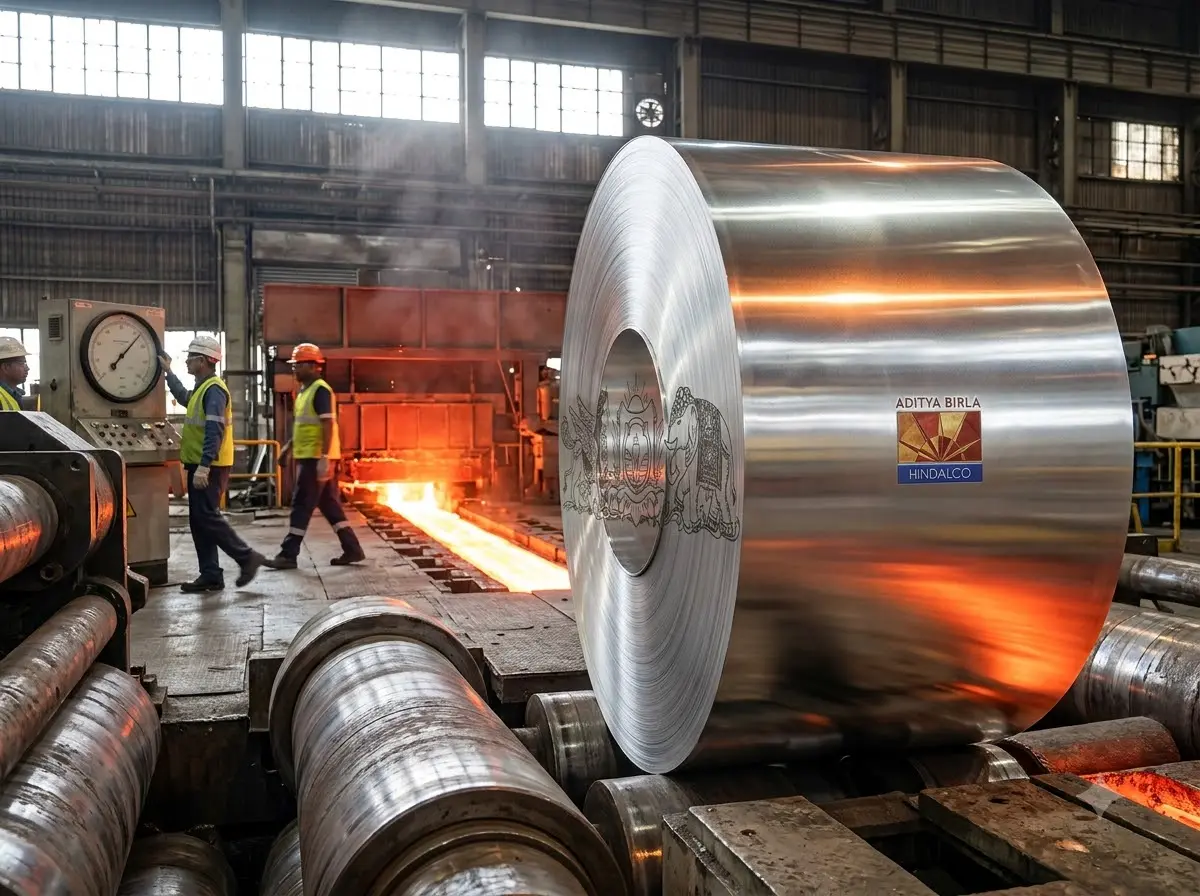
The Aluminium Price Shock That Paid the Bills
London Metal Exchange aluminium averaged $3,577 per tonne in the quarter, up from $2,447 a year earlier, according to the company’s investor materials cited across coverage. Hindalco linked the jump to the largest-ever supply shock from the West Asia conflict.
That price move flowed straight into upstream margins. India aluminium upstream delivered the single largest EBITDA contribution and the steepest percentage gain. The temporary scarcity premium effectively bankrolled both the exceptional charge absorption and continued capital spending.
Copper also benefited from higher realisations even as volumes dipped. The diversified metals mix limited any single-metal exposure.
Put the price ladder beside the margin ladder and the transmission is plain. A move from $2,447 to $3,577 per tonne on the LME coincided with India upstream EBITDA per tonne rising 59% to $2,331 and segment margins reaching 55%. Shipment growth of only 10 kt, from 325 kt to 335 kt, shows that price, not volume, did the heavy lifting.
That same cash generation is what let the group absorb a ₹2,299 crore net exceptional expense and still post a 75% rise in consolidated PAT. Without the scarcity premium, either the charge or the growth spend would have weighed far more visibly on the headline.
Novelis Restart and the Hidden Charge
Novelis, the US-based rolled-products subsidiary, posted adjusted EBITDA of $516 million (₹4,875 crore), up 24-37% depending on the reporting basis, on revenue of $5.8 billion. Shipments eased to 916 kt from 963 kt. EBITDA per tonne climbed to $563 from $432.
The Oswego hot mill restarted and now ramping up after fires in late 2025. Production resumed in June. Cost-optimisation programmes delivered more than $225 million in run-rate savings by quarter-end. Bay Minette commissioning is underway, with commercial shipments targeted for Q1 FY28.
- Oswego hot mill: restarted June 2026, production ramping
- Insurance recoveries: recognised through the quarter, netting an $18 million benefit after fire impacts in some tallies
- Shipments: still below prior-year levels due to residual disruption
- Bay Minette: on track for first commercial metal in early FY28
The consolidated numbers absorbed a ₹2,299 crore net exceptional expense, widely linked on market desks to Oswego fire costs and related items. Strip that out and pre-tax profit growth looks closer to a double. X-based analysts flagged the underlying run-rate as stronger than the headline 75% PAT rise.
Hindalco has started FY27 on a strong note, delivering record Revenue, EBITDA and PAT, with every business segment contributing meaningfully to this performance.
Satish Pai, Managing Director, said the India business set another record while Novelis improved on the Oswego restart and cost measures.
Unit economics tell the recovery story more cleanly than shipment totals. EBITDA per tonne at Novelis moved from $432 to $563 even as volumes stayed soft at 916 kt against 963 kt a year earlier. The gap between lower tonnes and higher unit profit is the combined effect of the hot-mill restart, insurance recoveries and the cost programme already past $225 million in run-rate savings.
Leverage Climbed to Fund the Next Leg
Consolidated net debt to EBITDA stood at 1.95x on June 30, 2026, versus 1.02x a year earlier. Novelis leverage reached about 4.5x on some brokerage calculations, a 24-quarter high, reflecting fire-related cash needs, working capital and heavy Bay Minette capex.
Management has guided toward moderation in the second half of FY27 as Oswego ramps, insurance continues and free cash flow turns positive at Novelis by year-end. The company remains committed to keeping consolidated leverage near 2x over time.
The rise is not distress. It is the visible cost of the growth assets now coming online. Higher aluminium cash flows gave Hindalco the room to keep spending through the disruption.
| Leverage Measure | Level | Context |
|---|---|---|
| Consolidated net debt / EBITDA | 1.95x | Up from 1.02x a year earlier |
| Novelis leverage (broker calc.) | ~4.5x | 24-quarter high |
| Stated longer-term aim | Near 2x | Consolidated, over time |
The path back toward that 2x band depends on three moving parts already flagged by management: Oswego volume ramp, further insurance inflows, and Novelis free cash flow turning positive by the end of FY27. Until those land, the higher ratio is the price of not pausing Bay Minette and the wider India project list.
Where the Capital Is Going
Pai pointed to a full pipeline. Aditya Smelter Phase 2 is on track for metal in FY28. Downstream projects include the Aditya FRP plant scaling up, battery foil and battery enclosure capacity, coated AC fins at Taloja, and copper tubes plus inner-grooved tubes already operational.
A copper and e-waste recycling project is due to commission in FY27. On the energy side, Hindalco operationalised a 65 MW round-the-clock renewable project at Aditya Aluminium, the only such captive plant in India. Waste utilisation hit 80%, water recycling 29%, and the company planted 80,000 saplings in the quarter.
Hindalco has held the title of world’s most sustainable aluminium company in the S&P Global CSA for six straight years through 2025.
These moves deepen the integrated model: captive resources and power upstream, higher-value rolled products, packaging, auto and battery materials downstream, plus recycling loops. The pipeline of strategic investments remains robust across both ends of the chain.
- Late 2025: Oswego fires disrupt Novelis rolled-products output
- June 2026: Oswego hot mill restarts and begins ramp
- FY27: Copper and e-waste recycling project due to commission
- Q1 FY28: Bay Minette targeted for first commercial shipments
- FY28: Aditya Smelter Phase 2 on track for metal
Read as a sequence, the dates show why leverage was allowed to rise now. Cash is being spent ahead of the FY28 volume steps, while the aluminium price spike and the early Novelis recovery still cover the gap.
How Upstream Cash Underwrites Downstream Growth
The mechanism linking the quarter’s earnings to the project list is straightforward. India aluminium upstream EBITDA of ₹7,390 crore, up 81%, and consolidated EBITDA of ₹14,989 crore created room to carry both the ₹2,299 crore exceptional charge and elevated growth capex without cutting the pipeline.
Downstream aluminium already shows the direction of travel. Sales of 104 kt produced revenue of ₹4,889 crore, up 46%, and a record ₹298 crore of EBITDA. That is still a fraction of upstream profit, yet it is the layer management is expanding through FRP, battery foil, battery enclosures and coated AC fins.
Novelis sits on the same logic at larger scale. Adjusted EBITDA of ₹4,875 crore arrived while shipments were still rebuilding and while Bay Minette commissioning continued. The more than $225 million in run-rate cost savings and the $18 million net insurance benefit improved unit returns before the next tranche of US capacity arrives.
Copper adds a third leg. Even with metal sales down 16% to 105 kt after planned maintenance, EBITDA rose to a record ₹918 crore on by-product realisations. That pattern reduces the need for every tonne of primary metal to carry the growth story alone.
Together the pieces describe an integrated bet: use a high-price, high-margin upstream quarter to keep funding rolled products, packaging, auto and battery materials, plus recycling, so that future cycles lean less on pure LME moves.
What Broker Targets Signal About the Trade-Off
Broker notes after Novelis’s earlier print and the consolidated release clustered around target prices from ₹1,075 to ₹1,240, with most houses constructive on the recovery path even while flagging debt. Shares moved higher on the day in line with the operational beat.
The range itself is a map of the debate. The constructive end assumes aluminium prices stay supportive long enough for Oswego to normalise and for Bay Minette commercial shipments to begin in Q1 FY28. The more cautious end treats Novelis leverage near 4.5x and consolidated net debt to EBITDA at 1.95x as constraints that only ease once free cash flow at Novelis turns positive by year-end.
Neither camp disputes the operating facts. Every major segment posted record EBITDA. Upstream margins hit 55%. Novelis EBITDA per tonne rose to $563. The split is over how quickly those earnings convert into a lower leverage ratio while the project list keeps running.
For equity holders the practical test is simple. If the scarcity premium in aluminium fades before Aditya Smelter Phase 2 and Bay Minette add volume, the 1.95x consolidated ratio and the Novelis peak leverage become the lasting headline. If the assets ramp on the guided timetable, the same debt financed a shift toward higher-value products rather than a one-quarter windfall.
What the Quarter Locks In
The 75% profit jump and 81% upstream EBITDA surge will dominate the first headlines. The second-order effect is clearer in the balance-sheet and project list. A supply-driven price spike and a hard-fought plant restart generated the cash and confidence to push leverage higher in service of multi-year capacity that reduces reliance on pure commodity cycles.
Broker notes after Novelis’s earlier print and the consolidated release clustered around target prices from ₹1,075 to ₹1,240, with most houses constructive on the recovery path even while flagging debt. Shares moved higher on the day in line with the operational beat.
If aluminium prices stay elevated and Oswego plus Bay Minette deliver volume, the leverage ratio should ease while margins broaden into value-added products. If the supply shock fades faster than the new assets ramp, the higher debt becomes the story that lingers. For now the company has used a strong quarter to buy time and assets rather than simply report them.
The sustainability markers sit alongside that financial choice. A 65 MW round-the-clock renewable project at Aditya Aluminium, waste utilisation at 80%, water recycling at 29%, and 80,000 saplings planted in the quarter all reinforce the same integrated model the growth capex is building. Six straight years as the world’s most sustainable aluminium company in the S&P Global CSA through 2025 is the external scorecard on that effort.
What the quarter locks in, then, is permission. Permission to carry leverage near the top of the comfort zone, permission to keep the FY27 and FY28 project calendar intact, and permission to treat a supply-shock windfall as bridge capital rather than surplus to be returned at once.
Frequently Asked Questions
What drove Hindalco’s 75% jump in Q1 net profit?
Record EBITDA across aluminium upstream (up 81% to ₹7,390 crore), copper (up 36% to ₹918 crore) and Novelis (adjusted EBITDA up 37% to ₹4,875 crore), combined with a 32% revenue rise, more than offset a ₹2,299 crore exceptional charge linked to the earlier Oswego disruption.
How much did aluminium prices rise in the quarter?
LME aluminium averaged $3,577 per tonne versus $2,447 in the year-ago quarter, a move Hindalco tied to West Asia supply disruption; the higher realisations lifted India upstream EBITDA per tonne 59% to $2,331.
What is the status of Novelis’s Oswego plant?
The hot mill restarted in June 2026 after fires in late 2025 and is now ramping production; insurance recoveries and cost savings have already improved the quarterly adjusted EBITDA per tonne to $563.
When will Bay Minette start commercial shipments?
Commissioning is underway and Novelis expects commercial shipments to begin in Q1 FY28, adding recycled and low-carbon rolling capacity in the United States.
Why did Hindalco’s net debt to EBITDA rise?
The ratio moved to 1.95x from 1.02x a year earlier mainly because of Novelis cash needs around the Oswego recovery, working capital and heavy capital expenditure on Bay Minette and other growth projects.

-
 TECH1 year ago
Where Garmin Watches are Made and How They are Assembled
-

 AUTO3 months ago
Tesla’s Roadster Is ‘a Few Weeks Away,’ Says Its Chief Designer
-
 NEWS10 years ago
Samsung Releases Galaxy Note7 TV Ad as Reddit AMA Leaks Specs
-
 NEWS10 years ago
Android 7.0 Nougat Rolls Out To Nexus Devices With New Emoji, Features
-
 FINANCE9 years ago
Cardano Price Surges as ADA Enters the Crypto Top Ten List
-
 NEWS10 years ago
Pre-Order the First Camera Made for Facebook Live Streaming Video
-
 FINANCE1 year ago
Binance Suspends Trading and Withdrawals for a System Upgrade
-
 FINANCE9 years ago
RChain Price Jumps Nearly 150% to a New All-Time High of $2.03