
NEWS
Rahul Gandhi’s Dharna Win Carries Its Own Political Cost
Seven-hour sit-in forced pellet FIR for Sahil Lochab and boosted Rahul Gandhi after CJP protests.

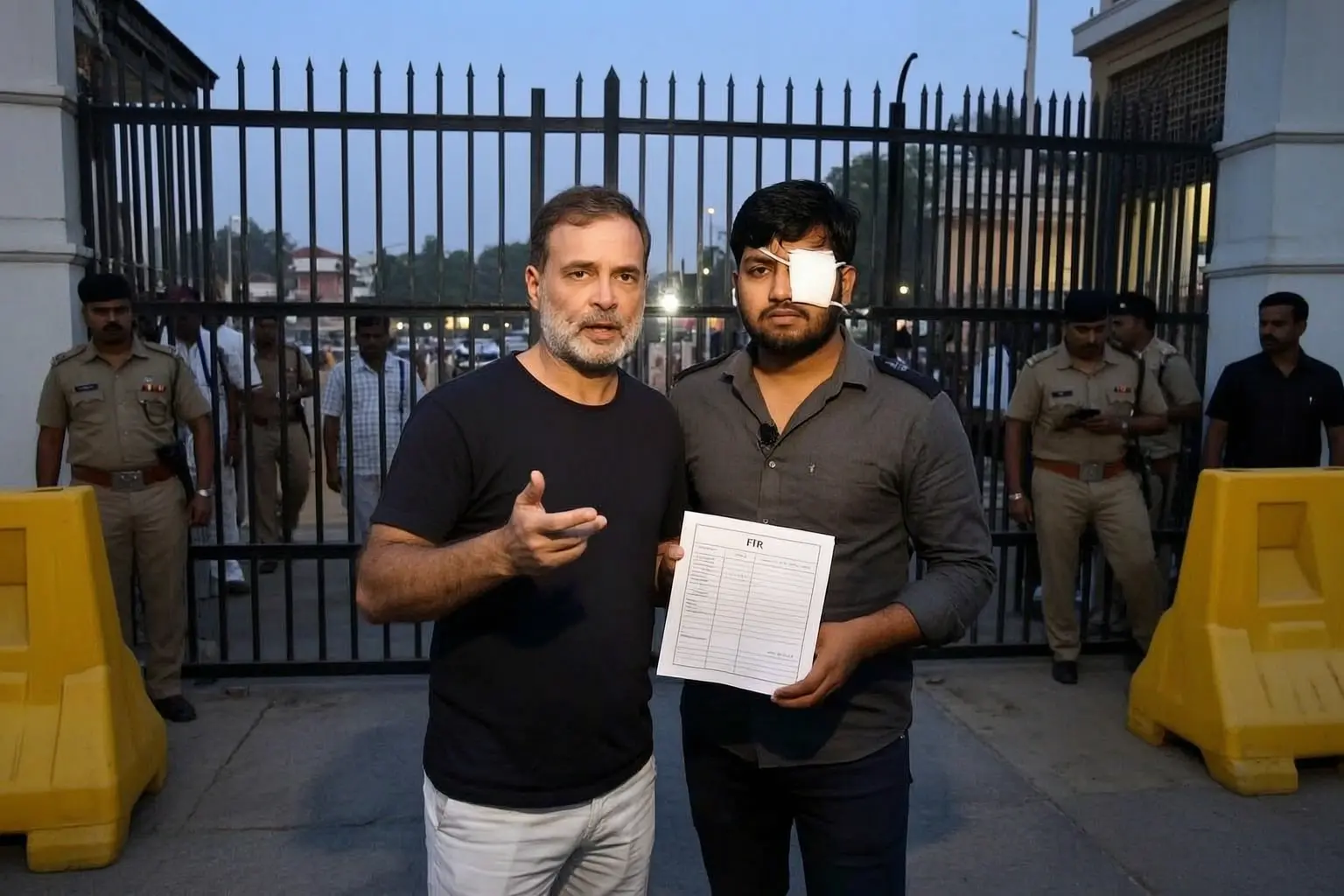
Rahul Gandhi ended a seven-hour sit-in at Delhi’s Parliament Street police station on 21 August only after officers registered an FIR for the pellet injuries suffered by 19-year-old student Sahil Lochab. The televised capitulation, after weeks of police refusal, gave the Leader of the Opposition a rare street victory against a government that rarely bends.
The moment capped a month in which a youth-led revolt over exam leaks first forced a Cabinet resignation and then handed Gandhi fresh political oxygen. It also exposed the frictions that come when the Congress leader moves to claim the spotlight.
What followed was less a sudden conversion by the police than a public stacking of pressure. Medical papers, a mother’s complaint, a sister’s presence and live cameras left little room for another quiet refusal. The episode also showed how quickly a single documented injury can reopen a larger fight over force, exams and accountability.
Seven Hours Outside the Parliament Street Station
Lochab, a School of Open Learning student at Delhi University, was among the protesters hit during the 20 July Chalo Sansad march. Medical records he carried showed more than 200 pellets in his body, three in one eye. Doctors put the chance of vision returning in that eye at under one percent. Some pellets sat near his heart and could not be removed.
He and his mother had submitted a seven-page complaint on 14 August and returned repeatedly to Connaught Place, Mandir Marg and Sansad Marg stations without an acknowledgement or IO number. On 21 August Gandhi escorted them first to Mandir Marg, then to the DCP New Delhi office at Parliament Street. When officers still declined, he sat down with Lochab, his mother and sister Priyanka Gandhi Vadra and refused to leave.
Congress workers climbed the gates. Barricades went up. In the evening police registered the case under Sections 118(1) and 125 of the Bharatiya Nyaya Sanhita against unknown persons for voluntarily causing hurt with dangerous weapons and endangering life. Gandhi called it only the first step towards justice and said the final order had come from the Union Home Ministry.
Sahil’s FIR has finally been registered. But the way it happened, you must see this.
Rahul Gandhi, X post, 22 August 2026
He later shared a video of how the FIR was registered. A general diary entry at the station had already recorded that Rapid Action Force personnel fired two rounds from an anti-riot gun on a DCP’s orders; a CRPF inquiry reportedly found seven rounds, five of which struck protesters. Delhi Police had earlier denied using pellets.
The gap between those records mattered. A diary note and a CRPF finding had already undercut the public denial. Still, no FIR had issued until the sit-in made further delay costly. Naming unknown persons kept the file alive without yet fixing responsibility on any officer or unit. For Lochab’s family, the paper was the first formal recognition after days of closed counters. For the opposition, it was proof that sustained presence outside a station could move a bureaucracy that ordinary visits had not.
How the Cockroach Protests Cracked the Government
The FIR drama sat on top of a larger rupture. The Cockroach Janta Party began as online satire after Chief Justice Surya Kant compared unemployed youth to cockroaches in May. By mid-June it had a physical sit-in at Jantar Mantar demanding Education Minister Dharmendra Pradhan’s resignation over the NEET-UG paper leak and CBSE marking failures that left millions of students in limbo and were linked to more than a dozen suicides.
- 20 June 2026: Extended mobilisation begins at Jantar Mantar.
- 28 June: Sonam Wangchuk joins and starts an indefinite hunger strike; six AISA students join him.
- 18 July: Police remove Wangchuk to hospital; CJP leaders begin their own fast.
- 20 July: Tens of thousands attempt the Chalo Sansad march. Police use lathis, tear gas and pellets. Officials report 118 personnel injured; hospital sources put protester injuries above 100.
- 23-24 July: Wangchuk ends his fast after written assurances from ministers JP Nadda and Jitendra Singh.
- 25 July: Pradhan resigns. CJP calls off the 36-day agitation after commitments on compensation of ₹1 crore per affected family and withdrawal of FIRs against peaceful protesters.
The full timeline of the 2026 protests shows the first time mass pressure forced one of Modi’s senior ministers out. Congress kept its distance early, wary that CJP might be linked to AAP. Gandhi joined the day after the crackdown with a protest outside the prime minister’s residence. From that point the opposition, with Modi and Shah largely absent from the Lok Sabha, dominated the monsoon session.
The sequence rewarded persistence more than party labels. Satire became a sit-in. A hunger strike drew wider notice. The march and the force used against it shifted the story from exam administration to state response. Written assurances and a resignation followed only after that climb in cost. Congress entered late, then moved quickly to occupy the parliamentary space the protests had opened.
From Amethi Defeat to Dual Wins in 2024
Gandhi’s standing had been low for years. He lost Amethi in 2019, faced constant lampooning, and heard repeated calls for the family to quit Congress leadership. The 2024 election reversed the slide. According to the 2024 Lok Sabha statistical reports, the BJP fell to 240 seats, short of a majority. Congress rose to 99. Gandhi won both Wayanad and Rae Bareli while Modi’s Varanasi margin shrank.
| Party | Seats Won | Vote Share |
|---|---|---|
| BJP | 240 | 37.02% |
| INC | 99 | 21.46% |
| SP | 37 | 4.64% |
| AITC | 29 | 4.43% |
| DMK | 22 | 1.84% |
The NDA still formed the government with allies. But the result ended the theory that pitting Gandhi against Modi automatically favoured the prime minister. Internal Congress discontent quieted. Gandhi stayed on the offensive in Parliament even as the opposition alliance later floundered in state polls.
Dual wins gave him a personal mandate the Amethi loss had stripped away. A larger Congress bench gave that mandate institutional weight. The seat arithmetic still left the NDA in office, yet it changed the tone of daily combat in the Lok Sabha. Street moments such as the Parliament Street sit-in now landed on a leader already treated as the opposition’s central face rather than a figure under constant internal doubt.
Silent Rifts With the Youth Movement and AAP
The same aggression that now draws applause also sharpens old wounds. AAP leaders accused Congress of collusion after Gandhi’s protest outside the PM’s residence. Atishi asked how Rahul could reach Lok Kalyan Marg when CJP marchers were stopped within 100 metres of Parliament. Sanjay Singh called it a BJP-orchestrated move to weaken the student agitation. Congress replied that it was amplifying the students’ cause.
- CJP spokespeople have stressed their protest stayed at Jantar Mantar and that the party is not leading every subsequent school protest.
- Pro-Congress YouTube voices have begun framing Gandhi as the new youth magnet who has already dimmed CJP.
- Congress dumped the DMK after Vijay’s TVK won Tamil Nadu, shocking even neutral observers given the Dravidian party’s long loyalty.
- Party leaders have shown little distress when agencies move against AAP or CPI(M) figures.
The columnist M R Narayan Swamy, no long-time Gandhi admirer, notes the danger plainly: Gandhi scores because he is Leader of the Opposition and heads the largest opposition party. Hogging the limelight after joining late risks eclipsing the cockroaches who first punctured the government’s image. Student anger over government schools also carries historical baggage; the quality of those schools deteriorated under earlier Congress rule, a fact AAP later exploited in Delhi.
Those rifts run on parallel tracks. CJP wants credit for the first puncture. AAP wants recognition for reach and restraint at Jantar Mantar. Congress wants the national frame. Each claim can be true in part and still crowd the others out when cameras settle on one surname.
Why Sonia Gandhi’s Pre-2014 Approach Still Matters
Sonia Gandhi built the UPA by accommodating allies even when it cost Congress seats or prestige. The current leadership has taken a harder line against parties it sees as spoilers in state after state. That stance may feel satisfying in the short run. It leaves the broader anti-incumbency front thinner precisely when the government looks vulnerable.
The BJP’s decision to celebrate Pradhan after his exit and to pursue cases against Jantar Mantar protesters has helped Gandhi win public sympathy. So has the online trolling of injured students. None of that substitutes for a coalition that can convert street heat into parliamentary numbers and state governments.
Accommodation once traded local pride for national reach. The harder line protects the Congress brand in head-to-head state fights. It also leaves fewer partners ready to pool anti-incumbency when a moment like the exam-leak revolt opens a gap. Sympathy after a sit-in travels fast. Seat shares still move through alliances.
The Supreme Court Panel and Unanswered Questions on Pellets
On 20 August the Supreme Court constituted a five-member high-powered enquiry committee headed by former judge R Subhash Reddy. Its brief covers the proportionality of force on 20 July, the use of pellets, lathis, tear gas and electric batons, injuries on both sides, and whether metallic kinetic projectiles should be banned for crowd control.
- Protester injuries: hospital sources reported more than 100; one CJP member suffered a broken leg; Lochab’s case is the most documented vision loss.
- Police claim: 118 personnel hurt, 15-20 vehicles damaged.
- Ammunition: RAF general diary and CRPF inquiry confirm pellet rounds were fired despite earlier public denials.
- Mandate: the panel will also examine protester violence and damage to public property.
| Side | Reported Harm | Source in Public Record |
|---|---|---|
| Protesters | More than 100 injured; vision loss in Lochab’s case; one broken leg | Hospital sources; medical records; CJP accounts |
| Police | 118 personnel injured; 15-20 vehicles damaged | Official claim |
| Ammunition trail | Two rounds in RAF diary; seven rounds in CRPF inquiry; five striking protesters | Station diary; CRPF inquiry |
Nadda dismissed Gandhi’s sit-in as camera-centric drama and pointed to the court process already under way. The FIR itself names no accused. Accountability for who ordered the firing, and under what rules, remains open.
The panel and the FIR now run on separate clocks. One can map weapons, orders and injuries across both sides. The other keeps a criminal file open without yet naming an officer. Together they lock the 20 July record into official process. Neither, on present terms, settles who gave the fire order or whether pellets stay lawful for crowd control.
How the Monsoon Session Amplified the Street
Once Gandhi joined after the crackdown, the opposition found an open field in the Lok Sabha. Modi and Shah were largely absent. The exam leaks, the march injuries and the minister’s exit filled the vacuum. Street timelines and parliamentary attacks began to reinforce each other rather than compete for attention.
That loop is fragile. Session calendars end. Cameras move. Without allies who can carry the same fight in state capitals, a strong fortnight in Delhi risks fading into another cycle of protest and denial. The monsoon phase showed what dominance looks like when the treasury benches leave space. It did not show how long such space lasts.
Why a Single FIR Rarely Ends the Fight
Registration under Sections 118(1) and 125 created a case where weeks of complaint had produced none. It did not identify who fired, who ordered the rounds, or how the earlier public denial of pellets would be reconciled with the diary and the CRPF count. Unknown persons remain the accused.
For the family, the document is a door that had stayed shut. For the government, it is a contained concession after a televised standoff. For the opposition, it is evidence that presence and publicity can still force paper into a file. The harder work sits beyond that paper: rules on kinetic projectiles, compensation already promised at Jantar Mantar, and a political front wide enough to keep those demands alive when the sit-in ends.
Gandhi has shown he can force the state to act for an ordinary citizen when cameras are rolling. The larger test is whether that skill builds a wider democratic front or simply recentres every protest around one family name. The CJP’s original organisers, the AAP, and regional allies will decide how much space they still concede.

-
 TECH1 year ago
Where Garmin Watches are Made and How They are Assembled
-

 AUTO3 months ago
Tesla’s Roadster Is ‘a Few Weeks Away,’ Says Its Chief Designer
-
 NEWS10 years ago
Samsung Releases Galaxy Note7 TV Ad as Reddit AMA Leaks Specs
-
 NEWS10 years ago
Android 7.0 Nougat Rolls Out To Nexus Devices With New Emoji, Features
-
 FINANCE9 years ago
Cardano Price Surges as ADA Enters the Crypto Top Ten List
-
 NEWS10 years ago
Pre-Order the First Camera Made for Facebook Live Streaming Video
-
 FINANCE1 year ago
Binance Suspends Trading and Withdrawals for a System Upgrade
-
 FINANCE9 years ago
RChain Price Jumps Nearly 150% to a New All-Time High of $2.03