
FINANCE
UPI Fee Power Shift Leaves Taxpayers and Cash Risks Exposed
Lok Sabha bill unlocks possible MDR on high-value UPI deals for big merchants, raising pass-through and cash-revival risks after years of taxpayer subsidies.

Lok Sabha has passed a bill that lets the Centre decide which electronic payments stay free of charges, opening the door to a Merchant Discount Rate on some UPI deals. No fee is live yet. Government sources point to large merchants with turnovers above ₹1 crore to ₹1.5 crore and transactions above ₹2,000, a slice officials peg at roughly 5 percent of volume but nearly 65 percent of value.
The change arrives after six years of zero-MDR rules that helped turn UPI into the world’s largest real-time system. The second-order question is whether even a narrow fee will push high-value payments back toward cash or simply raise prices that customers eventually pay.
What the Bill Changes
The Taxation and Other Laws (Amendment) Bill, 2026, alters Section 10A of the Payment and Settlement Systems Act, 2007. Until now the zero-charge rule was locked to electronic modes listed under the Income-tax Act, which covered UPI and RuPay debit cards. The new language lets the Central Government notify “one or more electronic modes of payment” that remain protected from direct or indirect charges.
In plain terms, the government gains flexibility. It can keep most of UPI free while carving out categories that banks and payment providers may bill. The bill does not set any rate, threshold or start date. Those decisions come later by notification after the law is gazetted.
- Lok Sabha cleared the measure without debate as part of a wider taxation package.
- The ban on charges stays in force until a fresh notification carves exceptions.
- Person-to-person transfers are expected to stay outside any MDR frame.
- Small merchants are repeatedly described as protected under the current thinking.
Finance Minister Nirmala Sitharaman has stressed that any MDR would fall on merchants, not end users, and would give banks and fintechs room to invest in infrastructure, innovation and security.
The shift from a statute-locked ban to a notification-based shield is the core legal move. Once gazetted, the Centre can redraw the free perimeter without returning to Parliament for each adjustment. That design keeps everyday rails open while leaving room to test limited commercial charging on defined slices of traffic.
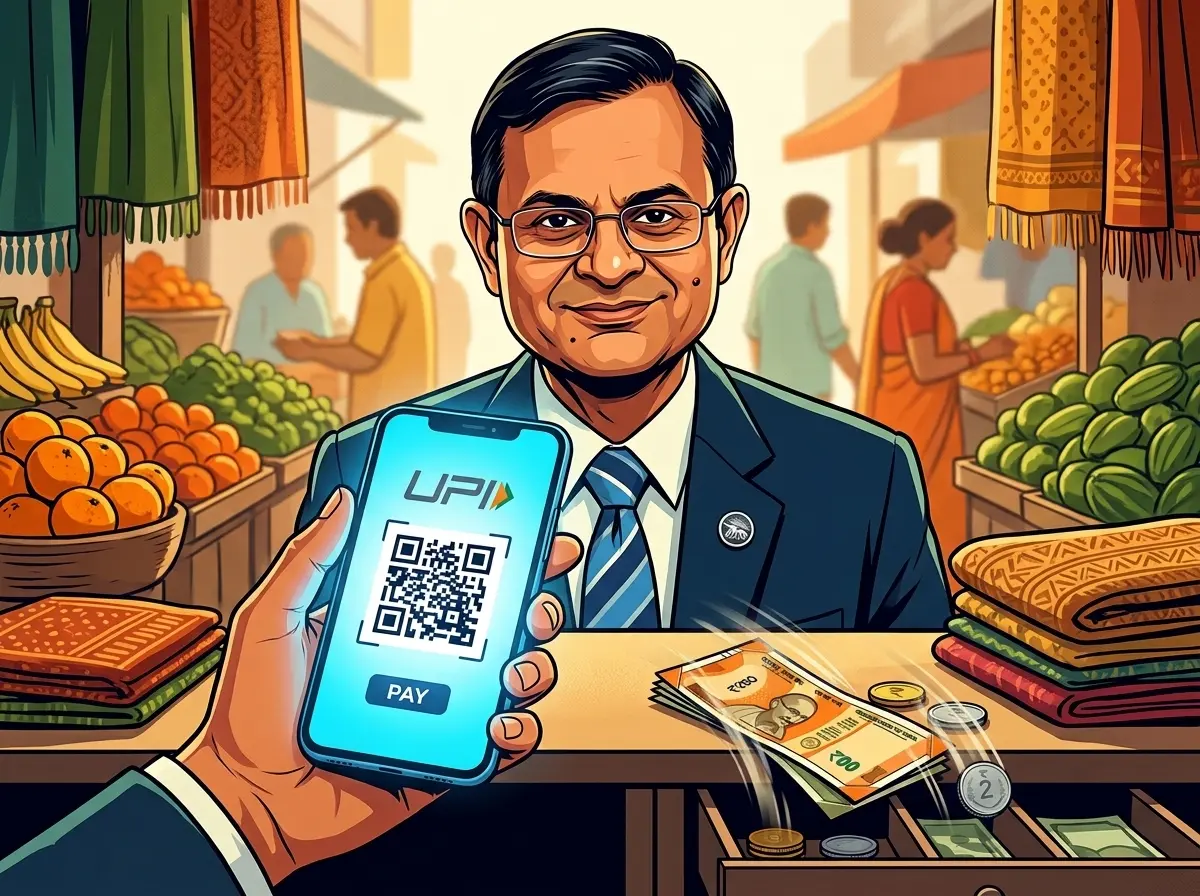
UPI Scale That Makes Fees Contested
The numbers explain both the success and the cost pressure. According to a government release, UPI processed 24,162 crore transactions in FY 2025-26 worth about ₹314 lakh crore. That works out to a daily average near 66 crore transactions and roughly ₹0.86 lakh crore in value. UPI now accounts for roughly 85 percent of India’s digital payment volume and nearly half of global real-time payment volume.
July 2026 alone saw more than 23.6 billion transactions. Ticket-size data show the bulk remain tiny: 86 percent of person-to-merchant payments sit below ₹500. The high-value tail, however, carries most of the rupee volume. Officials have estimated that a ₹2,000 floor would touch only about 5 percent of transactions yet capture close to 65 percent of value.
Key UPI markers (FY 2025-26)
- 24,162 crore annual transactions
- ₹314 lakh crore annual value
- 85% share of India’s digital payments volume
- 66 crore daily average transactions
| Payment slice | Share of transactions | Share of value |
|---|---|---|
| Below the discussed ₹2,000 floor | About 95% | About 35% |
| Above ₹2,000 (official estimate) | About 5% | Close to 65% |
| Person-to-merchant under ₹500 | 86% | Small ticket bulk |
That concentration is why a limited MDR looks fiscally attractive to banks and still politically defensible as sparing everyday kirana payments. It is also why any leakage of cost into final prices would hit the very segment that moves the largest sums.
Scale of this order multiplies even thin unit costs. Each extra crore of daily volume raises the bill for uptime, fraud screening and settlement capacity, which is why the value-heavy tail draws the policy focus.
Who Already Pays for Free UPI
Zero MDR has never meant zero cost. Banks, payment service providers and app operators fund technology, cybersecurity, fraud controls and 24×7 uptime. Since 2020 the government has run an incentive scheme that partially reimburses them for low-value person-to-merchant transactions up to ₹2,000 at small merchants.
The Hindu editorial cites a cumulative outlay of about ₹11,349 crore already paid, with another ₹2,000 crore budgeted for 2026-27. Earlier year-wise figures from the Press Information Bureau show rising then fluctuating support: roughly ₹1,389 crore in FY 2021-22, ₹2,210 crore in FY 2022-23 and ₹3,631 crore in FY 2023-24 for the combined RuPay and BHIM-UPI window. Industry voices and a parliamentary standing committee have said the incentives cover only a fraction of actual processing costs.
| Period | Incentive support |
|---|---|
| FY 2021-22 | ₹1,389 crore |
| FY 2022-23 | ₹2,210 crore |
| FY 2023-24 | ₹3,631 crore |
| Cumulative to date | About ₹11,349 crore |
| Budgeted 2026-27 | ₹2,000 crore |
Taxpayers therefore already underwrite part of the free ride. RBI Governor Sanjay Malhotra has put the broader point bluntly. After the August monetary policy meeting he said the costs “have to be paid by someone” and that the expense is already being passed on in some form, even if users do not see a line-item fee.
The costs have to be paid by someone. We all want that this public infrastructure should continue to strengthen.
Malhotra added that it was premature to decide who ultimately bears any new MDR and that consumers already pay indirectly through the wider economy.
The incentive path buys adoption at public expense yet leaves a gap that banks and fintechs say keeps widening as volumes climb. That gap is the pressure the new notification power is meant to relieve.
The Narrow Target and the Pass-Through Worry
Current official thinking, as reported across multiple outlets, focuses on two filters: merchant turnover above ₹1 crore to ₹1.5 crore and individual transactions above ₹2,000. Rates floated in briefings sit in the 0.25-0.5 percent band. Person-to-person transfers and small shopkeepers would stay free.
What we know
- Bill only enables future notification; no rate or date is fixed.
- Large-merchant and high-value focus is the working assumption of sources.
- Consumers are not meant to face a direct UPI charge.
What remains unconfirmed
- Exact turnover threshold, percentage rate and implementation timeline.
- Whether any charge will apply to wallets or prepaid instruments differently.
- How strictly banks will be barred from recovering costs from customers.
The practical fear is straightforward. A merchant facing a new 0.3 percent fee on a ₹10,000 sale may simply add the amount to the bill or quietly prefer cash. On X and in trader conversations the same point keeps surfacing: every merchant is also a cost-conscious seller, and higher acceptance costs tend to migrate into prices or payment preferences. That second-order shift, even if limited to big-ticket items, could blunt the very convenience that drove UPI’s climb past Visa-scale daily volumes.
The Payments Council of India clarified the consumer position in a widely shared thread: UPI stays free for users and small merchants; any discussion of charges concerns long-term sustainability for large commercial arrangements. Skeptics reply that real-world pricing rarely respects such neat lines.
Pass-through need not be a visible surcharge. A seller can round up the sticker price, steer big-ticket buyers toward cash, or reserve UPI discounts for smaller carts. Any of those responses would mute the fee’s visibility while still changing behaviour at the till.
Political Framing and the Free-Era Bargain
Sitharaman has pushed back against opposition claims that ordinary users will be hit. In replies on X she insisted MDR applies only to merchants and will fund the security and capacity that every user enjoys. Critics counter that the 2020 zero-MDR decision, coming after demonetisation and heavy promotion of digital payments, created an expectation of permanence. Reopening the door now, even narrowly, revives the charge that the public was steered onto rails that later acquire tolls.
Some online commentary has linked the timing to U.S. Trade Representative reports that criticised India’s payment rules as tilting the field against foreign card networks. No official statement treats the bill as a trade concession, and the government frames the change as domestic sustainability. Still, the perception itself feeds distrust.
Users who want to stay ready can still manage the basics without friction. Guides explaining how to locate your UPI ID remain useful everyday tools while the policy debate runs.
The political bargain of the free era was simple: the state would suppress direct fees to lock in habit, then manage costs through incentives and moral suasion on banks. The bill reopens that bargain without yet rewriting the everyday user experience.
How Zero MDR Became the Default
- April 2016, NPCI launches UPI with 21 banks.
- January 2020, Government mandates zero MDR on UPI and RuPay debit-card transactions to accelerate adoption.
- 2021 onward, Incentive scheme begins compensating banks and providers for low-value small-merchant traffic.
- March 2026, Parliamentary standing committee on finance calls for a viable tiered revenue model, noting incentives cover only a slice of costs.
- August 2026, Taxation bill amends the Payment and Settlement Systems Act to restore notification flexibility; RBI governor and finance minister address cost and investment questions.
The free era produced extraordinary scale. It also left the operating model dependent on a mix of private investment, partial public subsidy and forbearance by banks. That mix is now under strain.
Banks Want a Durable Line of Revenue
Banks and fintechs argue they need a durable revenue line to keep investing in fraud prevention and capacity as daily volumes head toward a billion. The incentive scheme, even at the levels already paid and budgeted, is described by industry voices and the parliamentary standing committee as covering only a fraction of processing costs.
A narrow MDR on large-merchant, high-value traffic is their preferred bridge. It leaves person-to-person transfers and small shopkeepers untouched under the current thinking, while giving providers a commercial return on the slice that already dominates rupee value. Sitharaman has framed that return as fuel for infrastructure, innovation and security that every user ultimately relies on.
Merchants and consumer advocates read the same design differently. Once the legal wall against charges falls, they worry the carve-outs will widen beyond the first notification. The enabling bill itself sets no ceiling on how far a future notice might reach.
High Value Traffic Faces the First Test
Because officials peg the discussed filters at roughly 5 percent of transactions and nearly 65 percent of value, the first live MDR would land where the money already concentrates. That is also where a merchant’s incentive to recover cost is strongest. A thin percentage on a large ticket is small in relative terms yet large enough in rupees to shape till behaviour.
Person-to-person rails and low-value kirana payments would, under the working assumptions, stay free. The open question is whether big-ticket buyers still find UPI the path of least resistance once acceptance costs rise for the sellers they face. Cash needs no intermediary and posts no discount rate.
The Payments Council of India’s public stance keeps consumers and small merchants outside the charge discussion. Skeptics answer that price formation at large merchants rarely stays neatly fenced. The test arrives only after a notification sets a rate and a start date.
RBI Surplus and the Unchosen Path
One alternative sits in plain sight. The RBI transferred a record surplus of roughly ₹2.86-2.87 lakh crore to the Centre for FY 2025-26. A modest slice of that flow could underwrite UPI infrastructure without new merchant fees. The Hindu editorial notes that using central-bank resources would shrink the dividend only slightly yet spare the government an unpopular decision. So far that route has not been taken.
Banks and fintechs argue they need a durable revenue line to keep investing in fraud prevention and capacity as daily volumes head toward a billion. Merchants and consumer advocates worry that once the legal wall falls, the carve-outs will widen. The second-order test will arrive after the first notification: whether high-value UPI stays frictionless or begins to carry quiet mark-ups that make cash look simple again.
For now the only hard fact is the enabling law. The rest remains a political and commercial negotiation whose costs, as Malhotra observed, someone will ultimately pay.

-
 TECH1 year ago
Where Garmin Watches are Made and How They are Assembled
-

 AUTO3 months ago
Tesla’s Roadster Is ‘a Few Weeks Away,’ Says Its Chief Designer
-
 NEWS10 years ago
Samsung Releases Galaxy Note7 TV Ad as Reddit AMA Leaks Specs
-
 NEWS10 years ago
Android 7.0 Nougat Rolls Out To Nexus Devices With New Emoji, Features
-
 FINANCE9 years ago
Cardano Price Surges as ADA Enters the Crypto Top Ten List
-
 NEWS10 years ago
Pre-Order the First Camera Made for Facebook Live Streaming Video
-
 FINANCE1 year ago
Binance Suspends Trading and Withdrawals for a System Upgrade
-
 FINANCE9 years ago
RChain Price Jumps Nearly 150% to a New All-Time High of $2.03