
BUSINESS
Zepto Cuts Valuation Hard and Delays IPO After Market Pushback
Zepto will raise about Rs 1,000 crore pre-IPO at $4-4.5 billion, far below its $7 billion peak.

Zepto will raise roughly Rs 1,000 crore in a pre-IPO private placement at a $4-4.5 billion valuation and has deferred its public listing by two to three quarters after domestic investors priced the quick-commerce firm well below its last private round. The company confirmed the plan on Saturday, citing a strong balance sheet that lets it focus on execution rather than accept the terms offered so far.
Co-founder and CEO Aadit Palicha told employees on Friday that the IPO, once targeted around July, will slip. The move marks a clear reckoning with public-market realities after a $7 billion private valuation just months earlier.
Pre-IPO Terms and the Official Pause
Zepto said it has agreed with major shareholders to close a pre-IPO private placement of equity ahead of its planned listing. The round will add to cash of Rs 5,681 crore with no debt as of March 31, 2026.
Zepto has agreed with major shareholders to close a pre-IPO private placement of equity ahead of its planned listing. This pre-IPO financing will add to the company’s strong balance sheet (5,681 crores of cash with no debt as of March 31, 2026). As part of the IPO process, the board and founders have received terms from public market investors to list the company and are appreciative of the expressed interest. However, at this time, and afforded by the company’s strong balance sheet, Zepto will focus on continued execution.
The company statement, carried by The Times of India, stopped short of naming investors or exact size. Multiple reports put the target near Rs 1,000 crore (about $105 million) and the valuation in the $4-4.5 billion range. Palicha told staff the listing remains within SEBI’s approved timeline once financials are refreshed and metrics improve.
The original plan targeted a fresh issue of up to Rs 8,010 crore plus an offer for sale of 11.35 crore shares by existing holders. That path is now on hold while the private round closes and the draft papers get updated.
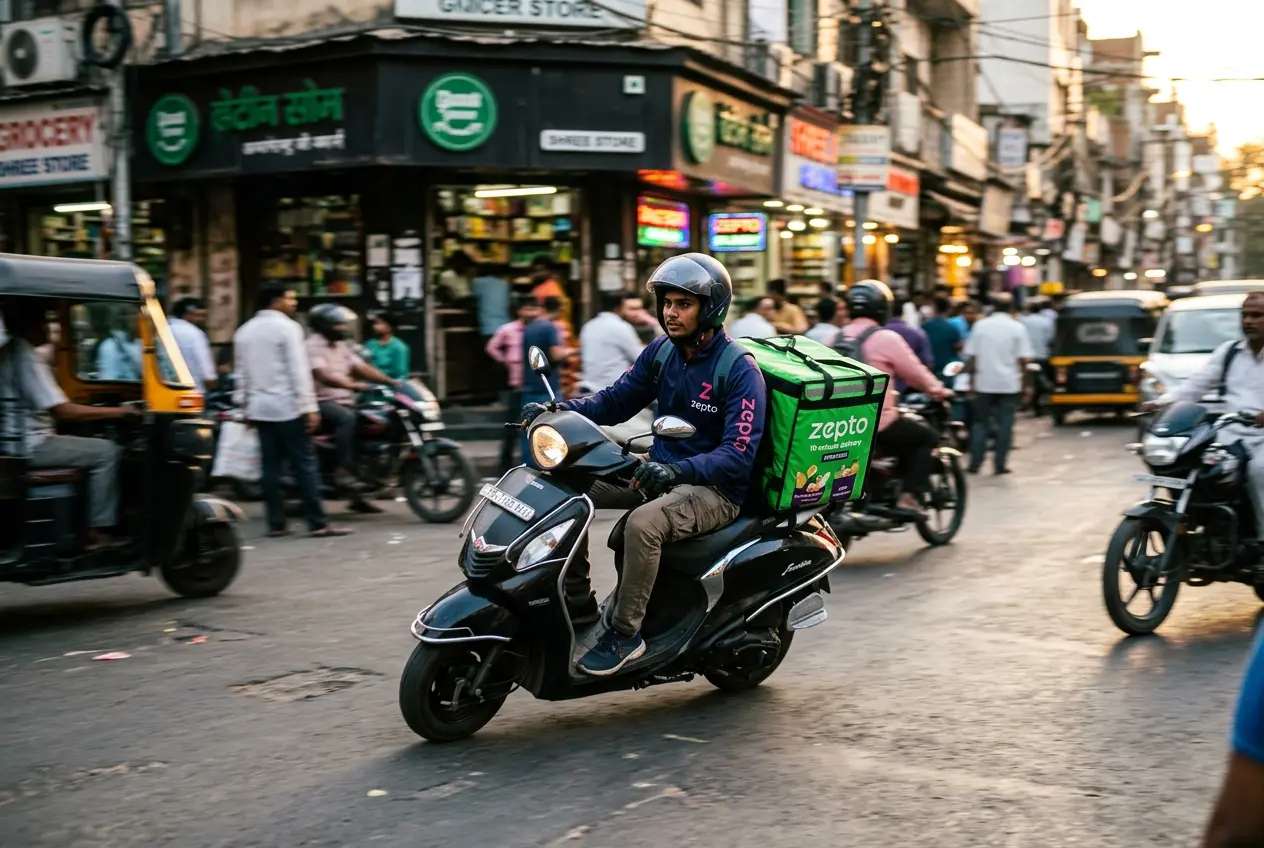
How the Valuation Came Down So Far
In October 2025 Zepto raised $450 million at a $7 billion valuation, a round led by California Public Employees’ Retirement System (CalPERS) with participation from existing backers. By mid-2026 domestic institutions were quoting $3-3.5 billion, with some as low as $2.5 billion.
| Milestone | Valuation | Context |
|---|---|---|
| October 2025 private round | $7 billion | CalPERS-led $450 million raise |
| Domestic investor feedback 2026 | $2.5-3.5 billion | Public-market terms offered |
| Pre-IPO target now | $4-4.5 billion | Bridge round under discussion |
That compression reflects both company-specific losses and a broader cooling toward pure-play quick commerce. An earlier 27 percent drop in Zepto IPO valuation expectations had already signaled the direction before this latest reset.
Public-market buyers simply refused to underwrite the private peak. The pre-IPO round is designed in part to lift domestic shareholding, currently around 40 percent, and give the company more flexibility on timing.
Cash Runway Meets the Burn Rate
Zepto ended March 2026 with Rs 5,681 crore in cash and zero debt. That buffer is real. So is the cash consumption.
- FY26 revenue from operations: Rs 22,624 crore, more than double the prior year
- Net loss FY26: Rs 5,905 crore, up 26 percent from Rs 4,695 crore
- Average daily orders: about 1.75 million, peaking near 2.3 million in Q4
- Dark stores: 1,139 as of March 31, 2026
- Annual transacting users: nearly 48 million
BofA Securities estimated earlier that at the Q4FY26 burn rate the company had roughly three quarters of runway left. The pre-IPO cash extends that window and reduces pressure to list into a cool reception.
Company materials on the Zepto investor relations operating metrics highlight order-volume CAGR above 119 percent between FY24 and FY26 and Q4 NRV of Rs 8,134 crore. Growth remains rapid. Profitability does not.
Domestic Funds Now Set the Price
The pushback came hardest from Indian mutual funds. They manage SIP money from retail savers and have little appetite for perpetual losses at premium multiples. One analysis circulating on X noted Blinkit’s far lower loss per order versus Zepto’s, plus the cushion of Zomato’s food-delivery profits that Zepto lacks as a pure-play.
SEBI rules already give domestic mutual funds a structural seat at the table: one-third of the anchor portion reserved for domestic mutual funds in main-board IPOs. That allocation becomes leverage when funds simply decline to bid at the price the company wants.
Foreign venture capital once wrote the big cheques and set the lofty marks. Today the domestic institutions that must buy the IPO decide what the market will actually clear. Zepto’s reset is one of the clearest demonstrations yet of that power shift.
Rivals Keep Raising the Competitive Bar
Amazon and Flipkart’s aggressive entry into quick commerce has changed the capital intensity of the race. Both are rolling out dark-store networks at speed. Blinkit (Eternal) and Instamart (Swiggy) already operate larger store counts and can lean on parent cash flows.
| Player | Approx. dark stores (recent) | Notes |
|---|---|---|
| Blinkit | 2,000+ | Leads store count; backed by Eternal food delivery |
| Zepto | 1,139 (Mar 2026) | Pure-play; fastest growth in orders |
| Instamart | High hundreds to low thousands | Swiggy parent support |
| Flipkart Minutes / Amazon Now | Rapid build-out | Deep-pocketed new entrants |
Investors see a market where scale alone no longer guarantees pricing power or path to profit. Zepto’s revenue more than doubled, yet losses widened. That combination is harder to sell in a public offering than it was in private rounds.
The company has also leaned on advertising revenue and its Zepto Pass subscription to offset lower commissions and keep prices competitive. Those levers help, but they have not closed the gap to breakeven.
What the Delay Buys and What It Costs
By pausing, Zepto keeps control of timing. It can update the updated draft offer documents and results with fresher numbers, show progress on unit economics, and wait for a more receptive window. The pre-IPO cash reduces the risk of a forced listing into soft demand.
The costs are equally concrete. Existing shareholders who hoped for an earlier exit must wait. Employees holding ESOPs face another period of illiquidity and potential further dilution. The valuation step-down locks in a lower mark for the next round of paper.
- December 2025: Confidential pre-filing of IPO papers with SEBI
- June 2026: Updated draft red herring prospectus filed, targeting July listing and up to Rs 8,010 crore fresh issue
- Late July 2026: Domestic valuation feedback lands at $2.5-3.5 billion; IPO work paused
- 1-2 August 2026: Pre-IPO private placement announced; listing deferred two to three quarters
Palicha has told staff the company will list once metrics improve and terms turn more favourable. That gives a rough window into early-to-mid 2027 if execution stays on track.
A Clearer Test for Pure-Play Quick Commerce
Zepto’s choice is rational given its cash position. It is also a public signal that the era of growth-at-any-price listings has narrowed. Domestic capital now demands a visible path to profits before it underwrites large floats.
Other startups watching the process will note the same lesson. High private marks from 2024-25 do not automatically translate into public-market support. When the largest buyers of IPO paper are mutual funds managing household SIPs, loss-making pure plays face a higher bar.
Zepto still processes millions of orders a day, runs more than a thousand dark stores, and sits on a multi-thousand-crore cash pile. The business continues. The valuation and calendar have simply been forced into line with what public investors are willing to pay today.
The next two to three quarters will show whether the operating improvements arrive in time for a cleaner listing, or whether another reset is still required.

-
 TECH1 year ago
Where Garmin Watches are Made and How They are Assembled
-

 AUTO3 months ago
Tesla’s Roadster Is ‘a Few Weeks Away,’ Says Its Chief Designer
-
 NEWS10 years ago
Samsung Releases Galaxy Note7 TV Ad as Reddit AMA Leaks Specs
-
 NEWS10 years ago
Android 7.0 Nougat Rolls Out To Nexus Devices With New Emoji, Features
-
 FINANCE9 years ago
Cardano Price Surges as ADA Enters the Crypto Top Ten List
-
 NEWS10 years ago
Pre-Order the First Camera Made for Facebook Live Streaming Video
-
 FINANCE1 year ago
Binance Suspends Trading and Withdrawals for a System Upgrade
-
 FINANCE9 years ago
RChain Price Jumps Nearly 150% to a New All-Time High of $2.03