
NEWS
Astrobase Everest Engine Breaks India’s Private Propulsion Barrier
Bengaluru startup Astrobase reveals India’s first private 800 kN full-flow staged combustion methalox engine.

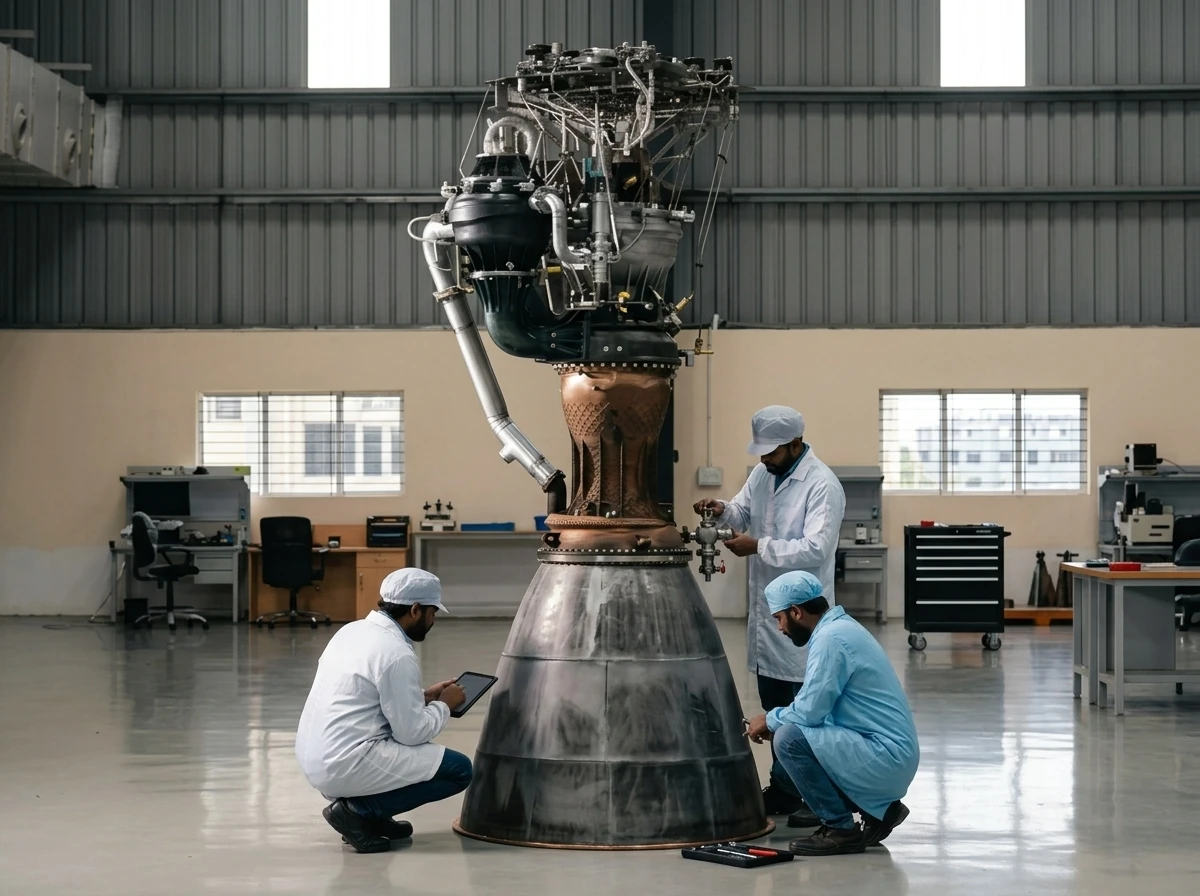
Bengaluru startup Astrobase Space Technologies on Friday unveiled Everest, India’s first privately built 800 kN full-flow staged combustion LOX-methane rocket engine designed for reusable medium-lift vehicles. The company says the fully integrated hardware is ready for full-engine hot-fire testing as the next step toward orbital flights.
The reveal comes weeks after Skyroot Aerospace’s Vikram-1 became India’s first private orbital rocket. Together the events signal private firms moving from small launchers into the high-thrust propulsion layer that has long defined national space programs.
That shift matters because thrust class and cycle choice set the ceiling for vehicle size, reuse economics and launch cadence. Everest is an early private bid to occupy that layer with domestic design authority rather than imported engines or simpler cycles.
Everest Puts 800 kN of Methalox Thrust on the Stand
Astrobase describes Everest as an 80-tonne-class engine using the full-flow staged combustion cycle, one of the most demanding architectures in rocketry. It burns liquid oxygen and liquid methane, delivers around 340 seconds of specific impulse, and throttles from 50 percent to 110 percent.
The design prioritizes reusability, precision control and faster turnaround. Critical components include 3D-printed parts produced in India. The company has already completed subscale hot-fire and turbopump cold-flow work; full-scale combustion tests are the immediate gate.
- 800 kN thrust class for medium-lift vehicles
- ~340 s specific impulse
- 50-110% throttle range
- Full-flow staged combustion LOX-methane cycle
Throttle authority across that band is what lets a reusable booster fly a controlled landing burn and still meet precise orbital insertion targets on the way up. The same hardware must therefore serve ascent performance and recovery without a second engine family.
Co-founder and CEO Neeraj Khandelwal said the engine makes Astrobase only the fourth commercial company globally to develop a high-thrust FFSC engine. India, the company added, becomes the fourth nation with the technology after Russia, the United States and China.
official Everest unveiling post on X drew hundreds of thousands of views within hours, with the hardware video circulating widely among Indian space watchers.
Integrated hardware on the stand is the public proof point after subscale firings and cold-flow work. The next gate is whether that assembly survives full-duration combustion under the thermal and mechanical loads the cycle imposes.
Why Full-Flow Staged Combustion Matters for Reuse
Most operational engines use simpler gas-generator or oxidizer-rich staged combustion cycles. Full-flow staged combustion routes the entire propellant flow through separate fuel-rich and oxidizer-rich preburners that drive the turbopumps before everything enters the main chamber. The result is higher efficiency, lower turbine temperatures and cleaner operation suited to repeated flights.
In practice the cycle splits the work across two preburners so each turbine sees a milder gas environment than a single preburner design would impose. Lower peak temperatures reduce the wear that forces heavy refurbishment between flights. Cleaner exhaust from methane further cuts the residue that builds up in kerosene engines.
- Entire propellant flow passes through the preburners
- Separate fuel-rich and oxidizer-rich paths drive the turbopumps
- Both streams then enter the main combustion chamber
- Efficiency rises while turbine temperatures fall
SpaceX’s Raptor family remains the only FFSC engine that has flown to orbit. Other programs sit at various ground-test stages. Methane’s clean burn reduces coking compared with kerosene, which helps the reuse case. For a company aiming at high launch cadence, the cycle choice is less about peak brochure numbers and more about an engine that can survive dozens of flights with limited refurbishment.
Astrobase positions Everest expressly for reusable medium-lift vehicles that need both high thrust and throttle authority for landing burns and precise insertion.
The Team That Mixed Crypto Scale and ISRO Cryogenics
Astrobase was founded in 2024. Its co-founders Neeraj Khandelwal and Devakumar Thammisetty bring complementary backgrounds. Khandelwal, an IIT Bombay alumnus, co-founded CoinDCX and scaled it to more than 15 million users and a $2.1 billion valuation. Thammisetty is a former ISRO scientist with over 13 years in rocket propulsion, focused on cryogenic systems. He contributed to GSLV Mk2 and Mk3 upper stages, Chandrayaan missions and human spaceflight work, and holds an advanced degree in rocket reusability from EPFL in Switzerland.
That pairing of rapid commercial scaling experience and deep flight-proven cryogenic knowledge is unusual in India’s young private space sector. One founder has already built and grown a large consumer platform under market pressure. The other has delivered flight hardware on national cryogenic stages and studied reusability abroad. The combination maps onto the dual problem of building hard propulsion and standing up a company that can produce it at rate.
The company operates a 46,000 square foot assembly and integration facility in Bengaluru and a dedicated high-thrust cryogenic test site on 21.5 acres in Anantapur, Andhra Pradesh. It calls the latter India’s only private high-thrust cryogenic rocket test facility.
All critical propulsion design authority, system engineering, manufacturing knowledge, software, test data and mission configuration will remain under Indian control.
The company statement frames the program as industrial capability, not a one-off technology demonstrator. Keeping design authority, test data and mission configuration inside the country is the industrial claim the hardware must eventually back.
From One Engine to 50 a Year and Launch on Demand
Astrobase’s stated production goal is up to 50 engines annually once facilities are fully online, with the ability to hot-fire roughly one engine per week. It plans to test around 20 engines before the first orbital attempt. First-phase expansion targets about 100 tonnes of annual launch capacity; the longer-term aim exceeds 1,000 tonnes through higher cadence.
The firm is also working toward launch-on-demand service that could prepare a dedicated mission within 15 days of an urgent national requirement. Those targets remain undemonstrated.
Reaching one hot-fire per week implies a test operations tempo that few private sites attempt. Testing roughly 20 engines before first orbit is the reliability filter the company has set for itself before committing a vehicle to flight.
IN-SPACe director (technical) Rajeev Jyoti noted that Astrobase is among the recipients of the agency’s Technology Adoption Fund supporting the 800 kN engine. The programme, he said, can add to India’s launch capability and open opportunities in the global space economy as testing advances.
The IN-SPACe Technology Adoption Fund selection followed a year-long technical evaluation. TAF can cover up to 60 percent of project cost for startups, with the overall scheme sized at several hundred crore rupees across multiple awards. Exact funding amounts for Astrobase have not been publicly detailed.
| Target | Figure | Status |
|---|---|---|
| Annual engine production | Up to 50 | Facility build-out |
| Engines tested before first orbit | ~20 | Planned |
| First-phase annual capacity | ~100 tonnes | Target |
| Longer-term capacity | >1,000 tonnes | Ambition |
| Urgent mission response | 15 days | Goal |
The company is building the full chain: engine manufacturing, high-flow testing, stage integration, vehicle qualification and launch operations. That vertical approach mirrors the infrastructure-first logic visible in its public milestones.
India Joins a Very Small Global FFSC Club
Only a handful of organizations worldwide have pursued full-flow staged combustion at meaningful thrust levels. SpaceX’s Raptor is the sole family with flight heritage. LandSpace in China has reported long-duration hot-fire campaigns on its Lanyan methalox FFSC engine. Other Chinese programs, Stoke Space’s Zenith, New Frontier Aerospace’s Mjölnir and state efforts sit at earlier rungs of the evidence ladder.
A detailed global FFSC maturity comparison places Astrobase’s 800 kN engine in the early but sequenced category: subscale firings and turbopump work disclosed, full hot-fire campaign underway, no published full-duration integrated result yet.
| Engine / Program | Thrust class | Cycle / Propellant | Maturity note |
|---|---|---|---|
| SpaceX Raptor 3 | ~280 tf SL | FFSC methalox | Flight-proven family |
| LandSpace Lanyan | ~220 tf | FFSC methalox | Long-duration ground tests |
| Astrobase Everest | 800 kN (~81 tf) | FFSC methalox | Integrated hardware, hot-fire next |
| Blue Origin BE-4 | ~240 tf | ORSC methalox | Flying on New Glenn / Vulcan |
Everest’s thrust sits below the largest Raptors and Lanyan but is sized for medium-lift rather than super-heavy. The private Indian entry expands the club and keeps design authority domestic.
BE-4 appears in the comparison as a flying methalox engine on a different cycle, oxidizer-rich staged combustion. That contrast underlines why FFSC remains rare: the dual-preburner path buys efficiency and reuse margin at the cost of far higher development and test burden before first flight.
What the Hardware Still Has to Prove
Unveiling integrated hardware is a real step. Full-engine hot-fire, stage static fire, hop tests, pad static fire and orbital flight remain ahead. Astrobase’s public roadmap lists engine hot-fire and stage static fire in 2026, hop test in 2027, booster static fire and inaugural orbital launch in 2028.
- 2024, Company founded; assembly factory operational
- 2025, Cold-flow testing; engine test facility online
- 2026, Full-scale engine hot-fire; stage static fire
- 2027, Hop test for booster recovery
- 2028, Booster static fire on pad; first orbital mission
Crowd reaction on X mixed celebration of the “SpaceX-level” architecture with quiet notes that hot-fire data and reuse cadence will separate brochure claims from operational engines. The facility itself, a high-flow fully automated cryogenic test site, is rare even globally and already functions as national infrastructure.
Each milestone on the list compounds the last. Hot-fire validates the integrated engine. Stage static fire validates the stage as a system. A hop test begins to close the reuse loop. Only then does pad static fire and orbital flight become a credible attempt rather than a leap.
Domestic Control Frames the Industrial Bet
The company statement that design authority, system engineering, manufacturing knowledge, software, test data and mission configuration will remain under Indian control is the policy frame around the hardware. Everest is presented as the start of a controlled industrial stack, not a single engine program that could later depend on foreign suppliers for critical know-how.
That frame fits the national context in which India becomes the fourth nation with high-thrust FFSC technology after Russia, the United States and China. A private firm holding the design authority changes who can iterate the engine and who can clear a mission configuration when national demand is urgent.
IN-SPACe support through the Technology Adoption Fund after a year-long technical evaluation ties the bet to public industrial policy. TAF can cover up to 60 percent of project cost for startups. The scheme’s overall size across multiple awards signals that the state wants private propulsion capacity to mature inside the country rather than remain a laboratory result.
Whether the industrial claim holds will be decided on the same path as the technical one: repeated firings, stage work, and eventually flight, all run from the Bengaluru assembly floor and the Anantapur test site.
Medium-Lift Reuse Sets the Vehicle Role
Everest is sized for reusable medium-lift vehicles rather than super-heavy lift. At roughly 81 tonnes of thrust it is smaller than the largest Raptors and Lanyan, yet large enough to power a medium-lift stack when clustered or staged. The throttle band from 50 percent to 110 percent is the operational feature that makes landing burns and precise insertion practical on the same engine.
Medium-lift with reuse is the market band where high flight rate and moderate payload can meet. The company’s first-phase target of about 100 tonnes of annual launch capacity, and the longer-term aim above 1,000 tonnes, only make sense if the engine can fly often with limited refurbishment. Cycle choice, methane propellant and throttle range are the three design answers to that rate problem.
Launch-on-demand within 15 days of an urgent national requirement is the service expression of the same idea. An engine family that is already in serial production and qualified for reuse is what would make a two-week dedicated mission preparation plausible. Until hot-fire and flight data exist, that service remains a stated goal rather than an offered product.
Khandelwal has framed the goal as owning a choke point: launch access that the entire orbital economy depends on. The engine is the first visible piece of that wager. Astrobase propulsion and test facilities now have to convert the integrated Everest hardware into repeated, reliable firings and then into flying vehicles.
If the hot-fire campaign and subsequent milestones hold, India gains a private path to high-thrust reusable propulsion that did not exist two years ago. The next data points will come from the test stand, not the unveil stage.

-
 TECH1 year ago
Where Garmin Watches are Made and How They are Assembled
-
 AUTO3 months ago
Tesla’s Roadster Is ‘a Few Weeks Away,’ Says Its Chief Designer
-
 NEWS10 years ago
Samsung Releases Galaxy Note7 TV Ad as Reddit AMA Leaks Specs
-
 NEWS10 years ago
Android 7.0 Nougat Rolls Out To Nexus Devices With New Emoji, Features
-
 FINANCE9 years ago
Cardano Price Surges as ADA Enters the Crypto Top Ten List
-
 NEWS10 years ago
Pre-Order the First Camera Made for Facebook Live Streaming Video
-
 FINANCE1 year ago
Binance Suspends Trading and Withdrawals for a System Upgrade
-
 FINANCE9 years ago
RChain Price Jumps Nearly 150% to a New All-Time High of $2.03