
BUSINESS
Congress Holds the Real Power Over Trump’s Saudi Nuclear Deal
Trump added a surprise Abraham Accords condition to the signed Saudi nuclear deal, but the required congressional notice still has not gone out.

U.S. Energy Secretary Chris Wright signed a civil nuclear cooperation agreement with Saudi Arabia on July 22, capping talks that stretched across two presidencies. Twenty four hours later, President Donald Trump blew it up with a single social media post, announcing Riyadh now had to join the Abraham Accords first. The letters required by federal law to start Congress’s own review of the deal still had not gone out.
That detail has been buried under the Trump-Netanyahu-Riyadh theater. But it means the loudest fight in Washington this week is not the one that decides this deal’s fate. A quieter, slower process on Capitol Hill does, and it has not even begun.
A Deal That Unraveled in Under a Day
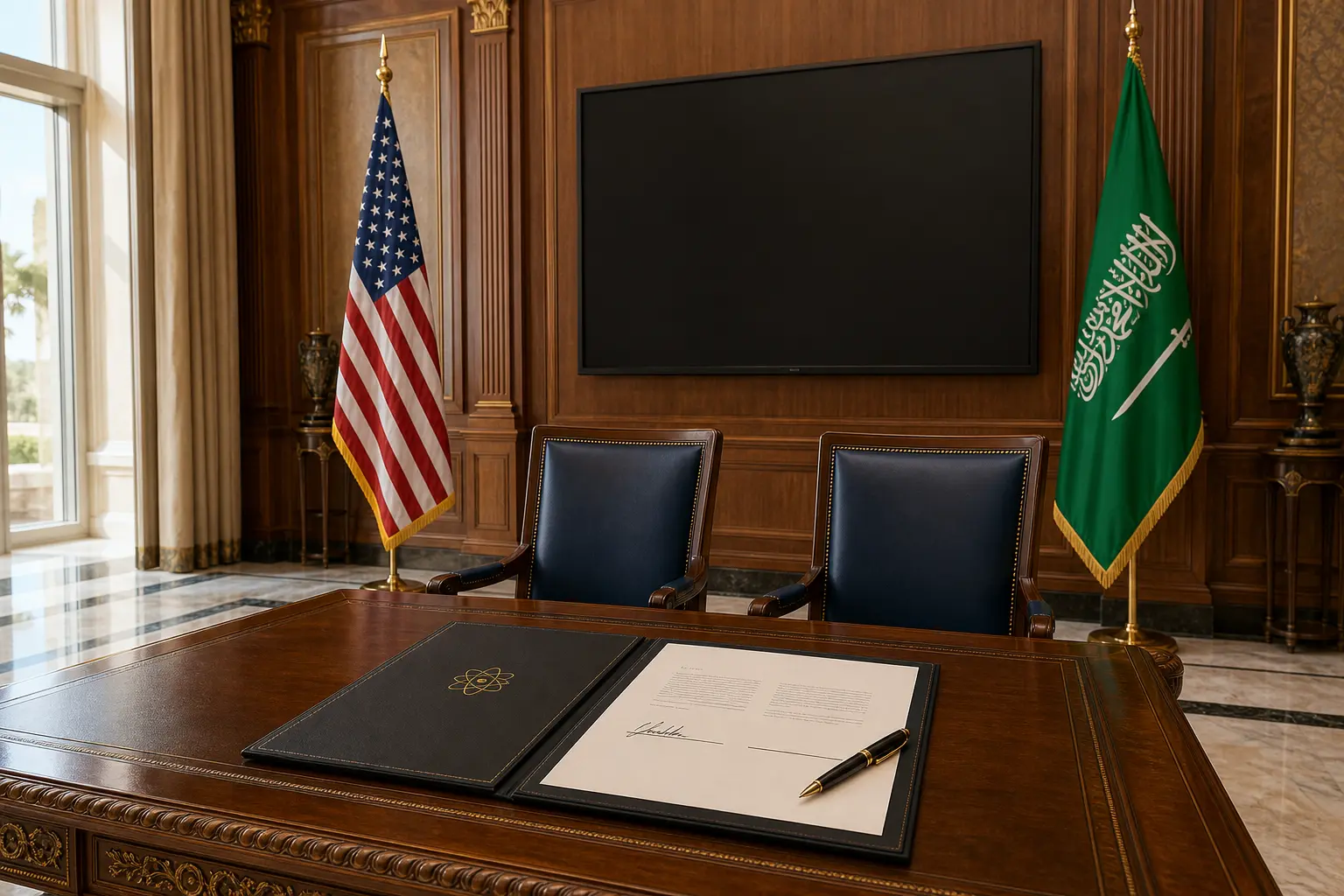
The signing itself looked like a finished product. Energy Department officials gathered at their Washington headquarters on a Wednesday for what CNN described as an event two decades in the making. American and Saudi flags flanked the table where Wright sat. A screen beamed in Saudi Energy Minister Prince Abdulaziz bin Salman from Riyadh. Wright and Abdulaziz signed what is known as a 123 agreement, along with a bilateral nuclear safeguards agreement.
Wright tried to head off proliferation worries at the signing.
Rest assured, these agreements uphold the highest standards of nuclear safety and nonproliferation, while relying on the world’s best nuclear technology and scientists, designed right here in the United States.
That was Wright, the U.S. Energy Secretary, at the signing ceremony. His reassurance did not survive the next morning. Trump posted that the agreement, already signed, would be approved, but was now “totally subject to Saudi Arabia joining the very respected and successful Abraham Accords,” the pact that normalized relations between Israel and several Arab states during his first term. The announcement caught Trump’s own nuclear negotiating team off guard, according to two sources briefed on the matter and cited by CNN. White House officials privately blamed the Energy Department for rolling the deal out at all, saying Wright, whom officials have previously complained gets ahead of himself, pushed forward with the Wednesday signing and a Fox Business interview despite being asked to hold off.
Why Hasn’t Congress’s Clock Started?
Congress has not started reviewing the Saudi deal because the White House has not sent the legally required notification letters, even after the public signing. Under Section 123 of the Atomic Energy Act, that omission means the formal countdown to the agreement taking effect has not begun at all.
The law requires two separate waiting periods before a nuclear cooperation agreement can take effect. First, the president must consult with the House Foreign Affairs and Senate Foreign Relations committees for at least 30 days of continuous session before formally submitting the text. Only after that can the agreement go to Congress for a second window, a 90-day review period before it can enter into force, during which lawmakers could pass a resolution blocking it.
CNN reported that as of Thursday, one day after the signing, those required letters still had not gone to Congress. Some Trump aides do not consider the deal finalized for exactly that reason. The photo-op flags and the Fox Business interview created the appearance of a done deal. The paperwork that actually starts the legal clock has not moved.
Riyadh’s Terms Look Nothing Like Abu Dhabi’s
Every prior U.S. nuclear deal in the region ran through one comparison: the United Arab Emirates’ 2009 agreement, nicknamed the “gold standard” because Abu Dhabi voluntarily gave up enrichment and reprocessing rights entirely. Saudi Arabia refused to accept those same limits for years. The deal Wright and Abdulaziz signed does not ask it to.
| Provision | Saudi Arabia (2026 deal) | UAE (2009 gold standard) |
|---|---|---|
| IAEA Additional Protocol required | No | Yes |
| Domestic uranium enrichment | Possible, pending a two-year joint study | Permanently renounced |
| Plutonium reprocessing | Not blocked, per Sen. Tim Kaine | Permanently renounced |
| IAEA inspection scope | Limited, per U.S. officials cited by CNN | Full Additional Protocol access |
| Who would run an enrichment plant | U.S. companies only, without transferring the technology | Not applicable |
CNN reported that the kingdom is not required to sign the Additional Protocol that the UAE accepted in 2009, and that the agreement includes limits on what inspections could take place at all. If the two-year study eventually favors enrichment, American firms would build and run the facility under a “black box” style arrangement meant to keep the sensitive technology out of Saudi hands, a structure Reuters had earlier reported was under discussion as a way to satisfy both governments.
What Lawmakers Say Is Missing
Senator Tim Kaine, a Democrat from Virginia who sits on the Foreign Relations Committee, said he remains uneasy about what the text does not do.
- It does not block reprocessing or enrichment outright, unlike the UAE’s 2009 agreement.
- It does not require the IAEA’s Additional Protocol, the inspection regime other 123 partners like the UAE accepted.
- It limits what inspections can occur on Saudi nuclear sites, according to U.S. officials.
- It has not been formally sent to the two congressional committees that must review it before the clock starts.
Kaine put his uncertainty about the deal’s actual status bluntly: “I have no idea whether this civil nuclear agreement is void until Saudi Arabia agrees to the Abraham Accords.” Andrea Stricker, deputy director of the nonproliferation program at the Foundation for Defense of Democracies, offered a different read on Trump’s surprise condition. She said it “may, helpfully, serve to delay the agreement from coming to fruition,” now that Riyadh has to weigh whether it wants to normalize with Israel at all.
Netanyahu Welcomes a Deal He Isn’t Named In
Israel has no formal role in a bilateral U.S.-Saudi nuclear agreement. It has enormous stakes in it anyway. A Saudi enrichment capability sits closer to Israeli territory than Iran’s, and Israeli officials have long treated Gulf enrichment rights as a security question, not just an energy one.
Prime Minister Benjamin Netanyahu’s office responded to Trump’s Abraham Accords condition, not to the nuclear deal itself. Its statement called Saudi Arabia joining the accords “an historic leap forward for peace in the Middle East,” adding the phrase “Peace through Strength.” It did not mention uranium, enrichment or safeguards once.
That silence is its own answer. Saudi Arabia has said for years it will not normalize relations with Israel without a clear path to Palestinian statehood, a position the kingdom has not dropped. The Saudi embassy in Washington did not respond to NPR’s request for comment on Trump’s new condition. Netanyahu got to claim a diplomatic win without having to say a word about the technology his government has quietly resisted for a decade.
How Saudi Arabia Got This Close
The past seven years show how far the two governments moved, and how many times the Israel question was attached to and detached from the nuclear talks.
- 2019: Prince Abdulaziz bin Salman says the kingdom wants to “go for the full cycle, from producing uranium, to enriching uranium, using the uranium, even acquiring the technologies.”
- January 2023: Abdulaziz says Saudi Arabia intends to use its own resources to produce low-enriched uranium.
- Under President Biden: Washington links a civil nuclear deal to a broader package requiring Saudi recognition of Israel.
- October 7, 2023: The Hamas attack on Israel and the war that followed stall that Israel-linked version of the deal.
- April 2025: Wright tells Saudi broadcaster Al Arabiya a 123 agreement is achievable “in a matter of months,” while acknowledging Riyadh still had not accepted the Atomic Energy Act’s nonproliferation terms.
- Around Trump’s May 2025 Gulf trip: Reuters reports Washington quietly drops the Israel-normalization precondition for nuclear talks, a concession sources call major.
- November 2025: Crown Prince Mohammed bin Salman visits the White House, where the two sides complete the legal foundation for a nuclear energy partnership.
- July 22, 2026: Wright and Abdulaziz sign the 123 agreement and a bilateral safeguards agreement in Washington.
- July 23, 2026: Trump reattaches the Israel condition by social media post, one day after the signing.
The reversal is not really a reversal. It is the same fault line the deal has carried since the Biden years, resurfacing after Washington spent sixteen months pretending it had been resolved.
Ninety Days Riyadh Hasn’t Started Counting
The Energy Department calls this a 30-year, multi-billion-dollar partnership that would give American companies a leading role in building Saudi Arabia’s nuclear sector. That part of the pitch has not changed since Wednesday. What has changed is the paperwork trail that determines whether any of it becomes binding.
Congress cannot start its 90-day clock until the White House sends the notification letters it has not yet sent. Saudi Arabia cannot resolve Trump’s new condition without deciding whether to break a decade-old position on Palestinian statehood. And Wright’s Wednesday reassurance that the deal upholds nonproliferation standards is now being tested by senators who read the same text and count what the UAE gave up in 2009 that Saudi Arabia has not.
Frequently Asked Questions
What is a Section 123 agreement?
It is a congressionally reviewed agreement required under the Atomic Energy Act of 1954 before the United States can transfer nuclear reactors, fuel or components to another country. The law lists nine nonproliferation criteria a partner state must meet unless the president grants an exemption.
Does the Saudi deal allow uranium enrichment immediately?
No. The agreement calls for a joint two-year study on whether enrichment is commercially viable in Saudi Arabia. If that study supports it, U.S. companies would build and operate the facility under an arrangement designed to keep the enrichment technology itself out of Saudi hands.
How long does Congress have to block the deal?
Once the White House formally submits the text, lawmakers get 90 days of continuous session to consider it. Before that submission can even happen, the president must first consult with the House Foreign Affairs and Senate Foreign Relations committees for at least 30 days of continuous session, a step CNN reported had not yet occurred days after the public signing.
What are the Abraham Accords?
They are a set of agreements brokered during Trump’s first term in 2020 that normalized diplomatic relations between Israel and the United Arab Emirates, Bahrain and Morocco. Saudi Arabia has never joined and has tied any normalization to progress toward Palestinian statehood.
How many countries already have 123 agreements with the U.S.?
The United States maintains 123 agreements with roughly two dozen countries, according to the Center for Arms Control and Non-Proliferation. The 2009 UAE agreement remains the only one in which a partner state gave up enrichment and reprocessing rights entirely.

-
 TECH1 year ago
Where Garmin Watches are Made and How They are Assembled
-

 AUTO3 months ago
Tesla’s Roadster Is ‘a Few Weeks Away,’ Says Its Chief Designer
-
 NEWS10 years ago
Samsung Releases Galaxy Note7 TV Ad as Reddit AMA Leaks Specs
-
 NEWS10 years ago
Android 7.0 Nougat Rolls Out To Nexus Devices With New Emoji, Features
-
 FINANCE9 years ago
Cardano Price Surges as ADA Enters the Crypto Top Ten List
-
 NEWS10 years ago
Pre-Order the First Camera Made for Facebook Live Streaming Video
-
 FINANCE1 year ago
Binance Suspends Trading and Withdrawals for a System Upgrade
-
 FINANCE9 years ago
RChain Price Jumps Nearly 150% to a New All-Time High of $2.03